
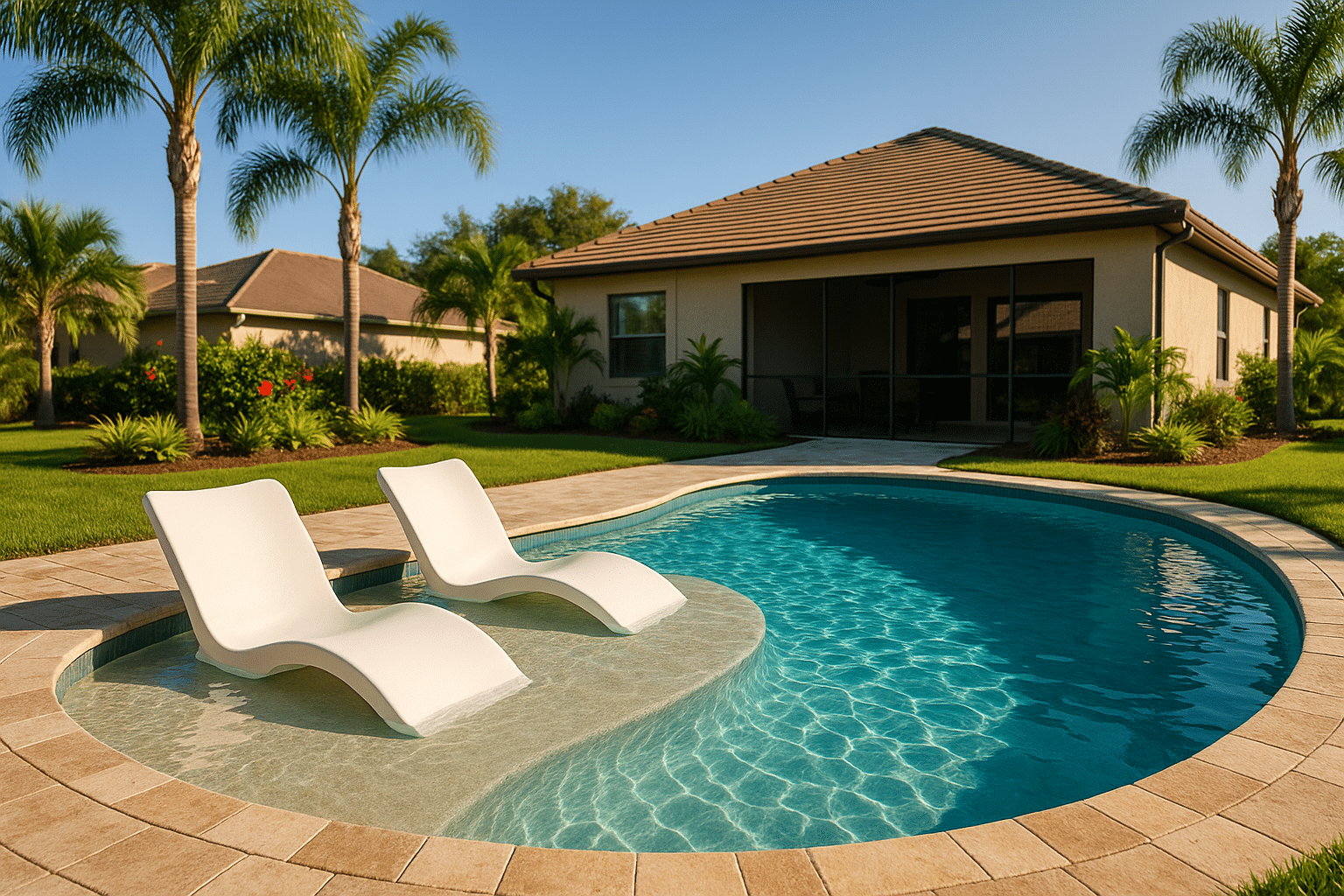
TL;DR: Tanning ledges, zero-entry slopes, and swim-outs all create shallow lounging or transition space in a pool, but they differ in footprint, cost, and who they serve best. This guide breaks down how each works, the trade-offs, and which option makes the most sense for Lake County and Central Florida backyards, lot sizes, and lifestyles.
If you’ve spent any time browsing pool photos for your Lake County backyard, you’ve probably noticed the same three features showing up again and again: a flat sun shelf with lounge chairs sitting in a few inches of water, a beach-like slope that walks straight into the pool, or a built-in bench along the wall. These are a tanning ledge, a zero-entry slope, and a swim-out, and while they look similar at a glance, they serve different purposes and fit different lots, budgets, and households.
Here’s how each one works, the real trade-offs, and which one tends to make the most sense for homes in The Villages, Clermont, Mount Dora, Leesburg, Eustis, and the rest of our Central Florida service area.
What Is a Tanning Ledge?
A tanning ledge, also called a sun shelf or Baja shelf, is
a shallow, flat platform, usually about 9 to 12 inches deep, built into the entry end of your pool
. You wade or step onto it and lounge rather than swim.
Tanning ledges are popular because they change how a family actually uses the pool. As one pool builder put it,
the biggest thing a tanning ledge does is lower the bar for getting in the water, so you don’t have to go swimming, you can just sit in the water for twenty minutes with a book
. For parents,
the ledge is a revelation, since parents relax more and kids have a safe zone they can play in for hours
.
Tanning Ledge Pros
- Multi-use space: Works for lounge chairs, kids’ play, pets, and umbrellas without anyone needing to tread water.
- Resort look: A ledge with loungers, an umbrella, and bubblers
just looks spectacular
and photographs well for a finished, high-end backyard. - Furniture-friendly depth: In-pool furniture like chaise lounges and small tables works well at typical ledge depths, though
areas deeper than 12 inches may cause furniture to float
.
Tanning Ledge Cons
- Space trade-off: A properly sized ledge can take up
80 to 100+ square feet of your pool, which is a real sacrifice in smaller pools
. - Less ideal for lap swimming: If your main goal is exercise, a ledge eats into usable straight swim length.
- Cost depends on construction type:
For fiberglass pools, a ledge is usually built into the shell at little or no extra cost, while for gunite pools, adding one typically runs $1,500 to $10,000 depending on size
.
Because a gunite shell is poured and formed on-site, our crews can size and place a tanning ledge anywhere in a custom concrete design, add rebar reinforcement, and dial in exact depth for your furniture. For design inspiration, see our custom concrete pool design ideas for Central Florida builds.
What Is a Zero-Entry (Beach Entry) Slope?
A zero-entry pool, sometimes called a beach entry, skips the wall and steps altogether. The pool deck slopes gradually into the water so depth starts at zero and increases as you walk in, just like walking into a lake or ocean.
Zero-entry design matters beyond aesthetics because it’s one of the recognized accessible entry methods under federal accessibility standards. For public pools, hotels, and HOA community pools in active adult communities like The Villages,
ADA 2010 Standards set binding requirements that directly shape zero entry pool design, and public pools with 300 or more linear feet of wall must provide two accessible entry points
.
The slope itself is tightly regulated for public pools. According to the U.S. Access Board,
zero depth entry pools are typically designed with very slight slopes, and the maximum slope of a zero depth entry should not exceed 1:12 continuing to a minimum depth of 30 inches
. A beach entry that stops at ankle depth without reaching that range is a decorative feature, not a code-compliant accessible entry.
Residential pools aren’t bound by the same federal mandate, which gives homeowners more design flexibility, but the same accessibility logic applies at home: a gradual slope is easier and safer for grandchildren, guests with limited mobility, and multigenerational households common across Lady Lake, Fruitland Park, and Tavares retirement and family neighborhoods alike.
Zero-Entry Pros
- Best-in-class accessibility: No steps, no ladder, ideal for toddlers, older adults, and anyone with joint or mobility concerns.
- Natural, resort-style look: A sloped entry reads like a private beach and pairs well with lanai and lagoon-style landscaping.
- Gradual depth progression: Lets swimmers of all ages and comfort levels wade in at their own pace.
Zero-Entry Cons
- Largest footprint of the three options: A true zero-entry slope needs significantly more horizontal run than a ledge or swim-out, which matters on tighter Central Florida lots.
- Higher cost and build complexity: More excavation, forming, and often a larger overall pool shape to accommodate the slope.
- Best suited to gunite construction: Because the slope is custom-formed, it’s almost exclusively a concrete pool feature rather than a factory fiberglass shell option.
What Is a Swim-Out?
A swim-out is a built-in bench or step ledge, usually along the pool wall, that sits a few inches below the waterline. Think of it as a shorter, narrower cousin of the tanning ledge, often placed near steps, a sun shelf, or a spa for a place to perch without fully exiting the water.
Swim-outs are compact, which makes them a practical fit for smaller backyards across Minneola, Montverde, and Groveland where lot size limits how much pool footprint can go to lounging space instead of swimming area.
Swim-Out Pros
- Small footprint: Delivers a resting spot without sacrificing significant swim space.
- Functional transition zone: Works well near spas, steps, or as a perch for kids supervising younger siblings in shallow water.
- Fits both fiberglass and gunite designs: Many factory fiberglass models include a built-in bench, and gunite crews can form one anywhere along the wall.
Swim-Out Cons
- Less lounging room: Too narrow for full lounge chairs or large groups compared to a tanning ledge.
- Fixed shape in fiberglass: If you choose a fiberglass shell, the swim-out location and size are set by the manufacturer’s mold.
Fiberglass vs. Concrete: How Construction Changes Your Options
Which feature you can get, and how customizable it is, depends heavily on whether you build fiberglass or gunite.
With fiberglass, tanning ledges and swim-outs are often molded directly into the shell. The surface of the ledge is smooth, and some models are specifically designed with in-water furniture in mind. The trade-off is that
the shape of the manufactured pool or separate ledge is not customizable
, so you’re selecting from the dimensions a given Latham model offers. We walk Lady Lake homeowners through exactly which fiberglass models include these features on our fiberglass pool installation page.
With gunite concrete, every feature is custom-formed on-site. You can size a tanning ledge, curve a zero-entry slope, or place a swim-out exactly where your backyard and sun exposure call for it. The trade-off is a longer build and a higher cost for added complexity like double rebar caging under a wide ledge. Our custom concrete pool building work in Tavares and concrete pool projects in Eustis both include ledges, swim-outs, and beach entries sized to each lot.
Which One Fits Lake County Living?
A few local realities shape which feature makes the most sense:
- Active adult communities (The Villages, parts of Fruitland Park and Lady Lake): Zero-entry slopes or swim-outs are popular for easier, step-free access as mobility needs change over time.
- Families with young kids (Clermont, Minneola, Groveland, Mount Dora): Tanning ledges give parents a shallow, visible zone for supervision while still having real swim space for older kids.
- Smaller infill lots (Tavares, Eustis, Leesburg): Swim-outs deliver a resting spot without consuming the footprint a full ledge or beach entry would need.
- Year-round outdoor living: With Central Florida’s long swim season, any of these features gets heavy use most of the year rather than sitting idle a few summer weekends like in colder climates.
Whatever you choose, Florida law still requires a compliant safety barrier around the pool.
The barrier must be at least 4 feet high on the outside
, and
bottom clearance is generally limited to 2 inches, with openings that cannot pass a 4-inch sphere
. We factor barrier placement into the design phase regardless of which entry feature you pick, since a wide zero-entry slope or ledge can affect where the code-required barrier line falls.
How This Fits Into Your Project Timeline
Adding a tanning ledge, zero-entry slope, or swim-out doesn’t usually change your overall project category, but it does affect design and forming time. Fiberglass projects with a built-in ledge or swim-out typically still run 2 to 4 months start to finish, since the feature is already part of the shell. Custom gunite projects with a hand-formed ledge or beach entry generally fall within the standard 4 to 6 month build window, with the extra forming and rebar work folded into the normal excavation and shell phase rather than adding a separate timeline.
Every pool we build, fiberglass or gunite, carries a limited lifetime shell warranty, and financing through Lyon Financial or Viking Capital can be structured to include upgraded features like a tanning ledge or beach entry in the total project cost rather than treating them as a late add-on.
Ready to compare options for your lot? Visit our pool builders and contractors page serving The Villages, FL to start a conversation about which entry feature fits your backyard, budget, and timeline.
Recommended Reads
- 12 Custom Concrete Pool Design Ideas to Inspire Your Central Florida Build
- Pool Builders & Contractors in The Villages, FL
- Custom Concrete Pool Building in Tavares, FL | R & R Pools
