
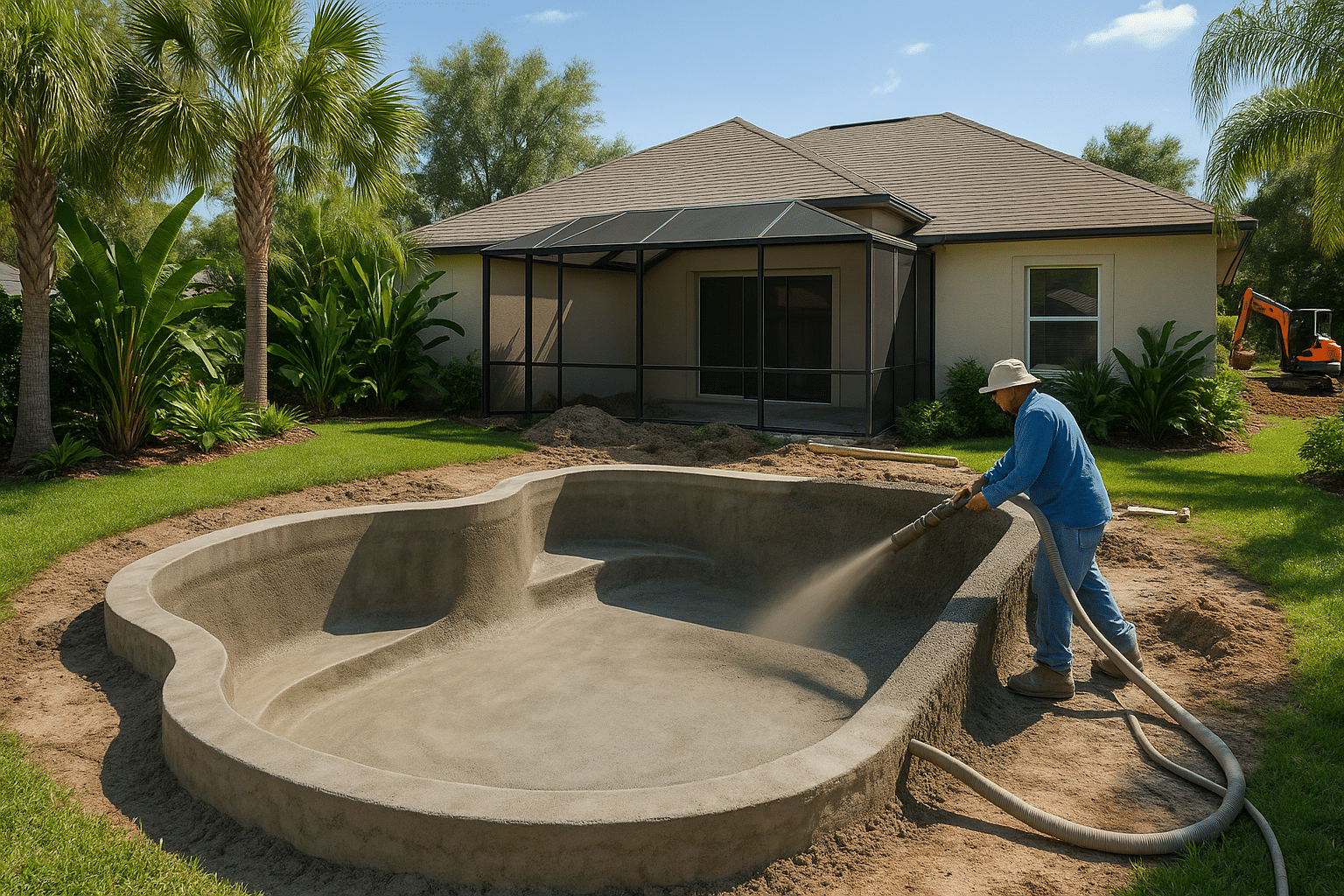
TL;DR: A gunite pool is a custom inground pool built by spraying a dry concrete mix over a steel rebar framework on your property. It offers unmatched design flexibility and can last 50 years or more, but requires periodic replastering every 10–15 years. If you want a fully custom shape, depth, or feature set, gunite is typically the go-to choice.
If you’ve been researching inground pools, you’ve almost certainly seen the word gunite — sometimes used alongside shotcrete or concrete pool, often without a clear explanation of what any of it actually means.
This guide breaks it all down: what gunite is, how a gunite pool is built, how it compares to other pool types, and what ownership really looks like over time.
What Is Gunite, Exactly?
Gunite is concrete — but the application method is what sets it apart. Compared to fiberglass and vinyl pools, gunite pools are built entirely on-site from raw materials rather than arriving as a pre-formed shell.
Specifically, the term “gunite” refers to the dry mix of cement and sand that is combined with water at the spray nozzle during application. Once sprayed, the material hardens into a dense, durable concrete structure.
In other words, gunite is applied using compressed air to force the material down a hose, and that material is then shot into place instead of being poured like a foundation. The high velocity of this application allows the gunite to stick to whatever structure it is shot against.
Gunite vs. Shotcrete vs. Concrete: What’s the Difference?
These three terms confuse almost every homeowner who starts researching pools. Here’s the plain-English breakdown.
Gunite vs. Concrete
Gunite is concrete. The difference is entirely in how it’s applied, and that application method is what makes it the ideal material for building a pool that can take any shape you can imagine.
Gunite vs. Shotcrete
Concrete pools can be constructed with either the shotcrete or gunite process, and the difference is when the concrete mixes with the water.
- Gunite (dry-mix): Gunite is a dry concrete mix that only mixes with water at the end of the nozzle as it’s being sprayed onto its final surface. The skilled technician operating the hose can control the amount of water added to the mixture as needed to achieve the desired consistency.
- Shotcrete (wet-mix): Shotcrete always refers to wet concrete that’s already fully mixed before it’s shot out of a hose.
Most concrete pools are built using the gunite process, because it tends to be easier to spray onto surfaces to the desired thickness. Gunite’s dry-mix application allows for greater control of the water-cement ratio during installation, which often leads to a stronger and more crack-resistant finish.
In swimming pool construction, shotcrete refers to wet mix and gunite to dry mix — in this context, these terms are not interchangeable.
How a Gunite Pool Is Built: Step by Step
Understanding the build process helps you set realistic expectations for timeline, disruption, and quality checkpoints.
- Design & Engineering — Your pool builder works with you on shape, depth, and features. At R & R Swimming Pools, we handle design and engineering in-house, which keeps communication tight and eliminates costly delays.
- Permitting — Inground pools always require a permit in Florida, as they involve excavation, electrical work, plumbing, and structural considerations. The Department of Business and Professional Regulation (DBPR) oversees the CPCG contractor license for pool work statewide. We handle all permitting on your behalf. (For a deeper look at the process, see our guide on pool permits in Lake County, FL.)
- Excavation — Like all other types of inground pools, a gunite pool begins with the dig or excavation, with heavy machinery moving into your backyard to dig a hole as near to the depth, width, shape, and size of the pool design you want.
- Steel Rebar Framework — Workers begin installing plumbing while also reinforcing the walls and floor of the excavated hole with steel rebar, which forms a sturdy cage onto which the pool builder’s nozzleman can spray gunite.
- Gunite Application — Your pool builder sprays a heavy coating of gunite around the rebar, which is then smoothed and left to set. Proper rebar placement, controlled gunite application, and adequate curing time are essential to creating a durable shell that resists cracking and shifting over time.
- Plumbing, Electrical & Equipment — Filtration systems, lighting, water features, and other mechanical components are installed during this phase.
- Interior Finish — After curing, the pool is finished with a surface material such as plaster, pebble, or tile. Plaster is the most common finish due to its wide range of color options. Premium options include quartz aggregate and pebble finishes for added durability and visual depth.
- Final Walkthrough & Inspections — The pool is filled, equipment is commissioned, and all work is inspected before handoff.
At R & R Swimming Pools, our in-house gunite crew builds shells 6 to 12 inches thick — thicker than many competitors — and we manage every phase above under one roof. Gunite projects typically run 4 to 6 months from contract to swim-ready.
Key Advantages of a Gunite Pool
Unlimited Design Freedom
One of the biggest advantages of gunite pools is complete design flexibility. Unlike prefabricated pool types, gunite allows you to customize the shape, size, and depth to fit your backyard. You can also add features like tanning ledges, waterfalls, spas, and custom steps, making it possible to create a fully personalized pool design.
Gunite allows for very versatile shapes and designs without the use of extensive formwork. That’s why it has been the material of choice for resort-style pools, negative edges, beach entries, and multi-level designs for decades.
Exceptional Structural Longevity
On average, a well-maintained gunite pool can last 50 years or more. However, certain components of the pool, like the plaster surface, tiles, and decking, will require maintenance and resurfacing over time.
Compared to other types of pools like vinyl liner pools or fiberglass pools, gunite pools have the potential for the longest lifespan. While vinyl liner pools typically need to be replaced every 7–15 years and fiberglass pools can last up to 25 years, gunite pools can last for decades with proper maintenance and care.
No Shell Size or Shape Restrictions
Fiberglass pools are limited to the molds a manufacturer produces. Gunite has no such constraints — if your backyard and budget support it, almost any shape, depth, or dimension is achievable. This makes gunite the preferred choice for large properties, uniquely shaped lots, and homeowners who want a one-of-a-kind result.
What Gunite Pool Ownership Really Looks Like
Gunite pools are not maintenance-free. It’s important to go in with clear expectations.
Surface Porosity and Water Chemistry
Gunite surfaces are more porous, so algae can become a problem if you do not stay on top of it. You will need to chemically treat the pool as long as it holds water and acid wash its surface, on average, about once every four years.
Consistent water chemistry is especially important in Florida’s warm climate, where algae growth is accelerated year-round.
Replastering
It is essential to consider replastering your gunite pool within a timeframe of 15 to 25 years, with water chemistry being the number-one reason for needing to replaster. Higher-end finishes like pebble aggregate tend to last longer than standard white plaster.
The Pool & Hot Tub Alliance (PHTA) — the industry’s leading standards body — generally discourages patch-only approaches and recommends full-surface replastering when significant wear is present. This is a planned, budgetable maintenance event, not an emergency repair.
Ongoing Maintenance Costs
Because of the porous surface, gunite pools typically require more chemical inputs and more frequent brushing than fiberglass pools. This is a real cost to factor into your decision — not a dealbreaker, but worth understanding before you commit. If lower long-term chemical costs and zero replastering are priorities, our fiberglass vs. gunite comparison for Florida homeowners covers both options side by side.
Is a Gunite Pool Right for Your Florida Backyard?
Gunite is the right choice when one or more of these apply:
- You want a shape, depth, or feature set that no manufactured shell can match.
- You’re building a large pool (over 600–700 square feet) where fiberglass shell sizing becomes limiting.
- You want to integrate a spa, raised bond beam, sun shelf, infinity edge, or other custom architectural detail seamlessly into the structure.
- You plan to stay in your home long-term and want a pool that outlasts the house itself.
- You want the thickest possible structural shell — our crew builds to 6–12 inches — for maximum durability in Florida’s sandy soils.
Fiberglass may be a better fit if you want a faster build (2–4 months vs. 4–6 months for gunite), lower ongoing chemical costs, and a non-porous surface that never needs replastering. Both pool types we build carry a limited lifetime shell warranty.
Permits, Licensing, and What Happens in Lake County
Most in-ground pool projects in Florida require building permits, plan reviews, and multiple inspections before construction can begin. Depending on the location and scope, homeowners may also need zoning approval, electrical permits, plumbing permits, or engineering documentation to comply with Florida building codes and local regulations.
Florida law requires that a licensed pool contractor apply for most permits related to pool construction. The contractor must hold an active license issued by the Construction Industry Licensing Board (CILB) under the Florida DBPR.
R & R Swimming Pools handles design, engineering, permitting, excavation, gunite application, plumbing, electrical, finishing, and final walkthrough — all in-house. You don’t coordinate subcontractors or chase paperwork.
Financing Your Gunite Pool
Custom gunite pools are a significant investment, and financing makes them accessible for many Lake County and Central Florida families. R & R Swimming Pools offers financing through Lyon Financial and Viking Capital — two of the most established pool-specific lenders in the country. For a full breakdown of how pool loans work, what rates look like, and what to expect at each step, see our guide on how to finance a pool in Florida.
Ready to Explore a Custom Gunite Pool?
R & R Swimming Pools has been building custom gunite and fiberglass pools for Lake County and Central Florida homeowners since 1985 — over 1,000 pools and spas completed across The Villages, Clermont, Mount Dora, Leesburg, Eustis, Lady Lake, Tavares, Minneola, Groveland, and 30+ surrounding communities.
Contact us to schedule a no-pressure consultation. We’ll walk your yard, talk through your design ideas, and give you a straight answer on whether gunite, fiberglass, or a combination is the right fit for your property and budget.
Recommended Reads
- How to Finance a Pool in Florida: Loan Options, Lenders, and What to Expect
- Pool Permits in Lake County, FL: What They Cost and How the Process Works
- Fiberglass vs. Gunite Pool: Which Is the Better Choice for Florida Homeowners?
