
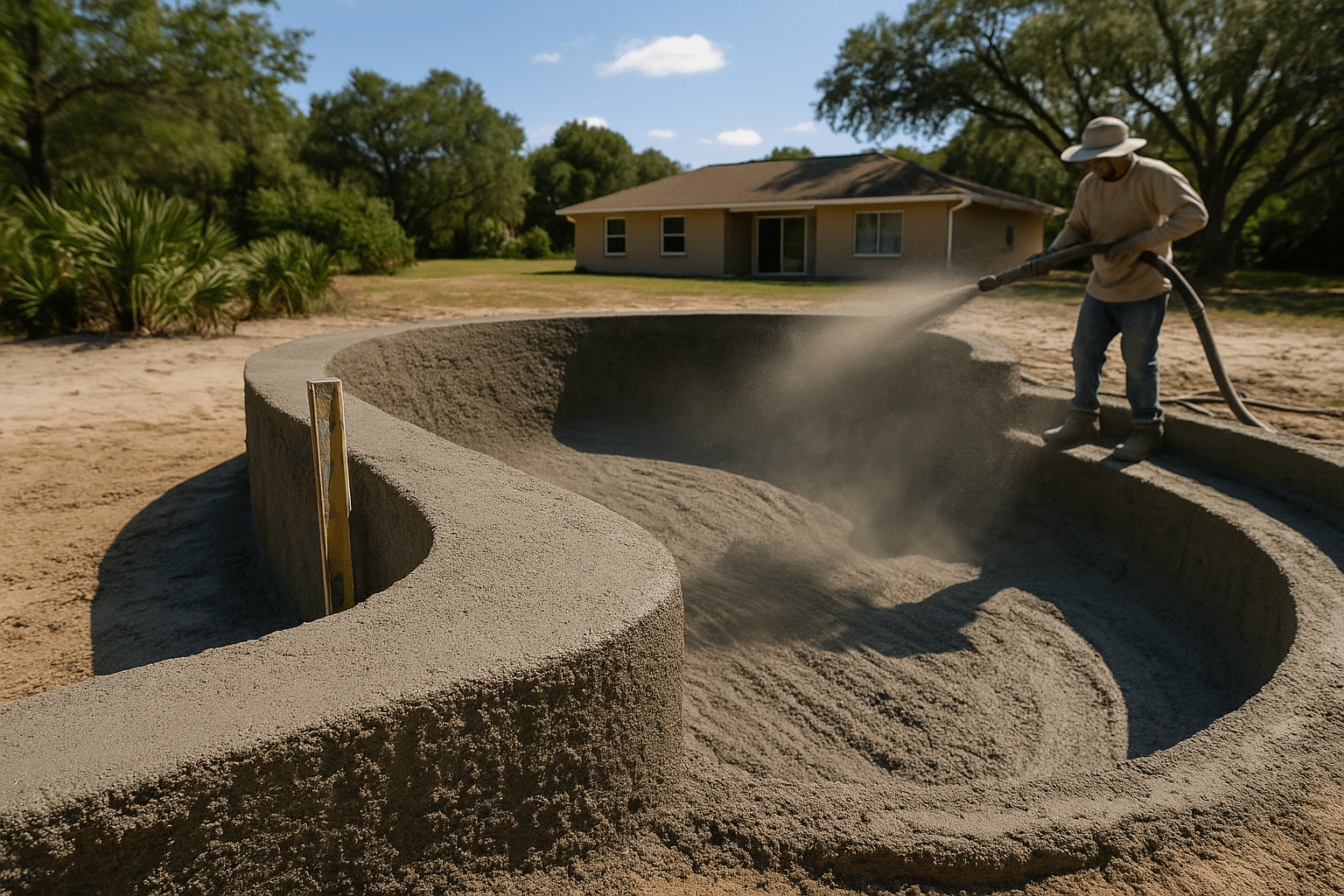
TL;DR: A structurally sound concrete (gunite) pool shell needs a minimum of 6 inches of thickness, though 8–12 inches is common in high-stress zones or challenging soil conditions. Thickness works in tandem with rebar spacing, concrete PSI, and proper curing — all governed by industry standards from ACI and ANSI/APSP. At R & R Swimming Pools, our in-house gunite crew builds shells ranging from 6 to 12 inches thick depending on design and site engineering.
When a homeowner asks, “How thick is the shell on a concrete pool?” they are really asking a deeper question: “How long will this pool hold up — and what am I actually paying for?”
Shell thickness is one of the most important structural variables in any gunite or shotcrete pool build. But it does not work alone. Thickness, rebar configuration, concrete compressive strength, and proper curing all operate as a system. Understanding how each piece fits together helps you evaluate bids, ask better questions, and avoid expensive surprises down the road.
The Baseline: What Does Industry Standard Say?
To be structurally sound, a concrete pool shell should generally be 6 inches thick. That is the widely accepted floor, not a ceiling. Typical wall thickness ranges from 6 to 10 inches, depending on pool depth and soil conditions.
The rebar grid must maintain a minimum 3-inch clearance from the earthen wall to allow full encapsulation by the cementitious mixture, per requirements referenced in the International Building Code (IBC) and the ANSI/APSP/ICC-5 standard. That standard — ANSI/APSP/ICC-5, published by the Pool & Hot Tub Alliance — covers permanently installed residential inground pools and is the benchmark most engineers and inspectors reference.
Florida adds another layer. Florida Building Code concrete provisions address materials and construction standards, including shotcrete compliance with ACI 318. In practice, your pool’s permitted structural plan controls the shell design, meaning the final thickness is set by your engineer’s drawings and approved by your local building department — not by any single universal rule.
Why Thickness Alone Is Not the Whole Story
A 6-inch wall of poorly mixed, under-reinforced concrete is not equivalent to a 6-inch wall engineered to code. Three other variables matter just as much.
1. Compressive Strength (PSI)
The American Concrete Institute (ACI) sets the minimum required concrete compressive strength at 4,000 PSI, or higher depending on soil and other site conditions. This is the ACI’s guidance published in ACI PRC-506.8-24: Shotcrete Use in Pool Construction — Guide.
In practice, gunite typically exceeds that floor. Using the shotcrete (wet) process, compressive strength will easily exceed 4,000 PSI; due to the cement content and lower water-to-cement ratio inherent in dry-mix (gunite) shotcrete, compressive strengths will normally far exceed the 4,000 PSI ACI minimum. Well-executed gunite can reach compressive strengths of 6,000 to 7,500 PSI — much higher than standard poured concrete.
2. Steel Reinforcement
Steel reinforcement plays a major role in the structural requirements for a gunite pool. Rebar strengthens the shell and prevents structural cracking over time. Most pools use #4 rebar (½-inch diameter) spaced 12 inches apart in both directions across the walls and floor.
Always maintain at least 3 inches of concrete cover between rebar and exposed surfaces — this protects the steel from corrosion. That 3-inch cover requirement is one reason a 6-inch minimum shell exists: you need enough concrete on each side of the steel to do its job.
3. Curing
Portland cement-based gunite requires a minimum 28-day cure period to achieve design compressive strength — typically 4,000 to 5,000 PSI for pool shells. During curing, the shell must be kept moist; premature drying causes shrinkage cracking that compromises waterproofing. The shell must be kept wet for 7–10 days to help the gunite cure to its highest PSI. Skip or shorten this period and you risk cracks, uneven surfaces, or long-term structural issues that are expensive to fix.
When More Than 6 Inches Is Required
Six inches is a starting point, not a finish line. Several conditions push thickness higher.
- Pool depth. Pool walls must resist both inward soil pressure and outward water pressure, and as pool depth increases, water pressure rises. Deeper pools — anything beyond 5 or 6 feet — typically require thicker walls or tighter rebar spacing to compensate.
- Soil conditions. Soil conditions are the primary driver of structural design decisions in concrete pool construction. Expansive or unstable soils exert lateral and uplift pressures that require additional rebar density, increased shell thickness, or engineered tie-down systems.
- Complex geometry. Engineering is especially relevant when the pool includes raised features, unusual geometry, significant elevation changes, difficult soil, or groundwater concerns. Bond beams, raised spas, and tanning ledges all introduce stress concentrations that demand more material.
- High-stress zones. In coves (the curved transition between floor and wall) and around structural openings like main drains and return fittings, builders routinely add thickness. A typical build might use 6 inches on standard walls, 8 inches in coves, and up to 12 inches at the bond beam.
At R & R Swimming Pools, our in-house gunite crew builds shells 6 to 12 inches thick depending on the pool’s design, depth, and the site engineering that comes from our permitting process. Every project goes through full design, engineering, and county permitting before a single shovel enters the ground — so the thickness your pool receives is the thickness the engineer specified for your specific yard and soil.
Want to understand how a custom gunite build compares to a fiberglass installation on your property? Our guide on what a gunite pool is and how it differs from other concrete pools walks through the full process.
Structural Cracking vs. Surface Crazing: Know the Difference
Not every crack in a concrete pool signals a structural failure, but knowing the difference matters.
Cracks in the concrete can be either in the structure itself or on the surface (crazing). A structural crack is usually caused by incorrect design or construction — an engineer must design the pool to withstand unstable or expansive soil, and the construction team must build it as specified. If the pool is engineered or constructed incorrectly, it may structurally fail and leak water.
Surface crazing — a network of fine, shallow cracks in the plaster finish — is a cosmetic issue caused by rapid drying or minor shrinkage. It does not indicate shell failure and is addressed during routine replastering. Structural cracks, by contrast, travel through the shell and allow water to escape into the surrounding soil. Proper shell thickness, correct PSI, adequate rebar cover, and controlled curing are the four defenses against structural cracking.
How This Compares to Fiberglass
A common question from homeowners comparing pool types is: “If a gunite shell needs 6–12 inches of concrete, why does a fiberglass pool work with a much thinner shell?” The answer lies in material science. Fiberglass is engineered to flex rather than resist. Its composite layers absorb and distribute ground movement rather than fighting it with mass. Gunite resists through compressive strength and rigid mass reinforced with steel.
Neither approach is inherently superior — they solve the same structural problem differently. Each has real trade-offs in cost, timeline, customization, and maintenance. For a detailed side-by-side breakdown specific to Florida conditions, see our fiberglass vs. concrete pool cost comparison for Florida.
What to Ask Your Pool Builder
Before you sign a contract with any pool contractor — in Lake County or anywhere in Central Florida — these are the questions that separate a serious builder from one cutting corners on shell thickness:
- What is the specified shell thickness for my pool, and where does it vary? Get the answer in writing from the structural drawings, not just a verbal estimate.
- What PSI mix design are you using? A reputable builder should reference at least 4,000 PSI per ACI guidelines — many quality crews hit 5,000 PSI or more.
- What rebar size and spacing does the engineer spec? #3 or #4 bar at 6–12 inches on center is standard; high-stress zones may require tighter spacing.
- How long will the shell be wet-cured before finishing begins? A minimum of 7 days of active moisture is the industry standard.
- Will the structural plans be stamped by a licensed Florida engineer and submitted for permit? This is not optional — it is required by the Florida Building Code, and it is your assurance that the design was reviewed by a professional.
At R & R Swimming Pools, every concrete pool we build is permitted, engineered, and inspected. Our in-house gunite crew — not a subcontractor — applies the shell, so quality control stays with us from excavation to final walkthrough.
The Long-Term Payoff of Getting Thickness Right
A properly engineered and built gunite pool is a long-lived asset. With proper care, gunite pools last 30 to 50 or more years. That lifespan depends heavily on the decisions made before the first yard of concrete leaves the hose — specifically, whether the engineer specified adequate thickness for your soil conditions, whether the rebar was correctly placed and tied, and whether the crew cured the shell long enough to reach full design strength.
Skimping on thickness to save money at construction is a trade-off that typically shows up years later as structural cracking, leaks, and costly repairs — often exceeding what was saved in the original build.
If you’re still in the research phase and want to understand what a full custom pool project costs in Lake County or the surrounding Central Florida communities, our inground pool cost guide for Central Florida covers 2025 pricing in detail.
R & R Swimming Pools: Built to Last Since 1985
R & R Swimming Pools has been building custom inground pools across Lake County and Central Florida since 1985 — with over 1,000 pools and spas completed. Our gunite concrete pools carry a limited lifetime shell warranty, and every project is handled in-house: design, engineering, permitting, excavation, plumbing, electrical, finishing, and final walkthrough. We serve The Villages, Clermont, Mount Dora, Leesburg, Eustis, Fruitland Park, Lady Lake, Tavares, Minneola, Wildwood, Groveland, Montverde, Sorrento, and 30+ surrounding communities.
Ready to talk specifics about your yard, your soil, and your ideal pool? Contact our team for a free design consultation.
Recommended Reads
- Fiberglass vs. Concrete Pool Cost in Florida: A Side-by-Side Breakdown
- Concrete Pool Pros and Cons: Is a Gunite Pool Right for Your Florida Yard?
- What Is a Gunite Pool and How Is It Different From Other Concrete Pools?
