
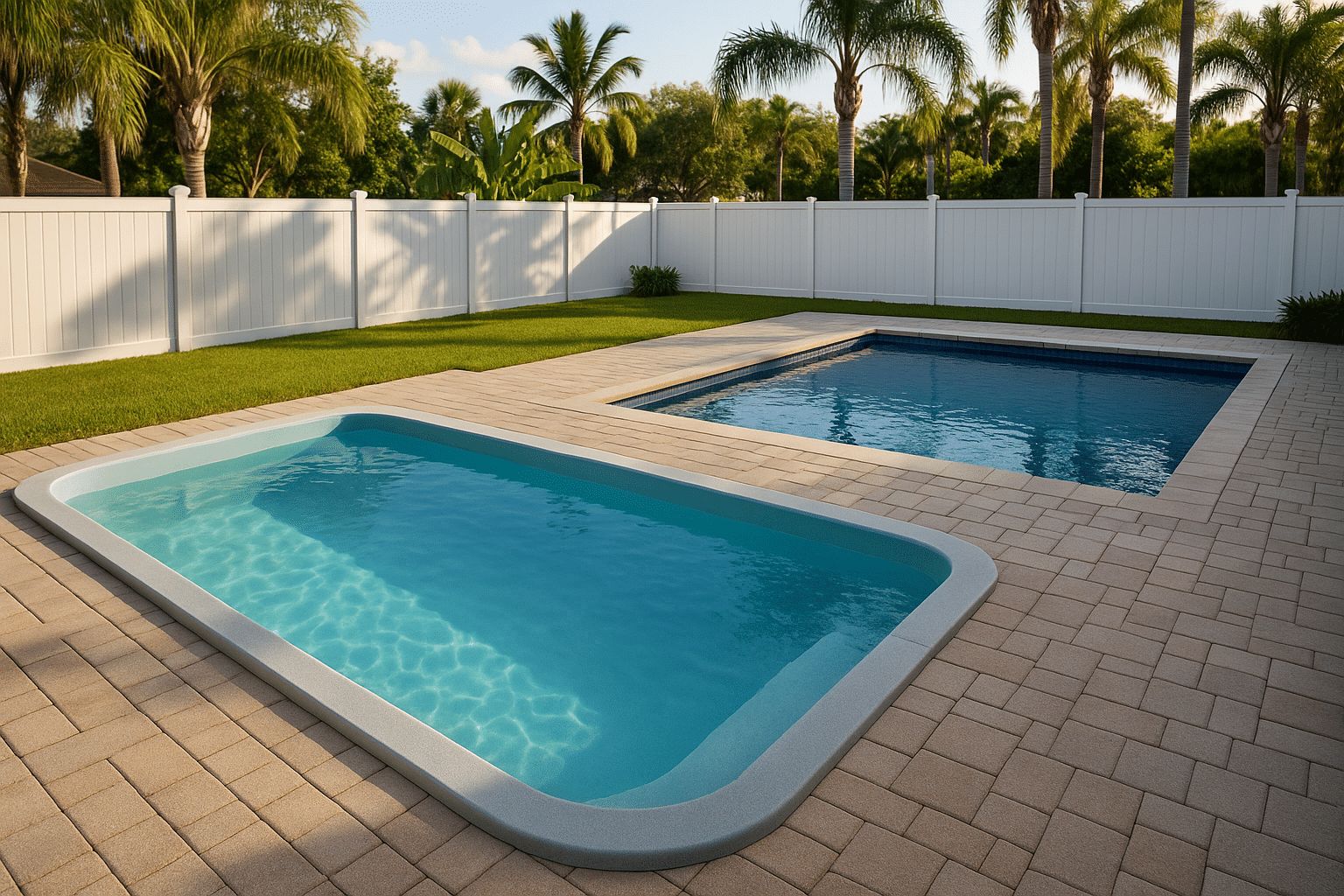
TL;DR: Fiberglass pools typically cost less upfront and significantly less to maintain over 10 years, while custom gunite concrete pools offer unlimited design freedom at a higher total cost of ownership. In Central Florida’s sandy, shifting soils and intense sun, both pool types work well—but the right choice depends on your budget, design goals, and how long you plan to stay in your home.
You’ve decided you want an inground pool. Now comes the question every Central Florida homeowner asks: fiberglass or concrete? The answer isn’t just about which shell looks better in a brochure. It’s about what you’ll spend on Day 1, what you’ll spend over the next decade, and how each pool type actually performs in Florida’s heat, humidity, and sandy soil.
This guide breaks down every major cost category side by side so you can make a confident decision before you ever talk to a builder.
How Each Pool Type Is Built
Understanding construction helps explain the price differences that follow.
Fiberglass pools arrive as a factory-molded, one-piece shell with a smooth, non-porous gel coat surface. The shell flexes with ground movement and typically lasts 25 or more years, with many lasting 30 to 50 years with proper care. A crane lifts the shell into an excavated hole, and crews connect plumbing and electrical from there.
Gunite (concrete) pools are built entirely on site. Gunite is a mixture of concrete and sand sprayed onto the walls and floor of the pool using a high-pressure hose, then left to cure for several days. Once cured, it is very strong and durable. At R&R Swimming Pools, our in-house gunite crew builds shells 6 to 12 inches thick, giving you a structure that can be shaped into virtually any size, depth, or configuration imaginable.
Upfront Installation Cost
Let’s look at real numbers. Prices vary by pool size, site conditions, and features—but here are the current market ranges for Central Florida and the broader U.S.:
- Fiberglass: Typically $45,000 to $100,000 depending on size, access, region, and extras like tanning ledges, a spa, or a waterfall.
- Gunite/Concrete: Usually starts around $60,000 and can move beyond $120,000.
As a real-world data point, an Orlando-area homeowner paid $58,500 in early 2025 for a 12×24 fiberglass pool, including excavation, crane delivery, and a 3-foot concrete deck.
Keep in mind that base quotes often exclude decking, fencing, lighting, and landscaping. Many contractors advertise a ‘starting at $45K’ price that rarely includes everything. Always request a line-item breakdown—if ‘electrical’ or ‘permits’ aren’t listed, they’re probably excluded.
Florida Permitting: What Every Pool Buyer Must Know
No matter which pool type you choose, you cannot skip this step. Every inground swimming pool in Florida requires a building permit before construction can begin, no exceptions. Florida is governed by the Florida Building Code (FBC), which establishes minimum standards for structural design, plumbing, electrical work, drainage, and safety barriers for all residential pool installations.
Along with the building permit, your project may require separate electrical and plumbing or gas permits. Electrical permits cover wiring for pumps, lighting, and outlets, while plumbing or gas permits are needed for pool heaters or automatic water fill systems.
Florida also requires pools to be enclosed by a fence or barrier at least 4 feet high, with self-closing and self-latching gates. Homes with direct pool access must have alarms on windows and doors leading to the pool area.
R&R Swimming Pools handles all permitting, engineering plans, and inspections in-house for every project we build across Lake County and Central Florida. You don’t have to navigate the Florida Building Code on your own.
Installation Timeline: Weeks vs. Months
In Florida, the faster your pool is done, the sooner you’re swimming—and the less disruption your yard endures during rainy season.
- Fiberglass: R&R typically completes fiberglass installations in 2 to 4 months from contract signing to final walkthrough. The shell itself drops in quickly; most of the timeline is permitting, site prep, and finishing work.
- Gunite/Concrete: Custom concrete builds at R&R run 4 to 6 months. Concrete pools can support custom shapes, grottos, waterfalls, and beach entries, but typical projects take 3 to 5 months for construction alone. Add permitting time, and planning ahead is essential.
If you’re buying a new construction home or have a specific summer target date, timeline matters enormously. Talk with your builder early.
10-Year Maintenance Cost: The Number Most Buyers Overlook
This is where the two pool types diverge most sharply—and where many homeowners get an unpleasant surprise a few years in.
Annual Maintenance
Fiberglass pools have a smooth gelcoat that resists algae, so annual maintenance costs often land near $1,200 per year—covering chemicals, electricity, and minor parts. Annual maintenance cost for a gunite pool hovers around $1,800, and every 8 to 12 years, plaster needs a full redo; today’s pool resurfacing cost for gunite ranges from $10,000 to $18,000.
Chemical Usage
Florida’s heat and sun accelerate algae growth in any pool—but surface type makes a big difference in how much chemistry you need. Fiberglass pools require 30% less chlorine than other pool types to keep clean. That’s because fiberglass surfaces have a non-porous gel coat that resists chemical penetration, creating a barrier that helps maintain consistent chemical levels and reduces the need for frequent adjustments.
By contrast, the surface of a concrete pool can increase the water’s alkalinity, leading to challenges with maintaining proper pH levels. You’ll find you need to apply muriatic acid more often, and you’ll need to closely monitor calcium levels. If calcium gets too low, it will leech from the plaster, requiring replastering much sooner.
Resurfacing
Concrete pools require acid washing every 3 to 5 years ($500–$800) and complete resurfacing every 7 to 15 years ($8,000–$15,000), depending on maintenance and water chemistry.
Fiberglass pools may need a new gelcoat 10 to 15 years in; current resurfacing costs average $7,000–$10,000.
The 10-Year Totals
According to Latham Pool Products, R&R’s authorized fiberglass manufacturer: the cost of maintaining a fiberglass pool is approximately $4,000 over the course of a decade. In comparison, the 10-year maintenance cost of a concrete pool ranges between $15,000 to $27,000—due to periodic resurfacing and higher chemical usage to maintain proper water chemistry.
Looked at over a full ownership period, a fiberglass pool can save homeowners $25,000–$35,000 in combined maintenance, energy, and resurfacing costs versus concrete over 10 years.
Florida-Specific Factors That Affect Both Pool Types
Central Florida’s environment creates conditions you won’t find in most national cost guides. Here’s what actually matters in Lake County and the surrounding communities:
- Soil movement: Fiberglass flexes slightly with ground movement, which is critical during Florida’s wet season when soil expands and contracts. This flexibility prevents the cracking that plagues concrete pools.
- UV exposure: The gel coat on fiberglass pools withstands intense UV exposure without fading for 15 to 20 years.
- Saltwater systems: Salt water systems, which are popular in Florida, work perfectly with fiberglass without the surface degradation seen in concrete. Salt slowly erodes concrete plaster and accelerates the resurfacing cycle.
- Heat retention: Fiberglass holds warmth better than concrete, so your heater works less for the same swim season. In a 12-month swimming climate like Central Florida, that translates to real annual savings.
Design Freedom: Where Concrete Still Wins
It’s only fair to acknowledge what gunite does better. Fiberglass pools arrive prefabricated, while concrete pools are built on-site to your exact specifications. That means with a custom gunite pool you can build:
- Any shape, including irregular freeform designs
- Beach entries and zero-entry slopes for toddlers
- Extra-deep diving areas (subject to local code)
- Attached grottos, raised spas, and vanishing edges
- Any width or length—not constrained by transport limits
Fiberglass shells come in manufacturer-set molds. R&R carries a wide range of Latham fiberglass pool models—including freeform, rectangular, and L-shaped options with built-in tanning ledges and seating—but if your dream pool has a one-of-a-kind shape, a custom gunite build is the honest answer.
Lifespan and Warranty
Fiberglass can last 25 to 30 years, while concrete pools can last 50 years or more. That said, a concrete pool’s longevity depends heavily on consistent maintenance and timely resurfacing. A neglected gunite pool can deteriorate faster than a well-kept fiberglass pool.
At R&R Swimming Pools, both our fiberglass and custom gunite pools carry a limited lifetime shell warranty, so you’re covered regardless of which type you choose.
Financing: Making Either Pool Affordable
Whether you’re leaning toward fiberglass or concrete, the sticker price doesn’t have to be a barrier. R&R works with Lyon Financial and Viking Capital—two lenders who specialize in pool financing and offer competitive rates for qualified homeowners. Explore your pool financing options before you set a budget so you know your real monthly payment range.
Side-by-Side Summary
| Category | Fiberglass | Gunite / Concrete |
|---|---|---|
| Upfront cost (installed) | ~$45,000–$100,000 | ~$60,000–$120,000+ |
| R&R timeline | 2–4 months | 4–6 months |
| Annual maintenance | ~$1,200/yr | ~$1,800/yr+ |
| 10-year maintenance cost | ~$4,000 | $15,000–$27,000 |
| Resurfacing | $7,000–$10,000 every 15–20 yrs | $10,000–$18,000 every 8–12 yrs |
| Chemical usage | ~30% less than concrete | Higher; pH harder to stabilize |
| Design flexibility | Manufacturer molds; many shapes | Fully custom—any shape or depth |
| Florida soil movement | Flexes; crack-resistant | Rigid; can crack over time |
| Saltwater compatible | Yes—no surface degradation | Yes, but accelerates plaster wear |
| Shell warranty (R&R) | Limited lifetime | Limited lifetime |
Which Pool Is Right for You?
Choose fiberglass if: you want a lower total cost of ownership, a faster installation, minimal ongoing maintenance, or saltwater compatibility without worrying about surface damage. Fiberglass is also a strong choice for families with young children—the smooth gel coat surface won’t scrape knees the way textured concrete can.
Choose gunite if: you have a specific custom shape in mind, need a beach entry or vanishing edge, want to incorporate a spa, grotto, or water feature that goes beyond standard mold offerings, or simply want the ultimate in design freedom and are comfortable with the higher long-term maintenance commitment.
R&R Swimming Pools has been building both types since 1985, with over 1,000 pools completed across The Villages, Clermont, Mount Dora, Leesburg, Eustis, and dozens of surrounding communities. We’ll give you a straight answer based on your yard, your budget, and your priorities—not just what’s easier for us to sell.
Ready to compare models and get a real price for your property? Contact R&R Swimming Pools for a no-pressure consultation.
