
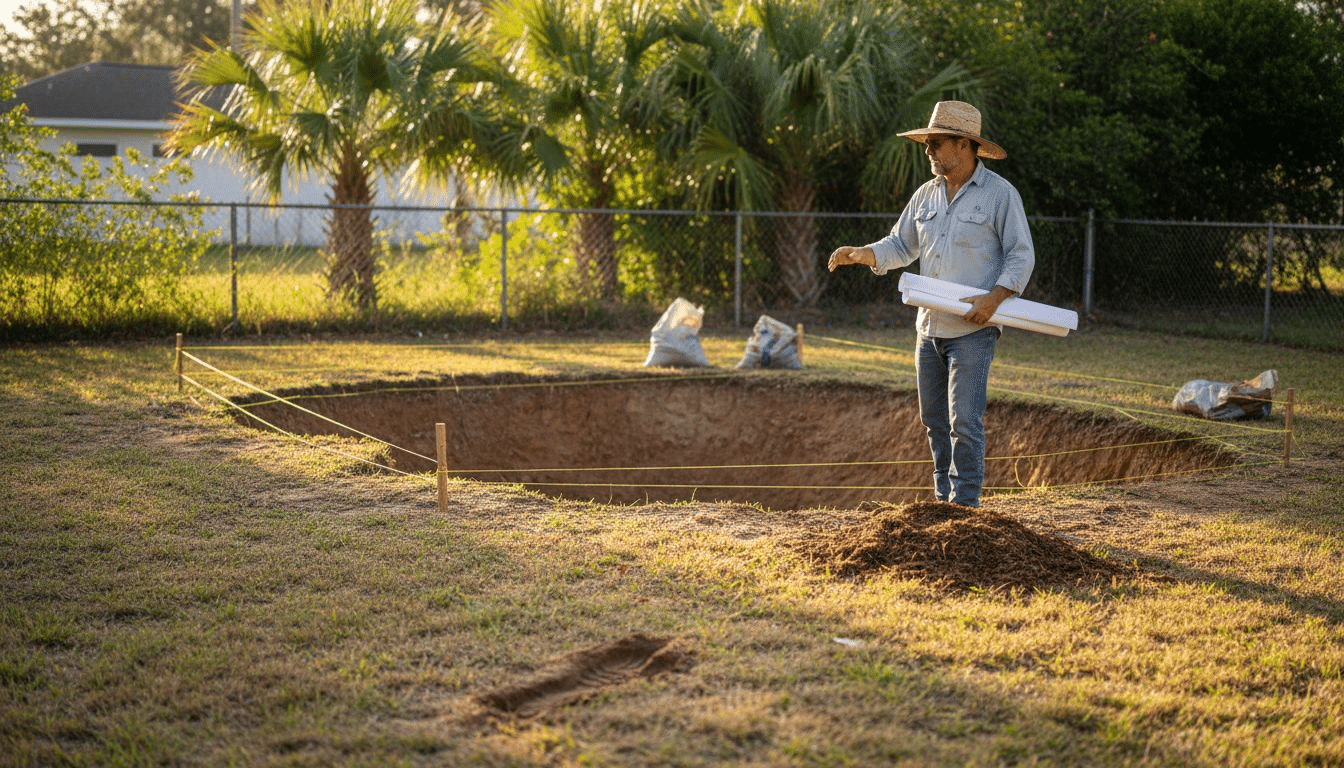
Planning a custom inground pool can feel overwhelming when facing permits, design choices, and Florida’s sandy soil. For Central Florida homeowners, understanding setback requirements, local codes, and the role of county health departments is key to avoiding costly mistakes. This guide breaks down each step, helping you confidently handle property surveys, material selection, excavation, system installation, and the final inspections that ensure your backyard oasis meets every standard.
Table of Contents
- Step 1: Assess Site And Secure Permits
- Step 2: Design Pool Layout And Select Materials
- Step 3: Excavate And Prepare Foundation
- Step 4: Install Pool Structure And Essential Systems
- Step 5: Inspect Installation And Complete Finishing Touches
Quick Summary
| Key Point | Explanation |
|---|---|
| 1. Understand Permitting Requirements | Assess property lines and contact local authorities to ensure compliance with zoning, setback, and HOA rules before applying for a pool permit. |
| 2. Plan Pool Design Wisely | Choose pool shapes, materials, and additional features based on long-term costs, maintenance, and how they fit with your yard’s layout and sunlight exposure. |
| 3. Ensure Accurate Excavation Practices | Locate underground utilities before digging and carefully prepare the foundation to prevent structural issues in the future due to poor soil compaction. |
| 4. Install Systems According to Codes | Properly install plumbing and electrical systems, ensuring all components are safe and meet local regulations, to avoid safety hazards later. |
| 5. Complete Required Inspections | Schedule and pass all inspections before filling the pool; this ensures compliance and avoids legal issues during home sales or insurance claims. |
Step 1: Assess Site and Secure Permits
Before breaking ground on your custom pool, you need to understand your property and navigate the permitting process. This step determines whether your pool dream is feasible on your land and ensures you’re compliant with local regulations. Getting this right upfront saves thousands in costly rework and legal headaches.
Start by examining your property boundaries and existing structures. Walk your yard with a measuring tape and note distances from your house, property lines, utility lines, and any neighboring buildings. Central Florida properties often have specific setback requirements—the distance your pool must be from property lines—that vary by county. You’ll also need to identify easements, which are areas where utility companies or local governments have rights to access underground lines.
Contact your local county building department next. They’ll tell you the specific setback distances, zoning restrictions, and whether your lot is large enough for your desired pool size. Some neighborhoods in Central Florida have HOA rules that add additional restrictions beyond county codes. Ask about required submittals for your permit application.
Prepare scaled drawings showing your pool’s proposed location relative to property lines, nearby structures, and equipment placement. The 2021 International Swimming Pool and Spa Code requires these dimensioned drawings with your permit application. Include details like pool depth, equipment locations, and deck layout.
Submit your permit application with all required documents to your building department and, if applicable, your county health department. Florida’s permitting process typically takes 2 to 4 weeks for residential pools. Be prepared to answer questions or provide additional information if the reviewer needs clarification.
Your permit is non-negotiable—building without one can result in fines, difficulty selling your home, and forced removal of the pool.
Key items to prepare before applying:
- Property survey showing lot lines and dimensions
- Proposed pool plans with scaled measurements
- Proof of property ownership
- HOA approval letter (if applicable)
- Proof of setback compliance with existing structures
Pro tip: Have a professional surveyor mark your property lines before you meet with the building department—it prevents misunderstandings and speeds up permit approval by days.
Step 2: Design Pool Layout and Select Materials
Now that your site is approved, it’s time to design your pool layout and choose the materials that will define your backyard for decades. These decisions affect everything from maintenance costs to durability and aesthetics, so thoughtful planning here pays dividends later.
Start by visualizing how your pool fits into your yard’s flow. Consider where you’ll spend time lounging, where guests will enter, and how the pool relates to your house and landscaping. Think about sun exposure throughout the day—afternoon shade might appeal to you in Florida’s heat, while morning sun keeps water warm. Sketch rough layouts or work with a designer to explore different configurations.
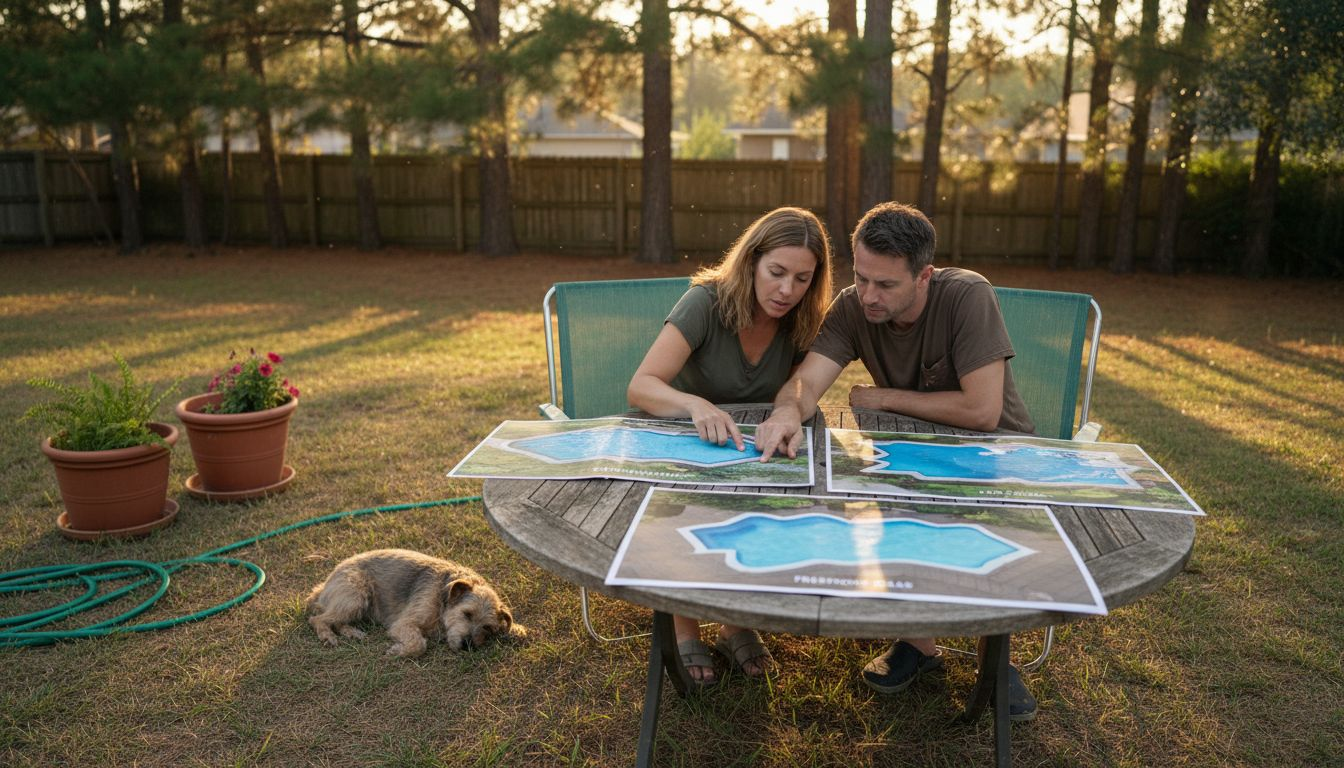
Next, consider the three main pool materials used in Central Florida: concrete, fiberglass, and vinyl. Each has distinct advantages and trade-offs. Concrete pools offer complete customization in shape and size, though they require regular resurfacing every 10 to 15 years. Fiberglass pools arrive pre-formed, install faster, and need less maintenance, but your shape options are limited to existing mold designs. Vinyl pools are budget-friendly upfront but require liner replacement every 5 to 10 years.
Your choice impacts long-term costs. Concrete pools typically cost more initially but can last 50 years with proper care. Fiberglass offers mid-range pricing with moderate maintenance. Vinyl pools have lower installation costs but accumulate expenses through liner replacements. Research sustainable design practices that minimize environmental impact while meeting your needs.
Here’s how the main pool construction materials compare in terms of durability, maintenance, and customization:
| Material Type | Lifespan | Maintenance Needs | Customization Level |
|---|---|---|---|
| Concrete | 50+ years | High (resurfacing needed) | Fully customizable |
| Fiberglass | 25-30 years | Low (easy care) | Limited shapes |
| Vinyl | 10-15 years | Moderate (liner replacement) | Some shape flexibility |
Decide on additional features that enhance your experience. Consider water features like fountains or spillovers, integrated lighting, seating ledges, or sun shelves for young children. Plan equipment placement—pumps, filters, and heaters need accessible locations away from main views.
Material selection determines maintenance frequency, long-term expenses, and how your pool ages over time.
Questions to ask yourself:
- What’s your budget for initial installation and ongoing maintenance?
- How much customization matters to you in shape and features?
- Are you willing to trade upfront cost for lower maintenance?
- How does your chosen material complement your home’s style?
Pro tip: Request samples of different finishes and materials, then visualize them in your yard under different lighting—what looks good at the showroom might feel different in your backyard’s actual conditions.
Step 3: Excavate and Prepare Foundation
Excavation is where your pool transitions from plan to reality. This critical step requires precision and careful attention to soil conditions, because a poorly prepared foundation leads to cracking, settling, and costly repairs down the road.
Before digging begins, your contractor must locate all underground utilities. Call 811 or visit your local utility locating service to have gas, electric, water, and sewer lines marked on your property. This prevents dangerous and expensive accidents. Your contractor will also verify no utility easements cross your pool location, as these restrict construction.
The excavation depth depends on your pool design and soil type. Most inground pools in Central Florida require excavation 6 to 8 feet deep, though this varies based on your chosen depth and deck design. The excavation process removes topsoil and suitable material from your pool basin and surrounding areas. Proper excavation depth and soil conditions must align with your design specifications and local codes.
Once excavated, the real foundation work begins. Your contractor will grade and compact the soil to create a stable base that prevents settling. Florida’s sandy soil requires careful compaction in layers to achieve proper density. Poor compaction causes the pool structure to shift unevenly, creating cracks in concrete or stress on fiberglass shells.
For concrete pools, a base layer of sand is spread and compacted, then reinforced with rebar. For fiberglass pools, a smooth sand base ensures the shell sits evenly without pressure points. Vinyl pools need similar preparation with careful grading to support the structure.
A weak foundation today becomes an expensive structural problem tomorrow—compaction matters more than you might think.
Key preparation tasks before your contractor begins:
- Confirm utility locations are marked and documented
- Clear vegetation and debris from the work area
- Ensure proper drainage away from the excavation site
- Verify soil conditions meet engineering requirements
- Schedule inspections before backfilling
Pro tip: Watch your soil during excavation—if it appears unusually wet or soft, ask your contractor about soil amendments or additional compaction, as Florida’s high water table sometimes requires extra foundation reinforcement.
Step 4: Install Pool Structure and Essential Systems
This is where your pool truly comes to life. Installation of the pool structure and its systems transforms your excavated hole into a functional swimming pool. This phase demands precision, as improper installation compromises performance and creates safety hazards.
Your contractor begins by installing the chosen pool structure. For concrete pools, steel rebar is positioned in the basin, then concrete is poured and finished. For fiberglass pools, the pre-formed shell is carefully lowered into the excavated area and leveled perfectly. For vinyl pools, the frame and walls are assembled, then the vinyl liner is installed. Each material requires different techniques, but all demand meticulous attention to level and alignment.
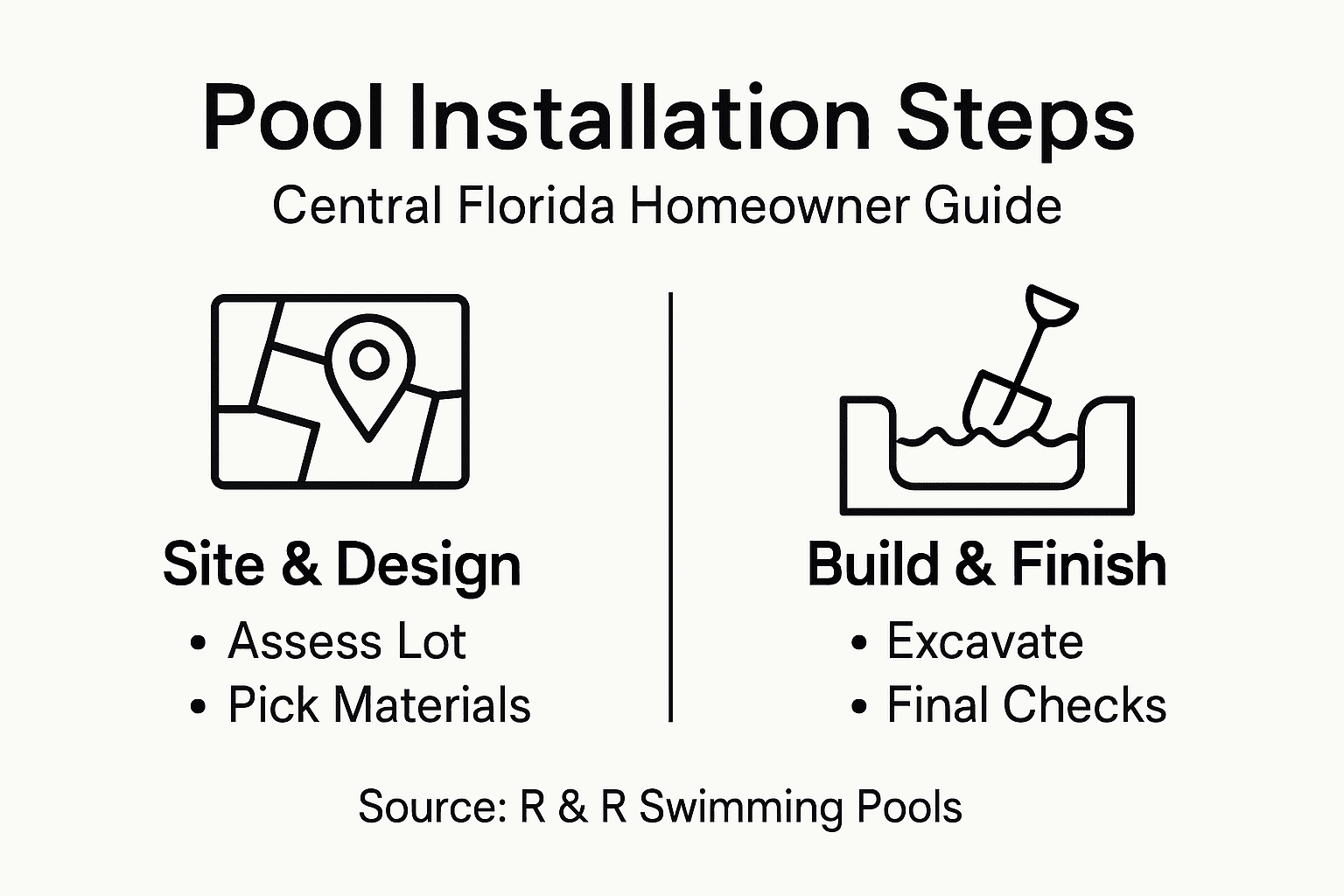
Next comes the critical systems installation. Your pool requires proper plumbing and electrical systems that comply with safety codes. This includes the circulation system (pump and filter), drainage, chemical treatment equipment, and often heating systems.
The circulation system keeps water clean and safe. Water is drawn from the pool, filtered to remove debris and contaminants, and returned through return lines. Your contractor installs plumbing lines between the pool, equipment pad, and returns, ensuring proper sizing for your pool’s volume and flow rate.
Electrical work requires a licensed electrician. Ground fault circuit interrupter (GFCI) outlets protect against electrical hazards. Pump motors, heaters, and lighting all need proper wiring and connections. Florida code requires bonding of all metallic components for safety.
Rushed system installation creates leaks, inadequate filtration, and electrical problems that emerge after you’ve already paid and the contractor has moved on.
Essential systems your contractor installs:
- Circulation pump and filter for water movement and cleaning
- Main drain and skimmer lines for debris removal
- Return lines distributing cleaned water back to the pool
- Chemical feeder or saltwater chlorination system
- Optional heating system for year-round comfort
- Electrical connections and safety bonding
Pro tip: Request a walkthrough where your contractor explains each system’s location and function, and ask for documentation showing all inspections passed—this knowledge helps you maintain the pool and troubleshoot problems later.
Step 5: Inspect Installation and Complete Finishing Touches
You’re in the final stretch. Your pool structure is complete and systems are installed, but before you fill it with water, official inspections must verify everything meets code. Only after passing inspection can you legally use your pool.
Your local building department schedules a final inspection to verify compliance with all construction codes. The inspector checks structural integrity, electrical safety, plumbing connections, and proper drainage. For concrete pools, they examine curing and surface condition. For fiberglass and vinyl pools, they confirm proper installation and levelness. Safety barriers and anti-entrapment devices must be installed correctly and meet code requirements.
The county health department also conducts inspections to verify sanitation standards and operational readiness. They confirm chemical treatment systems are properly installed and accessible. Once both inspections pass, you’ll receive your operating permit, which is required before you can legally use the pool.
After inspection approval, your contractor completes the finishing touches. The pool deck is finished—whether pavers, concrete, or composite materials. Landscaping around the pool is completed, creating your finished backyard oasis. Railings, gates, and safety fencing are installed if required by your property or HOA. Equipment pads are finished, and any decorative features like water features or lighting are completed.
Your contractor will schedule a training session to show you how to operate systems and maintain your pool. They’ll explain pump operation, filter cleaning, chemical balance, and seasonal care. Ask questions about everything you don’t understand.
An inspection failure now is far better than discovering code violations later when selling your home or dealing with insurance claims.
Final inspection checklist items to expect:
Below is a summary of key steps and inspections required before you can legally use your new pool:
| Step | Main Focus | Inspection Involved |
|---|---|---|
| Foundation Prep | Soil compaction, drainage | Site and soil verification |
| Structure Install | Alignment, system setup | Structural and plumbing check |
| System Setup | Pumps, electrical safety | GFCI and flow inspections |
| Final Touches | Decking, safety features | Final code and safety review |
- Structural integrity and surface finish verification
- Electrical connections and GFCI outlet testing
- Plumbing line integrity and drainage confirmation
- Safety barriers and gate functionality
- Chemical treatment system accessibility
- Anti-entrapment drain covers installation
- Deck and landscaping completion
- Documentation of all passed inspections
Pro tip: Keep all inspection reports, permits, and system documentation in a waterproof folder for your records—future homebuyers and insurance companies will ask for this proof of compliance and proper installation.
Simplify Your Central Florida Pool Installation Journey with R & R Swimming Pools
Building a custom inground pool involves crucial steps like securing permits, selecting the right materials, expert excavation, precise system installation, and passing final inspections. These challenges require deep knowledge of local codes, reliable craftsmanship, and tailored design to avoid costly mistakes and delays. If you want a pool that matches your vision and fits your property flawlessly, trusting seasoned professionals is key. At R & R Swimming Pools, we combine over three decades of Central Florida expertise with personalized service to guide you through every phase confidently.
Whether you are exploring pool designs, curious about the best materials for your yard, or need guidance on permitting and inspections, our Pool School provides valuable insights to prepare you. Dive into our R & R | R & R Swimming Pools page to see real projects showcasing quality and creativity that stands the test of time.
Ready to bring your pool dreams to life without the stress and guesswork? Visit R & R Swimming Pools today and schedule your free quote. Experience craftsmanship that honors your backyard, meets all Central Florida requirements, and turns your outdoor space into a refreshing retreat. Don’t wait to create lasting memories—start building your perfect pool now.
Frequently Asked Questions
What is the first step in the pool installation process for homeowners?
Before installing a pool, homeowners should assess their property and secure the necessary permits. Begin by measuring your yard and understanding local regulations to avoid costly mistakes later on.
How long does it typically take to get a pool permit in Central Florida?
The permitting process for residential pools in Central Florida usually takes about 2 to 4 weeks. Prepare all required documents in advance to help expedite this process.
What materials are commonly used for pools in Central Florida, and how do they affect installation?
Common pool materials in Central Florida include concrete, fiberglass, and vinyl, each with different costs and maintenance needs. Select the material based on your budget and desired customization to ensure your pool meets your lifestyle requirements.
How do I ensure my pool is built on a solid foundation?
To ensure a solid foundation, it is essential to properly mark underground utilities and prepare the soil through compaction. Verify that your contractor checks soil conditions and avoids potential issues by scheduling inspections before any backfilling takes place.
What should I expect during the final inspection before using my pool?
During the final inspection, expect verification of structural integrity, safety features, and compliance with plumbing and electrical standards. After passing the inspection, you will receive your operating permit, allowing legal use of your pool.
How can I maintain my pool after installation?
Regular maintenance of your pool includes monitoring chemical levels, cleaning the filter, and checking the pump operation. Schedule routine maintenance tasks weekly or monthly to keep your pool in optimal condition and extend its lifespan.
