
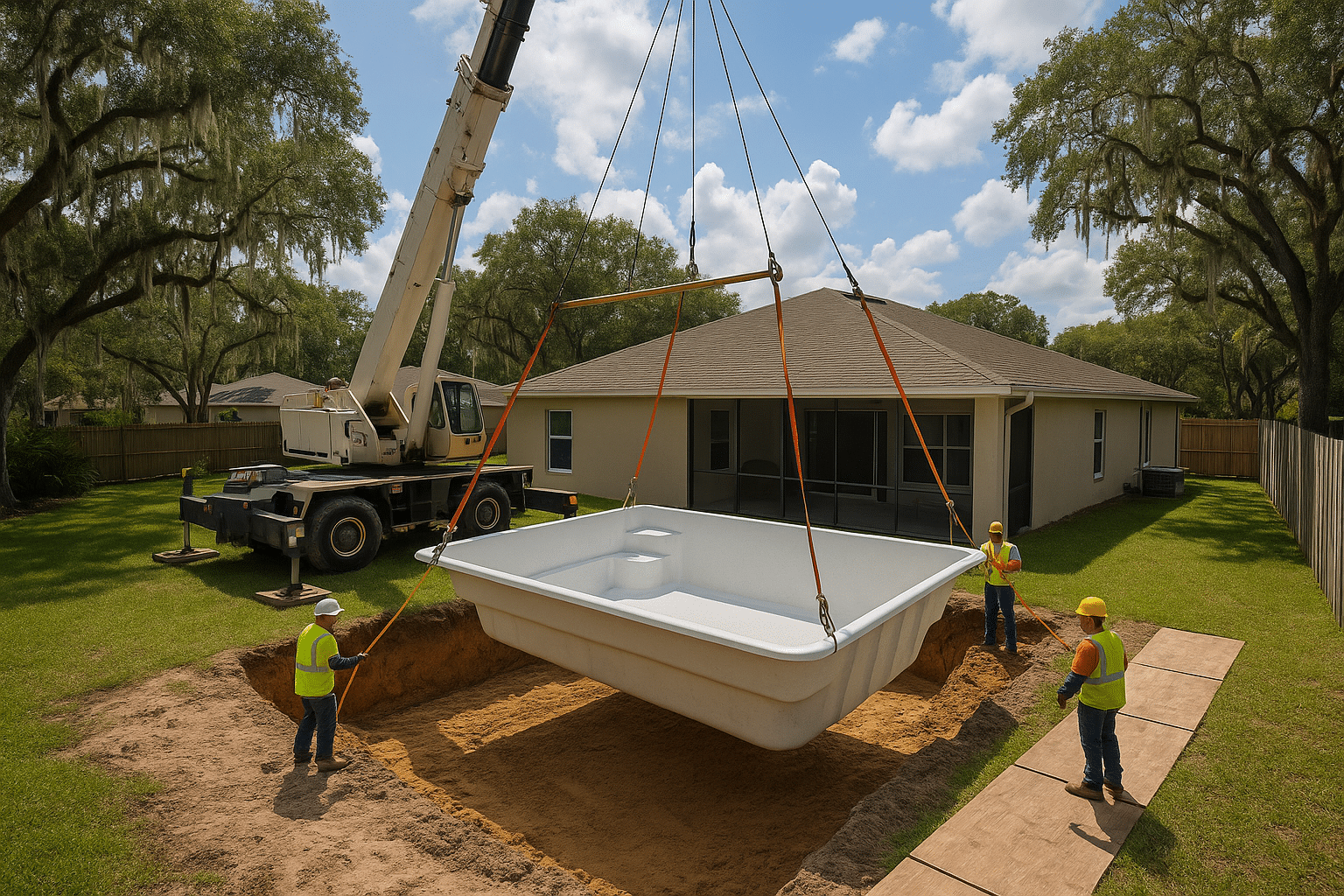
TL;DR: Fiberglass pool shells arrive in one piece and almost always need a crane (or sometimes a track excavator) to lift them off the truck and into the hole. Your yard needs roughly 10-14 feet of clear, obstruction-free width from the street to the excavation, overhead clearance away from power lines, and stable ground for the crane to set up safely. R & R Swimming Pools evaluates access during your site visit so there are no surprises on delivery day.
If you’re comparing fiberglass and concrete pools for your Lake County backyard, one question comes up fast: can a crane actually get to my pool site? Because fiberglass shells arrive pre-molded in one piece, getting that shell from the delivery truck into the ground is a logistics project of its own. Here’s what that process actually requires, how it differs from gunite construction, and how to know if your property is ready.
Why Fiberglass Pools Need Crane Access in the First Place
Unlike a gunite pool, which is built in place from steel rebar and sprayed concrete, a fiberglass pool is manufactured off-site as a single, finished shell and shipped to your property on a flatbed trailer.
The shell is delivered in a single piece on a long trailer and lowered by crane, so your yard needs a clear path for both the truck and the lift.
Excavation machinery and the actual fiberglass pool must get their way into the construction site, and the pool shell can be moved by a crane, but heavy machinery must have an optimal route to the site and back without much obstruction.
In some cases a large track excavator can set the shell instead of a crane, but
the recommended method of setting the pool shell is by making use of a crane or boom truck
, according to Latham Pool Products’ official installation guidance.
How Much Clearance Does a Crane Actually Need?
Access requirements vary by lot, but the industry generally works from these benchmarks:
- Path width:
Fiberglass pools require wider access paths (12-14 feet) for shell delivery
, though many installers can work with less in a pinch using specialized equipment. - Height clearance:
Most manufacturers require a minimum clearance of 14 feet in height and 12 feet in width to accommodate the transportation of your pool shell. - Truck turning radius:
Fiberglass shells need larger turning radiuses (25-30 feet) for delivery trucks. - Rigging: For wider models,
Latham recommends lifting all pool models over 12′ wide with a spreader bar and 20′ lifting straps.
Tight lots aren’t automatically a dealbreaker.
A crane is almost never strictly required for every fiberglass installation, and experienced crews with the right trailer or dolly setup can often work with as little as 10′-6″ of clearance between two houses.
That said, every property is different, which is why an in-person site evaluation matters more than a generic rule of thumb.
What Can Block Crane or Truck Access
Before delivery day, we walk the route from the street to the excavation and look for:
- Overhead power lines. This is the single biggest safety concern on any crane job.
Overhead power lines are a major hazard, and OSHA standard 29 CFR 1926.1408 requires cranes to maintain a 20-foot minimum clearance from energized lines up to 350 kV, and up to 45 feet for higher voltages.
If lines run directly over your access path, the crane may need to reposition or the utility may need to be contacted first. - Low tree branches.
Overhead power lines or tree branches below 18 feet
can force a reroute or require trimming before the crane can swing the shell into place. - Fences, gas meters, AC units, and generators.
Even with 10 feet of width, the space is frequently obstructed by air conditioning units, gas meters, standby generators, or low-hanging roof eaves.
Many of these can be temporarily moved or removed for the day. - Parked vehicles and boats.
Driveway clearance means moving vehicles, trailers, and boats away from the house
before the crew arrives. - Soft or sloped ground. Cranes need stable, level ground to set outriggers safely — soggy Central Florida lawns after heavy rain can delay a lift.
Fiberglass vs. Concrete: Different Access Needs
This is one of the real tradeoffs between fiberglass and gunite construction. Gunite pools are built with smaller equipment delivered in stages — rebar, forms, and a concrete pump truck — so
concrete pools can utilize smaller equipment for tight spaces
. Fiberglass, by contrast, is an all-at-once delivery: one shell, one lift, one shot at getting it positioned correctly. That’s part of why fiberglass installs move faster overall once the shell is set, but it also means access planning has to happen early — ideally before you sign a contract, not after the shell shows up on a trailer.
What Happens on Delivery Day
Once your site is excavated and the crane or rigging equipment is in position, the process generally follows these steps:
- Route and obstacle check. The crew confirms the path is clear of vehicles, low branches, and overhead hazards.
- Excavation dug to spec.
An excavator removes the vast majority of the dirt, digging only slightly beyond the dimensions of the pool by 8 to 12 inches for a tight fit. - Shell inspection. The pool is checked for shipping damage and verified against order specs before it’s lifted.
- Rigging and lift.
Use of a crane with four 20-foot straps is recommended for the process of setting
the shell into the hole. - Leveling and backfill.
The pool is then set by crane or other equipment using lifting straps to meet APSP/ANSI codes for level application,
then braced and backfilled.
Because R & R Swimming Pools handles design, permitting, excavation, and the full fiberglass install in-house, we coordinate the crane logistics as part of the project rather than leaving a homeowner to arrange it separately — which is common when you buy a shell directly from a supplier.
Why This Matters More in Lake County and Central Florida Neighborhoods
Local lot layouts make access planning especially important here. Many communities around The Villages and other active-adult neighborhoods have narrower side-yard setbacks, HOA fencing, and mature landscaping that can affect the delivery route. Newer construction in and around Clermont often comes with tighter lot spacing between homes, while established neighborhoods in Leesburg may have overhead utility lines running along the back property line that need to be factored into the crane’s swing radius. We see similar considerations throughout Mount Dora, Tavares, Eustis, Fruitland Park, and Lady Lake, where tree canopy and overhead service drops are common.
Florida’s sandy soil is generally favorable for crane outrigger stability compared to clay-heavy regions, but seasonal rain can still soften ground quickly, so timing matters during the summer wet season.
When Crane Access Issues Might Push You Toward Concrete
If a site visit reveals a backyard that’s genuinely inaccessible — blocked by a house on one side, a pool enclosure on the other, and no realistic crane path — a custom gunite pool built in place may be the more practical option. Because our crews pour and finish concrete shells on-site piece by piece, we can often build in locations where a one-piece fiberglass shell simply can’t be delivered.
Questions to Ask Before You Commit to Fiberglass
- How wide is the clearest path from the street to the backyard, including gates and side yards?
- Are there overhead power lines or low tree limbs anywhere along that path or above the pool site?
- Is there room for the crane or boom truck to set up with stable outriggers near the excavation?
- Will any fencing, A/C units, or utility equipment need to be temporarily moved?
Our team answers all of these during a free, in-person site evaluation before you ever sign a contract — so you know exactly what delivery day will look like. Learn more on our fiberglass pool installation page, or ask about access planning specific to your neighborhood when you request a quote.
The Bottom Line
Crane access is the single biggest site-specific variable in a fiberglass pool project. Most Lake County and Central Florida properties have enough room to make it work, but narrow side yards, overhead lines, and soft ground are the three things most likely to complicate a delivery. A thorough site walk before construction begins — not after the shell arrives — is what keeps a fiberglass install on schedule.
Recommended Reads
- Fiberglass Pool Installation Lady Lake FL | R & R Pools
- Fiberglass Pool Installation Leesburg FL | R & R Pools
- Fiberglass Pool Installation Clermont FL | R & R Pools
