
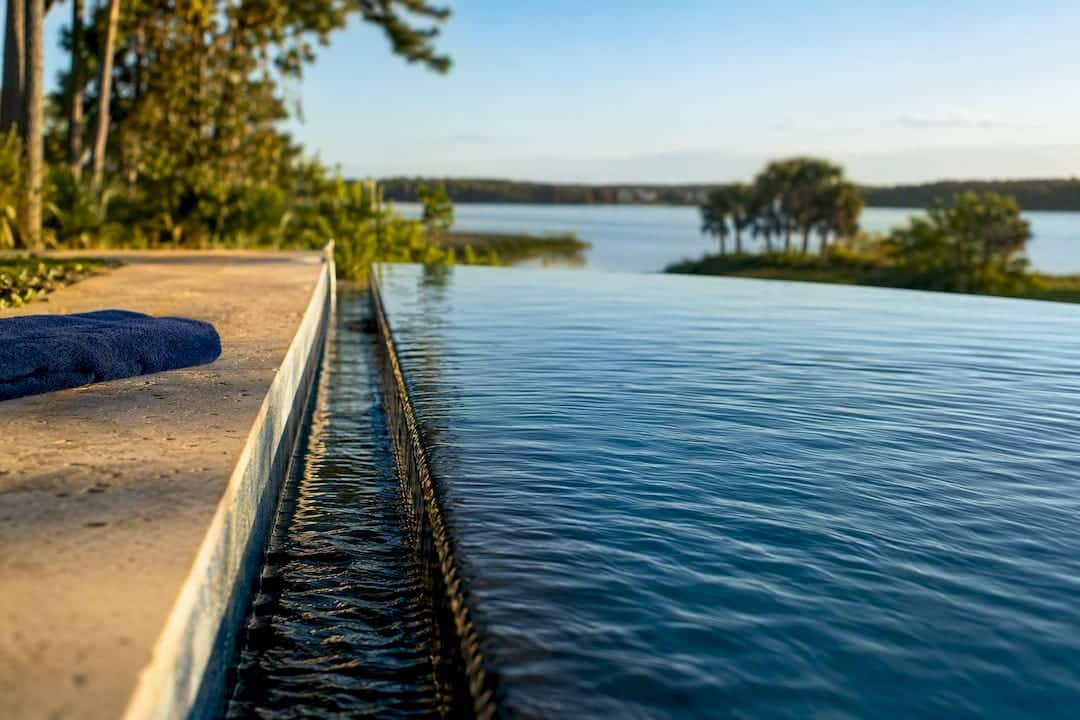
An infinity edge pool uses a lowered weir wall that lets water spill continuously into a hidden catch basin, creating the illusion of a pool with no far edge. It works best on elevated or sloped lots with an open view, and it’s worth the investment only if you have the right sightline, a stable budget for extra engineering, and the patience for higher maintenance. If your lot is flat and view-blocked, check the checklist below before committing.
TL;DR:
- A level and precise weir height, large enough catch basin, and correctly sized recirculation pump are critical for system reliability and proper water flow.
- Sightline assessment must confirm that views of the horizon or distant water fall behind the pool’s edge from main viewing points to ensure the illusion is effective.
- Proper structural engineering, including a soils report, reinforced concrete, waterproofing, and hydraulic calculations, is essential to prevent cracks, settling, and overflow failures.
- Infinity pools cost more than standard pools mainly due to engineering, equipment, and site-specific features like retaining walls or premium finishes; budgeting should account for these.
- Regular maintenance involves replenishing evaporation losses, inspecting the weir, cleaning the catch basin, and using energy-efficient pumps and covers to manage higher water loss and operational costs.
Table of Contents
- How Infinity Edge Pools Work: Weir, Catch Basin, and Recirculation
- Design and Sightline Considerations: Where an Infinity Edge Succeeds or Fails
- Site and Structural Requirements: Soils, Drainage, and Waterproofing
- Costs and Budget Drivers: Realistic Ranges and What Raises the Price
- Maintenance and Operating Considerations: Water Loss, Energy, and Routine Care
- Design Ideas and Finishes to Maximize the Vanishing-Edge Effect
- Is It Worth It? Decision Checklist and Questions to Ask Your Builder
- Publisher Perspective: How We Approach Infinity-Edge Projects
- How Randrswimmingpools Can Help: Free Site Assessment and Next Steps
- Sources
How Infinity Edge Pools Work: Weir, Catch Basin, and Recirculation
The mechanism behind every infinity pool is simpler than it looks from the deck. Water rises to a lowered edge, called a weir, and spills over into a catch basin (sometimes called a balance tank) hidden below deck level. A dedicated pump then pulls that water back up into the main pool, keeping the flow steady rather than draining the pool dry.
Three things make the system work correctly:
- The weir must sit at a precise, level height, since even a small variance in slope sends more water over one side than another.
- The catch basin needs enough volume to absorb the water displaced when swimmers get in and out, plus normal overflow.
- The recirculation pump and piping have to be sized to the basin, not just the pool, or the system runs dry on one end and floods on the other.
None of this matters if nobody can actually see the “vanishing” part, which is why sightline planning comes before any hydraulic drawing gets finalized.
Design and Sightline Considerations: Where an Infinity Edge Succeeds or Fails
A vanishing-edge pool lives or dies on what you can see from where you actually sit. Walk the yard at eye level from the patio, the kitchen window, and any second-story vantage point before assuming the effect will read the way it does in photos.
- Test the sightline first. Stand or sit at your main viewing spots and check whether the horizon, tree line, or water beyond your property actually falls behind the pool’s far edge.
- Match the strategy to your slope. A naturally sloped lot lets the edge fall away toward a view with minimal grading; a flat lot usually needs a raised shell or terraced retaining walls to create that same drop.
- Have a fallback if the view is blocked. Perimeter overflow edges, dark interior finishes, or a raised spa built into one side can deliver a similar visual payoff without requiring a distant view at all.
This is also where a landscape integration plan earns its keep, since planting and terracing can frame or extend a sightline that would otherwise fall short.
Site and Structural Requirements: Soils, Drainage, and Waterproofing
Every infinity edge is, at its core, a structural commitment before it’s a design feature. A geotechnical soils report should come before any drawing gets finalized, especially on hillside or previously graded lots, because unstable or expansive soil under a raised shell or retaining wall is how cracks and settling start years later.
Insist on these elements from any builder:
- A soils report specific to your lot, not a generic regional assumption.
- Reinforced concrete walls and footings sized to the shell’s height and slope, engineered by a licensed structural professional.
- Waterproofing membranes and joint detailing at every seam where the catch basin meets the main shell.
- Hydraulic calculations for surge and water-in-transit capacity, not a basin sized by guesswork.
An undersized catch basin is one of the most common and costly failures in infinity edge construction, because it either overflows onto the deck or starves the pump when several swimmers get out at once.
Pro Tip: Ask your builder for the specific bather-displacement calculation used to size the catch basin. If they can’t walk you through the math, that’s a warning sign worth taking seriously.
Costs and Budget Drivers: Realistic Ranges and What Raises the Price
Infinity edge construction reliably lands in a higher cost band than a standard custom pool, and the gap comes from engineering and equipment, not the water itself. Exact quotes vary widely by region, lot condition, and finish level, so treat any online range as a starting conversation rather than a fixed number.
The biggest cost drivers include:
- The catch basin itself, which requires excavation, structural reinforcement, and waterproofing beyond a standard pool shell.
- Retaining walls or raised shell construction on sloped or elevated sites.
- Larger or additional pumps and plumbing sized for the recirculation loop.
- Premium interior finishes like dark tile or plaster, chosen specifically to enhance the mirror effect.
- Landscaping and hardscape work needed to frame the view and finish the elevated structure.
A standard inground pool skips most of that list entirely, which is the real reason infinity builds cost more.
Maintenance and Operating Considerations: Water Loss, Energy, and Routine Care
Infinity edges lose more water to evaporation than a standard pool because a larger surface area is constantly exposed and moving. That extra evaporation also means more frequent chemical dosing, since minerals and sanitizer concentrate faster as water leaves the system.
An auto-fill system paired with a properly sized cover cuts down on both water loss and the labor of manually topping off the pool. Pump runtime is another factor: the recirculation pump for the catch basin runs continuously, not on a typical filtration cycle, so a variable-speed or energy-efficient model makes a real difference in the monthly electric bill.
Routine care worth budgeting for:
- Periodic catch-basin cleaning to clear debris before it reaches the pump.
- Regular inspection of the weir edge for level and wear.
- More frequent water testing tied to the higher evaporation rate.
Statistic Callout: Dark finishes and larger exposed surfaces both accelerate evaporation, which is why efficient pumps and covers are standard recommendations rather than optional upgrades on infinity builds.
Design Ideas and Finishes to Maximize the Vanishing-Edge Effect
Dark interior finishes, particularly dark tile or dark plaster with carefully chosen grout, deepen the mirror effect that makes an infinity edge look bottomless rather than just wet. Lighter finishes tend to wash out the illusion, especially in bright Florida sun.
A few pairings consistently work well:
- A tanning ledge on the near side balances the visual weight of the open edge.
- An integrated spa, raised slightly above the main shell, adds a focal point without competing with the view.
- Linear or laminar lighting along the weir edge extends the effect after dark.
- A fire feature near the edge photographs well and reinforces the sense of depth at night.
Browse real infinity and vanishing-edge builds to see how these elements read together before finalizing your own layout.
Is It Worth It? Decision Checklist and Questions to Ask Your Builder
Run through this before signing any contract, because the questions you skip now are the ones that cost you later.
- Do you have a genuine view or elevation change from your main sightlines, or would a perimeter-overflow alternative serve you better?
- Is your budget realistic for the added engineering, not just the visible finish work?
- Are you prepared for the extra maintenance load, including evaporation and pump runtime?
- Has your builder handled infinity edges before, and can they show completed projects with similar site conditions?
- Do they work with a licensed structural engineer, and will they commission a soils report before design?
- Can they explain their catch-basin sizing method and hydraulic calculations in plain terms?
- What warranty covers the structural and hydraulic components specifically, not just the finish?
Pro Tip: If a builder can’t produce a soils report recommendation, a specific catch-basin sizing method, or references from a comparable infinity project, treat that as a red flag rather than a minor gap.
Publisher Perspective: How We Approach Infinity-Edge Projects
Custom concrete and fiberglass pools have been built across Central Florida since 1985, with infinity edges following a sequence of site and soils assessment first, structural engineering second, hydraulic design third. Aesthetics come last, after the site proves it can support the structure. When a lot’s slope or view doesn’t justify the added cost, we say so and point toward a perimeter-overflow or raised-spa alternative instead of forcing a mismatch.
— Results
How Randrswimmingpools Can Help: Free Site Assessment and Next Steps
Custom concrete and fiberglass pools are designed and built across Central Florida, including the soils, structural, and hydraulic groundwork an infinity edge requires before construction.

A free site consultation may include a walk of sightlines, an assessment of whether a lot supports a vanishing edge or a simpler alternative, and a high-level budget range. What to expect:
- A review of elevation, slope, and view from your main viewing points.
- A recommendation on whether a soils report is needed before design moves forward.
- A ballpark budget range based on your site conditions, not a generic estimate.
If financing is part of your planning, review financing options alongside your consult. Start with the custom pool installation guide for Central Florida homes and request your free site assessment to see exactly what your lot can support.
Sources
- Infinity pool — Wikipedia
- Infinity Edge Pool Engineering & Site Grading (2026) — M&M Pool Builders
- Infinity Pool Pros & Cons: Is The View Worth It? — Pool Envy Designs