
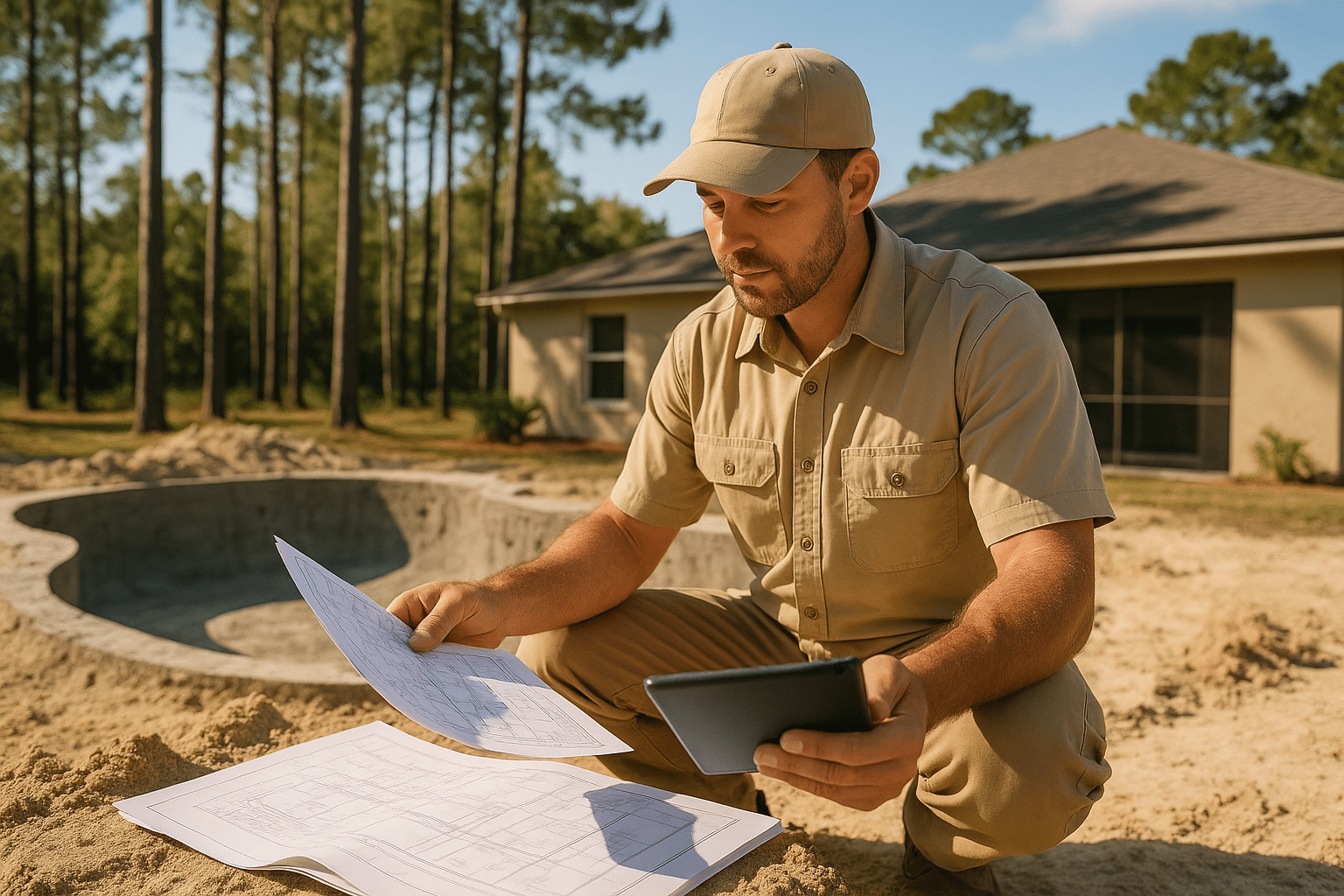
TL;DR: Before signing any pool contract in Lake County, Ocala, or elsewhere in Central Florida, verify the builder’s license directly through the Florida DBPR’s free online portal. This guide walks through the exact steps to confirm license type, status, and scope, plus the mistakes that let unlicensed pool work slip through.
A new pool is one of the largest investments a Central Florida homeowner will make in their property, and it’s also one of the most heavily regulated. Before you hire anyone to dig a hole in your Lake County or Marion County backyard, you need to confirm that the company holds a valid, active Florida pool contractor license. Here’s exactly how to do it, step by step.
Why License Verification Matters in Central Florida
Florida requires pool builders to carry a specific state-level credential, not just a general business license. A Certified Pool Contractor (CPC) is a state license that allows a contractor to work in any county or municipality, obtained through the state Department of Business and Professional Regulation (DBPR).
This matters because Florida Statute § 489.105 classifies contractor categories and establishes that unlicensed contracting is a first-degree misdemeanor for a first offense and a third-degree felony for subsequent offenses. If something goes wrong on an unlicensed job, from a cracked shell to a drowning-prevention barrier that fails inspection, you have far less legal and financial protection.
Fast-growing retirement and new-construction communities across Lake County, Marion County, and the surrounding area, including The Villages, Ocala, Belleview, and Summerfield, see a steady stream of pool-building activity every year. That volume also attracts contractors who cut corners on licensing, insurance, or permitting. A five-minute license check protects you before you ever sign a contract.
What You’ll Need Before You Start
- The contractor or company’s full legal name, as it appears on their estimate or website
- The license number, if it’s listed on their proposal, truck, or business card
- A notepad to record the license type, status, and expiration date
How to Verify a Florida Pool Contractor’s License
-
Go to the official DBPR license verification portal
Skip third-party lookup sites and go straight to the source. The tool is found at the official DBPR online services portal (DBPR Online Services). This is the only verification mechanism backed directly by the state.
-
Search by name or license number
Search by the contractor’s first name, last name, or city, or, if you have it, the specific license number — either search method works.
-
Confirm the license type matches pool construction
Florida issues several contractor license classes, and not all of them cover pool building. Florida issues several types of contractor licenses through the DBPR, including Certified General Contractor (CGC), Certified Building Contractor (CBC), Certified Residential Contractor (CRC), Certified Pool/Spa Contractor (CPC), and others, and each license type authorizes specific scopes of construction work. For new inground pool construction, you specifically want to see a CPC (Certified Pool Contractor) license. A Registered Pool Contractor license will begin with RP followed by numbers. Registered (RP) licenses are typically limited to a single county, while a certified CPC license allows the holder to build statewide.
-
Check that the status reads Active, not expired or delinquent
The search results will return a current status flag. Confirm the license is currently active, not expired or suspended. A license that shows “delinquent,” “null and void,” or “suspended” is a hard stop; do not sign a contract until that’s resolved or you’ve chosen a different builder.
-
Review the full record, not just the summary line
Open the matching record and review it in full rather than stopping at the summary line. The DBPR record verifies four fields: the licensee’s name, profession, address, and license status. Make sure the business name and address on the record match what’s on your written proposal.
-
Confirm the license holder matches the company on your contract
Pool contractors operate as a “qualifying agent” tied to a specific business entity. If the name on the license doesn’t match the company that will actually sign your contract, ask why. A mismatch can mean the license isn’t actually covering the entity doing your work.
-
Check for disciplinary history and understand what the lookup does, and doesn’t, show
A clean “active” status confirms registration, not quality of work. A current license confirms standing with the DBPR; it does not confirm today’s insurance coverage or that the coverage matches your project, so verify insurance directly with the carrier and confirm the license class matches the scope of your work. Also keep in mind that DBPR addresses state-level licensing, not local occupational licenses issued by individual counties or municipalities, which may be required in addition to the state license.
-
Ask the contractor directly, then verify their answer
Ask the contractor for their full legal name and license number before you ever request a quote. Any established, reputable builder will provide this without hesitation. Then run the number yourself rather than taking their word for it.
Common Mistakes Homeowners Make
- Trusting a truck decal or business card alone. Logos and license numbers can be copied. Always verify independently through DBPR.
- Confusing a pool service technician with a licensed contractor. Pool service technicians are not licensed contractors; a technician is qualified to do basic pool service such as cleaning the pool and filters and adjusting water chemistry. That credential does not authorize new pool construction.
- Assuming a Registered Pool Contractor (RP) license covers the whole state. RP licenses are typically county-specific, while CPC licenses are valid statewide, as noted above.
- Skipping the insurance check. An active license doesn’t guarantee current general liability or workers’ comp coverage. Ask for a certificate of insurance directly from the contractor’s carrier.
- Not checking the business entity name. Verify that the name on the license matches the name on your contract, deposit check, and permit application.
- Waiting until after signing to check. Do this before you put down a deposit, not after.
Why This Matters More in a Growing Market Like Lake and Marion Counties
Communities such as The Villages, Clermont, Mount Dora, Leesburg, and Ocala have seen sustained new-construction and backyard remodel demand for years, which means more pool contractors, established and new, competing for the same jobs. A proper license check is one of the fastest ways to separate an experienced, accountable builder from someone operating outside the law. It’s also worth pairing this check with a broader vetting process. Our guide on how to choose a pool builder in Florida walks through six additional things to confirm, including insurance, references, and warranty terms, before you sign anything.
What a Verified License Doesn’t Tell You
Confirming an active CPC license is step one, not the whole vetting process. It doesn’t tell you how a company handles permitting delays, whether their fiberglass or gunite crews are in-house, or how their warranty actually works if a shell issue shows up five years down the road. Once you’ve confirmed licensing, it’s worth comparing build types and costs. See our breakdown of fiberglass vs. concrete pool cost in Florida and our Central Florida inground pool pricing guide to understand what you should expect to pay once you’ve narrowed down a licensed, reputable builder.
Final Checklist Before You Sign
- License type is CPC (or RP, if the contractor only works in your specific county)
- Status shows Active, not expired, suspended, or delinquent
- Name and address on the DBPR record match your written proposal
- Insurance certificate obtained directly from the carrier
- Local building permit requirements for your county confirmed
- Contract reviewed against the recommendations in a buyer’s guide like ours
Recommended Reads
- How to Choose a Pool Builder in Florida: 7 Things to Check Before You Sign
- Pool Builders & Contractors in The Villages, FL
- Fiberglass vs. Concrete Pool Cost in Florida: A Side-by-Side Breakdown
Sources
- sarasota.floridahealth.gov
- floridapoolservicedirectory.com
- floridageneralcontractorlicense.com
- fspa.com
- floridacontractorcheck.com
