
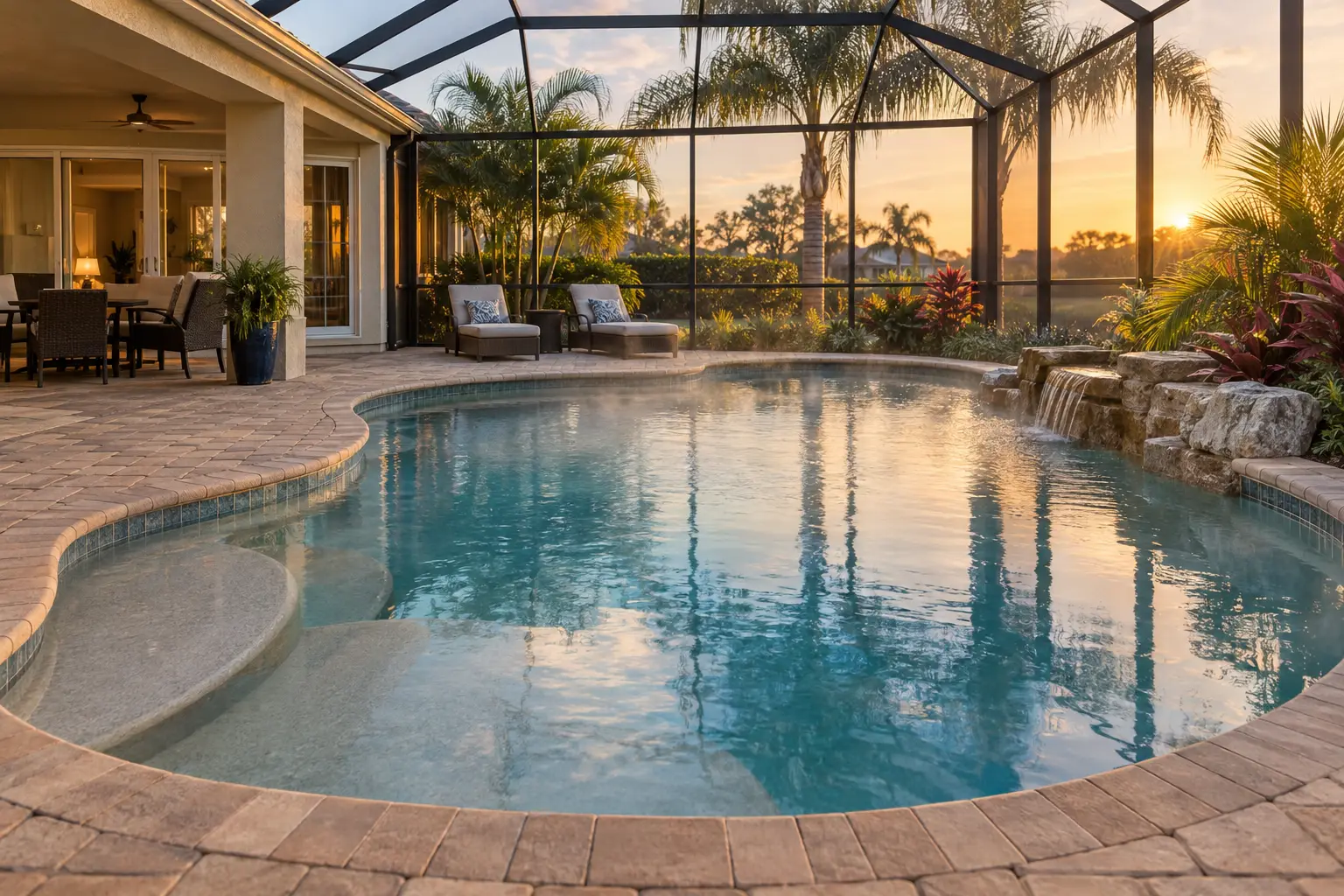
TL;DR: Yes, you can swim through the winter in The Villages if your pool is heated. The usual setup is a heat pump that pulls warmth from the daytime air plus a solar cover that holds the heat in overnight. Plan the heater during design, and use the cover every night so the heater doesn’t have to work as hard.
Can you count on a heated pool for winter swimming in The Villages?
Yes. A heated pool for winter swimming in The Villages is very doable. A heat pump sized right for your pool, plus a solar cover, can keep the water comfortable through most of the winter, even after nights in the 30s. Without heat, the water cools down with the air, and most people find it too chilly in the coldest weeks.
Here is the local picture. Our winters are mild during the day but cool at night. In nearby Ocala, the 1991-2020 climate normals put the average January low at about 45°F. The Villages spans Sumter, Lake and Marion counties, and winter nights here can drop into the 30s. That is why so many owners in The Villages, Lady Lake and Leesburg heat their pools. Snowbirds feel it most, because the months you are in town are the months the water is coolest.
It does work. Barry, one of our customers, said it plainly: “Even though it was 30 degrees on Christmas Day my wife and I went swimming in 82 degree pool water.”
How does a pool heat pump work?
A heat pump takes heat out of the outside air and moves it into your pool water. It does not burn fuel to make heat. The U.S. Department of Energy’s guide to heat pump pool heaters explains that pool water passes through the filter and then through the heater as it circulates.
There is one catch. According to the Department of Energy, heat pumps work efficiently as long as the outside air stays above about 45°F to 50°F. Most winter afternoons here are warmer than that, so the heat pump does most of its work during the day. On a cold night it slows down, and that is when the cover earns its keep.
Heat pump efficiency is rated as a coefficient of performance, or COP. Florida’s energy code sets a minimum COP of 4.0 for heat pump pool heaters, tested at low air temperature. The Department of Energy also notes that heat pumps cost more to buy than gas heaters, but they usually cost much less to run each year. With proper care, they can last 10 years or more.
Which pool heater makes sense for Central Florida winters?
If you want to swim from December through February, a heat pump with a solar cover is the practical choice for most homes. Here is how the common options compare.
| Option | How it heats | Good fit for | Limits in our winters |
|---|---|---|---|
| Heat pump | Moves heat from the outdoor air into the water | Steady heat for people who swim often | Slows down when air drops below about 45-50°F |
| Solar heating panels | Pumps pool water through collectors warmed by the sun | Low yearly operating cost | Less heat on cloudy, short winter days; needs sunny roof space |
| Gas heater | Burns natural gas or propane | Fast heat, such as warming a spa | Costs more to run than a heat pump; Florida requires 82% minimum efficiency |
| Solar cover alone | Holds in daytime heat and cuts evaporation | Stretching the swim season in fall and spring | Usually not enough on its own during a cold stretch |
Some homeowners combine options. For example, a raised spa holds far less water than the pool, so it warms up much faster.
Why does a solar cover matter so much in winter?
Most of a pool’s heat escapes from the surface. The Department of Energy says evaporation is by far the biggest source of heat loss. It calls a cover the single most effective way to lower heating costs, with savings of 50 to 70 percent possible. You can read the details on the Department of Energy’s pool cover page.
Florida law also covers this. The Florida Building Code, Energy Conservation says an outdoor heated pool must have a vapor-retardant cover, a liquid cover or another proven way to reduce heat loss. There is an exception when more than 70 percent of the heating energy comes from a heat pump or solar. So a pool heated by a heat pump may not legally need a cover, but we still recommend one for winter.
A clear bubble-style solar cover still lets most of the sunlight through. The Department of Energy says a clear bubble cover may cut the sun’s heat gain by only 5 to 15 percent. Put the cover on at night and take it off when you swim. A screen enclosure, which most pools here have, may soften the wind a little, but it does not replace a cover.
Is heating your pool worth it? Pros and cons
For many people in The Villages, yes, especially if you live here in winter. Here are the trade-offs.
Pros
- You can swim in the months when snowbirds and seasonal residents are actually here.
- Grandkids visiting over the holidays or spring break can use the pool.
- Warm water feels better for gentle laps, walking in the water and stretching.
- You get many more months a year out of the pool you paid for.
Cons
- Your electric bill goes up in the months the heater runs.
- The cover has to go on and come off every day to get the full savings.
- A heat pump needs room near the pool equipment, and the fan makes some noise.
- On smaller villa lots, finding a spot for the equipment takes some planning. Our guide to fiberglass pools that fit villa lots covers lot size in more detail.
What you pay to heat the pool depends on a few things: the pool’s surface area, the temperature you set, how often you use the cover, your electric rate and how many months you heat. A Department of Energy efficiency guide lists 78°F to 82°F as the recommended range, and setting the water near the low end of that range saves energy.
Why R & R Swimming Pools is a fit for a heated pool
R & R Swimming Pools has been building pools in Central Florida since 1985, with more than 1,000 fiberglass and concrete pools completed. One of the setups we install is a heat pump with a solar cover for year-round swimming. Johnny, our designer, leads the first meeting and makes a virtual pool design so you can see the layout before the build. Owner Devin Burch is on site through every phase and keeps you updated daily. We are an authorized Latham dealer for fiberglass pool installation in The Villages, and we also build custom concrete pools. Both pool types carry a limited lifetime warranty. Our design consultation is free, and we ask for a recent property survey first. Financing is available through Lyon Financial and Viking Capital. You can learn more about our pool building work in The Villages.
If you would like to talk about heating a new pool, call R & R Swimming Pools at (352) 432-8843 or book your free design consultation.
Frequently Asked Questions
What water temperature is comfortable for winter swimming?
A Department of Energy efficiency guide lists 78°F to 82°F as the recommended pool temperature range. Setting the water near the low end of that range uses less energy, and many people turn it up a degree or two on colder days.
Should I plan for pool heat before construction starts?
Yes. It’s easiest to plan the heater’s location, plumbing and electrical service during design, before anything is built. Tell your designer at the first meeting that you want to swim in winter.
Does Florida require a cover on a pool heated by a heat pump?
Florida’s energy code requires a cover or another proven way to cut heat loss on outdoor heated pools. It makes an exception when more than 70 percent of the heat comes from a heat pump or solar. Even so, a cover cuts your heating costs a lot.
Can I turn the heater off when I leave for the summer?
Most owners don’t need heat in a Central Florida summer, when average highs in the area reach about 90°F. Many seasonal residents only run the heater during the cooler months they’re in town.
Recommended Reads
- Fiberglass Pool for a Villa in The Villages: What Fits?
- Pool Builders & Contractors in The Villages, FL
- Fiberglass Pool Installation The Villages FL | R & R Pools
