
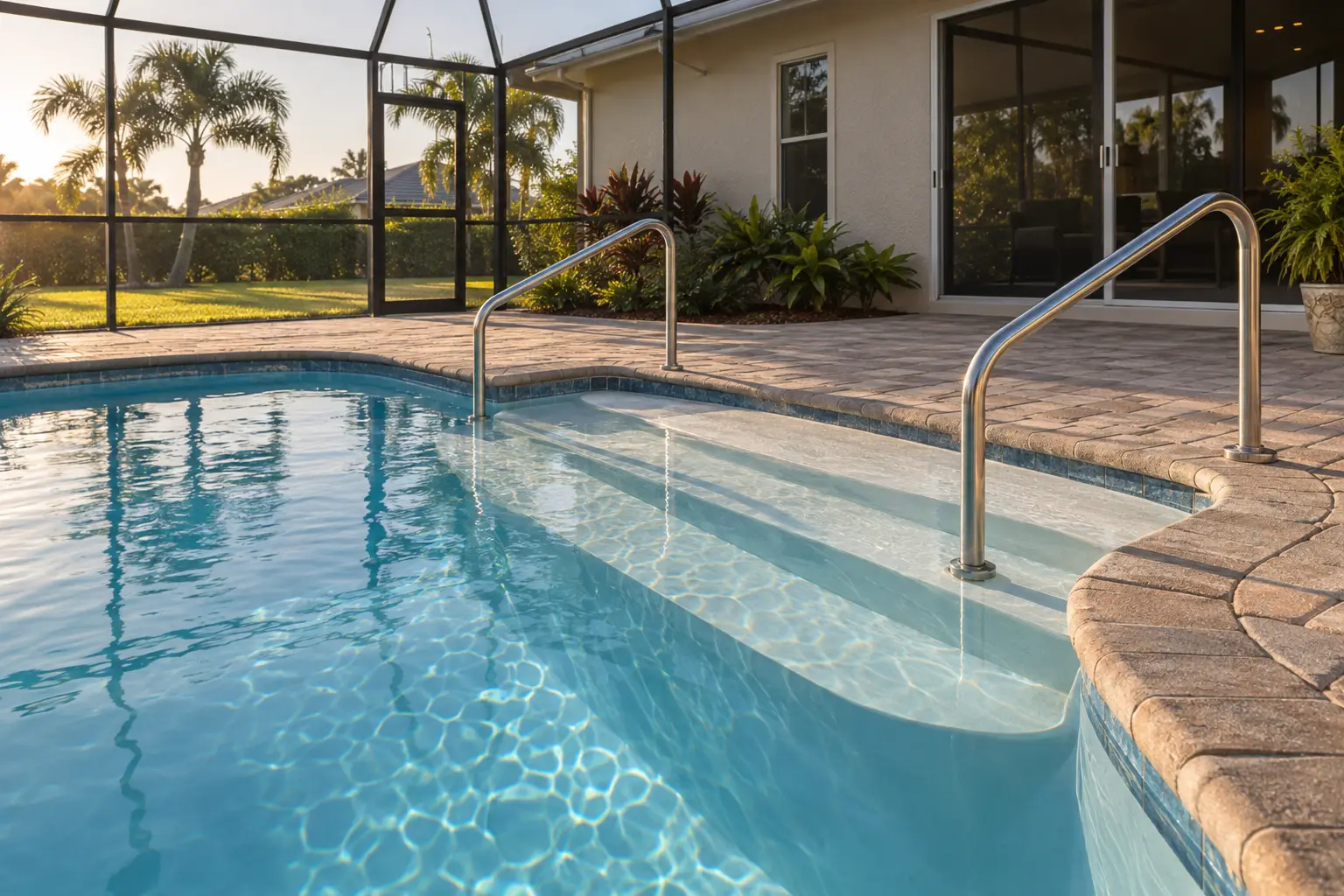
TL;DR: For most seniors, the easiest pool entry is a set of wide, shallow steps with a handrail on each side and a bench at the bottom. Extra steps, extended-length rails, a beach entry or sun shelf, and well-marked step edges can add more support. The best mix depends on your mobility, your lot size and how you plan to use the pool.
What pool entry steps and handrails work best for seniors?
For most seniors, the easiest way into a pool is a set of wide, shallow steps with a sturdy handrail on each side, plus a bench at the bottom where you can rest. A beach entry or sun shelf can give you a gentler halfway stop. The right mix depends on your balance, your knees and hips, and how much room your yard has.
Homeowners in The Villages and around Lake County ask us about pool entry steps and handrails for seniors all the time. Below are seven options we go over at the kitchen table, what each one does, and the trade-offs.
Why does an easy entry matter so much for older swimmers?
The steps are where you shift your weight the most, and a fall hits harder as we age. The CDC reports that more than one out of four older people fall each year, and falling once doubles your chances of falling again.
The upside is just as real. The CDC notes that water-based exercise can help people with arthritis use their joints better and ease pain, and it can improve quality of life for older adults. A good entry is often what turns a pool into something you use every day, not just something you look at from the lanai.
7 pool entry options that make getting in and out easier
1. Wide steps with low risers
Shorter steps mean less lift for each knee. Deep treads give your whole foot a place to land, so you aren’t balancing on your toes. Steps that run across the shallow end also give you more than one spot to get in.
2. A handrail on both sides
Two rails let you hold on with both hands, which is steadier than one. For public pools, the U.S. Access Board guide to accessible pools calls for stair handrails spaced 20 to 24 inches apart, with the top of the rail 34 to 38 inches above the step edge. Those rules are written for public pools, not backyard pools, but they make a useful yardstick when you’re deciding where your rails go.
3. Extended-length handrails
A standard rail may stop after the top step or two. An extended rail reaches farther down, so you have something to grip until you’re standing in the water. We’ve built extended-length handrails, along with extra steps, for a homeowner with limited mobility.
4. Extra steps to split up the drop
Adding a step or two spreads the same depth over more, smaller moves. It uses a little more of the shallow end, but for stiff knees or a new hip, that trade is often worth it.
5. A bench at the bottom
A built-in bench next to the steps gives you a place to sit down, catch your breath and ease into the water. It also makes a nice spot to sit and talk while the grandkids splash.
6. A beach entry or sun shelf
A beach entry is a gradual slope, like walking into a lake. A sun shelf is a wide, shallow ledge that works as a resting stop before the deeper water. Both take more room than steps. The Access Board guide says sloped entries in public pools need handrails on both sides no matter how gentle the slope, and we’d suggest the same at home. Our guide to tanning ledges, zero-entry slopes and swim-outs compares these features in more detail.
7. Tile and lights that mark each step
Under moving water, it’s hard to see where one step ends and the next begins. A strip of contrasting tile on each step edge, plus LED lighting near the entry, makes every edge easier to see, day or night.
How do the main entry options compare?
| Entry option | Best for | Space needed | Things to weigh |
|---|---|---|---|
| Standard steps, one rail | Swimmers with good balance | Small | Only one hand to hold; taller steps |
| Wide steps, two rails | Most seniors, including stiff knees or hips | Small to medium | Rails need to be placed so they don’t block other swimmers |
| Extra steps plus extended rails | Limited mobility or recovering from surgery | Medium | Uses more of the shallow end |
| Beach entry with rails | Anyone who struggles with any step | Large | Takes the most pool and deck space |
| Sun shelf plus steps | Resting, sitting, watching grandkids | Medium to large | Still needs good steps to reach deeper water |
What should Villages and Lake County homeowners plan for?
Plan the entry around your lot, your lanai door and your winters.
Lot size. Many homes in The Villages, which spans Sumter, Lake and Marion counties, are villas and designer homes on smaller lots with a lanai. On a tight lot, wide steps with two rails usually fit better than a full beach entry.
The walk to the steps. Most pools here sit inside a screen enclosure. Putting the steps near the lanai door means a shorter walk across a wet deck.
Winter use. Winter nights here can drop into the 30s, so many owners heat their pools. The CDC notes that people with rheumatoid arthritis have shown more health improvements from exercising in warm water than from other activities. If you’ll swim in January, plan steps and rails you’ll trust year-round.
Pool type. Latham fiberglass pools come with steps and benches built into the shell, so you pick a model whose entry fits you. Custom concrete pools are built on a steel rebar framework with 6 to 12 inches of gunite and can be shaped to almost any step layout. Our fiberglass vs. gunite comparison for Florida homeowners covers the bigger differences. Whether you live in Leesburg or Summerfield, the same questions apply.
What are the pros and cons of a fully accessible entry?
The main pro is confidence: you can get in and out on your own, every day. Here’s the full picture.
Pros
- Steadier footing, with two hands on the rails
- Places to sit and rest on the way in
- Easier for guests with bad knees and for small grandkids
- More likely to keep you swimming and exercising
Cons
- Takes up swim space in the shallow end
- Adds to the project cost, since extra steps, longer rails, more tile and more lighting all add material and labor
- A beach entry may not fit on a small villa lot
- Rails need careful placement so they don’t get in the way
Why R & R Swimming Pools is a good fit
- R & R Swimming Pools has been building inground pools in Central Florida since 1985, with more than 1,000 fiberglass and concrete pools completed.
- We have built extra steps and extended-length handrails for a homeowner with limited mobility.
- Johnny, our pool designer, leads the first meeting and makes a virtual pool design, so you can see where the steps and rails go before we build.
- Owner Devin Burch is on site through every phase and keeps you updated along the way.
- We are an authorized Latham dealer, and we also build custom gunite pools.
- Both pool types carry a limited lifetime warranty.
- We hold a 4.9 Google rating from 35 reviews as of November 2026.
As Craig in The Villages put it: “Devin constantly kept in touch with us and updated us on a daily basis regarding the entire process for the build.”
Ready to plan steps that fit how you move?
Start with a free design consultation with R & R Swimming Pools, with no cost and no obligation. Please have a recent property survey ready. Call (352) 432-8843 or book your free design consultation online.
Frequently Asked Questions
Will senior-friendly steps work for visiting grandkids too?
Yes. Wide steps, a bench and a sun shelf give small children a shallow place to sit and play near an adult. The handrails help kids climb out too.
How long does it take to build a pool with custom steps and handrails?
A fiberglass pool usually takes about 2-3 weeks of active construction, and about 2-4 months from design and permits to the final walkthrough. Concrete pools usually take 4-6 months, depending on the design and permitting.
What do I need before the first design meeting?
We ask for a recent property survey first. That way the design accounts for property lines, easements and setbacks, which affect where the pool and its steps can go.
Can I see where the steps and rails will go before construction starts?
Yes. Johnny creates a virtual pool design so you can see the layout, including the entry, before the build begins, and he’s glad to make changes until it feels right.
Is financing available for a new pool?
Yes. We offer pool financing through our lending partners, Lyon Financial and Viking Capital.
Recommended Reads
- Tanning Ledges, Zero-Entry Slopes, and Swim-Outs: Which Pool Feature Is Right for You?
- Fiberglass vs. Gunite Pool: Which Is the Better Choice for Florida Homeowners?
- Concrete Pool Pros and Cons: Is a Gunite Pool Right for Your Florida Yard?
