
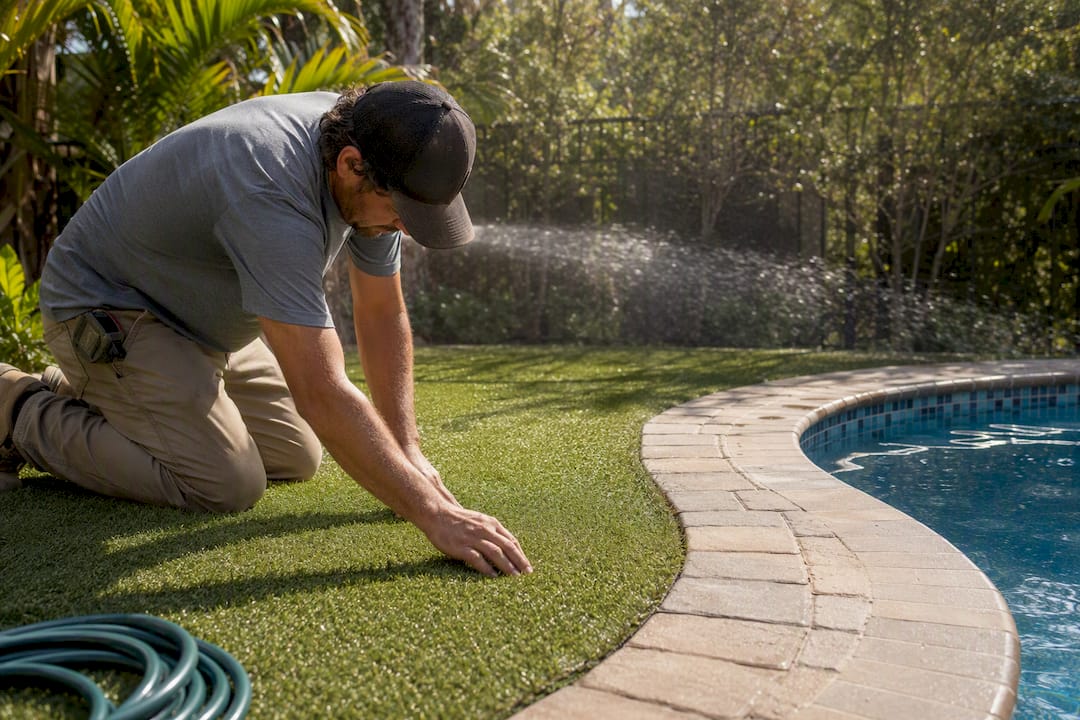
Yes, synthetic turf works well around a pool, but only when it’s pool-grade material over a compacted, draining base with secure edging. Done right, it cuts down on mud and tracked debris and gives you a soft, cool surface underfoot. Done wrong, water pools underneath, algae moves in, and the edges lift within a season.
TL;DR:
- Proper installation requires permeable backing, UV-stabilized polyethylene fibers, and a pile height between 1.25 and 1.75 inches to prevent pooling and rot.
- Drainage management must include graded bases, perimeter drains, and catch basins, especially for heavy splash or rain, to avoid odors and mildew.
- Regular rinsing, brushing, and infill maintenance are necessary to keep turf fibers upright, control odors, and prevent microbial growth in damp areas.
- Cost depends heavily on site prep, base depth, drainage features, and edging rather than turf grade alone, with professional installation recommended for complex sites.
- Local safety codes demand proper drainage, slip resistance, and secure edges to prevent tripping hazards and ensure chemical safety in poolside turf areas.
Table of Contents
- Is Synthetic Turf Around Pools Worth It? Pros and Cons
- What Specs Matter in Pool-Grade Synthetic Turf?
- How Do You Install Turf Around a Pool Correctly?
- How Do You Manage Drainage and Chemical Exposure?
- What’s the Maintenance Routine for Pool-Area Turf?
- How Do You Keep Poolside Turf Cool Underfoot?
- What Does Poolside Turf Cost, and What Drives the Price?
- What Safety Rules Apply to Turf Near a Pool?
- How Do You Stop Mold and Mildew Under Poolside Turf?
- When Should You Bring In a Pool Contractor?
- Sources
Is Synthetic Turf Around Pools Worth It? Pros and Cons
The honest answer depends on how you use your backyard. Turf solves real problems, but it introduces a few new ones you need to plan for before you sign a contract.
On the plus side, pool-grade turf keeps mud and grass clippings from tracking into the water, cuts down on mowing and irrigation entirely, and gives kids and bare feet a forgiving surface compared to concrete or pavers. Families with young kids tend to notice the difference immediately, since scraped knees and hot pavement burns both drop off the list of concerns. Pet owners get a bonus too: no muddy paw prints trailing across the patio after a rainstorm.
The trade-offs are just as real. Turf gets hot in direct sun, sometimes hot enough to make bare feet retreat fast during a Florida afternoon. Poor installation traps water underneath, which breeds odor and mildew over time. Upfront installed cost runs higher than a bag of grass seed, and you still need periodic rinsing to keep chlorine and sunscreen residue from building up.
- No mud or clippings tracked into the pool
- Comfortable, consistent surface for bare feet
- Minimal mowing, watering, or fertilizing
- Surface heat and drainage risk if installed poorly
- Higher upfront cost than natural grass
Homes with heavy weekend entertaining tend to see the biggest payoff, since turf shrugs off foot traffic that would turn a lawn into a dirt patch by midsummer.
What Specs Matter in Pool-Grade Synthetic Turf?
Not all turf belongs near a pool, and the backing is where most bad installs go wrong first. A fully permeable or perforated backing lets water pass straight through instead of pooling underneath, where it stagnates and starts to smell. Perforated flow-through backings resist hydrolysis far better than foam or solid rubber backings, which trap moisture and break down faster near chlorinated splash zones.
Fiber material matters just as much. Polyethylene fibers with UV stabilization hold up to sun and pool chemicals better than cheaper alternatives, and pool-grade specs typically call for pile heights around an inch to two inches for a balance of cushion and drainage speed. Look for these before anything else:
- Permeable or perforated backing, not solid or foam
- Polyethylene fiber with UV stabilization
- Pile height between 1.25 and 1.75 inches
- Face weight and blade shape rated for high foot traffic
- Infill that resists odor and improves grip when wet
Infill choice deserves its own conversation. Acrylic-coated sand and TPE both improve traction and help regulate surface temperature, and some products layer in zeolite or antimicrobial infills specifically to control odor in areas that stay damp longer than the rest of the yard. Skip crumb rubber infill near a pool. It absorbs heat aggressively and can carry a tire smell that only gets worse in humid air.
Pro Tip: Ask your installer for the turf’s technical data sheet, not just a sample swatch. The backing type and permeability rating are usually printed right on it, and that single sheet tells you more than a showroom feel test ever will.
How Do You Install Turf Around a Pool Correctly?
Most turf failures near pools trace back to five predictable mistakes, all of which happen before a single blade of fiber gets rolled out. The base work is the part nobody sees later, and it’s the part that determines whether the install lasts a decade or needs to be torn out in two years.
- Assess the site first. Map existing slope, note what needs to come out (old sod, mulch, broken pavers), and plan where excess water will travel once turf goes down.
- Excavate and separate. Remove several inches of native soil and lay geotextile fabric to keep the aggregate base from mixing with the soil underneath.
- Build the base. Quality installations use a compacted open-graded aggregate base run through a plate compactor in layers, not dumped and leveled in one pass.
- Grade the slope. Pitch the base roughly 1 to 2 percent away from the pool and the house, and add perimeter or French drains to manage water where it tends to collect.
- Seam and secure the edges. Turf gets cut precisely around coping and pavers, seamed to avoid visible lines, and anchored with edge restraint that won’t lift as the material expands and contracts in heat.
- Apply infill and brush. Infill goes down in stages, worked into the fibers with a power brush so the blades stand upright instead of matting down.
Roughly a third of the callbacks contractors see on poolside turf trace back to inadequate compaction alone, which lets the base settle unevenly and creates low spots where water sits. Unsecured edges and skipped geotextile fabric account for most of the rest. Precise cutting and secure containment around coping is what keeps the edge from becoming a tripping hazard six months in. Getting the base and drainage right at the start of a project is the same principle covered in pool landscaping step by step for homeowners, where site prep drives everything downstream.
How Do You Manage Drainage and Chemical Exposure?
Drainage isn’t a nice-to-have near a pool. It’s the difference between turf that lasts and turf that smells like a wet basement by year two. Water splash, chlorine exposure, and heavy foot traffic make proper drainage and UV resistance critical in ways that a backyard lawn area simply doesn’t face.
Permeable backing handles routine splash and rainfall on its own, letting water pass through into the graded aggregate below. Heavier volumes, like a pool that gets a lot of cannonballs or sits in a low-lying yard, call for subsurface drains or catch basins tied into the perimeter grading.
| Water source | Typical volume | Management approach |
|---|---|---|
| Routine splash-out | Low, frequent | Permeable backing + graded base |
| Heavy rain events | High, occasional | Perimeter drains, 1 to 2% slope away from structures |
| Pool overflow/backwash | Moderate, occasional | Catch basin or French drain tied to base drainage |
Chemical exposure needs its own routine, separate from rainfall. Regular rinsing removes chlorine, salt, and sunscreen before they turn sticky, which is the single most effective habit for keeping turf looking new. Skip it for a season and you’ll notice a faint chemical film building up in high-splash zones, especially right along the coping line where overspray lands hardest.
What’s the Maintenance Routine for Pool-Area Turf?
The upkeep is lighter than a lawn, but it isn’t zero. A quick weekly hose-down and a monthly brush-through with a stiff broom keeps fibers standing and prevents matting in high-traffic paths.
- Rinse weekly, and immediately after a pool party with heavy sunscreen or splash exposure
- Brush monthly against the grain to keep blades upright
- Spot-clean sunscreen and salt residue with a mild soap and water solution
- Use enzyme cleaners for pet waste rather than harsh bleach, which can degrade fibers over time
- Call a pro if you notice persistent odor, standing water, or a musty smell after rinsing
Watch the seams and infill level over time. Thinning infill or a seam that’s started to separate are both signs the installation needs attention before a small issue turns into a bigger repair. The same rinse-and-inspect habit fits naturally alongside a broader pool maintenance workflow most owners already follow for the water itself.
How Do You Keep Poolside Turf Cool Underfoot?
Surface heat is the one complaint every poolside turf owner brings up eventually. The fix starts with material choice: light-colored fiber blends and cooling infills outperform shade structures alone for actual surface temperature reduction, since dark fibers absorb far more solar energy.
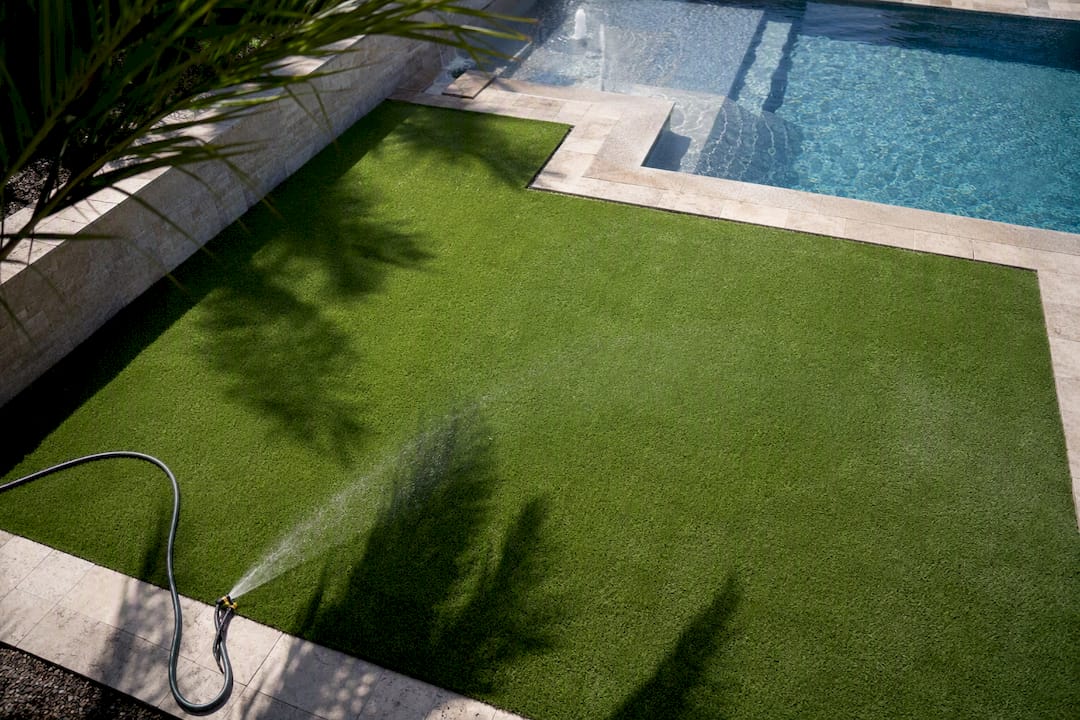
Design helps too. Narrow paver or stepping-stone bands through high-traffic turf zones reduce both heat exposure and point-load damage from lounge chairs left in one spot too long. A quick hose-down or brief misting cycle right before peak pool hours drops surface temperature fast, which matters more than any single product spec on a 95 degree afternoon.
Pro Tip: Put furniture pads under lounge chair legs. Turf that gets crushed in the same spot day after day loses its spring and stays flattened even after brushing.
What Does Poolside Turf Cost, and What Drives the Price?
Installed cost for pool-grade turf, including proper base and drainage work, typically runs higher than basic backyard turf because the base preparation is more involved and the material specs are higher grade. Price varies widely by region, site complexity, and how much demo and drainage work the site needs.
The biggest cost drivers show up before the turf itself gets ordered:
- Demolition and access, especially removing old concrete, sod, or pavers
- Base depth and compaction requirements for the specific soil type
- Drainage features like French drains or catch basins
- Edge restraint and precision cutting around coping
- Turf grade, pile height, and infill selection
A serious contractor quote breaks out labor, base material, turf product, and drainage work as separate line items, not one lump figure. Ask about warranty coverage on both the turf product and the installation workmanship separately. Contractors who stand behind their base work usually say so up front.
What Safety Rules Apply to Turf Near a Pool?
Pool areas fall under local building and safety codes that govern slip resistance, barrier requirements, and surface drainage, and turf doesn’t get a pass just because it’s not concrete. Most jurisdictions require the pool deck surface, turf included, to drain away from the water rather than toward it, both for chemical safety and to keep the deck from becoming a slick hazard after rain.
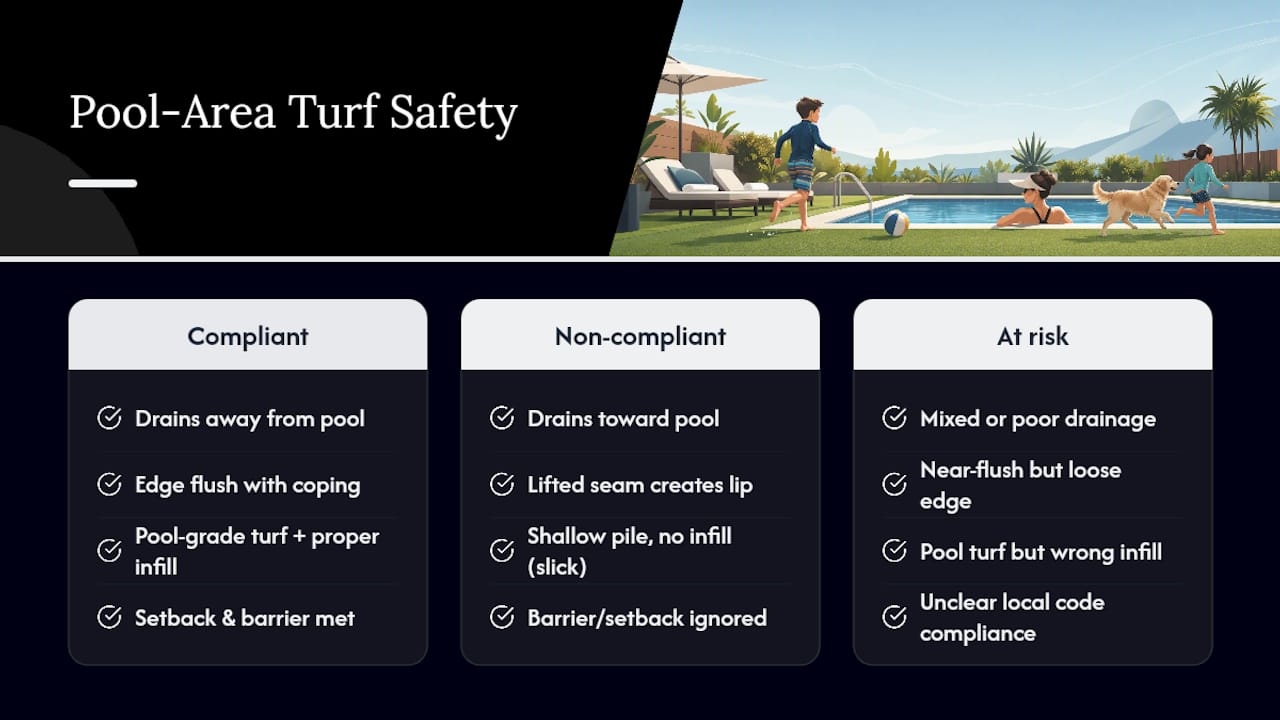
Edge transitions matter for code compliance too. Any seam or edge near coping needs to sit flush enough that it doesn’t create a lip someone could trip on while walking wet and barefoot. Precise cutting and secure edge containment around coping isn’t just a cosmetic detail. It’s a liability issue if a guest catches a toe on a lifted edge.
Slip resistance is the other half of the safety picture. Pool-grade turf offers slip control and reduced mud tracking compared with many hard surfaces, which is part of why it’s gained ground as a pool surround option in the first place. Wet turf with the right infill grips better underfoot than wet tile or smooth pavers, but that only holds true if the infill and pile height match pool-grade specs. Cheap landscape turf with a shallow pile and no infill can turn slick fast once splashed.
Check your local pool barrier and setback requirements before installation, since some municipalities have specific rules about surface materials within a certain distance of the water’s edge. A contractor familiar with your area’s codes will know these details cold.
How Do You Stop Mold and Mildew Under Poolside Turf?
Humidity around a pool never really lets up, which makes mold and mildew prevention less about a one-time fix and more about ongoing habits. The single biggest factor is drainage at the base level. If water can’t escape underneath the turf, moisture sits against the backing and creates exactly the damp, shaded conditions mildew needs to take hold.
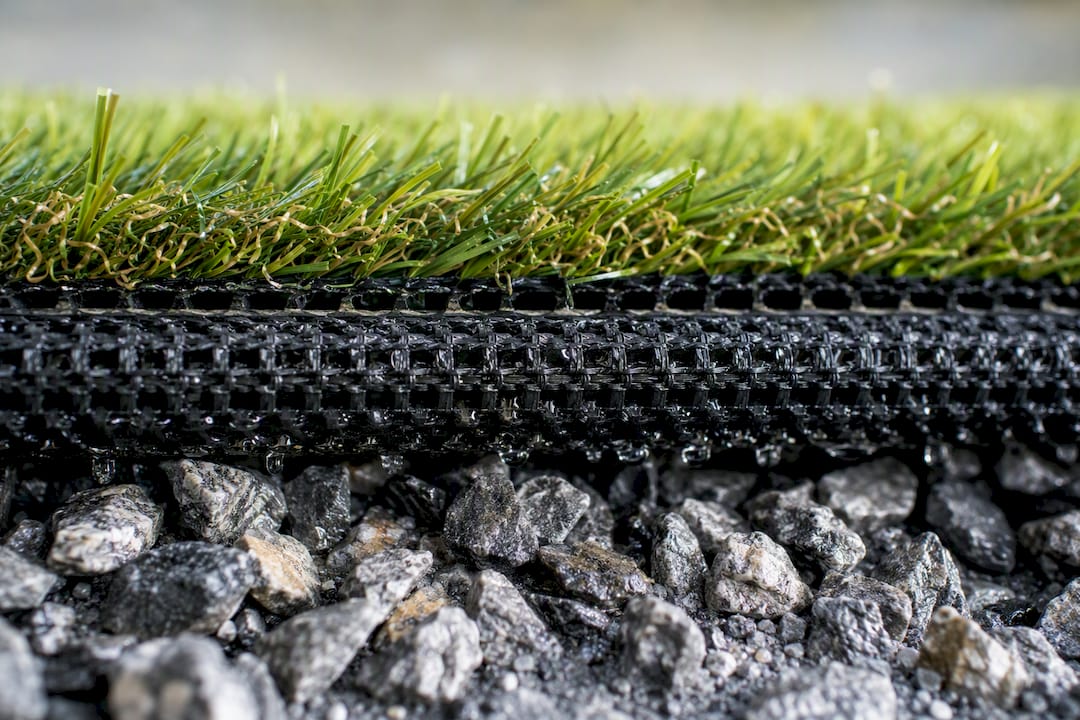
Permeable backing paired with a properly graded, compacted base handles most of this automatically, letting splash and rain pass through instead of pooling. Where humidity runs consistently high, an antimicrobial or odor-control infill adds another layer of protection, since some infills are specifically formulated to resist microbial growth in areas that stay damp longer than average.
On the maintenance side, the fix is almost boring in its simplicity: rinse regularly, brush to keep fibers from matting into a moisture-trapping layer, and avoid letting wet towels or pool toys sit on the same patch of turf for days. Shaded areas near fences or landscaping deserve extra attention, since they dry slower than open, sun-exposed zones. If you ever catch a musty smell that doesn’t clear after rinsing, that’s usually a sign moisture is trapped somewhere in the base, not just on the surface, and it’s worth having someone check the drainage before the smell gets worse.
When Should You Bring In a Pool Contractor?
Some poolside turf projects are simple enough for a confident DIYer with a compactor rental. Others aren’t, and knowing which category yours falls into can save you from a costly redo. Complex grading, tight integration with existing coping, or any situation requiring structural drainage work is where professional experience earns its cost. A contractor who’s graded dozens of pool decks knows how water actually moves across your specific site, not just how it’s supposed to move on paper.
Before hiring anyone, ask for their compaction specs in writing, a drawn drainage plan, product data sheets for the turf itself, and written warranty terms covering both material and labor. A reputable contractor should also have a photo portfolio of similar poolside installs and be willing to connect you with past clients.
Randrswimmingpools has built and renovated pool surroundings across Central Florida since 1985, and that history includes plenty of lessons about what fails when base work gets rushed. Beyond installation, look for a contractor who documents the handover clearly, including maintenance expectations, so you’re not guessing at care routines a year later. Resources like Pool School exist for exactly that reason: turning a one-time install into something homeowners actually understand how to maintain.
If your project involves reworking the deck alongside pool renovations or new construction, it’s worth getting a free quote from Central Florida’s pool contractors before committing to a DIY turf plan that might need to be undone later. Financing options are also available through Randrswimmingpools’ financing program for homeowners tackling a full backyard renovation rather than turf alone.
— Results
Sources
- What to Keep in Mind When Installing Artificial Grass Around a Pool Deck | Synthetic Grass Warehouse
- Artificial Grass Around Pool: Safe, Cool, Resort-Level Results – CAL PRO Artificial Turf
- Artificial Grass Around Pools: Is It Safe, Durable & Worth It? – CCGrass
- Best Artificial Turf Around Pools: What to Know Before You Buy | JCTurf
- Can you use artificial grass around a pool deck? | Greatmats
