
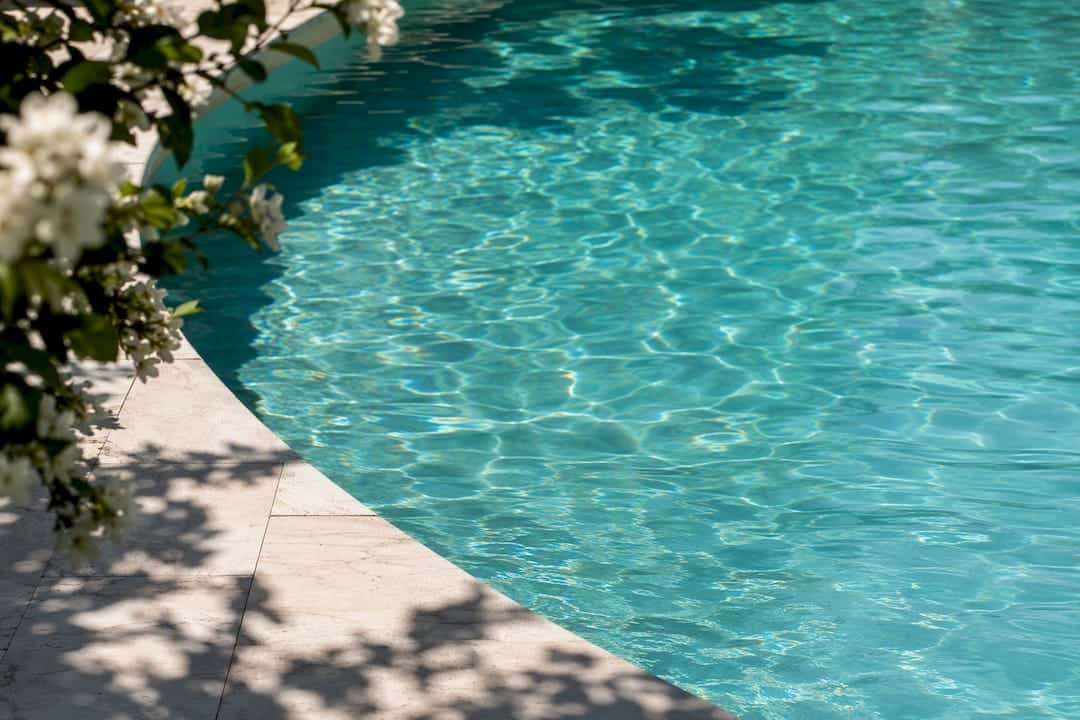
Your pool finish sets the base color, and depth and light tune it from there. Light finishes like white or pale plaster produce bright, tropical aqua. Medium blues and teals settle into a steady, balanced blue that holds up in shade. Dark finishes, charcoal, black, deep blue, create a mirror-like, deep lagoon effect. If your water suddenly turns green, brown, or cloudy, that’s chemistry or filtration, not finish design.
TL;DR:
- The actual pool water color depends on finish tone, water depth, and surrounding light, with darker finishes absorbing more light and appearing deeper.
- Testing finish samples in outdoor wet conditions at different times of day and depths provides a more accurate preview than dry indoor samples.
- High-reflectivity light finishes produce bright and tropical hues, while medium shades offer consistent color, and dark finishes create a lagoon effect but can heat the water and reduce visibility.
- Variations in water clarity or color shifts overnight indicate chemical or filtration issues, not finish design.
- Choosing a finish should be based on comprehensive site analysis, real-world sample testing, and planned lighting, rather than online photos or dry chips.
Table of Contents
- What causes the pool color water effect in the first place?
- How do light, medium, and dark finishes change the water’s look?
- Does the material itself change the color, not just the shade?
- How do depth and sunlight change the way a finish looks?
- Is that green or cloudy water a design choice or a problem?
- How do you actually choose a finish without guessing?
- How does R&R put this into practice on real projects?
- What I’ve learned watching homeowners pick the wrong finish
- Get your finish right the first time with a real sample test
- Sources
What causes the pool color water effect in the first place?
Pool water isn’t blue because of a dye or a filter setting. It’s blue because water physically absorbs long wavelengths, reds, oranges, yellows, faster than it absorbs blue and green. The deeper or wider the body of water, the more of that red light gets swallowed before it bounces back to your eye, which is why the ocean looks navy from a boat but clear in your hand. Your pool works the same way, just at a smaller scale, which is exactly why the finish underneath matters so much.
Three things happen at once every time you look at your pool. Light reflects off the surface (sky, clouds, your neighbor’s palm tree). Light scatters through the water column and picks up whatever color the finish is radiating back. And light refracts as it crosses the air to water boundary, bending and shifting how saturated everything looks depending on your viewing angle. Wind riffles the surface and breaks up reflections into a thousand tiny mirrors, which is why a still pool at 7 a.m. looks like glass and the same pool at 2 p.m. with a breeze looks like it’s shimmering.
Before committing to a finish, test it the way the water will actually see it:
- View a wet sample outdoors, never dry indoors under fluorescent lights.
- Check it at different depths since a bucket test reads lighter than a 6-foot deep end will.
- Look at it morning, midday, and late afternoon before you decide.
How do light, medium, and dark finishes change the water’s look?
Finish tone is the single biggest lever you control, and the differences aren’t subtle once water is sitting on top of them.
- Light and white finishes bounce back the most light, producing a bright, crystalline “Caribbean” blue that reads especially well in smaller or shaded backyards where you want the water to feel like it’s glowing rather than receding.
- Medium blues and teals give you the steadiest, most forgiving result. They hold a consistent color across weather and light conditions, tolerate partial shade better than lighter finishes, and hide small debris (a leaf, a bit of pollen) far better than white plaster does.
- Dark blues, charcoal, and black finishes absorb rather than reflect, which produces that dramatic, mirror-still lagoon look designers love for infinity edges and resort-style builds. The tradeoff: reduced visibility to the pool floor and noticeably more heat absorption, which can be a bonus in cooler climates and a nuisance in a Florida July.
Matching finish to your yard matters more than matching finish to a photo you liked online. A small, mostly shaded pool with a dark finish can look murky rather than moody. A large, sun-drenched pool with pure white plaster can wash out to look almost gray at midday glare.
Pro Tip: Bring your sample chip to the actual pool site and hold it at water level, not eye level. Finishes read differently from three feet up than they do from a pool chair.
Does the material itself change the color, not just the shade?
Yes, and this is the part homeowners skip past. Color is only half the equation. Texture and material change how light moves through the water on top of the finish.
- Plaster gives a smooth, predictable, budget-friendly result, but standard plaster is prone to mottling and gradual fading as pigments break down under sun and chlorine exposure over the years.
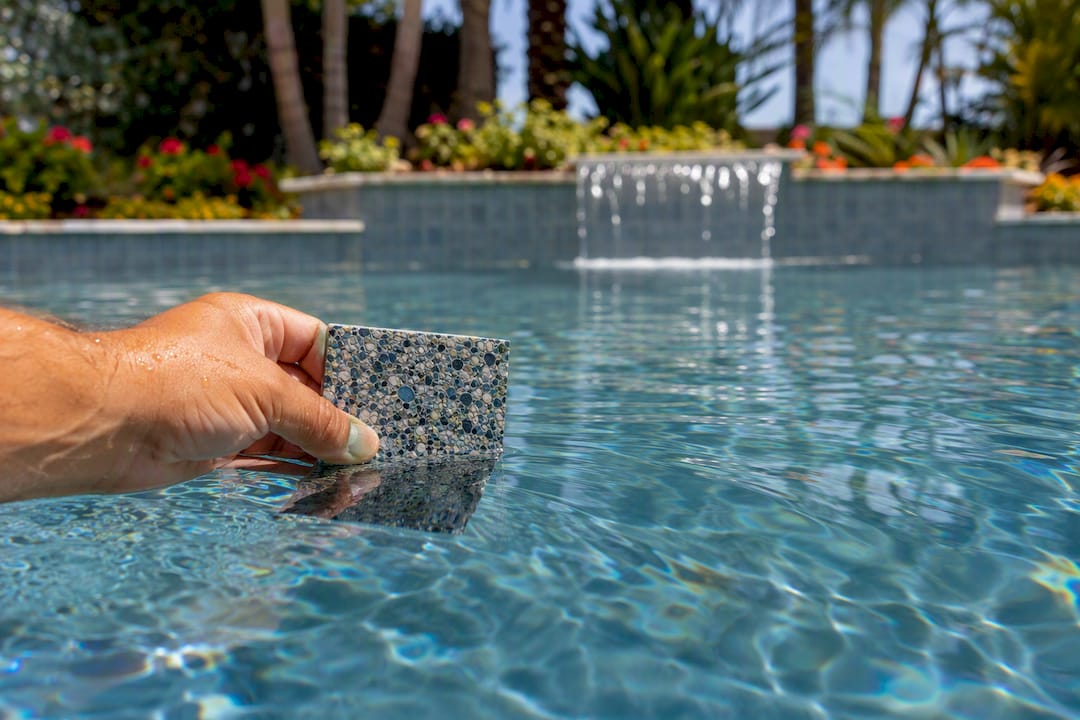
- Pebble and aggregate finishes add micro-shadows between the individual stones, which deepens and richens the tone compared to a flat plaster in the same base color.
- Glass tile is translucent, so it doesn’t just reflect light, it transmits it, creating an edge glow that flat materials can’t replicate. Grout color and pattern spacing change the effect more than people expect.
- Porcelain and ceramic tile are vitrified during manufacturing, which means the color is fired into the material rather than sitting on the surface, giving meaningfully better long-term color stability against UV and chemical fading.
If a mosaic accent wall or waterline border is part of your plan, a supplier that specializes in stone mosaic pool applications can show you texture options that a flat sample chip simply can’t demonstrate.
How do depth and sunlight change the way a finish looks?
The same finish reads as three different colors depending on where you’re standing and what time it is. Shallow zones like a tanning ledge or the first step show the finish almost at full brightness, since there’s barely any water column to filter the light. Move into the 3 to 5 foot range and you get a softer, more even blue. Push into a 6 foot or deeper end and that same finish reads noticeably darker and more saturated, sliding toward navy or cobalt even though the material underneath never changed.
Weather and surroundings layer on top of that:
- Midday sun brightens and slightly bleaches the perceived color; low afternoon sun warms it toward gold and turquoise; overcast skies mute colors toward gray-green.
- Dense green trees or hedges throw a greenish cast onto the water’s surface, while a light-colored deck reflects extra light back in, brightening the whole pool.
- After dark, LED color temperature takes over entirely. A cool white LED will read very differently against a dark pebble finish than a warm white will, and colored LED options can shift a blue pool toward purple or green on command, something worth planning with a lighting design that accounts for your finish choice.
Is that green or cloudy water a design choice or a problem?
It’s a problem, every time. None of the finish and lighting effects above produce sudden color shifts. If your water changes color overnight, it’s chemistry.
- Green water almost always means algae growth from low sanitizer levels.
- Brown or rust-tinted water points to oxidized metals, usually iron or copper, in the water supply or equipment.
- Cloudy or hazy water signals turbidity, often from a filtration problem or pH and alkalinity swinging out of range.
Start with a water test kit to check sanitizer, pH, alkalinity, and metals before you touch anything else, then run the filter and shock the pool if the test confirms an imbalance. Persistent cloudiness after that usually means a filtration issue that needs a professional look, and regular upkeep is what protects the finish color you paid for in the first place.
How do you actually choose a finish without guessing?
Work backward from the look you want, then test that assumption against your real backyard.
- Define the goal first. Bright and tropical, deep and dramatic, or steady and low-maintenance, pick one before you look at a single chip.
- Audit your site. Map where shade falls throughout the day, note your deck and landscaping colors, and confirm your depth profile, since all three change how any finish performs.
- Test wet, not dry. View large sample boards outdoors at morning, midday, and evening, and wet a sample in a bucket to get a rough sense of how depth will deepen the tone.
- Check it under your planned lighting. If you’re installing LEDs, view the sample under a comparable light source before you commit.
- Finalize together. Choose finish, waterline tile, and lighting as one package rather than three separate decisions, and set realistic expectations for how the color will shift over the pool’s lifetime.
Pro Tip: Take photos of your wet samples at each time of day and keep them on your phone. Memory tricks people into remembering a chip as bluer or brighter than it actually was.
How does R&R put this into practice on real projects?
Randrswimmingpools has built and remodeled pools across Central Florida since 1985, and finish selection is never a five-minute decision in a showroom. Every project includes on-site sample viewing under real sun, not just a catalog photo, plus lighting guidance so the finish you pick looks the way you expect after dark. Homeowners walk through a site audit, wet sample testing, and a lighting plan before a single decision gets locked in, and the portfolio and client feedback reflect four decades of getting that match right the first time.
What I’ve learned watching homeowners pick the wrong finish
The biggest mistake isn’t picking a color, it’s trusting a dry, one-inch chip over a real wet sample at pool depth. The second is ignoring the shade map and falling for a dark finish that looks moody online but murky under your oak trees by 3 p.m. Favor durability and visibility over drama if you have kids or pets in the pool daily; save the dramatic dark lagoon look for pools where the aesthetic genuinely outweighs the maintenance tradeoff. If you’re on the fence, ask to see sample boards in person before you sign anything.
— Results
Get your finish right the first time with a real sample test
Randrswimmingpools solves the exact problem this article walks through: guessing at a finish from a small dry chip and being surprised by the real result. Every consultation includes outdoor wet sample viewing, lighting compatibility checks, and a site audit that accounts for your actual shade, deck color, and depth profile before you commit to anything.

Whether you’re planning a new build or restyling an aging pool, the process starts the same way: get eyes on real samples in your own backyard, under your own sun. If you’re building from scratch, the custom pool installation guide walks through how finish, shape, and lighting come together, and the concrete pool building page covers finish and plaster options in detail. Ready to see samples against your own yard? Request a site audit and quote to get started.
Sources
- How is the color of a swimming pool perceived? | Gres Aragón
- How pool depth and sunlight change your water color
- Light Vs Dark Pool Plaster: How Color Changes Water Appearance – Residential Pool Service
- The colour of swimming pool water – Kronos Ceramiche
- What Affects Pool Water Color? – Platinum Pools
