
TL;DR:
- Regional pool regulations are designed to address local drowning risks, climate conditions, and enforcement resources specific to each community. Florida’s laws, among the most detailed nationally, require barriers that meet strict height, opening size, and hardware standards, with alternative safety features permitted. Compliance must be verified before use, at resale, or after renovations to ensure safety and avoid costly retrofits or liability issues.
Regional pool regulations are mandated safety rules that govern how residential swimming pools must be built, enclosed, and maintained to reduce drowning risks specific to each community’s environment and enforcement capacity. Florida homeowners face some of the most detailed pool safety laws in the country, and understanding why regional pool regulations exist is the first step toward building a pool that passes inspection, protects your family, and holds its value at resale. The state’s Residential Swimming Pool Safety Act sets the baseline, but county codes and local ordinances layer additional requirements on top. This article explains the full picture.
Why regional pool regulations vary across the US
No single federal law governs residential pool safety in the United States. The federal Virginia Graeme Baker Act applies only to public pools and spas, leaving residential pool safety entirely to state and local governments. That gap produces a patchwork of rules where a fence that satisfies code in Arizona may fail inspection in Florida.
Local governments adjust rules based on unique community safety risks and their own enforcement capabilities. A coastal Florida county with year-round outdoor swimming faces a fundamentally different risk profile than a Minnesota county where pools sit frozen for five months. That difference justifies different rules, different inspection schedules, and different barrier standards.
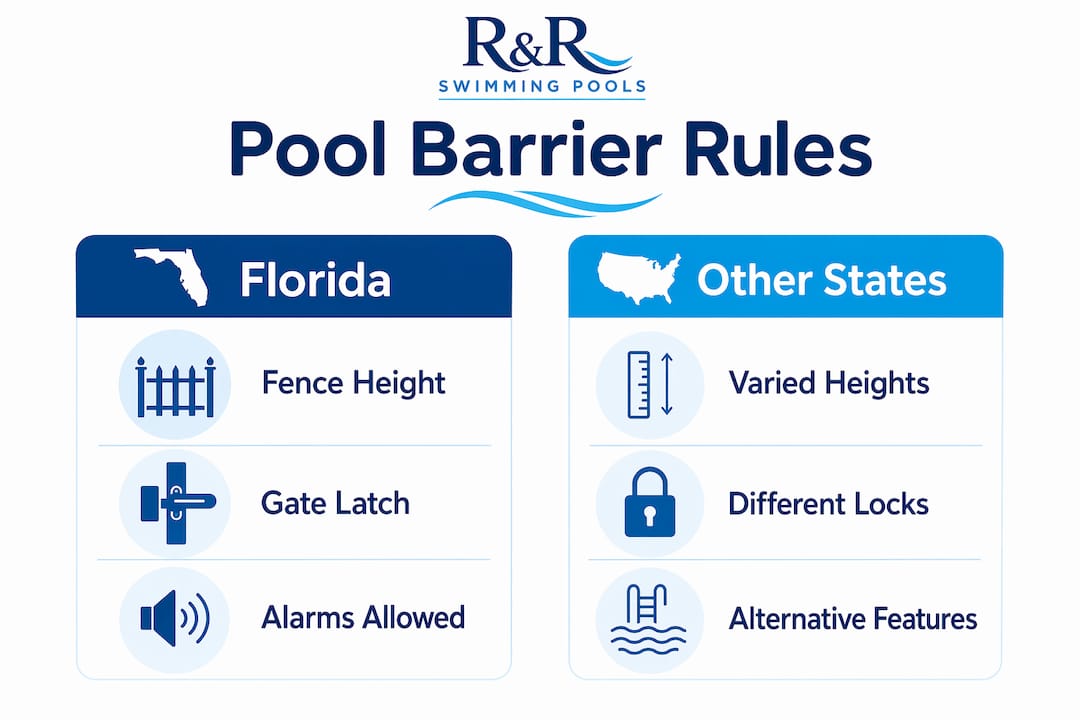
The table below shows how selected states approach pool fence and barrier requirements differently.
| State | Minimum fence height | Gate requirement | Notable alternative features |
|---|---|---|---|
| Florida | 48 inches | Self-closing, self-latching | Alarms, ASTM-rated covers |
| California | 60 inches | Self-closing, self-latching | Door alarms, safety covers |
| Texas | 48 inches | Self-closing, self-latching | Pool alarms permitted |
| Arizona | 60 inches | Self-closing, self-latching | Limited alternatives |
| New York | 48 inches | Self-closing, self-latching | Alarms and covers permitted |
The practical takeaway for you as a Central Florida homeowner is straightforward. You cannot rely on general advice from national home improvement sources or guidance written for another state. Your compliance requirements come from Florida Chapter 515, your county building code, and any applicable HOA rules, all of which may differ from each other.
What are the specific pool regulations for Central Florida homeowners?
Florida’s Residential Swimming Pool Safety Act requires every new residential pool to have at least one approved safety feature in place before the pool can be used. The law applies to all new construction and to existing pools that undergo substantial renovation. Here are the core barrier requirements you need to know:
- Fence height: Minimum 48 inches measured from the outside of the barrier
- Opening size: No opening in the barrier may allow passage of a 4-inch sphere
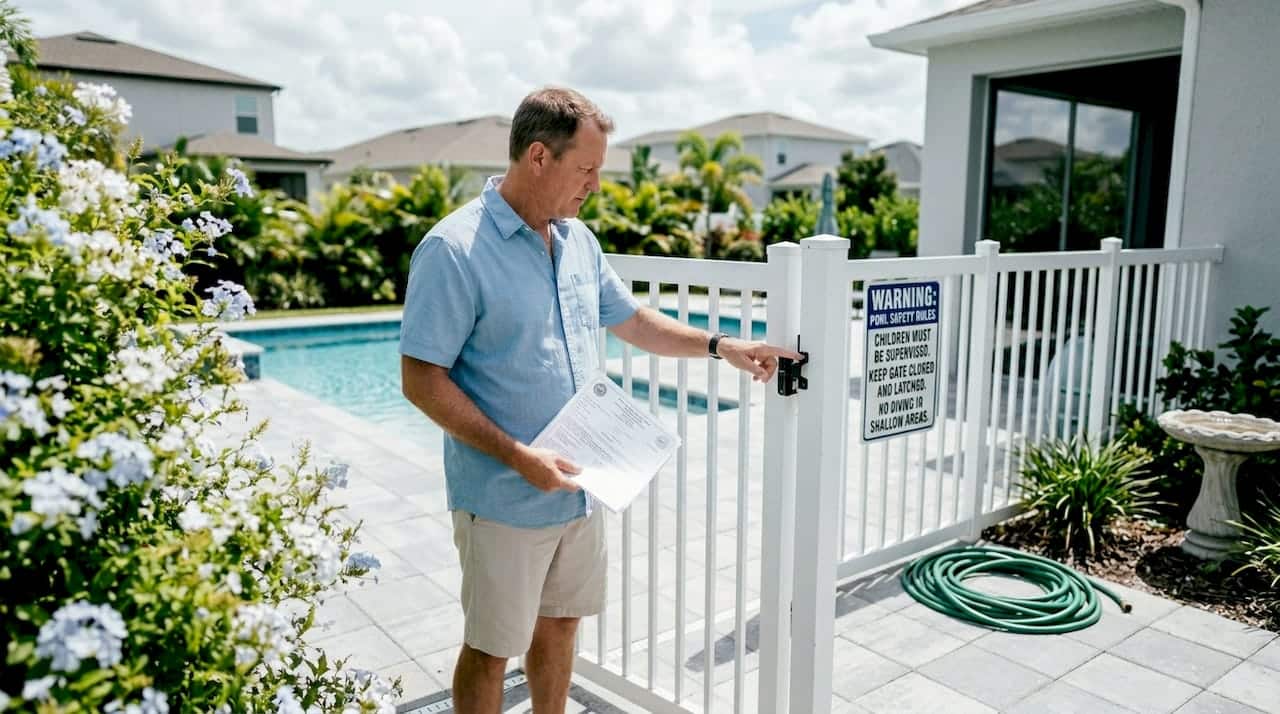
- Gate hardware: Gates must be self-closing and self-latching, with the latch positioned at 54 inches above grade so a child cannot reach it
- Gate swing: Gates must open outward, away from the pool
- Barrier placement: The barrier must completely surround the pool and separate it from the house and yard
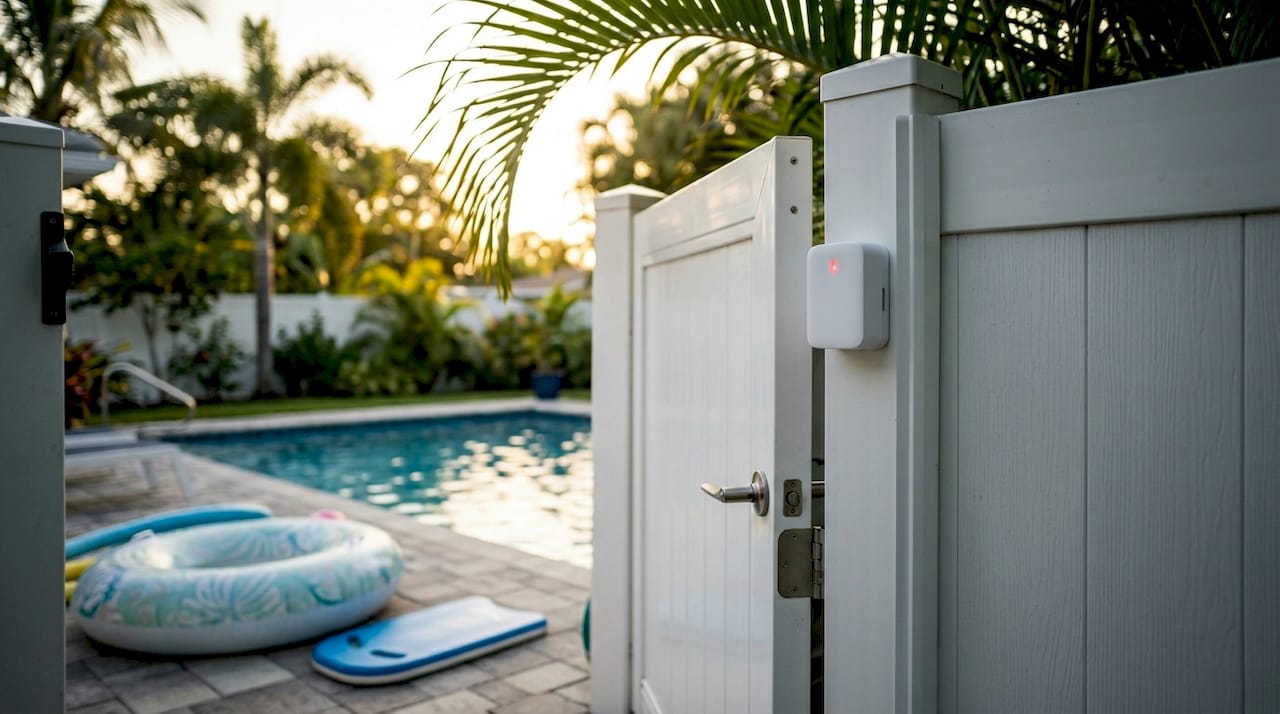
Beyond fencing, Florida code permits alternative safety features including door alarms on all house doors that provide direct access to the pool, power safety covers meeting ASTM F1346 standards, and exit alarms on pool gates. Fence barriers remain the most common compliance path because they provide passive protection without requiring any action from a homeowner or guest.
Material choice is flexible under Florida code. Tempered glass panels, aluminum picket fencing, and vinyl privacy panels all qualify as long as the dimensional and hardware requirements are met. Tempered glass has become popular in coastal and lakefront areas of Central Florida because it resists corrosion and preserves sightlines to the water.
The Sarasota County Building and Development Services office administers the permitting and inspection process for pools in that jurisdiction. Your permit application must include barrier plans, and the final inspection will verify every measurement before your certificate of completion is issued.
Pro Tip: Contact your county building department before you finalize your barrier design. Inspectors will tell you exactly which details they measure and what they commonly flag. That one conversation can prevent a failed inspection and a costly retrofit.
HOA rules in communities like Lake Nona, Windermere, and Dr. Phillips frequently exceed the statutory minimums. Some HOAs require 60-inch barriers or restrict visible fence materials to maintain neighborhood aesthetics. Always check your HOA covenants before ordering materials.
Why are pool safety regulations necessary?
The numbers behind pool drowning risk make the case for regulation clearly. Proper use of isolation pool fencing could prevent an estimated 348 drowning deaths in the United States every year, with an economic impact of $4.5 billion saved annually. That figure covers medical costs, emergency response, and the long-term economic consequences of preventable deaths. Florida, with its warm climate and high pool density, carries a disproportionate share of that national risk.
“Isolation fencing that completely surrounds a pool on all four sides reduces a child’s drowning risk by up to 83% compared to perimeter fencing that includes the house as one side of the barrier.” — Research cited in Unrealised Potential of Pool Fencing, PubMed 2025
Child drowning is the leading cause of accidental death for children ages one to four in Florida. That statistic is the primary driver behind why pool safety regulations exist at the state level. Regulations do not exist to create paperwork. They exist because passive barriers work when supervision fails, and supervision always fails eventually.
Effective pool safety uses a layered protection approach that combines physical barriers, alarms, active supervision, and emergency readiness. Regulations codify the physical barrier layer because it is the only layer that functions without human action. Alarms can be silenced. Covers can be left off. A properly installed four-sided fence with a self-latching gate operates every second of every day.
State public health pool programs also address ongoing operation and maintenance, not just initial construction. Inspections after installation verify that barriers have not been altered, that gate hardware still functions, and that no gaps have developed over time. This ongoing oversight is why compliance is not a one-time event.
From a liability standpoint, a non-compliant pool exposes you to significant legal risk if someone is injured on your property. Homeowners insurance policies frequently include clauses that reduce or deny coverage when a pool does not meet local code requirements. Compliance is not just a safety measure. It is financial protection.
What steps should Central Florida homeowners take to stay compliant?
Navigating pool regulations successfully requires a specific sequence of actions, not just a general awareness of the rules.
- Pull your permit before breaking ground. Pool construction in Central Florida requires a building permit that includes barrier plans. Starting without a permit creates legal exposure and may require you to demolish completed work.
- Choose your compliance path early. Decide between a four-sided barrier, a door alarm system, or an ASTM-rated safety cover before your contractor finalizes the design. Each option has different cost and maintenance implications.
- Do not assume your yard fence qualifies. Many homeowners assume their existing yard fence meets pool barrier requirements, but Florida law imposes specific hardware and dimensional standards that standard yard fencing rarely satisfies.
- Verify every measurement before inspection. Permitting success depends on matching barrier installation details to inspector criteria precisely. Fence height, gate latch location, and opening size are all measured at inspection, not estimated.
- Plan for resale compliance. A pool’s compliance status is reevaluated at property sale, insurance review, or inspection. Florida law provides no grandfather exemption for safety barriers, so an older non-compliant pool will require upgrades before closing.
- Schedule a post-installation inspection promptly. Do not use the pool until the final inspection is complete and your certificate of completion is issued.
Pro Tip: Keep a physical file with your permit, approved plans, and inspection certificates. When you sell your home, this documentation speeds up the buyer’s due diligence and prevents last-minute compliance disputes that can delay or kill a closing.
Working with a licensed pool contractor who knows Central Florida’s specific county codes removes most of the guesswork from this process. The pool permits process in Central Florida involves multiple agencies, and an experienced contractor manages that coordination on your behalf.
Key takeaways
Regional pool safety laws exist because local governments are best positioned to address the specific drowning risks, climate conditions, and enforcement resources of their communities, and Florida’s rules are among the most detailed in the nation.
| Point | Details |
|---|---|
| No federal residential pool law | State and local governments set all residential pool safety rules, creating region-specific requirements. |
| Florida’s 48-inch barrier rule | Fences must be 48 inches tall with self-latching gates at 54 inches and openings no larger than 4 inches. |
| Yard fences rarely qualify | Standard yard fencing does not meet Florida’s pool barrier hardware and dimensional requirements. |
| No grandfather exemption | Existing pools must meet current safety barrier standards at resale, inspection, or insurance review. |
| Layered safety is most effective | Barriers, alarms, supervision, and emergency readiness together reduce drowning risk more than any single measure. |
What four decades of pool installations taught me about compliance
Most homeowners I talk to think pool regulations are primarily about bureaucracy. They are not. They are about the specific, measurable ways that physical barriers prevent child drownings, and Florida’s rules reflect decades of data on what actually works.
The detail that surprises homeowners most is the gate latch height. Positioning a latch at 54 inches above grade is not arbitrary. It reflects research on the reach height of children under five, the age group at highest drowning risk. When I see a gate latch installed at 48 inches because it looked right to the installer, I know that pool will fail inspection and, more importantly, that it is not actually protecting anyone.
The second misconception I encounter regularly is that compliance is a one-time event. Florida law is clear that compliance is reevaluated at resale and at any major renovation. Homeowners who install a non-compliant barrier and assume they are done face expensive retrofits when they try to sell. The cost of getting it right the first time is always lower than the cost of correcting it under deadline pressure during a real estate transaction.
My honest view is that the homeowners who treat pool regulations as a safety investment rather than a compliance burden end up with better pools, fewer inspection failures, and more peace of mind. The pool safety guide for Central Florida we publish reflects that philosophy. Regulations are not the ceiling on what you should do. They are the floor.
— Randrswimmingpools
Build your pool right the first time with Randrswimmingpools
R and R Swimming Pools has designed and installed custom inground pools across Central Florida since 1985, and every build includes full navigation of local permitting, barrier requirements, and county inspections.

Whether you are choosing between inground pool types or working through the details of your installation plan, the Randrswimmingpools team brings four decades of local code knowledge to every project. We handle the permit applications, coordinate with county building departments, and install barriers that pass inspection the first time. Contact Randrswimmingpools today to schedule your free quote and start your project with confidence.
FAQ
What does Florida’s pool safety law require for new pools?
Florida’s Residential Swimming Pool Safety Act requires every new residential pool to have at least one approved safety feature, which can be a four-sided barrier, a door alarm, or an ASTM-rated safety cover. Fence barriers are the most common compliance path because they provide passive protection without requiring any human action.
Does my existing yard fence count as a pool barrier in Florida?
Standard yard fencing does not meet Florida’s pool barrier requirements. Florida law mandates specific gate hardware, a minimum 48-inch height, and opening sizes no larger than 4 inches, criteria that most general yard fences do not satisfy.
Are older pools exempt from current Florida pool safety regulations?
Florida law provides no grandfather exemption for safety barriers. A pool’s compliance status is reevaluated at property sale, insurance review, or inspection, meaning older pools must meet current barrier standards before a home can be sold.
Why do pool regulations differ so much between states?
Pool safety laws vary by state because local governments tailor rules to their community’s specific drowning risks, climate conditions, and enforcement capacity. Florida’s year-round outdoor swimming season creates a higher baseline risk than states with shorter pool seasons, which justifies more detailed requirements.
How much can proper pool fencing reduce drowning risk?
Isolation pool fencing that completely surrounds a pool on all four sides can reduce child drowning risk by up to 83% compared to perimeter fencing that uses the house as one side of the barrier. Proper fencing across the US could prevent an estimated 348 drowning deaths annually.
