
TL;DR:
- Pool permits act as ongoing project managers that ensure safety, legality, and proper inspection sequences.
- Skipping or rushing permit processes can lead to delays, legal penalties, or invalidated real estate transactions.
- Hiring licensed contractors and confirming jurisdictional requirements early can prevent common permitting pitfalls and project delays.
Most homeowners assume pool permits are just a stack of forms to file before the real work begins. That assumption can cost you weeks of delays, thousands in rework, and in some cases, a pool you legally cannot use. Permits are active enforcement tools that control every stage of your project, from the first shovel in the ground to the moment you fill the pool with water. This guide walks you through every layer of the permitting process so you can move forward with confidence, avoid costly surprises, and protect your investment from day one.
Table of Contents
- Why permitting matters in pool projects
- Types of pool permits and key checkpoints
- Contractor licensing and permitting risks
- Critical safety requirements: barriers and access
- Jurisdiction and public vs. residential pools: what changes?
- The uncomfortable truth about pool permitting in Central Florida
- Get expert help for a stress-free permitting process
- Frequently asked questions
Key Takeaways
| Point | Details |
|---|---|
| Permits ensure safety | The permitting process verifies your pool meets structural and safety standards before use. |
| Licensing is critical | Hiring a properly licensed contractor is required to obtain permits and avoid stop-work risks. |
| Scope triggers different permits | Changes to electrical, barriers, or drains can turn a simple project into a permit-required renovation. |
| Local rules vary | City and county authorities may impose different permitting procedures, so check jurisdiction before starting. |
| Inspections are multi-stage | Pass all required inspections before your pool can be filled and legally used. |
Why permitting matters in pool projects
Think of a pool permit less like a permission slip and more like a project manager that never sleeps. It sets the rules, schedules the checkpoints, and decides when your pool is legal to use. Permitting is not just paperwork; it serves as an enforcement mechanism that determines when work is legal and which inspections must be passed before the pool can be filled and used.
That means your contractor cannot simply finish the job and hand you the keys. The pool sits empty and unusable until every required inspection is passed and the final approval is issued. For homeowners who have already planned a summer opening date, a missed inspection or a failed checkpoint can push that date back by weeks.
There are also serious legal consequences to skipping or rushing the process. Stop-work orders can freeze your project mid-construction. Unpermitted work can trigger fines, force demolition of completed sections, or create problems when you sell your home. Title companies and buyers routinely check for open or missing permits, and an unpermitted pool can kill a real estate deal entirely.
Understanding the reasons to build a pool in Central Florida is easy. Understanding the rules that protect that investment takes a little more effort, but it is absolutely worth it.
Here is what permits are designed to enforce:
- Structural integrity verified through pre-pour and bonding inspections
- Electrical safety confirmed through rough-in and final electrical checks
- Barrier and access control ensuring child safety requirements are met
- Drain and suction compliance protecting against entrapment hazards
- Zoning and setback rules confirming the pool location is legally allowed
“A permit is the legal bridge between a homeowner’s vision and a finished, usable pool. Without it, you have a construction project. With it, you have a verified, safe, and legally occupied backyard feature.”
Our Central Florida pool permitting guide goes deeper on jurisdiction-specific rules, but the foundation is always the same: permits protect you, your family, and your property value.
Types of pool permits and key checkpoints
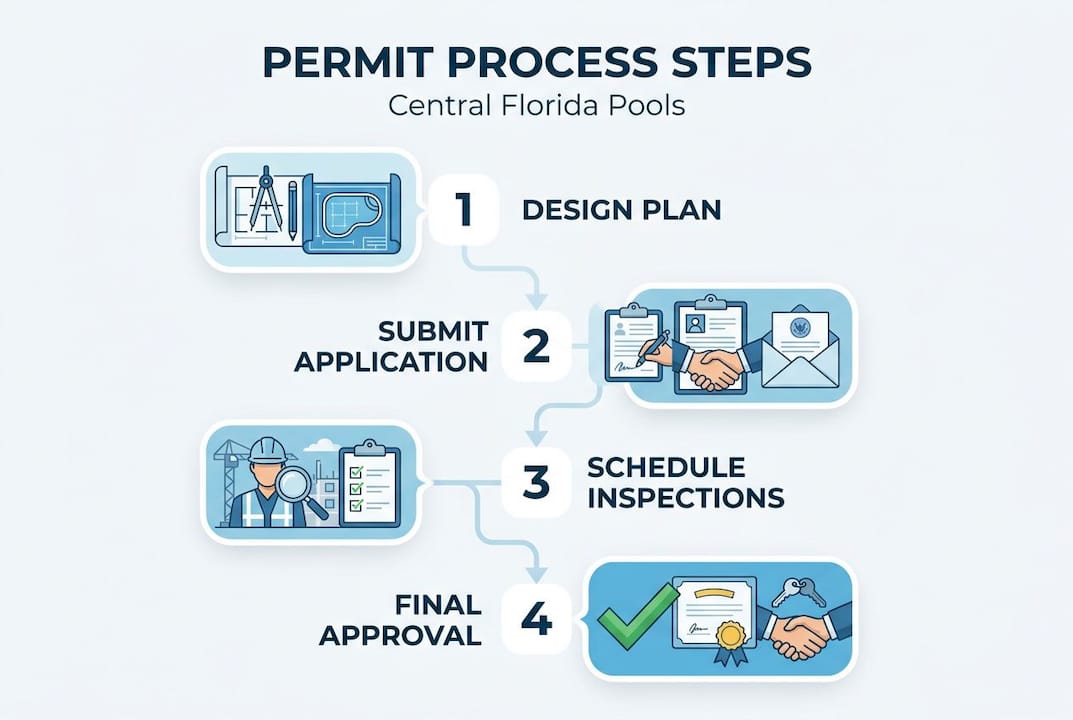
Not every pool project requires the same permits. The scope of your work determines which permits are triggered, and getting this wrong at the start causes expensive delays later. In Central Florida jurisdictions like Seminole County, pool projects are regulated through layered checkpoints including zoning and land-use review, Florida Building Code structural review, and electrical checks under the National Electrical Code, with additional permit triggers depending on project scope.
Here is a breakdown of the most common permit types:
| Project scope | Permits typically required |
|---|---|
| New inground pool | Building, electrical, plumbing, barrier/enclosure |
| Pool renovation with new equipment | Mechanical, electrical |
| Barrier or fence modification | Barrier/enclosure permit |
| Main drain replacement | Plumbing permit |
| Resurfacing only | Usually none (see note below) |
| Spa addition to existing pool | Building, electrical, plumbing |
The inspection process for a new pool build follows a staged sequence. Each phase must be passed before the next phase of construction can proceed:
- Pre-pour inspection confirms the shell layout, steel placement, and dimensions before concrete is poured
- Bonding inspection verifies that all metal components are electrically bonded to prevent shock hazards
- Electrical rough-in inspection checks wiring, conduit, and panel connections before they are covered
- Final inspection confirms barrier compliance, drain cover installation, and overall completion before the pool is filled
Pro Tip: Schedule your inspections before you need them, not when you need them. Inspectors in busy Central Florida counties can be booked out several days. A missed inspection window can stall your entire build schedule.
One area that surprises many homeowners is the renovation trigger rule. Major renovation scope can trigger permits for safety and access elements even when resurfacing alone might not. If you are replacing a main drain, adding a heater, upgrading to LED lighting, or modifying your fence while resurfacing, you will likely need one or more permits even if the tile and plaster work alone would not require them.
Our pool inspection process guide explains each checkpoint in detail, and our pool planning steps resource helps you map out your project scope before you ever contact a building department. Reviewing zoning regulations in Florida early in your planning process also helps you avoid setback surprises that can require redesigns.
Contractor licensing and permitting risks
Here is something most homeowners do not realize until it is too late: not every contractor can legally pull a pool permit in Florida. The Florida Department of Business and Professional Regulation (DBPR) governs pool contractor licensing under Chapter 489, and only contractors with the right license class can submit permit applications for residential pool work.
Florida recognizes two primary license classes for pool contractors:
- Certified Pool/Spa Contractor: Licensed at the state level, can work anywhere in Florida without additional local registration
- Registered Pool/Spa Contractor: Licensed at the local level, can only work in specific counties or municipalities where they are registered
Unlicensed or improperly licensed contractors cannot obtain permits and create serious stop-work risk. If your contractor pulls a permit they are not qualified to pull, or worse, starts work without one, the local building department can shut down your project entirely. You may be left with an unfinished pool, legal liability, and no clear path to completion.
The practical homeowner methodology is straightforward: confirm whether your planned project scope triggers a permit, then verify that your contractor’s license class matches the work before anything is submitted to the building department.
Here is what to check before hiring any pool contractor:
- Verify their DBPR license number on the Florida state licensing portal
- Confirm whether they are Certified (statewide) or Registered (local only)
- If Registered, confirm they are registered in your specific county or city
- Ask who will pull the permit and confirm that person holds the appropriate license
Pro Tip: Always ask your contractor for their license number before signing a contract. A reputable contractor will provide it without hesitation. If they resist or change the subject, treat that as a serious warning sign.
Our team of licensed pool builders carries the proper credentials for every project we take on in Central Florida, and we handle the permitting process so homeowners never have to navigate the building department alone.
Critical safety requirements: barriers and access
Barrier requirements are not optional, and they are not negotiable. Florida law mandates specific physical safety measures around every residential pool, and these requirements are verified at inspection time before any pool can receive final approval.
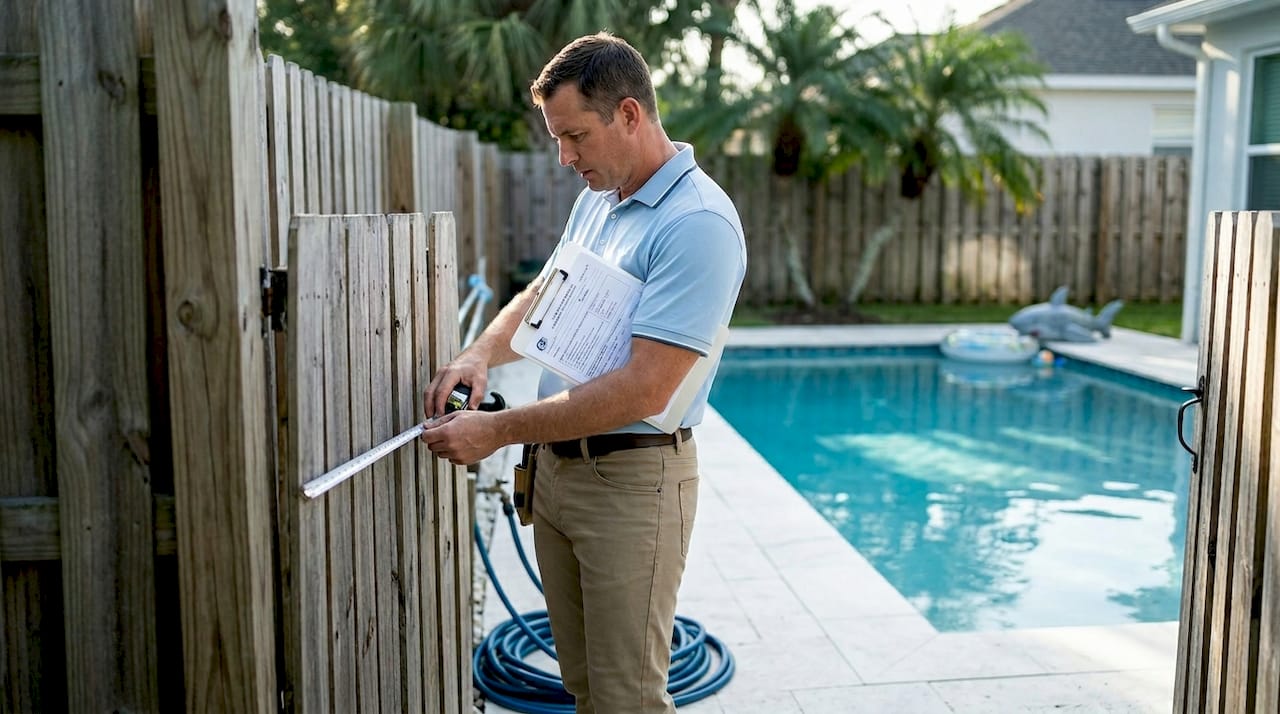
For residential pools, barrier and access control is a core permitting and safety requirement explicitly tied to Florida Statute and verified at inspection.
Here is what the law requires:
| Barrier element | Minimum requirement |
|---|---|
| Fence or wall height | At least 4 feet high |
| Gate hardware | Self-closing and self-latching |
| Latch placement | On pool side of gate, out of child’s reach |
| Door alarms | Required on any door with direct pool access |
| Pool alarms | Required in certain configurations |
| Drain covers | Must meet ANSI/ASME anti-entrapment standards |
These requirements exist because drowning is one of the leading causes of accidental death for children under five in Florida. The barrier inspection is not a formality. Inspectors check gate hardware, latch height, fence continuity, and drain covers in detail. A single non-compliant gate can fail your final inspection and delay pool use.
If you are modifying an existing barrier as part of a renovation, that modification will trigger a new permit requirement. Even replacing a gate or extending a fence section requires review if it affects the pool’s enclosure. Our pool installation steps guide walks through how barrier requirements fit into the overall build timeline.
“Barrier compliance is not a box to check at the end. It is a design decision that should be made before construction begins.”
Jurisdiction and public vs. residential pools: what changes?
One of the most overlooked variables in Central Florida pool permitting is jurisdiction. Your address determines which building department has authority over your project, and the rules can vary significantly depending on whether you live in an unincorporated county area or within a city’s limits.
Incorporated cities have their own building departments, so residents must confirm which office has authority for their specific address before submitting any permit application. A homeowner in Oviedo follows a different process than a homeowner in unincorporated Seminole County, even if they live just a few miles apart.
For public pools, the complexity increases further. Florida Department of Health (FDOH) operating and plan approval and sanitation oversight can add an additional permitting layer beyond local building permits for public pools. This matters for homeowners in planned communities, HOA developments with shared pools, or anyone considering a pool that will serve more than a single family.
Key differences between residential and public pool permitting:
- Residential pools: Permitted through local building authority, staged safety inspections, one-time certificate of completion
- Public pools: FDOH plan approval required, annual operating license, routine sanitation inspections, stricter water quality standards
- HOA or community pools: May require both FDOH oversight and local building permits depending on classification
Pro Tip: Before submitting any permit application, call your local building department and confirm your jurisdiction. Give them your address and ask specifically whether your home falls under city or county authority. This five-minute call can save you weeks of misdirected paperwork.
Our custom pool installation guide covers jurisdiction-specific considerations across the Central Florida region, including the communities we serve most frequently.
The uncomfortable truth about pool permitting in Central Florida
After decades of building pools across Central Florida, we have seen the same permitting problems repeat themselves. And most of them were completely avoidable.
The biggest one is scope creep. A homeowner starts with a simple resurfacing project, then decides to add a new light fixture, replace the main drain, and upgrade the pump while they are at it. Each of those additions is reasonable on its own. Together, they cross multiple permit thresholds that the original plan never accounted for. The contractor either does not know or does not say anything, and the project stalls when the building department flags unpermitted work mid-construction.
The second problem is inspection timing. Inspections must align precisely with build milestones. If your contractor covers the bonding work before the bonding inspection is completed, the inspector will require it to be exposed again. That means breaking apart finished work, paying for rework, and losing days or weeks on your timeline. This is not a rare edge case. It happens regularly when contractors prioritize speed over process.
The third problem is the most frustrating: contractor licensing mismatches. A Registered contractor who is not registered in your specific county cannot legally pull your permit. Some contractors do not disclose this until after the contract is signed. By then, you are already behind schedule and potentially locked into a relationship with someone who cannot legally complete your project.
What most guides miss is this: the time to confirm permit triggers is before you finalize your project scope, not after. A quick conversation with your local building department or a knowledgeable contractor can tell you exactly which permits your project will require. That conversation costs nothing. Discovering the answer mid-construction can cost thousands.
We share practical resources on planning custom pools and in-depth education through our pool school to help homeowners ask the right questions before any work begins.
Get expert help for a stress-free permitting process
Permitting does not have to feel like a maze. With the right team handling your project, every permit, inspection, and approval checkpoint becomes a managed step rather than a stressful unknown.
At R&R Swimming Pools, we have been navigating Central Florida’s permitting landscape since 1985. We know which jurisdictions require what, how to sequence inspections to keep your project on schedule, and how to avoid the scope creep traps that delay so many builds. Our inground pool installation guide gives you a clear picture of the full process, and our pool remodeling process guide covers renovation-specific permitting in detail. Visit our pool school resources to keep learning, or reach out to schedule your free consultation today.
Frequently asked questions
Do I need a permit to resurface my existing pool in Central Florida?
Typically, resurfacing alone does not require a permit, but any major renovation scope that includes electrical, barrier, or main drain modifications will trigger permit requirements even if the surface work alone would not.
What inspections are required before I can use a new pool?
You must pass staged inspection checkpoints including pre-pour, bonding, electrical rough-in, and a final inspection that verifies barrier compliance and drain covers before the pool can be legally filled and used.
How does the permit process change if my home is in a city instead of unincorporated county?
Incorporated cities have their own building departments with processes that may differ from county requirements, so you must confirm which office has authority for your specific address before submitting any permit application.
Who can legally pull pool permits in Central Florida?
Only contractors licensed under Florida DBPR as Certified or Registered Pool/Spa Contractors under Chapter 489 can legally pull pool permits for residential projects in Central Florida.
What are the consequences of skipping pool permitting?
Unpermitted pool work risks stop-work orders, fines, and required demolition of completed sections; the pool cannot be legally used until all required inspections are passed and final approval is issued by the building department.
