
Saltwater and chlorine pools both sanitize with the same active compound, hypochlorous acid, but they deliver it in completely different ways, and that difference shapes everything from your weekly routine to your 10-year budget. Saltwater pools use a salt chlorine generator (SCG) to produce chlorine continuously through electrolysis, keeping levels steady and low. Traditional chlorine pools rely on manual additions of liquid, tablets, or granules, which creates peaks and valleys in chlorine concentration. The result: saltwater pools tend to feel softer on skin and eyes, while chlorine pools cost less on day one but demand more hands-on attention week after week.
Here is the quick picture before we go deeper:
- Mechanism: Saltwater pools convert dissolved salt into chlorine via electrolysis; chlorine pools use direct chemical additions.
- Maintenance: Saltwater pools need less frequent chemical dosing but require periodic salt cell cleaning; chlorine pools need testing 2–3 times weekly and regular shocking.
- Health: Saltwater pools produce fewer chloramines, reducing eye and skin irritation and chemical odor.
- Upfront cost: Saltwater pools cost more to install due to the generator; chlorine pools have a lower barrier to entry.
- Long-term cost: Saltwater pools typically run cheaper annually, though periodic salt cell replacement every few years is a real expense.
- Equipment risk: Salt is corrosive to certain metals and natural stone, requiring compatible materials.
Table of Contents
- How do saltwater pools actually work?
- How traditional chlorine pools sanitize your water
- Maintenance comparison: saltwater vs chlorine pools
- Health benefits and risks of saltwater pools
- Cost comparison: installation, maintenance, and long-term expenses
- Which pool type is right for you?
- Debunking the “maintenance-free” myth about saltwater pools
- Environmental impact: how the two systems compare
- How long does pool equipment last in each system?
- Common problems specific to each pool type
- What saltwater and chlorine do to pool surfaces and fixtures
- Randrswimmingpools builds pools designed for the system you choose
- Key Takeaways
How do saltwater pools actually work?
A saltwater pool is not a chlorine-free pool. That is the most important thing to understand upfront. The system dissolves pool-grade sodium chloride in the water to a concentration approximately one-tenth that of ocean water, creating a mild salt solution. As the pump circulates water through the salt cell, a low-voltage current converts the salt into hypochlorous acid, the same sanitizing agent you get from a bag of chlorine tablets.
Because the generator runs continuously while the pump operates, chlorine levels remain steady instead of fluctuating widely as with manual dosing. That consistency is the real reason swimmers report fewer “itchy eyes” days and less odor in saltwater pools. The water’s mild salinity level makes it feel silky to most swimmers, closer to a teardrop than to ocean water.
Key operational facts about saltwater systems:
- The salt cell contains titanium plates coated with ruthenium and iridium oxides that perform the electrolysis.
- Salt concentration stays well below ocean levels, so the water does not taste or feel briny.
- Electrolysis raises pH over time, so weekly acid additions are typically needed to keep pH in the 7.2–7.6 range.
- The salt cell requires cleaning every 3–6 months to prevent calcium scale buildup on the plates.
- Saltwater pools are not chlorine-free. They generate chlorine on site rather than requiring you to add it manually.
Pro Tip: Keep calcium hardness below 400 ppm and acid-wash the salt cell regularly. In hard-water regions, calcium scale is the single biggest threat to cell efficiency and lifespan.
How traditional chlorine pools sanitize your water
Chlorine pools are the most common pool type in the United States, and the chemistry is straightforward. You add chlorine directly to the water as liquid sodium hypochlorite (typically 10–12.5% concentration), trichlor tablets, or granular cal-hypo. Once in the water, chlorine dissociates into hypochlorous acid, which kills bacteria and algae on contact.
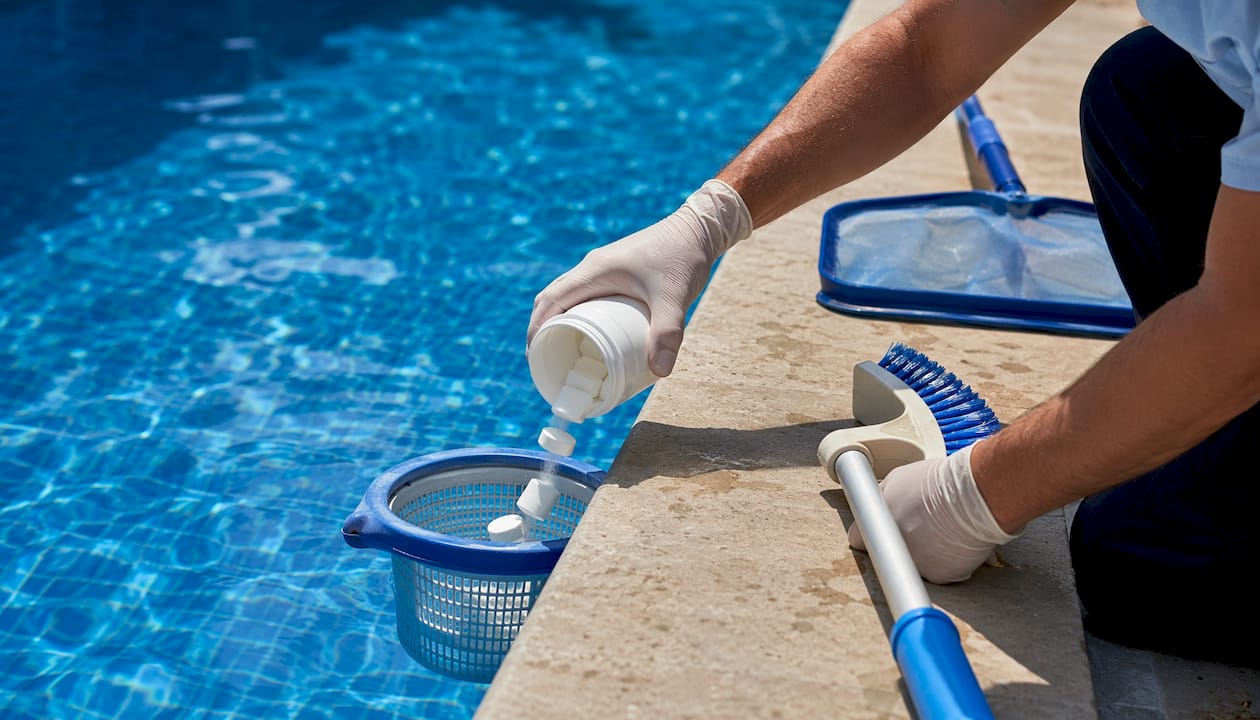
The catch is that manual dosing creates fluctuations. Right after you add chlorine, levels spike. As the sun burns it off and swimmers introduce organic matter like sweat and body oils, levels drop. Those valleys are where chloramines form. Chloramines are the combined chlorine compounds responsible for the classic “pool smell,” red eyes, and skin irritation. Contrary to popular belief, that chemical odor signals too little free chlorine, not too much.
A few operational realities of chlorine pools:
- Testing 2–3 times per week is standard during swim season to catch imbalances before they become problems.
- Stabilizers like cyanuric acid (CYA) protect chlorine from UV degradation but can accumulate over time, reducing chlorine effectiveness in a condition called chlorine lock.
- Weekly shocking clears chloramine buildup and resets free chlorine levels after heavy use.
- Trichlor tablets add CYA with every dose, which is convenient but requires monitoring to avoid over-stabilization.
- Chlorine chemicals require safe storage in a cool, dry, ventilated space, away from children and pets.
Maintenance comparison: saltwater vs chlorine pools
The maintenance difference between the two systems is real, but it is often mischaracterized. Saltwater pools are lower-touch, not no-touch. The work shifts from frequent chemical additions to periodic mechanical upkeep of the salt cell.
| Factor | Saltwater pool | Chlorine pool |
|---|---|---|
| Water testing frequency | 1–2 times per week | 2–3 times per week |
| Chlorine dosing | Automatic via generator | Manual: liquid, tablets, or granules |
| pH management | Weekly acid additions (electrolysis raises pH) | Varies by chlorine form used |
| Salt cell cleaning | Every 3–6 months | Not applicable |
| Shocking | Occasional, less frequent | Weekly or after heavy use |
| Stabilizer monitoring | Minimal | Regular (CYA creep with tabs) |
| Salt cell replacement | Every 3–7 years | Not applicable |
| Chemical storage | Salt only (no special precautions) | Chlorine requires ventilated, secure storage |
Saltwater systems reduce weekly maintenance time by 50% or more for most pool owners by eliminating the need for frequent manual chlorine additions and the pH management cascade that follows each dose. You are still managing your pool chemistry; you are just doing it less often. The tradeoff is that when the salt cell eventually wears out, replacing it takes time and money that chlorine pool owners never face.
Water hardness matters more for saltwater pools than most guides acknowledge. In hard-water regions where calcium hardness runs 150–300+ ppm, calcium scale deposits on the salt cell plates faster, forcing more frequent cleaning and shortening cell lifespan. Proper pool water balance is not optional with either system, but the consequences of neglect hit saltwater equipment harder.
Health benefits and risks of saltwater pools
The comfort advantage of saltwater pools is real, though the mechanism is worth understanding clearly. Saltwater pools do not eliminate chlorine. They reduce chloramine formation by keeping free chlorine at steady, low levels rather than allowing the peaks and valleys that occur with manual dosing. Chloramines are what cause red eyes, dry skin, and that sharp chemical smell, so fewer chloramines means a noticeably more comfortable swim.
Swimmers with sensitive skin, eczema, or eye sensitivity tend to report the biggest improvement after switching to saltwater. The low dissolved salt concentration at roughly 3,200 ppm also contributes to the silky feel many swimmers describe. Swimwear and hair hold up better too, since the water chemistry is less aggressive than a heavily dosed chlorine pool.
Health considerations to keep in mind:
- Saltwater pools carry minimal allergy risk. Allergic reactions to the salt or the chlorine saltwater pools generate are relatively rare, while chemical chlorine allergies are more common.
- The salt used in pool systems is odorless and requires no special handling or storage precautions.
- A neglected saltwater pool can be just as irritating as any poorly managed chlorine pool. Consistent maintenance is the actual variable.
- Salt is corrosive to certain metals and natural stone. Fixtures, ladders, and rails made from incompatible materials can degrade faster in a saltwater environment if not properly specified.
Cost comparison: installation, maintenance, and long-term expenses
The financial picture depends heavily on your time horizon. Chlorine pools win on day one; saltwater pools tend to win over five or more years.
| Cost factor | Saltwater pool | Chlorine pool |
|---|---|---|
| Inground installation | — | — |
| Salt chlorine generator (standard inground) | $500–$900 | Not applicable |
| Professional generator installation | $100–$300 | Not applicable |
| Annual chemical costs | $100 | $300–$600 |
| Salt cell replacement (every 3–7 years) | $1,000–$1,800 | Not applicable |
| Annual electricity (generator) | $50–$150 extra | Minimal |
The salt cell replacement cost deserves special attention. Cells contain titanium plates coated with iridium and ruthenium oxides, and those precious metals have risen sharply in price. Homeowners who replaced a cell for $500 in 2015 are paying $1,000–$1,800 today. That trend is narrowing the long-term cost advantage of saltwater pools, though most mid-to-large pool owners still come out ahead over a five-year window.
Converting an existing chlorine pool to saltwater costs $600–$2,200, covering the generator, initial salt load, and professional installation. For owners who want to try the system without building a new pool, conversion is a practical path.
Which pool type is right for you?
The honest answer depends on three things: your upfront budget, how much time you want to spend on maintenance, and what materials surround your pool.
Choose a saltwater pool if:
- You swim frequently and want softer, less irritating water for daily use.
- You prefer automated chlorine production over weekly chemical runs to the pool store.
- Your pool is 20,000 gallons or larger, where the generator’s payback period is shorter.
- You are comfortable budgeting $1,000–$1,800 every 3–6 years for a replacement salt cell.
- You do not want to store bulk chlorine chemicals at home.
Choose a chlorine pool if:
- Upfront cost is your primary constraint.
- Your pool is smaller (under 15,000 gallons) or used only a few months per year.
- You have natural stone coping, copper fixtures, or other salt-sensitive materials you do not want to replace.
- You prefer direct, hands-on control over every chemical addition.
A hybrid approach works well for some owners: use a saltwater generator as the primary sanitizer and keep liquid chlorine on hand for heat waves, heavy bather loads, or the weeks when the salt cell is being cleaned. Many pool owners find this gives them the comfort of steady chlorination with the flexibility to respond quickly when conditions change.
Lifestyle, environment, and budget all shape the right answer. There is no universally correct choice, only the one that fits how you actually live and swim.
Debunking the “maintenance-free” myth about saltwater pools
The biggest misconception about saltwater pools is that they run themselves. They do not. What they do is shift the type of maintenance required, from frequent chemical additions to periodic mechanical upkeep.
Saltwater pool maintenance centers on the salt cell and water chemistry balance rather than chlorine dosing. Owners who understand this thrive with the system; those who expect to set it and forget it often end up with a failing cell, unbalanced water, and a pool that feels worse than a standard chlorine setup.
Lifestyle factors that influence which system suits you:
- Pool usage frequency: Heavy daily use favors saltwater’s steady chlorination; occasional weekend use may not justify the generator cost.
- Budget stability: Salt cell replacement is a predictable but real expense. If irregular large costs are a problem, factor that in.
- Equipment sensitivity: Older pools with copper heaters, bronze fittings, or natural stone need material upgrades before adding a salt system.
- Travel habits: If you are away frequently, saltwater’s automated production is a genuine advantage over manual dosing.
Pro Tip: Test pH and alkalinity weekly even with a saltwater system. Electrolysis consistently pushes pH upward, and letting it drift above 7.8 reduces chlorine effectiveness and accelerates scale buildup on the cell plates. A pool water test kit takes five minutes and protects a $1,000+ investment.
Environmental impact: how the two systems compare
Neither system has a clear environmental edge. Chlorine and saltwater pools weigh in about the same overall, but they create different types of environmental load.
Saltwater pools consume more electricity because the salt chlorine generator runs continuously while the pump operates. A typical residential unit draws 150–300 watts, adding roughly $50–$150 per year to the electricity bill. Chlorine pools avoid that generator draw but require the ongoing production, packaging, and transportation of chemical chlorine, along with the safety infrastructure for storing hazardous materials at home.
Salt discharge is worth considering if you live in a drought-prone region or have a septic system. Backwashing a saltwater pool releases salt-laden water into the surrounding soil or drainage system. Some municipalities have restrictions on salt discharge, so checking local regulations before installation is worth the time. On the chemical handling side, saltwater pools eliminate the need to store chlorine tablets or liquid chlorine, which reduces household chemical risk for families with children and pets.
How long does pool equipment last in each system?
Equipment longevity is where the saltwater vs chlorine comparison gets genuinely complicated, because the answer depends heavily on material choices made at installation.
In a chlorine pool, standard equipment like pumps, heaters, and ladders faces no unusual corrosion risk from the sanitizer itself. The main wear factors are UV exposure, water chemistry balance, and physical use. A well-maintained chlorine pool’s equipment can last 10–20 years or more with routine care.
Saltwater pools introduce a corrosive environment that accelerates degradation of incompatible materials. Copper heaters, bronze fittings, and certain natural stones are particularly vulnerable. Properly specified saltwater pools use cupronickel heaters, 316-grade stainless steel hardware, and sacrificial zinc anodes to protect metal components from galvanic corrosion. When those material choices are made correctly at the design stage, equipment longevity is comparable to a chlorine pool.
The salt cell itself is a consumable. Expect a lifespan of 3–7 years depending on water hardness, usage frequency, and how diligently the cell is cleaned. In hard-water regions, the lower end of that range is more realistic without consistent acid washing.
Common problems specific to each pool type
Every pool system has its failure modes. Knowing them in advance saves money and frustration.
Saltwater pool problems:
- Calcium scale on the salt cell: The most common issue in hard-water areas. Scale reduces chlorine output and forces the cell to work harder, shortening its life. Quarterly acid washing prevents it.
- pH drift: Electrolysis consistently raises pH, so without regular acid additions, the water becomes alkaline, reducing chlorine effectiveness and causing cloudy water.
- Corrosion of incompatible materials: Ladders, lights, and heaters made from the wrong metals degrade faster in a salt environment. This is a design problem, not a maintenance problem.
- Low salt levels: Rain dilution and backwashing reduce salt concentration over time. The generator’s control panel usually alerts you, but ignoring low-salt warnings causes the cell to work harder and wear faster.
Chlorine pool problems:
- Chloramine buildup: The classic “pool smell” and red-eye problem. Caused by insufficient free chlorine to break down combined chlorine compounds. Weekly shocking and proper dosing prevent it.
- CYA accumulation: Trichlor tablets add cyanuric acid with every dose. Over a season, CYA can climb high enough to lock chlorine in an inactive form, requiring a partial drain and refill to reset levels.
- Inconsistent chlorine levels: Manual dosing creates peaks and valleys. Missing a dose during a heat wave or after a pool party can allow algae to establish quickly.
- Chemical storage hazards: Liquid chlorine and granular shock require careful storage away from heat, moisture, and each other. Mixing different chlorine products can cause dangerous reactions.
What saltwater and chlorine do to pool surfaces and fixtures
The effect on pool surfaces is one of the most underappreciated differences between the two systems, and it cuts both ways.
Saltwater is corrosive to certain metals and natural stone. Travertine, limestone, and other porous natural stones used for coping or decking can absorb salt and deteriorate over time if not properly sealed. Metal fixtures, particularly those made from copper, brass, or low-grade stainless steel, are vulnerable to accelerated corrosion. Underwater lights, ladder rails, and diving board hardware all need to be rated for saltwater exposure. Heaters are the most expensive casualty of an improperly specified saltwater pool: a standard copper heat exchanger can fail within a few years in a salt environment.
Chlorine pools are generally easier on pool structures and surrounding materials, but they are not harmless. High chlorine concentrations, particularly after shocking, can bleach vinyl liners, fade painted surfaces, and degrade certain gaskets and seals over time. The key difference is that chlorine’s surface effects are usually the result of poor chemical balance, while saltwater’s corrosive effects can occur even in a well-maintained pool if the wrong materials were used at installation.
For concrete and fiberglass pools, both systems are compatible with proper material selection and maintenance. Fiberglass pools with a quality gel coat hold up well in saltwater environments. Concrete pools need appropriate surface finishes and regular inspection of grout lines, since salt can work into micro-cracks over time.
Randrswimmingpools builds pools designed for the system you choose
Deciding between saltwater and chlorine is only half the decision. The other half is making sure your pool is built to handle whichever system you pick, with the right materials, the right equipment pad, and the right surface finishes from day one.
R and R Swimming Pools has been designing and building custom inground pools across Central Florida since 1985. The team specifies salt-compatible materials, properly sized generators, and corrosion-resistant fixtures for saltwater builds, so you are not discovering material incompatibilities two years after installation. For chlorine pools, the focus is on durable surfaces and equipment layouts that make weekly maintenance as straightforward as possible. Whether you are starting fresh or converting an existing pool, the inground pool installation guide walks through every phase of the process. Ready to get a design that fits your system, your budget, and your backyard? Request a free quote and talk through your options with a team that has built pools in Central Florida longer than most pool companies have existed.
Key Takeaways
Saltwater pools cost more upfront but typically deliver lower annual operating costs and a more comfortable swim experience, making them the better long-term choice for most heavily used inground pools.
| Point | Details |
|---|---|
| Chlorine delivery method | Saltwater pools generate chlorine via electrolysis; chlorine pools rely on manual chemical additions. |
| Annual maintenance cost | Saltwater pools run roughly $100 per year in chemicals vs. $300–$600 for chlorine pools. |
| Salt cell lifespan | Salt cells last 3–7 years and cost $1,000–$1,800 to replace currently. |
| Health and comfort | Saltwater pools produce fewer chloramines, reducing eye and skin irritation for regular swimmers. |
| Randrswimmingpools | Builds custom inground pools in Central Florida spec’d for either saltwater or chlorine systems from the ground up. |
