
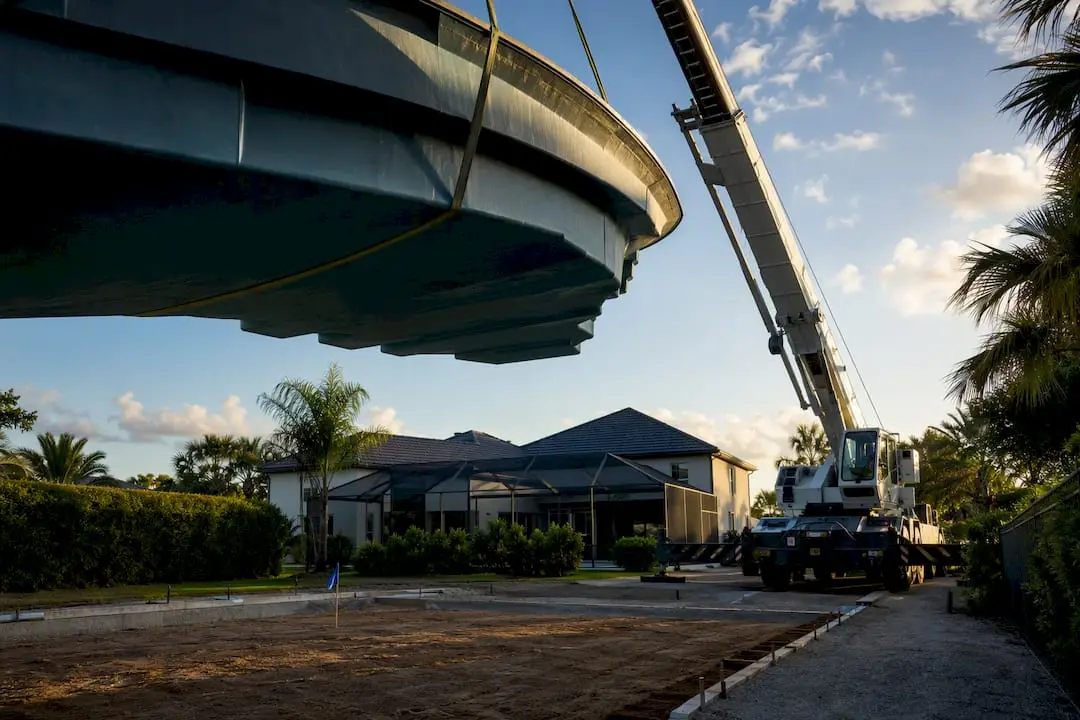
Most fiberglass pool shells max out around 16 feet wide, 40 feet long, and 8 feet deep, not because manufacturers can’t build bigger, but because a bigger shell can’t reliably get from the factory to your backyard in one piece. Every dimension beyond those numbers runs into highway width restrictions, crane reach limits, or gate widths on a typical residential lot. What follows covers the transport rules behind those numbers, the site-access issues that shrink them further, common catalog sizes, and how to figure out what actually fits your yard.
TL;DR:
- Fiberglass pool shells typically max out at 16 feet wide due to highway width restrictions and transport permits, unless specialized routing is arranged.
- Actual water space is about a foot less in both length and width because of the structural perimeter beam, affecting yard and fence planning.
- Larger shells, especially those approaching 16 by 40 feet, require detailed route surveys, oversize permits, and careful crane placement to ensure delivery feasibility.
- Site access constraints such as gate widths, crane overhead clearance, and soil excavation limits are critical considerations before choosing a pool size.
- Costs, maintenance, and safety regulations all scale with pool size, making larger shells more expensive to install, operate, and secure.
Table of Contents
- Typical maximum dimensions explained: width, length, depth
- Why width usually stops at about 16 feet: transport and highway rules
- Common standard sizes and use cases
- Site access and installation constraints: crane, gates, and overhead lines
- Permits, setbacks, and HOA rules that limit size
- How to pick the right fiberglass pool size
- Costs and operating implications of larger shells
- What an experienced installer checks before committing to a size
- Safety regulations specific to larger fiberglass pools
- Cost implications tied to increasing pool size beyond typical limits
- Impact of size limits on pool maintenance and cleaning
- When fiberglass stops being the right answer and concrete takes over
- Get a feasibility check before you commit to a size
- Sources
Typical maximum dimensions explained: width, length, depth
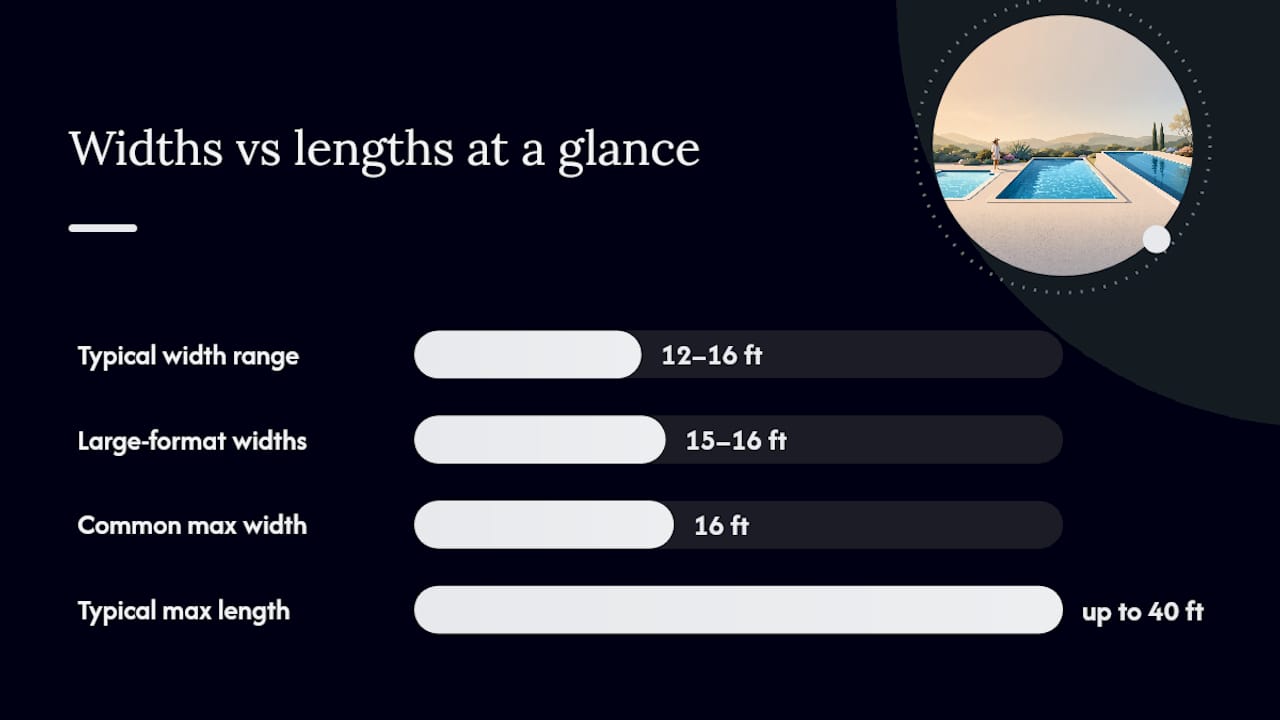
Fiberglass shells come out of the mold as one continuous piece, and that manufacturing method is exactly what caps how large they can get. Width is the tightest constraint: most shells stay around 16 feet wide, with the majority of large-format models landing between 15 and 16 feet. Length has more room to work with. Shells commonly run from 12 to 16 feet wide and stretch up to roughly 40 feet long, which covers everything from small plunge pools to full lap pools.
Depth is its own story. Shallow ends typically start around 3.5 feet and deep ends max out near 8 feet, since a deeper mold is harder to build without structural weak points and harder to haul without cracking.
Here’s something a lot of buyers miss when they measure their yard against a spec sheet:
- Published shell dimensions include the structural beam, a wall roughly 6 inches thick that runs around the top perimeter.
- That beam eats into usable water space, so subtract about a foot combined from the listed length and width to estimate the actual swimmable area.
- A “16×32” model, in other words, gives you closer to 15×31 feet of actual water.
That gap matters when you’re sizing a pool against a fence line or an existing patio slab. A foot of miscalculation on either end can mean the difference between a shell that clears your side yard and one that doesn’t.
Why width usually stops at about 16 feet: transport and highway rules
Width is where transport regulations do the most damage to your options. Standard highway load-width allowances top out well before 16 feet without a permit, which is exactly why manufacturers cluster their biggest shells right at that width. Push past it, and the shell needs an oversize load permit, a specific travel route, and often a pilot or escort vehicle trailing the truck.
That doesn’t make wider shells impossible, just more expensive and more logistically fragile. Rural roads, low bridges, and tight intersections can turn a straightforward delivery into a multi-hour detour, or force the transport company to travel at night when traffic is lighter.
Before you fall in love with a 16 foot wide model, ask your installer to walk through:
- Whether a route survey has been done from the factory or distributor to your property.
- Whether the delivery requires a police escort or oversize permit, and who covers that cost.
- Whether local road authorities have any seasonal or time-of-day restrictions on oversize loads.
Pro Tip: Ask your installer for the actual road route the shell will travel, not just a general “yes we can deliver it.” A route survey catches problems (a low overpass, a sharp turn onto your street) weeks before delivery day instead of the morning of.
Common standard sizes and use cases
Manufacturers group their catalogs into rough size bands, and matching one to your household saves a lot of second-guessing.
- Small (roughly 10 to 26 feet long): Great for compact yards, small households, or anyone who wants a cooling-off spot rather than a swim lane. Widths usually run 8 to 12 feet.
- Medium (27 to 34 feet): The range most families land in. A 14×28 footprint is frequently cited as a sweet spot because it balances real swim space against a manageable yard footprint and easier transport.
- Large (35 to 40+ feet): Built for serious entertaining, larger families, or homeowners who want dedicated lap space. Widths here typically sit at 15 to 16 feet, right at the transport ceiling.
Popular rectangular anchors worth knowing as you compare specs: 14×28, 15×30, 16×32, and 16×40. The 16×40 sits at the outer edge of what a single-piece shell can realistically deliver, so expect more logistics conversation with your installer if that’s the model you want.
Site access and installation constraints: crane, gates, and overhead lines
A shell that survives the highway still has to get from your driveway into the hole in your yard, and that’s often the tighter bottleneck. Route surveys and crane plans are standard practice for a reason: a crane needs a stable, level pad close enough to swing the shell over your house or around it, and it needs overhead clearance the whole way. A single low power line across your side yard can rule out a crane path that looked fine on paper.
Larger shells also mean more excavation. A 16×40 model displaces significantly more soil than a 14×28, which affects how much dirt needs to be hauled off site and how long the hole stays open before the shell drops in.
Hand your installer this checklist before you commit to a size:
- Minimum gate and side-yard width the crane and shell need to pass through.
- Driveway turn radius for the delivery truck.
- A stable, load-bearing spot for the crane pad, ideally without recent fill dirt.
- Overhead utility lines along every possible crane approach.
Pro Tip: Walk the exact path from the street to the hole with a tape measure before you fall in love with a 16 foot wide shell. Gate openings that look “close enough” by eye are the single most common reason installs stall midway.
Permits, setbacks, and HOA rules that limit size
Transport and cranes aren’t the only ceiling on size. Local zoning almost always sets a minimum setback from property lines, septic fields, and easements, and that setback eats directly into how much pool you can fit regardless of what the shell itself can handle.
A few things worth checking before you shop for a size:
- Confirm your municipal setback requirements for pools, decks, and pool fencing with the local building department.
- Ask whether your septic system or drain field imposes an additional buffer zone.
- Pull your HOA covenants early. Some cap pool square footage or ban certain shapes and depths outright, independent of what the county allows.
- Request a site plan review before finalizing a shell size. Permit offices can flag conflicts before you’ve committed to a model.
Timelines vary, but budgeting a few weeks for permit review and HOA sign-off before your installer orders the shell avoids a costly resize later.
How to pick the right fiberglass pool size
Start with how you’ll actually use the pool, not how large a shell looks on a spec sheet. Lap swimmers want length over width; families who entertain want deck space and shallow lounging areas; households with young kids often do better with a shallower, moderate footprint than a deep 8 foot model.
Weigh these in order:
- Primary use: laps, entertaining, kids, or a mix.
- Yard footprint: measure for the pool plus deck, fencing, and required setbacks, not just the water itself.
- Access feasibility: can a crane and delivery truck realistically reach the hole?
- Long-term cost: bigger shells cost more to heat, clean, and chemically treat every single month.
Bring these exact questions to your installer consultation:
- “What’s the largest shell you’ve successfully set on a property with access like mine?”
- “Has a route survey been done for this specific model to my address?”
- “Who handles permits, and is escort cost included in the quote?”
- “What’s the crane placement plan, and does it clear my overhead lines?”
Pro Tip: If an installer can’t answer the crane placement question specifically, that’s your cue to slow down. A vague answer on crane logistics usually means the size hasn’t been vetted for your property yet.
Watch for these red flags: no documented crane access, a delivery route with a bridge or intersection the transport company hasn’t confirmed, or an HOA that flatly bans large above-grade decking. Any of those should push you toward a smaller shell or toward custom concrete construction instead.
Costs and operating implications of larger shells
Bigger shells cost more before you’ve even filled them with water. Larger sizes require more excavation, more haul-off, and often more elaborate decking, all of which show up in the installed-cost estimates that scale with size and feature add-ons.
Running costs scale too. Water volume drives heating and chemical needs directly, so a 16×40 pool needs meaningfully more energy to heat and more chemical volume to balance each week than a 14×28.
A useful rule of thumb: operating cost tracks water volume almost linearly. Double the gallons, and you’re roughly doubling the monthly chemical and heating burden, even before factoring in a bigger pump running longer cycles.
- Excavation and haul-off scale with footprint, not just surface area.
- Decking and fencing costs rise with perimeter length.
- Escort or permit fees apply only at the largest, widest sizes.
What an experienced installer checks before committing to a size
A route survey, a soil report, and a crane placement plan aren’t extra steps, they’re the difference between a smooth install and a delivery that stalls in your driveway. A reputable contractor confirms all three before ordering a shell, along with a permit pre-check with your local building department.
A reputable local pool contractor has built and installed pools in Central Florida communities since the 1980s, working through exactly these feasibility checks on both fiberglass and concrete projects. If you’re evaluating a large-format shell, ask to see prior installs of a similar size and ask specifically how access was handled on that property, not just how the finished pool looks.
Safety regulations specific to larger fiberglass pools
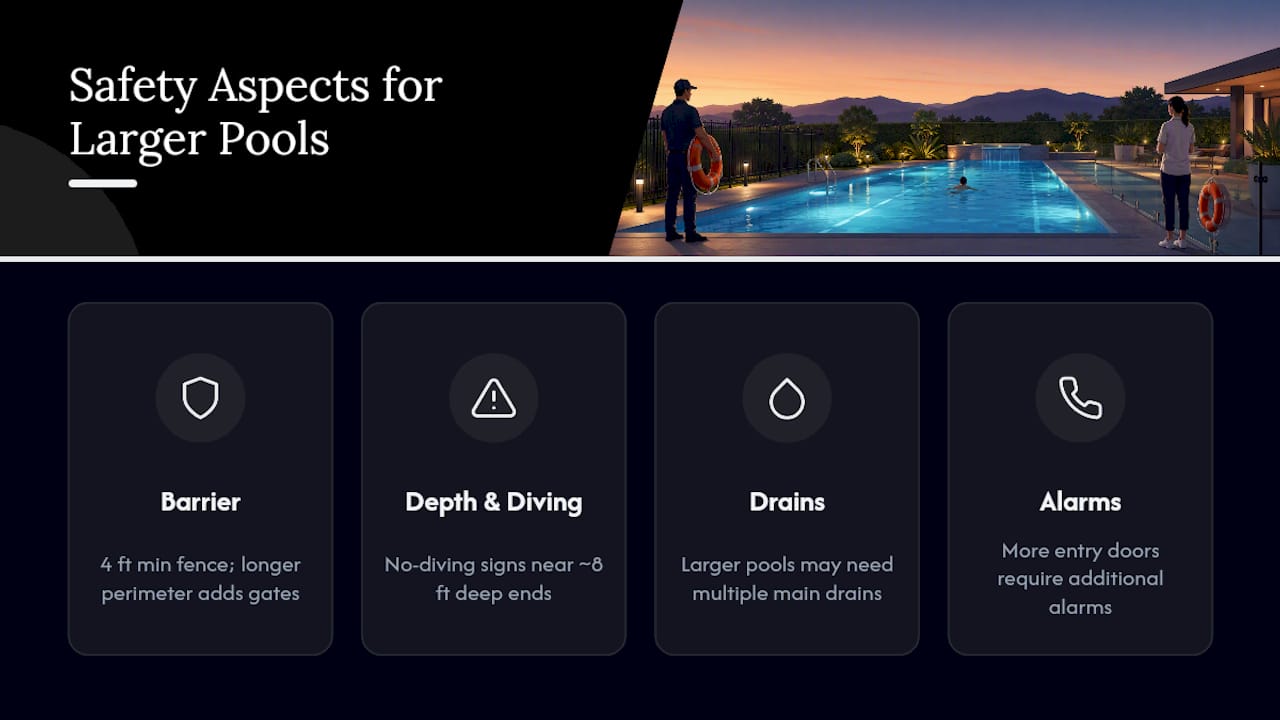
Pool size doesn’t change the fundamentals of pool safety code, but it does change how those codes get applied. Most jurisdictions require a compliant barrier, typically a fence at least 4 feet tall with a self-latching gate, around any residential pool regardless of size. Larger pools often mean a longer perimeter to fence, which raises both material cost and the number of gate access points that need self-closing hardware.
Depth matters for signage and diving restrictions. Pools with deep ends approaching the 8 foot maximum typically require “no diving” markers unless a diving board or slide is engineered specifically for that depth, and many local codes distinguish between diving-rated and non-diving-rated deep ends. Larger pools with expansive shallow areas may also trigger additional requirements around anti-entrapment drain covers, since a bigger surface area often means multiple main drains or suction points rather than one.
Alarms are another consideration that scales with size. Some jurisdictions require pool alarms or door alarms on any structure leading directly to the pool area, and a larger pool with more entry points from the house can mean more alarmed doors to wire in. None of this is exotic. It’s standard pool-safety code applied across a bigger perimeter, which is exactly why it’s worth confirming with your local building department during the permit review rather than assuming your fence plan from a smaller pool project will simply scale up.
Cost implications tied to increasing pool size beyond typical limits
Once you push toward the outer edge of what a fiberglass shell can do, roughly 16 feet wide, 40 feet long, costs stop scaling in a straight line and start climbing faster. A shell at the very top of the size range often needs oversize transport permits, possible police escorts, and a more involved crane rigging plan, all added costs that a mid-size 14×28 or 15×30 shell simply doesn’t trigger.
Site work compounds it. Excavating for a 16×40 shell means moving substantially more soil than a 14×28, and that dirt has to go somewhere, usually a haul-off fee calculated by the load. Decking follows the same pattern: a bigger perimeter means more square footage of pavers or concrete, plus a longer fence run to stay code compliant.
If you’re right at the edge of what a fiberglass shell can practically deliver, it’s worth pricing out a custom concrete build for comparison. Concrete doesn’t have the same transport ceiling, so at very large sizes it sometimes becomes cost-competitive once you’ve added up escort fees, specialized crane rental, and the premium that comes with ordering a shell at the top of a manufacturer’s size chart.
Impact of size limits on pool maintenance and cleaning
Water volume is the variable that quietly drives most maintenance work, and it scales with every foot of length and width you add. A larger pool holds more gallons, which means more chemical volume needed to keep sanitizer levels balanced and a pump and filter system that has to work harder to turn over that larger volume on schedule.
Surface area matters just as much for physical cleaning. A 16×40 pool has roughly twice the surface to skim, brush, and vacuum compared to a 14×28, and that extra area translates directly into more time spent on routine upkeep or a higher bill if you’re paying a service to handle it. Robotic and automatic pool cleaners scale in price with the surface area they’re rated to cover, so a bigger shell often means stepping up to a more capable, and pricier, cleaning tool.
Filtration equipment sizing follows the same logic. A pump and filter matched to a small or medium shell will be undersized for a large one, leading to cloudier water and more frequent manual intervention. Fiberglass surfaces resist algae better than plaster, which helps regardless of size, but a bigger pool still means a bigger surface for that resistance to matter on. None of this makes a large pool unmanageable. It just means the maintenance routine that worked fine on a compact plunge pool needs to scale up alongside the shell.
When fiberglass stops being the right answer and concrete takes over
Fiberglass wins on speed and factory-controlled quality almost every time, but it has a ceiling, and pretending otherwise does readers a disservice. Once you’re pushing past 16 feet wide, past 40 feet long, or want a deep end beyond 8 or 9 feet, you’re no longer shopping for a shell. You’re negotiating with transport regulations and crane physics that no manufacturer can engineer around.
Concrete has no such ceiling. It’s poured in place, shaped to your yard rather than trucked in as one piece, and it’s the honest answer once your ambitions outgrow what a single-mold shell can deliver. Randrswimmingpools builds both, and the right call usually comes down to whether your yard and your wish list fit inside a shell’s practical limits or need something built from the ground up.
— Results
Get a feasibility check before you commit to a size
Some pool contractors provide homeowners with something a spec sheet can’t: an actual site visit that confirms whether the shell you want can get through your gate, past your power lines, and onto a stable crane pad, before you sign anything.

That matters because the biggest sizing mistakes happen on paper, not on site. A 16×40 model might look perfect in a brochure and still be a poor match for a narrow side yard or a driveway that can’t turn a delivery truck. Experienced contractors have handled that evaluation process across Central Florida for decades, whether the right answer turns out to be a mid-size fiberglass shell or a fully custom concrete build for a yard that needs more room to work with.
If you’re weighing your options, start with a site visit and quote for pool construction and bring your rough size wish list. You’ll walk away knowing exactly what your property can support, and what it can’t, before you spend a dollar on a shell.
Sources
- What Sizes Do Fiberglass Pools Come In? (Thursday Pools)
- Essential Steps for Fiberglass Pool Installation (Tracer Companies)
- How to buy a fiberglass pool in 2025 (River Pools eBook)
- Fiberglass Pool Shapes and Sizes KS | Fiberglass Pool Install
