
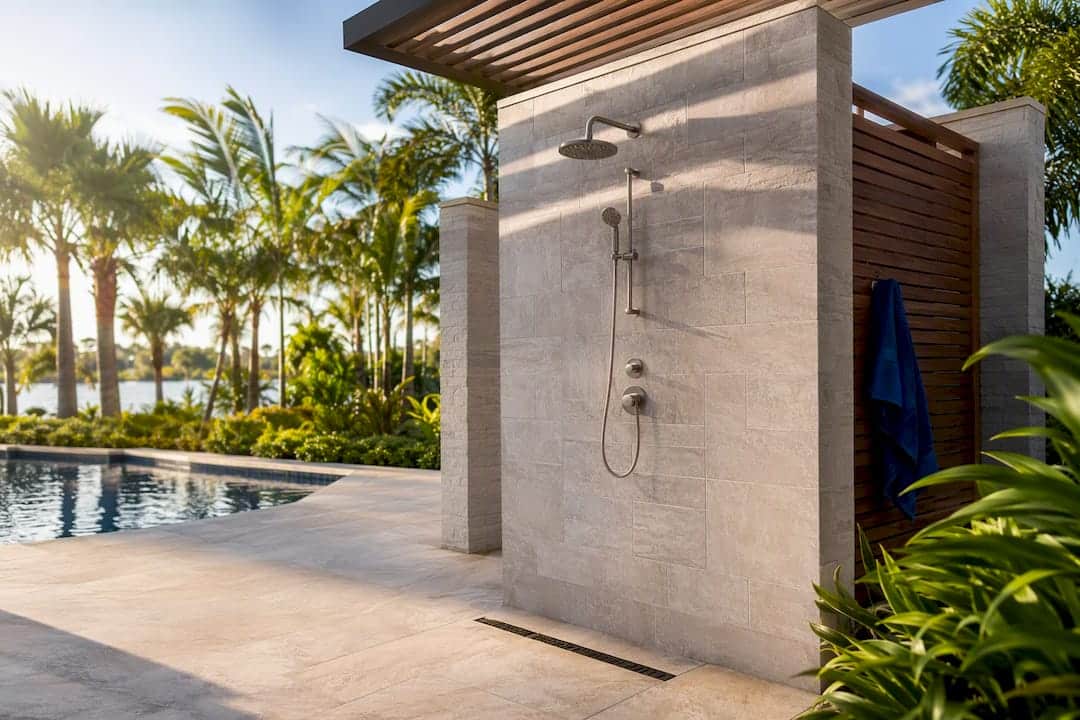
The best outdoor shower ideas fall into a handful of proven types: rustic cedar enclosures, freestanding stainless columns, tiled courtyard showers, teak spa setups, and portable hose-fed units. Each one trades off differently on cost, upkeep, and privacy. Cedar and teak look warmer but need annual sealing; stainless columns cost more upfront but need almost no maintenance; portable kits are cheap and fast but skip the hot water and permanent drainage the built-in versions offer.
TL;DR:
- Use 316L stainless steel fixtures near pools or coastlines to prevent corrosion, which is crucial as cheaper alloys tend to fail quickly in salt air.
- Proper drainage with a slope toward a drain or well is essential for safety, with textured porcelain or slate offering the best slip resistance in wet conditions.
- Hard-plumbed showers with hot water should incorporate pressure-balance valves and exterior drain-down valves to ensure safety and winterization.
- Budget-friendly options like hose-fed units lack hot water and drainage, making them suitable for temporary or seasonal use, especially for renters.
- Planning the shower during pool construction or using integrated plumbing reduces long-term costs and simplifies installation and maintenance.
Table of Contents
- 8 Outdoor Shower Ideas Worth Copying
- Which Materials Actually Survive Outdoors?
- Flooring, Drainage, and Slip Resistance
- Plumbing, Hot Water, and Winterizing Without Wrecking Your Pipes
- DIY Kit or Hired Pro? What the Cost Ranges Tell You
- Keeping It Clean: Maintenance and Seasonal Care
- What a Backyard Contractor Wishes Every Homeowner Knew
- An Installer’s Take on Getting It Right
- Bring Your Outdoor Shower Vision to a Backyard Pro
- Sources
8 Outdoor Shower Ideas Worth Copying
Not every style suits every yard. A few of these work best tucked against a fence line; others need open sky and a pool deck nearby. Here’s where each one earns its place.
-
Rustic cedar enclosure. Vertical cedar slats built into a three-sided box give privacy without a roof, and the wood silvers into a soft gray over a couple of seasons. Best for wooded lots or cottage-style yards; expect moderate installation complexity since you’re framing and fastening panels, not just bolting a fixture to a wall.
-
Freestanding stainless column. A single upright column with a shower head and foot-wash valve. No enclosure, no privacy, minimal footprint. Ideal next to a pool where modesty isn’t the point, just rinsing off chlorine and sand.
-
Tiled courtyard shower. A fully enclosed, roofed space with tile walls and floor, closer to an outdoor bathroom than a rinse station. Highest cost and complexity, but it’s the only style here that functions in cooler months.
-
Coastal rinse station. Simple, salt-tolerant hardware mounted on a post near a beach path or pool gate. Built for speed, not lingering.
-
Pergola-covered shower. Open-air structure with a slatted roof for dappled shade and a sense of enclosure without full walls. Works well paired with climbing vines for natural screening.
-
Integrated poolside shower. Plumbed directly into the pool equipment area, sharing trenching and often a footing with the pool deck. Best planned during initial construction rather than added later.
-
Minimalist privacy-screen shower. A single stainless or teak fixture paired with a slatted or louvered screen instead of full walls. Compact footprint, moderate privacy, low installation complexity.
-
Portable or hose-fed shower. Freestanding units that connect to a garden hose with no plumbing tie-in at all. The fastest and cheapest option, and a fair one for renters or seasonal properties.
Which Materials Actually Survive Outdoors?
Material choice determines whether your shower looks good for two years or twenty. Outdoor fixtures face constant moisture, UV exposure, and, near a pool, chlorine and salt spray that eat through cheaper metals fast.
- 316/316L stainless steel is the standard for coastal or pool-adjacent installs because it resists chloride-induced corrosion, including at welded joints where cheaper alloys tend to fail first, according to Nattura Shower’s materials guide.
- 304 stainless holds up fine inland, away from salt air or heavy pool splash, at a lower price point than 316L.
- Brass or copper develop a patina over time and work well in traditional or farmhouse-style yards, though they need occasional polishing if you want to keep the shine.
- Teak and cedar bring warmth and texture but require yearly oiling or sealing to resist graying and splitting.
- Powder-coated steel and composites are budget-friendly and low-maintenance, but check the coating warranty since chips expose bare metal to rust.
Pro Tip: If your shower sits within about 50 feet of a pool or coastline, spend the extra money on 316L. The savings from 304 stainless disappear fast once you’re paying to replace corroded fittings after two Florida summers.
Flooring, Drainage, and Slip Resistance
Flooring gets overlooked until someone slips on wet tile. Textured porcelain, slate, teak decking tiles, pebble mosaic, and broom-finished concrete all perform well in wet, high-traffic zones, with nine common floor options ranging in cost, grip, and drainage behavior.
- Slope the pad with an appropriate gradient toward a drain or dry well; a small composite pad over gravel with a linear PVC drain is a common detail many contractors use.
- Skip polished stone or glossy tile in the shower zone entirely.
- For slip resistance, look for a wet DCOF rating of 0.42 or higher, or an R11 rating, which Omni Surfaces identifies as the threshold for safe wet-area flooring.
Textured porcelain performs reliably for slip resistance and handles freeze-thaw cycles well in colder climates.
Plumbing, Hot Water, and Winterizing Without Wrecking Your Pipes
Three setups cover almost every backyard: hose-fed units with no plumbing at all, house-mounted kits tied into an exterior spigot, and hard-plumbed showers run on dedicated lines with their own shutoffs. Hose-fed is fine for a quick rinse station; anything with hot water or a fixed location deserves real plumbing.
-
Add hot water safely by tying into the house supply with PEX and a pressure-balance valve, which prevents scalding when someone flushes a toilet or starts the dishwasher mid-shower. This Old House’s installation walk-through recommends running a dedicated interior shutoff plus an exterior drain-down valve for exactly this reason.
-
Install shutoffs where you can reach them. An interior valve lets you isolate the line without shutting off water to the whole house.
-
Winterize before the first hard freeze. Drain the line completely, then follow with a compressed-air blow-out if you’re in a freeze-prone area. Never use automotive antifreeze on potable lines; it’s toxic, and Practical Sailor’s winterizing guidance is blunt about that. Food-grade propylene glycol is the only acceptable substitute if a straight drain-down isn’t enough.
Pro Tip: Label your shutoff valves the day you install them. Six months later, nobody remembers which one feeds the outdoor shower, and that’s how a small leak turns into a wet crawl space.
DIY Kit or Hired Pro? What the Cost Ranges Tell You
Hardware-only kits for a house-mounted shower run roughly $100 to $1,000, while freestanding columns and designer towers land closer to $800 to $3,800 once you account for finish and fixtures. Installed costs, factoring in two to five hours of plumber labor for anything hard-plumbed, typically fall between $500 and $1,400 for house-mount kits, and $900 to $3,800 for freestanding columns and custom enclosures, according to Modland’s cost guide.
- A plug-and-play portable tower starting around $120 skips plumbing entirely, and a pre-cut cedar kit can go up in an afternoon.
- Hard-plumbed hot water, drainage tie-ins, and any structural anchoring into a pool deck or footing are where DIY should stop.
- If your project needs a permit, touches an existing water heater line, or shares drainage with pool equipment, bring in a licensed contractor rather than guessing at code.
Keeping It Clean: Maintenance and Seasonal Care
Annual maintenance costs stay near $0 to $60 for stainless fixtures and climb higher for wood, which needs sealing or oiling yearly to fight graying and cracking, per Modland’s estimates.
- Rinse mineral deposits off stainless with a vinegar solution a few times a season.
- Reseal teak or cedar once a year, more often in full sun.
- Scrub grout lines and check the drain for debris before it slows to a trickle.
- Pair 316 or 304 stainless with a composite deck for the lowest combined maintenance load.
Pro Tip: Mold loves shaded, poorly drained corners. If your shower sits under a pergola, check the base after heavy rain and clear standing water before it turns green.
What a Backyard Contractor Wishes Every Homeowner Knew
Run 3/4-inch PEX through the equipment trench while it’s already open, cap the ends, and label them for future expansion. Anchor columns on real concrete footings, not just decorative pavers. Plan drainage slope before you pick tile. And when you’re hiring anyone, ask to see a portfolio and a written warranty before signing anything.
An Installer’s Take on Getting It Right
Pick a style that matches how your family actually uses the yard, not the one that photographs best. A shower for rinsing kids off after the pool needs different placement and drainage than one built for a quiet garden soak. Plan for who will maintain it and how they’ll reach the valves, long before the tile goes down.
— Results
Bring Your Outdoor Shower Vision to a Backyard Pro
A cedar enclosure or stainless column looks great in a photo, but the showers that hold up for years are the ones planned alongside the plumbing, drainage, and footings already going into your yard. Experienced pool builders in Central Florida can plan your shower to share a trench, a water line, and a drainage plan with your pool instead of it being added as an afterthought.

That kind of integration is where a contractor earns their fee. Permits, hot-water tie-ins, and anchoring a column into a structural footing are exactly the parts of this project that go wrong without someone who’s pulled the permits before. If you’re also weighing enclosure materials or a privacy screen, a resource like One Day Doors & Closets’ guide to bathroom-grade doors is worth a look for finish ideas.
If you’re planning a new pool and want the shower built into the design from day one, start with a look at new pool construction and request a quote.
Sources
- How to hook up water to an outdoor shower – This Old House
- Outdoor Shower Materials Guide | Why AISI 316L Stainless Steel Matters – Nattura Shower
- 2025 Cost-&-Material Guide to Building a Weather-Proof Outdoor Shower – Modland
- Outdoor Shower and Pool Bath Surfaces That Actually Hold Up – Omni Surfaces
- Practical Sailor — winterizing best practices and antifreeze safety