
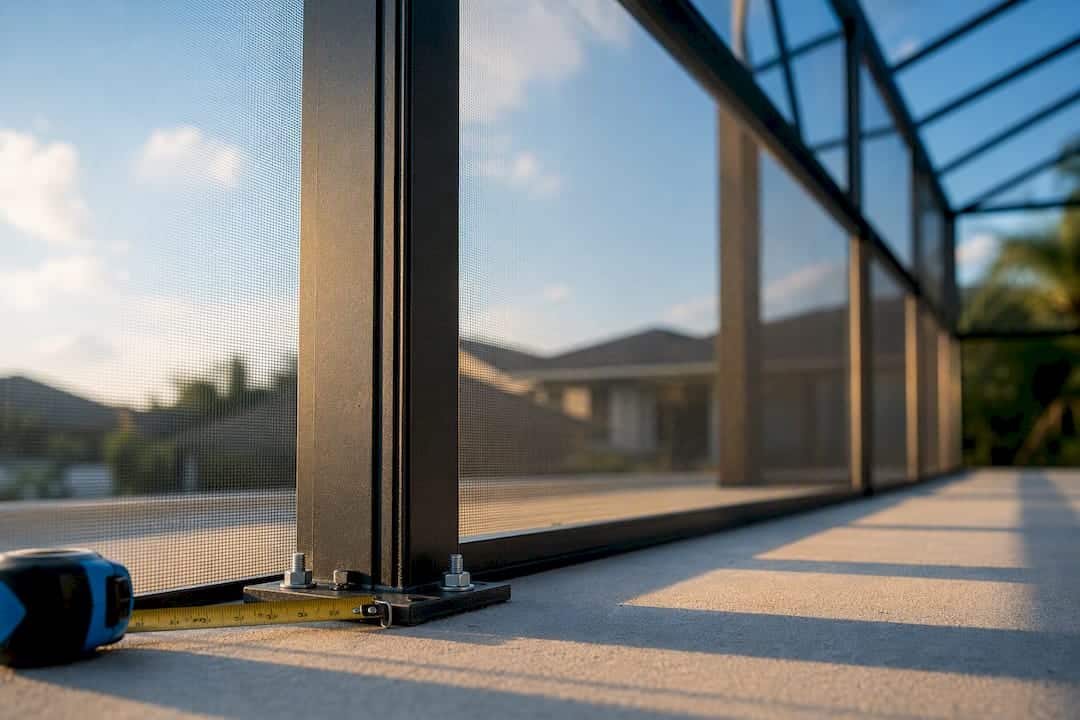
Most Florida homeowners pay within a broad range for a professionally installed pool screen enclosure, with average costs typically reflecting local wind zone, deck condition, and roof complexity factors. Where you land in that range comes down to your wind zone, the condition of your existing pool deck, and how complicated the roofline is. Get a site-specific quote before you budget anything firm.
TL;DR:
- Coastal properties require higher engineering costs due to stricter wind-load requirements, often increasing total expenses by 20-30%.
- Roof style impacts price, with flat roofs being the cheapest while cathedral and hip roofs can add 15% to 25% to the enclosure cost.
- Site conditions like slab edge distance and lot access can add thousands of dollars for foundation modifications and complicate installation.
- Quotes lacking signed and sealed engineering plans pose significant risks, especially in hurricane zones, and can void insurance coverage after storm damage.
- Estimating costs involves calculating total area, applying per-square-foot rates, and adding 8% to 15% for permits, engineering, and extras.
Table of Contents
- How Much Does a Pool Screen Cost in Florida on Average?
- What Drives the Price of a Pool Cage in Florida?
- How Do You Estimate Your Own Enclosure Cost?
- What Permits and Building Code Rules Apply to Florida Screen Enclosures?
- What Should You Ask Contractors Before Signing a Quote?
- How Much Should You Budget for Maintenance and Lifespan?
- Why Central Florida Site Conditions Change Your Quote
- The Real Trade-Off: Cheap Now or Sound Later
- Get a Site-Specific Estimate From Randrswimmingpools
- Sources
How Much Does a Pool Screen Cost in Florida on Average?
That $12 to $25 per square foot corridor holds up across most of the state, but where a project falls inside it depends heavily on geography and design. A flat-roof enclosure on a slab in good condition sits at the low end. A cathedral or hip-roof design with heavier engineering pushes toward the high-end fast, according to HomeGuide’s cost data.
Three example footprints show how that math plays out on a real backyard:
- 15×30 pool with a modest lanai (approximately 900 sq. ft. of screen area): typically on the lower side of the cost spectrum
- 20×40 pool with a full-size lanai (approximately 1,600 sq. ft.): generally higher, reflecting size and features
- 30×50 pool with an extended patio and screened side yard (approximately 2,800 sq. ft.): tends to incur the highest costs.
Coastal properties in high-velocity hurricane zones typically face increased costs due to stricter engineering and code requirements. Stricter wind-load rules and mandatory signed-and-sealed engineering documents in those areas, as required under Florida’s high-velocity hurricane zone code for screen enclosures, add cost that inland Central Florida homeowners rarely see. If you’re near the coast, budget toward the upper half of the range from the start rather than getting surprised by a bid that looks “too high” compared to a friend’s inland quote.
What Drives the Price of a Pool Cage in Florida?
Five factors do almost all the work in moving a quote up or down, and understanding each one tells you where you actually have control and where you don’t.
Size and geometry. Bigger enclosures use more aluminum and mesh, obviously, but shape matters just as much as square footage. An enclosure wrapped around an irregular deck with multiple angles costs more per square foot than a simple rectangle, because every corner and transition needs extra framing and labor.
Roof style. A basic flat or shed roof is your cheapest option. Step up to a cathedral roof, and you’re often looking at a 15% to 25% premium over flat, because the ridge beams, extra bracing, and taller aluminum sections all add material and installation time. Hip roofs and multi-level designs land somewhere in between, and they tend to fit better against a two-story home’s sightlines. Our guide to pool enclosure types breaks down which roof style suits which home.
Materials and hardware. Aluminum gauge, mesh weight, and fastener quality don’t show up as a separate line item on most quotes, but they should. Thin extrusions and standard hardware save money upfront and cost you in five years when fasteners start staining and panels start flexing in a summer storm.
Wind-load engineering. This is the big one. Florida requires enclosures to be engineered for the wind speeds assigned to your specific address, and that engineering has to be signed and sealed by a licensed professional under Florida Building Code rule 61G20-1. Bracing, anchor spacing, and beam sizing all scale with your wind zone, and that’s not negotiable no matter how tight your budget is.
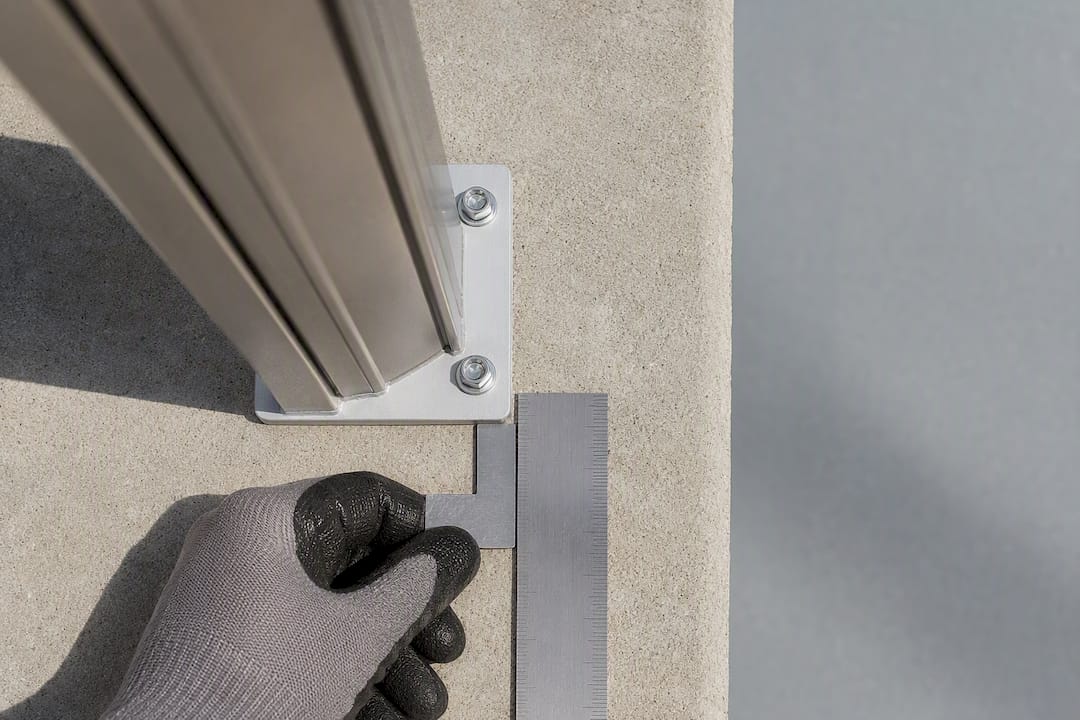
Site conditions. If your existing slab doesn’t have enough edge distance to anchor the enclosure safely, expect a footer extension or slab thickening. That single fix can swing your per-square-foot number more than any other line item on the quote.
Pro Tip: Ask every contractor for the edge distance measurement on your slab before they finalize a bid. It’s a five-minute check that can expose a $2,000 to $5,000 surprise before you sign anything.
How Do You Estimate Your Own Enclosure Cost?
You can build a workable ballpark yourself before calling a single contractor. Here’s the process:
- Measure your total screen area, not just the pool footprint. Include the lanai, any covered patio, and side yards that will be enclosed. A 15×30 pool with a 10×30 covered lanai gives you roughly 750 sq. ft. of usable pool space plus 300 sq. ft. of lanai, for a total closer to 1,000 to 1,100 sq. ft. once you add walkway margins.
- Apply the per-square-foot range. At $12 low, $18 typical, and $25 high, a 1,000 sq. ft. project runs $12,000 low, $18,000 typical, and $25,000 high before extras.
- Add what per-square-foot pricing doesn’t cover. Permits, engineering fees, and any concrete remediation sit outside that base rate. Budget an additional 8% to 15% on top of your per-square-foot estimate to cover those items realistically.
Run the same math on a 1,600 sq. ft. footprint and you get $19,200 to $40,000 before extras, which lines up with the medium-project range covered earlier. This gives you a number to walk into your first consultation with, not a guess.
What Permits and Building Code Rules Apply to Florida Screen Enclosures?
Every legitimate pool enclosure project in Florida runs through a permitting process, and skipping it is a decision that comes back to bite homeowners at resale or claim time. The state assigns ultimate design wind speeds by location, and local building departments use those figures, drawn from Florida Building Code wind-load provisions, to determine how your specific enclosure has to be engineered.
Base permit fees in most Florida cities start around $75 to $150, but that’s just the application. Plan review, inspections, and any HOA-required documentation add to the total, and most contractors fold these costs into their quotes rather than listing them separately.
Enclosures in wind-borne debris regions may rely on removable or retractable panel provisions, and when a design uses that approach, the contractor is required to notify both the homeowner and the local building department under the same code section governing enclosure engineering.
That’s not a bureaucratic detail. An unpermitted enclosure can complicate a home sale, trigger a red tag from the building department, and in some cases void a homeowner’s insurance coverage entirely if storm damage occurs on unpermitted structural work. Our guide to pool permits in Central Florida walks through what your local jurisdiction will actually require.
What Should You Ask Contractors Before Signing a Quote?
A cheap bid that skips engineering documentation isn’t a bargain. It’s a liability you’re inheriting. Before comparing prices, hand every contractor the same set of facts and ask for the same breakdown back.
Give them:
- Your property address (wind speed and flood zone vary by location, even within the same county)
- Current slab condition and age, including any known cracking near the pool edge
- HOA design restrictions, if applicable, including height and color limits
Ask them for:
- A line-itemed quote separating materials, labor, engineering, permits, and footer work
- Copies of the signed and sealed engineering plans they’ll file with the permit
- The specific aluminum gauge and fastener type they’re using, and whether those fasteners are rated for corrosion resistance
Pro Tip: If a contractor can’t produce a sample of a signed and sealed engineering plan from a past project within a day of asking, treat that as a warning sign, not an inconvenience.
Watch for vague scope language, no mention of local references, or a bid that comes in noticeably below every other estimate with no explanation for the gap. Contractors managing tight access sites sometimes bring in outside logistics help, similar to how One Day Doors & Closets of Central Florida handles constrained-access installations on the home improvement side. If your bid doesn’t account for access challenges on your lot, ask why.
How Much Should You Budget for Maintenance and Lifespan?
A well-maintained screen enclosure lasts 10 to 15 years before a full rescreen, though Florida’s UV exposure and salt air near the coast can shorten that window. Rescreening a mid-size enclosure typically costs a fraction of the original install, since the aluminum frame usually stays in place.
- Choose stainless steel or coated fasteners in coastal zones to slow corrosion around anchor points
- Schedule a yearly visual inspection for loose panels, sagging mesh, and rust streaks near screws
- Fix small tears and loose fasteners immediately rather than waiting for storm season to expose them
Why Central Florida Site Conditions Change Your Quote
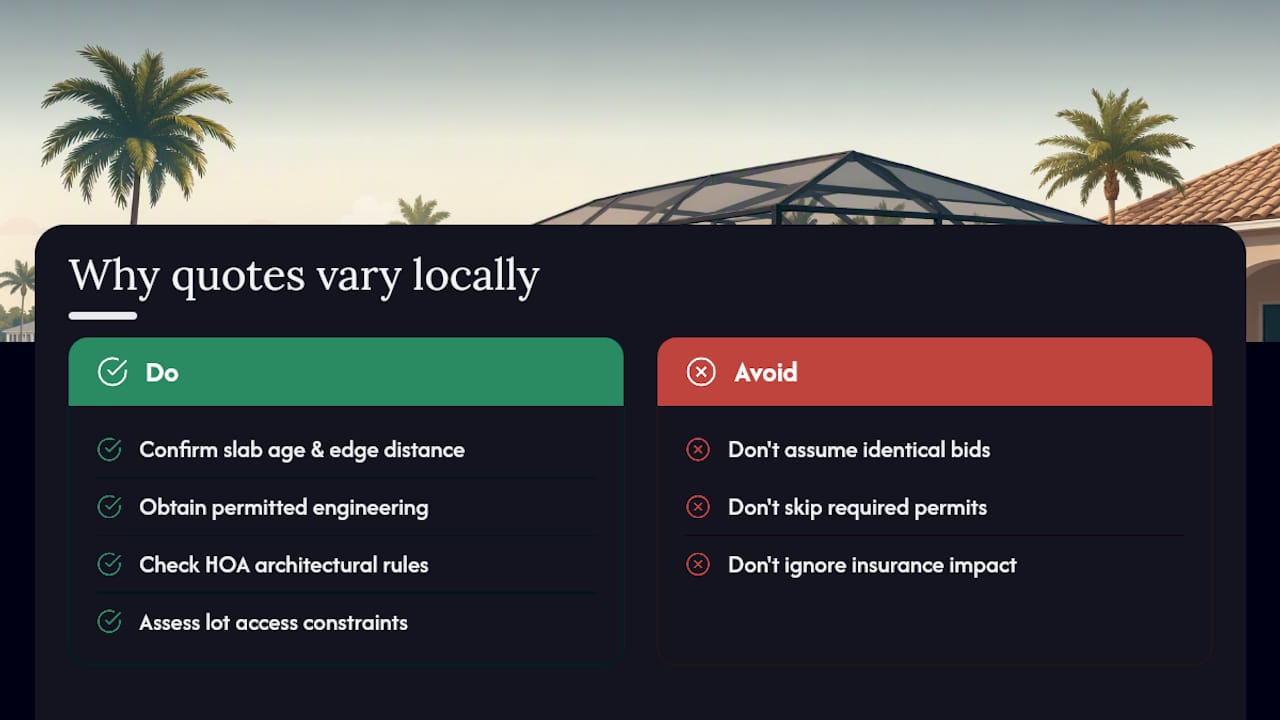
Central Florida’s mix of aging slabs, tight HOA architectural review, and varied lot access means two homes on the same street can get meaningfully different bids for what looks like the same enclosure. A slab poured in the 1990s often needs edge-distance verification that a newer build skips entirely.
Documented, permitted engineering protects more than your enclosure. It protects your insurance standing after a named storm. Randrswimmingpools has worked through these local variables across Central Florida since 1985, and homeowners planning ahead can find deeper budgeting detail in our Pool School resources or our overview of financing options for larger backyard projects.
The Real Trade-Off: Cheap Now or Sound Later
The lowest bid on your desk right now is rarely the cheapest option over ten years. Thinner aluminum and skipped reinforcement lower the sticker price today and raise your risk of storm damage, insurance disputes, and a rescreen job coming sooner than it should. An engineered, permitted enclosure costs more upfront because it’s built to survive the wind event it’s rated for, not just pass inspection on paper.
If you’re choosing between two quotes and one has no engineering documentation attached, that’s not really a choice between “cheap” and “expensive.” It’s a choice between a structure and a gamble.
— Results
Get a Site-Specific Estimate From Randrswimmingpools
Every number in this guide is a starting point, not your final answer. Your actual quote depends on your address, your slab, and your roofline, and the only way to nail that down is a site visit. Experience with permitting, engineering coordination, and wind-zone requirements is important for managing your project’s needs. They’re a process we already know.
If you’re planning a new pool alongside your enclosure, our custom pool installation guide for Central Florida homes walks through how the two projects come together on one timeline and one permit set. Ready for real numbers instead of a range? Request a free, site-specific estimate and find out what your actual backyard costs to enclose.
Sources
- 61G20-1 (Florida Building Code rule on aluminum screen enclosure design)
- High-Velocity Hurricane Zones — Screen Enclosures (UpCodes)
- Pool enclosure cost guide (HomeGuide)