
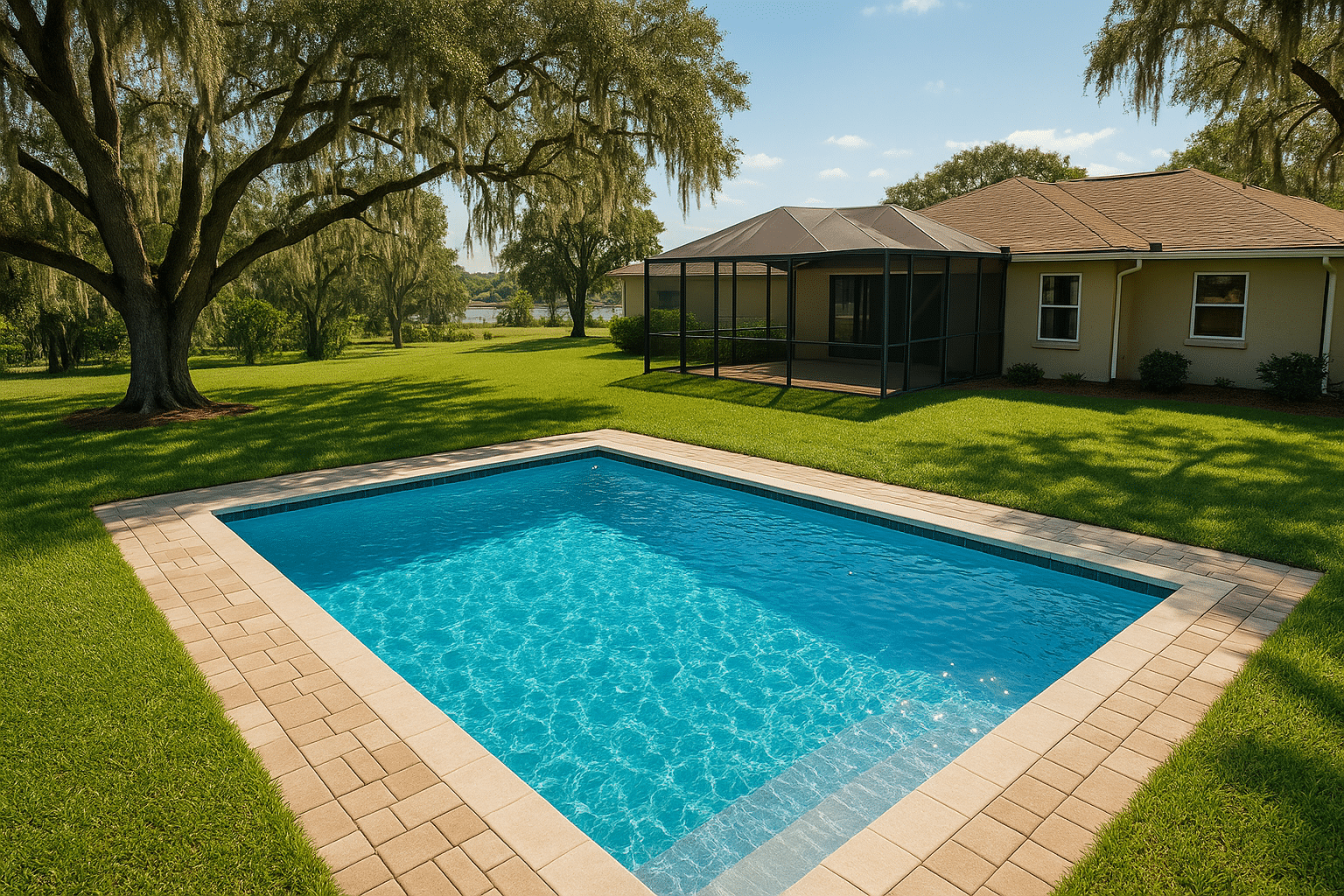
TL;DR: Every inground pool in Lake County, Florida requires a building permit — plus trade permits for electrical and plumbing — before a single shovel breaks ground. Permit fees across Florida typically range from $400 to $1,800 depending on pool size, design complexity, and your specific municipality. A licensed pool builder handles all permitting on your behalf, so understanding the process helps you set realistic expectations for timeline and budget.
You’ve picked out the pool design, crunched the numbers, and you’re ready to move forward. Then someone mentions permits — and suddenly the process feels a lot more complicated than it did on the showroom floor.
The good news: if you hire a licensed pool builder, the permitting process runs in the background. The better news: once you understand what it involves, it stops being intimidating and starts being something you can plan around.
Here’s a plain-language breakdown of what pool permits cost in Lake County, FL, what the process looks like from application to final inspection, and what state safety rules you need to know before your project starts.
Why You Need a Pool Permit in Lake County
Permits aren’t optional. Per Florida Building Code Section 105.1, any owner or authorized agent who intends to construct a structure — including a swimming pool — must apply to the building official and obtain the required permit before work begins.
This applies across all of Lake County, whether your home sits in unincorporated areas or within one of the county’s 14 municipalities (The Villages, Lady Lake, Leesburg, Eustis, Mount Dora, Tavares, Clermont, and others). Each jurisdiction issues its own permits, which is why your builder confirms jurisdiction before submitting anything.
Building without a permit creates serious problems: work-stoppage orders, doubled fees, difficulty selling your home, and potential liability if something goes wrong. As permit guides for Lake County note, working without proper permits can result in fines, project delays, or even removal of completed work.
What Permits Does a Pool Project Require?
A residential inground pool isn’t covered by a single permit. Most projects require several:
- Building permit — required for all new inground pools; covers the shell, structure, and decking
- Electrical permit — needed for pool lighting, pumps, and all associated wiring
- Plumbing permit — covers the plumbing tied to pool equipment, water features, and spa jets
- Screen enclosure permit — if you’re adding a lanai or pool cage (a separate permit in Lake County)
- Notice of Commencement — a recorded document required before the first inspection on any project valued over $5,000
In Lady Lake and similar Lake County municipalities, all swimming pool permits include electrical, plumbing, and plan review as bundled line items, with state surcharges calculated on top. If you’re adding a wood deck or platform for pool entry, that requires its own separate permit as well.
How Much Does a Pool Permit Cost in Lake County?
Permit fees in Florida — including Lake County — are calculated based on the declared construction value of your project, not a flat rate. That means a larger, more complex pool costs more to permit than a standard shell.
Across Florida, pool permits typically cost between $400 and $1,800, depending on your county and the complexity of your pool design. Lake County municipalities generally fall within that range, with the total varying based on pool size, added features (spa, water features, screen enclosure), and which jurisdiction your property sits in.
On top of the base permit fee, Florida law requires two state surcharges on every permit:
- 1.5% Building Code Administrators (BCA) Surcharge
- 1.0% Department of Business and Professional Regulation (DBPR) Surcharge
These percentages are applied to each permit type and added to the total at checkout. The minimum charge for each surcharge is $2.00 if the calculated amount falls below that threshold.
Lake County’s Building Services division offers a self-guided fee estimator online where you can answer a few questions about your project and get an approximate cost — including any impact fees — before you submit a formal application.
What About Impact Fees?
In some parts of Lake County, particularly in growing communities like Clermont, Minneola, and Groveland, your project may also trigger transportation or utility impact fees. These are one-time charges assessed by the county or municipality and are separate from the building permit fee. Your builder and the county’s fee estimator tool will flag these if they apply to your parcel.
The Pool Permitting Process: Step by Step
Here’s how a typical pool permit moves from application to final approval in Lake County:
- Jurisdiction check — Your builder confirms whether your property falls under unincorporated Lake County (handled by the Lake County Building Services Division at 315 W. Main Street, Tavares) or within a municipality that runs its own permitting office.
- Application submission — All Lake County permit applications are submitted online through the Accela Citizen Access portal. Your builder uploads the application, pool schematic plans, a scaled site plan showing pool placement and setbacks from property lines and structures, and a completed Pool Safety Affirmation form identifying the required barriers.
- Plan review — Reviewers from building, electrical, and plumbing check the submittal for Florida Building Code compliance. If comments come back, your builder responds and resubmits — resubmittals re-enter the review queue, which is one reason first-time accuracy matters.
- Permit issuance and Notice of Commencement — Once approved, fees are paid, the permit is issued, and a Notice of Commencement is recorded before the first inspection.
- Inspections during construction — Multiple inspections occur at key milestones: excavation, steel (for gunite pools), plumbing rough-in, electrical rough-in, gunite/fiberglass shell placement, and decking.
- Final inspection and Certificate of Completion — After all inspections pass and all required safety features are in place, the building department issues a Certificate of Completion. No pool can be filled and used until this is issued.
Building Services is open Monday through Friday, 8 a.m. to 4 p.m., and walk-in submittals are scanned into the system and reviewed in date order alongside online submissions.
Florida Pool Safety Requirements: What the Law Requires
One of the most important parts of the permit process is the safety barrier inspection. Florida has some of the strictest residential pool safety laws in the country — and they apply to every new pool built in Lake County.
Under the Florida Residential Swimming Pool Safety Act (Chapter 515, Florida Statutes), every new residential pool must include at least one of the following approved safety features to pass final inspection:
- An isolation fence (barrier) that separates the pool from the home, with a self-closing, self-latching gate
- An approved safety pool cover that meets ASTM F1346 performance standards
- Door and window exit alarms on all access points from the home to the pool area, rated at a minimum of 85 dB(A) at 10 feet
- A subsurface pool alarm that sounds when someone enters the water, compliant with ASTM F2208
If you choose the fence option — the most common choice — here’s what the law requires for the barrier itself:
- At least 4 feet tall on the outside (measured from finished ground level on the access side)
- No gaps, openings, indentations, or protrusions that could allow a young child to crawl under, squeeze through, or climb over
- Gates must be self-closing and self-latching, opening outward away from the pool
- No permanent structures nearby that could be used to climb the barrier
The pool barrier must completely surround the pool and separate it from all non-pool areas of the property. A Certificate of Completion cannot be issued until the required safety feature is verified and approved.
Who Pulls the Permit — You or Your Builder?
Your licensed pool builder pulls the permit. This is standard practice and the right way to do it. As Lady Lake’s building services department notes, if a contractor asks you to secure the permit yourself, that’s a warning sign — they may not be licensed, which puts the homeowner entirely at risk.
A licensed builder carries the required state license, liability insurance, and workers’ compensation coverage, all of which must be on file before a permit is issued. At R & R Swimming Pools, we handle the full permit package — application, plans, trade permits, inspections, and final walkthrough — as part of every project. You don’t have to chase paperwork.
How Permits Affect Your Project Timeline
Permit review is typically the longest single wait in a pool project, and it runs before construction can begin. In Lake County, plan review timelines vary by season and current workload. During peak building periods, expect two to four weeks for initial review; resubmittals add time.
This is one reason fiberglass pools can move faster overall: engineering plans are largely pre-approved at the manufacturer level, which can simplify the local review. For a custom gunite pool with unique features, the plan set is more detailed, which can mean a longer review window.
As a general guide, fiberglass pool projects from contract to completion typically run 2 to 4 months, and custom concrete (gunite) projects run 4 to 6 months — permit review time included. See our fiberglass vs. concrete cost comparison for a full side-by-side breakdown of both pool types, including timeline differences.
Does Permitting Add to My Total Pool Budget?
Yes — permit fees, state surcharges, and any related costs (survey, Notice of Commencement recording fee, screen enclosure permit) are real line items in your pool budget. For most Lake County homeowners, the total permitting cost lands between a few hundred and roughly $1,500 to $2,000 when you add up all trade permits, surcharges, and ancillary fees.
That’s a small fraction of a total pool investment. For current overall pricing, our Central Florida inground pool cost guide breaks down what you can expect to spend on each phase of a new build.
If you’re financing your pool, permit costs are typically rolled into the total project amount. R & R Swimming Pools works with Lyon Financial and Viking Capital to connect homeowners with pool-specific loan options. Our pool financing guide for Florida walks through the most common loan types, what lenders look for, and how to get pre-qualified.
Ready to Start? Here’s What Happens Next
When you work with R & R Swimming Pools, the permitting process is handled entirely by our team. We’ve been building pools in Lake County and Central Florida since 1985 — more than 1,000 pools and spas — and we know every jurisdiction’s requirements, current review timelines, and how to get your application approved the first time.
Contact us to schedule a design consultation, and we’ll walk you through design, permitting, construction, and final walkthrough from start to finish.
Recommended Reads
- Fiberglass vs. Concrete Pool Cost in Florida: A Side-by-Side Breakdown
- How Much Does an Inground Pool Cost in Central Florida? (2025 Pricing Guide)
- How to Finance a Pool in Florida: Loan Options, Lenders, and What to Expect
