TL;DR: A custom gunite concrete pool in Central Florida typically takes 4 to 6 months from signed contract to swimming, with permitting, excavation, steel and plumbing, gunite application, a critical 28-day cure, and finishing each taking their own chunk of time. Weather, permit office workload, and design complexity are the biggest variables that can stretch or shrink that window.
If you’re planning a custom concrete pool, the question everyone asks first is simple: how long until we can actually swim in it? The honest answer is that a gunite pool build is a multi-month process, and understanding why each phase takes the time it does will help you plan your budget, your backyard, and your patience.
Below is a realistic, month-by-month breakdown of what happens between signing a contract and your first swim, along with the factors that most often speed up or slow down a Florida build.
The Short Answer: 4 to 6 Months, Start to Finish
For a fully custom gunite concrete pool, most Central Florida builds run 4 to 6 months from the day the contract is signed to the day the pool is filled and swim-ready. That window includes design and engineering, permitting, excavation, steel and plumbing rough-in, gunite application and curing, tile and decking, and the final interior finish and fill.
Industry data backs up this general range.
In general a pool takes about 8-12 weeks depending on a multitude of issues that can come up throughout the build process
, and other builders report that
gunite pool construction tends to take up to 12-16 weeks or more
once every phase and possible delay is factored in. Florida’s permitting and inspection requirements, discussed below, are often what pushes a project toward the longer end of that range.
If you’re still deciding between shell types, our side-by-side breakdown of fiberglass vs. concrete pool cost covers how timeline differences factor into overall budget.
Phase 1: Design, Engineering, and Permitting (2 to 6+ Weeks)
Before any dirt moves, your design has to be finalized, engineered, and approved by the local building department. This phase varies more than any other, and it depends heavily on your county’s current workload.
- Design and contract: Finalizing shape, depth, features, and equipment selections.
- Engineering: A structural engineer stamps the plans for your specific soil and site conditions.
- Permit submission and plan review: Your builder submits site plans, structural drawings, and safety barrier documentation to the county.
Plan review timelines differ by jurisdiction. Some builders report that
many pool permit applications in Florida take one to two weeks for review before construction can begin
, while other sources note the
approval typically takes 2-6 weeks through the county building department
. If your property is in an HOA-governed community, add time: HOA design review can run an additional several weeks before the county application is even submitted.
Central Florida Permitting Considerations
Florida’s building code requires specific safety compliance before a permit is finalized, including pool barrier and gate standards. According to national pool safety guidance,
most states follow core CPSC-based standards: a barrier at least 4 feet tall, gaps no wider than 4 inches, self-closing and self-latching gates, full four-sided enclosure, and no climbable features
. These barrier requirements matter because they’re enforced through your local building department’s inspection process, and missing a detail here can add days or weeks to your permit timeline.
Phase 2: Excavation and Steel (1 to 2 Weeks)
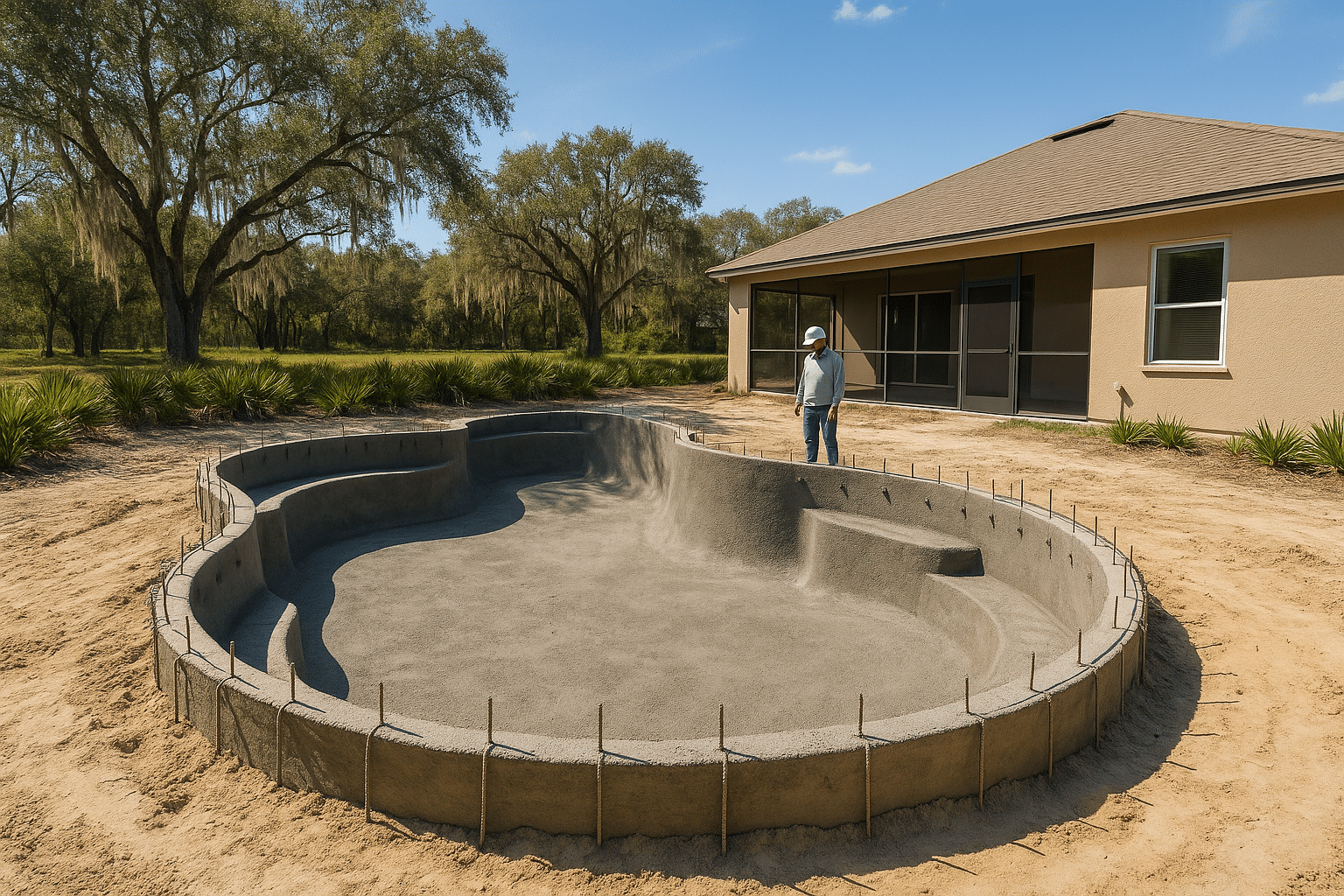
Once permits are in hand, excavation typically moves fast, usually just a few days depending on soil conditions and yard access. Crews then set the steel rebar framework that gives the shell its structural skeleton, along with the plumbing lines and electrical conduit that will run underneath and around the pool.
This is also when your builder locks in shell thickness specifications. If you want to understand what that steel-and-concrete combination actually delivers in terms of strength, see our guide on how thick a concrete pool shell should be.
Phase 3: Gunite Application (1 to 2 Days of Work, Then a Hold)
This is the phase most homeowners picture when they think “pool construction.” A specialized crew sprays the gunite (a pneumatically applied concrete mixture) over the steel framework to form the shell itself.
The spraying itself is quick. What follows is not.
Phase 4: The Critical Curing Period (Up to 28 Days)
This is the single biggest fixed-length phase in the entire build, and it cannot be rushed without compromising the pool’s structural integrity.
Concrete applied by the gunite process needs to cure for roughly one month (28 days) for the particles and molecules in the concrete mixture to fully bond together and reach their maximum strength and durability.
Some builders will move forward with certain finishing steps sooner, since
curing a gunite pool usually takes 7 to 28 days, depending on the outside temperature, pool shape, and overall construction conditions.
Reputable builders won’t cut this corner. As one industry source explains,
this curing process can last up to 28 days before the structure is ready for the next steps, as explained by experts at the American Concrete Institute.
Skipping or shortening this window is one of the most common causes of long-term cracking and structural issues in poorly built pools.
The good news: curing time isn’t wasted time. Reputable crews use these weeks productively.
This waiting period is not wasted time. Your builder should use these weeks to complete tile work, install coping, pour decking, and set equipment.
Phase 5: Tile, Coping, and Decking (2 to 4 Weeks)
While the shell cures, your crew installs waterline tile, sets coping stones around the perimeter, and pours the surrounding pool deck.
While the gunite is curing, your pool contractors will set the perimeter tile and pool wall capstones. Perimeter pool tile helps you maintain cleanable surfaces, and the capstones help with draining water from the pool.
This phase is also weather-sensitive. Florida’s summer rain patterns can delay concrete pours for decking, so builders often schedule this work carefully around forecasts. If you’re weighing design options for this stage, browse our custom concrete pool design ideas for inspiration on decking, coping, and finish combinations.
Phase 6: Interior Finish, Fill, and Start-Up (1 to 2 Weeks)
Once the shell has fully cured and decking is complete, crews apply the interior finish, plaster, pebble, or polished aggregate, in a single day. The pool is then filled immediately, and a start-up technician balances the water chemistry over the following days.
Electrical and equipment inspections typically happen in this window as well, since
you will need to have your pool’s electrical work and bonding inspected before your project is complete.
What Can Slow Down (or Speed Up) Your Timeline
Factors That Add Time
- Permit office workload: Busy counties or peak building seasons can extend plan review.
- Weather: Florida’s summer storm season is the most common cause of schedule slippage.
Since new pool construction typically takes several months, it’s likely that bad weather will interrupt the process at some point. Extreme temperatures and precipitation can delay excavation, concrete curing, tiling, and plastering. - Design complexity: Grottos, tanning ledges, spas, and unusual shapes require more gunite application time and can extend curing.
- HOA review: Adds weeks before the county permit process even starts, in HOA-governed communities.
Factors That Keep You on Track
- A complete, accurate permit submission the first time (avoiding correction cycles)
- An experienced in-house crew that doesn’t wait on subcontractor scheduling
- Starting your build in the fall or winter, ahead of Florida’s rainy season
Concrete vs. Fiberglass: Why the Timeline Differs
If speed is a top priority, it’s worth knowing that fiberglass pools install faster because the shell arrives pre-manufactured rather than being built on-site. Fiberglass projects typically run 2 to 4 months compared to 4 to 6 months for custom gunite. That said, the difference is often smaller than marketing suggests, since permitting, decking, and finishing timelines are similar for both pool types.
For a full cost comparison between the two, including how labor and material costs affect your final price, see our Central Florida inground pool cost guide. And if you’re still unclear on what actually makes a pool “gunite” versus other concrete methods, our gunite pool explainer breaks down the construction method in more detail.
When Timeline Should Factor Into Your Decision
Concrete’s longer build time is the tradeoff for near-total design freedom, custom depths, shapes, tanning ledges, spas, and integrated features that fiberglass molds can’t replicate. If you’re working toward a specific date, like a graduation party, a retirement move-in, or hosting family for a holiday, plan your contract signing 5 to 7 months ahead to leave buffer for permitting and weather delays.
If your priority is getting in the water as fast as possible with fewer design constraints, fiberglass may be the better fit. If you want a fully custom shape, depth, and feature set built to your exact backyard, the extra months for a gunite build are part of the investment.
Final Thoughts
A concrete pool build is a marathon, not a sprint, but every phase serves a structural or code-driven purpose. Understanding the 28-day cure, the permit review window, and the weather-dependent finishing stages helps you set realistic expectations and avoid the frustration of comparing your timeline to a neighbor’s fiberglass install or a rushed job that skipped curing steps.
Recommended Reads
- How Much Does an Inground Pool Cost in Central Florida? (2025 Pricing Guide)
- What Is a Gunite Pool and How Is It Different From Other Concrete Pools?
- How Thick Should a Concrete Pool Shell Be? What the Numbers Mean for Durability
