
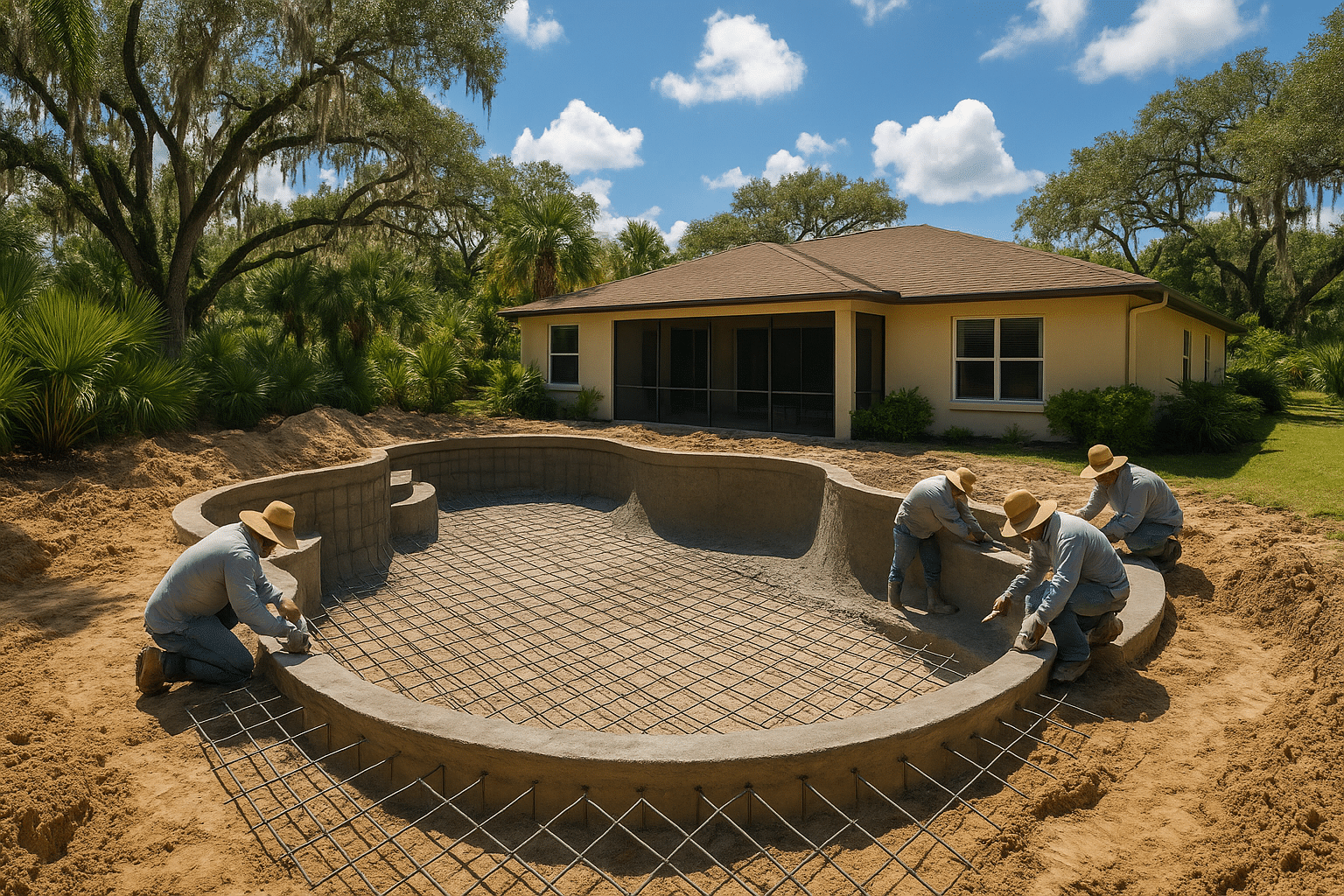
TL;DR: Fall and winter (October through April) generally offer the smoothest pool-building conditions in Central Florida because they fall within the region’s eight-month dry season, but a well-run builder can excavate and pour gunite or set a fiberglass shell successfully almost any month of the year. The bigger factors are permitting lead time, contractor scheduling, and whether you want to swim by summer or avoid construction during peak hurricane season.
If you’re planning an inground pool in Lake County or anywhere across Central Florida, timing your build isn’t just about personal preference. It affects how fast your project moves through permitting, how construction crews handle weather delays, and whether you’re swimming by the time the heat hits in May.
Here’s what actually matters when deciding when to start, and why the “best” time depends as much on your goals as it does on the calendar.
Central Florida’s Two Seasons: Wet and Dry
Unlike northern states with four distinct seasons, Central Florida really only has two from a construction standpoint: wet and dry.
Our dry season is an eight-month period from October through May, during which average rainfall is around 3 inches per month.
The rainy season is a four-month period from June through September, with average rainfall of about 7.8 inches each month, accounting for roughly 60% of the area’s average annual rainfall.
For Orlando specifically,
August is the wettest month, averaging 8 inches of rain, while December is the driest.
That seasonal swing has real consequences for excavation, concrete curing, and site drainage.
How Rainy Season Affects Pool Construction
Rain doesn’t stop a pool build, but it can slow certain stages:
- Excavation: Heavy, saturated soil is harder to dig and can delay the dig-out and rebar stages of a gunite pool.
- Gunite/shotcrete application: Concrete crews need relatively dry, stable conditions to shoot and finish shells properly.
- Plumbing and electrical trenching: Standing water in trenches can hold up inspections.
- Decking and pavers: Rain delays curing time for concrete decks.
None of this means you can’t build in summer. Florida crews build pools year-round, and afternoon storms are usually short, predictable, and scheduled around. But if your site has heavy clay soil, poor natural drainage, or you’re building near a lake or wetland setback, a dry-season start reduces the number of weather-related delay days.
Why Hurricane Season Matters for Timing (Not Just Rain)
Central Florida construction planning also has to account for the Atlantic hurricane season.
The North Atlantic hurricane season officially runs from June 1 to November 30
, and
the vast majority of tropical storms and hurricanes are typically seen during August through October, the peak months of the season.
A direct hurricane strike is rare for inland Lake County compared to coastal areas, but tropical systems can still bring heavy rain bands, high winds, and site shutdowns for a few days at a time. Builders with an in-house crew (rather than a patchwork of subcontractors) are generally better equipped to reschedule quickly and keep a project moving once weather clears.
Fall and Winter: The Traditional Sweet Spot
For homeowners who want the fewest weather disruptions, October through April lines up with the dry season and sits outside the worst of hurricane season. Benefits include:
- More predictable excavation and gunite shooting schedules
- Lower humidity, which can help with curing and finishing work
- A pool that’s fully cured, tiled, and ready well before the summer swim season
- Less competition for inspection slots compared to the spring rush
This is also when many builders see a seasonal uptick in requests, especially from retirees and active adult community residents in places like The Villages, Fruitland Park, and Lady Lake who want their pool finished before out-of-town guests arrive for the winter season.
Spring: The Most Popular (and Busiest) Season to Start
Spring is when demand peaks. Homeowners across Clermont, Mount Dora, Leesburg, and Eustis often want to break ground in February or March so the pool is ready by Memorial Day. That’s a reasonable goal, but it means:
- Permitting offices and builders are at their busiest
- Material and labor scheduling windows fill up faster
- You need to start the design and permitting process earlier than you’d think
Fiberglass pools typically take 2 to 4 months from start to finish, while custom gunite concrete pools run 4 to 6 months. If you want to swim by early summer, working backward from that date (and starting design in late fall or early winter) is the realistic path. Our month-by-month concrete pool timeline breaks down exactly what each phase looks like.
Summer: Still Buildable, With Trade-Offs
Summer construction is common in Central Florida, and plenty of pools are built successfully between June and September. The trade-offs are more afternoon rain delays, higher humidity, and hurricane-season uncertainty. The upside is that summer is when most families are motivated to start, since they’re using someone else’s pool and ready to build their own.
Permitting Timelines Don’t Change by Season
Regardless of when you start, Florida’s permitting requirements stay the same.
Under Florida Building Code section 424.2, all pools must have an entrapment prevention system
, and
pool barriers must be a minimum of 48 inches above grade and located no farther than the pool perimeter.
In unincorporated Lake County, residential pool permits also require
a notice of commencement to be recorded and certified for permits with a job value over $5,000.
Depending on your property, septic approval, HOA sign-off, or Green Swamp Area of Critical State Concern review may also apply. These steps take roughly the same number of weeks no matter what month you file, which is why early design and engineering work matters more than the calendar date you break ground.
For a full breakdown of what happens at each stage, from permitting through final walkthrough, see our Florida pool construction timeline guide.
Fiberglass vs. Concrete: Does the Best Start Time Differ?
Not dramatically, but there are a few nuances:
Fiberglass Pools
Because the shell is factory-built and delivered as a single unit, fiberglass installations move faster and have fewer weather-dependent stages. A fiberglass project started in late winter can often be swim-ready before peak summer heat.
Gunite Concrete Pools
Concrete pools involve more on-site, weather-sensitive stages: excavation, steel, gunite shooting, curing, tile, and decking. Starting in the dry season gives a gunite crew more consecutive workable days, which can help keep a 4-to-6-month timeline on track. If you’re still deciding between the two, our custom concrete pool design ideas page shows what’s possible with a fully custom gunite build.
So, When Should You Actually Start?
Here’s the practical answer for most Lake County and Central Florida homeowners:
- Want it done with the fewest weather delays? Start design/permitting in fall, break ground in winter (October–February).
- Want it ready for summer? Start the permitting and design process by late fall or early winter, so excavation can begin by early spring.
- Don’t mind a longer runway and want to build in summer anyway? It’s doable, just expect more rain-day scheduling and build in a little buffer.
The single biggest mistake homeowners make isn’t picking the “wrong” season. It’s waiting too long to start the design and permitting process and then being surprised their pool isn’t ready when they expected. Whatever month you’re reading this in, the best time to start the conversation with a builder is now, not when you want to be swimming.
If you’re still comparing builders or want to understand what questions to ask before signing a contract, read how to choose a pool builder in Florida before you commit.
Recommended Reads
- 12 Custom Concrete Pool Design Ideas to Inspire Your Central Florida Build
- How Long Does It Take to Build a Concrete Pool in Florida? A Month-by-Month Timeline
- Florida Pool Construction Timeline: What Happens at Every Stage of Your Build
