
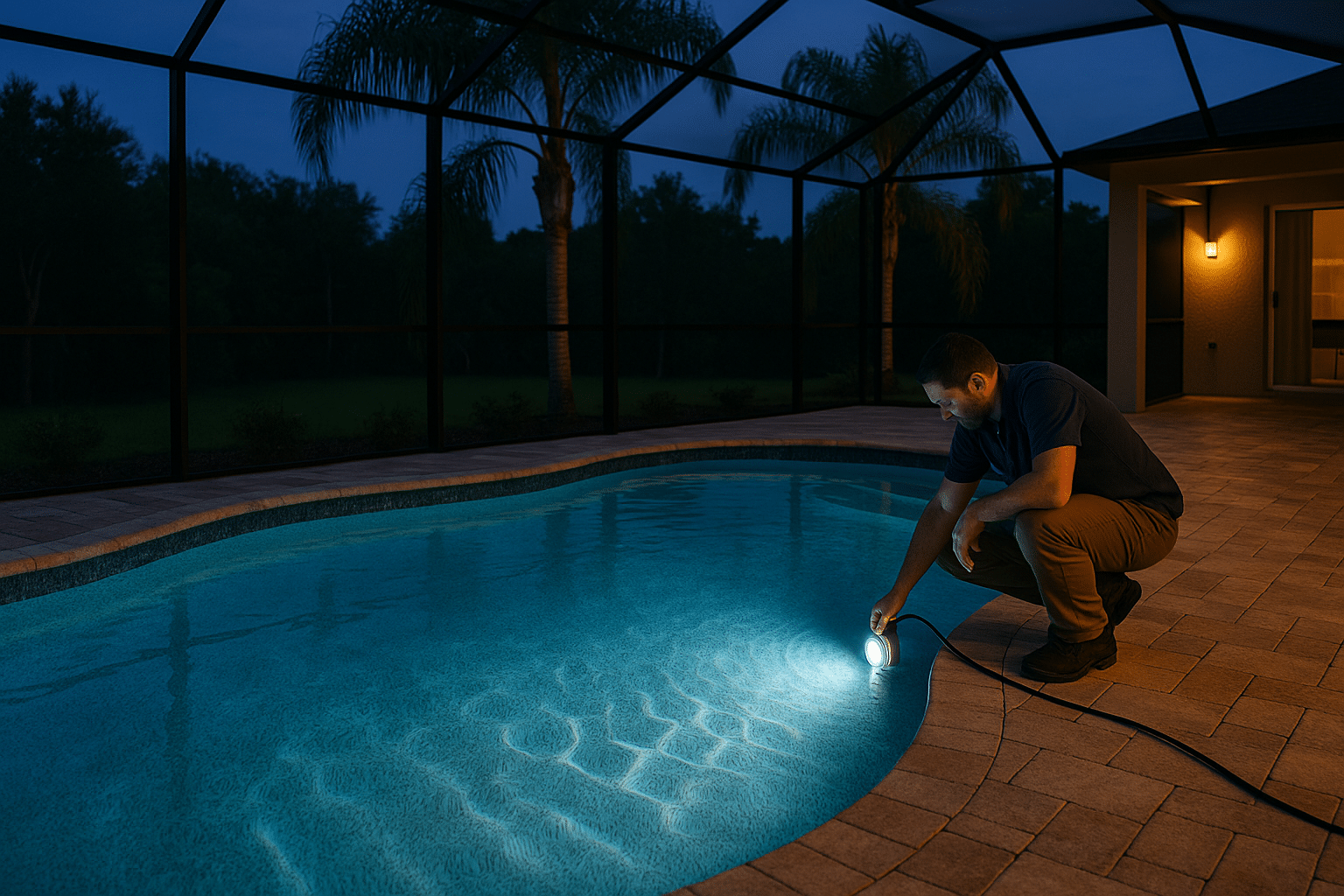
TL;DR: Your main LED pool lighting choices are color-changing or white underwater lights, spa lights, step lights, deck lights, and water feature lights. LEDs use at least 75 percent less energy than incandescent bulbs and last about 25 times longer. Place them at steps, benches, the deep end, and the spa so you can see the whole pool after dark. Good lighting helps, but it never replaces barriers or an adult watching the water.
What Are the Main LED Pool Lighting Options?
The main LED pool lighting options are color-changing underwater lights, white underwater lights, spa lights, and lights for the deck, steps, and water features. Most Central Florida pools use a mix of these. Underwater LEDs light up the water, and low deck lights show you the edges and steps.
This matters more in Lake County and around Ocala than you might think. In December the sun sets before 6 p.m., so a lot of evening swims and lanai dinners happen in the dark. Here are six options to talk over with your builder.
- Color-changing underwater LEDs: These blend colored LEDs to make many shades and slow color shows. To give one example, Pentair’s IntelliBrite 5G line offers five fixed colors and seven preset color shows. They work well for parties and quiet nights alike.
- White underwater LEDs: White light gives a clean, bright look and shows the pool floor clearly. It’s a good pick if safety and a simple style matter most to you.
- Spa lights: A smaller light inside the spa helps you see the seats and steps. If you’re planning one of our pool and spa combo designs, ask whether the spa light can be set to match the pool’s color.
- Step, bench, and ledge lighting: Light at the shallow end shows people where it’s safe to stand. This helps most around entry steps, benches, and tanning ledges and zero-entry slopes.
- Deck and landscape lights: Low lights along walkways, planters, and the pool edge show people the path between the lanai door and the water.
- Water feature lights: A light pointed at a waterfall, sheer descent, or bubbler adds glow and movement without making the whole yard bright.
How Do LED Pool Lights Compare to Older Bulbs?
LEDs beat halogen and incandescent bulbs on energy use, lifespan, and heat. The U.S. Department of Energy says LEDs use at least 75 percent less energy than incandescent bulbs, give off almost no heat, and last 25 times longer. A long life is a big deal for a light that sits underwater in a sealed fixture.
| Light type | Energy use | Expected life | Color choices | Best for |
|---|---|---|---|---|
| Color-changing LED | At least 75% less than incandescent | About 25 times longer than incandescent | Many colors and preset shows | Setting a mood, entertaining |
| White LED | At least 75% less than incandescent | About 25 times longer than incandescent | White only, often dimmable | A clear view, simple look |
| Halogen | About 25% less than standard incandescent | Usually about the same as incandescent | White only | Older pools |
| Incandescent | Highest; about 90% of the energy becomes heat | Shortest | White only | Older pools, mostly replaced |
LEDs cost more up front than old bulbs. You get that back over the years through lower power bills and fewer fixture changes. Your lighting cost depends on how many lights you want, the fixture type, and whether you add a control system. Ask for each of those as its own line in your estimate.
Where Should Pool Lights Go to Improve Safety After Dark?
Put light where people step, sit, and get into the water: the steps, benches, deep end, and spa. In a dark pool, it’s hard to see where the depth changes, and it’s hard to spot someone under the water.
The stakes are real here. The Florida Department of Health reports that drowning is the leading cause of unintentional death for children ages 1 to 4 in Florida. It also says home pools are where most young children are likely to drown. Good lighting helps adults see the whole pool at night. It does not replace fences, alarms, or an adult watching the water.
- Point underwater lights away from the house and main seating so they don’t shine in your eyes.
- Light the steps and entry points first. Wet steps are hard to see at night.
- On a long or L-shaped pool, plan for more than one light so the far end isn’t left in the dark.
- Put low deck lights along the path from the lanai door to the pool.
- Put the lights on a timer so they come on at dusk even when nobody remembers.
For retirees in The Villages, clear step lighting makes evening swims easier and more relaxing. Families with young kids in Summerfield often care most about seeing the whole pool from the back door.
Are Low-Voltage LED Pool Lights Safer?
Yes. Low-voltage LEDs lower the risk of shock, and they’re a common choice for new pools. Many underwater LED lights come in both 120-volt and 12-volt versions. In the U.S., pool wiring follows Article 680 of the National Electrical Code. As Electrical Contractor magazine explains, Section 680.23 covers underwater lights, and a low-voltage light must be powered through a listed low-voltage transformer.
The code also covers bonding, GFCI protection, and where switches and outlets can go. Florida also has a separate building code chapter, Chapter 45, just for private swimming pools. How each rule applies can depend on which code edition your area uses. That’s why pool lighting is a job for a qualified crew, not a weekend project.
Color-Changing or White LEDs: What Are the Pros and Cons?
Color-changing LEDs give you more mood choices. White LEDs give you a simpler, brighter view of the water. Both save the same energy over old bulbs.
- Pro (color): You can pick a calm blue for a quiet night or run a color show for a party.
- Pro (color): Some lines work with pool control systems, so you can set colors and schedules in one place.
- Con (color): They cost more than white-only lights and have more settings to learn.
- Con (color): Dark colors like deep blue or red light up the pool floor less clearly than white.
- Pro (white): You get the clearest view of the water, plus a simple setup.
- Con (white): You get one look, and some people find it plain.
One Florida tip: bright lights near a screened pool enclosure pull bugs onto the screen. In a study reported by Science, incandescent bulbs drew about 8 insects per hour, compared with about 4.5 for warm-colored LEDs. Warm-tone deck lights can help on summer nights.
Why Plan Your Lighting With R & R Swimming Pools?
Underwater lights are easiest to put in while the pool is being built, because the fixtures and wiring go in before the deck is poured. Planning them during design means you won’t have to cut into a finished deck later. Here’s what our team brings to the job:
- R & R Swimming Pools is family-owned and has served Lake County and Central Florida since 1985.
- We have completed over 1,000 pools and spas.
- We handle design, engineering, permitting, plumbing, and electrical in-house.
- Our own team does the final walkthrough with you.
- Financing is available through Lyon Financial and Viking Capital.
You can learn more about our pool building services in The Villages and Lake County.
Want help choosing lights for your new pool? Call R & R Swimming Pools at (352) 432-8843 or request a free quote, and we’ll go over your options with you.
Frequently Asked Questions
How many underwater lights does a pool need?
It depends on the pool’s size, its shape, and how bright the light is. A small, simple pool may only need one light. Longer or L-shaped pools often need two or more to avoid dark spots, and a spa usually gets its own light.
Do LED pool lights get hot?
No, not really. The U.S. Department of Energy says LEDs give off almost no heat and stay cool to the touch, unlike incandescent bulbs.
Can I control my pool lights with an automation system?
Many color LED pool lights can connect to a pool control system, so you can set colors and schedules from one place. Ask your builder which controls work with the lights you pick.
Can I switch an older pool to LED lights?
Often, yes, but it depends on your current fixture, the light niche, and the wiring. A qualified pool pro can tell you whether a direct LED replacement will fit or whether you need more electrical work.
Recommended Reads
- How to Finance a Pool in Florida: Loan Options, Lenders, and What to Expect
- Tanning Ledges, Zero-Entry Slopes, and Swim-Outs: Which Pool Feature Is Right for You?
- Pool and Spa Combos in Florida: Design Options, Costs, and Benefits
