
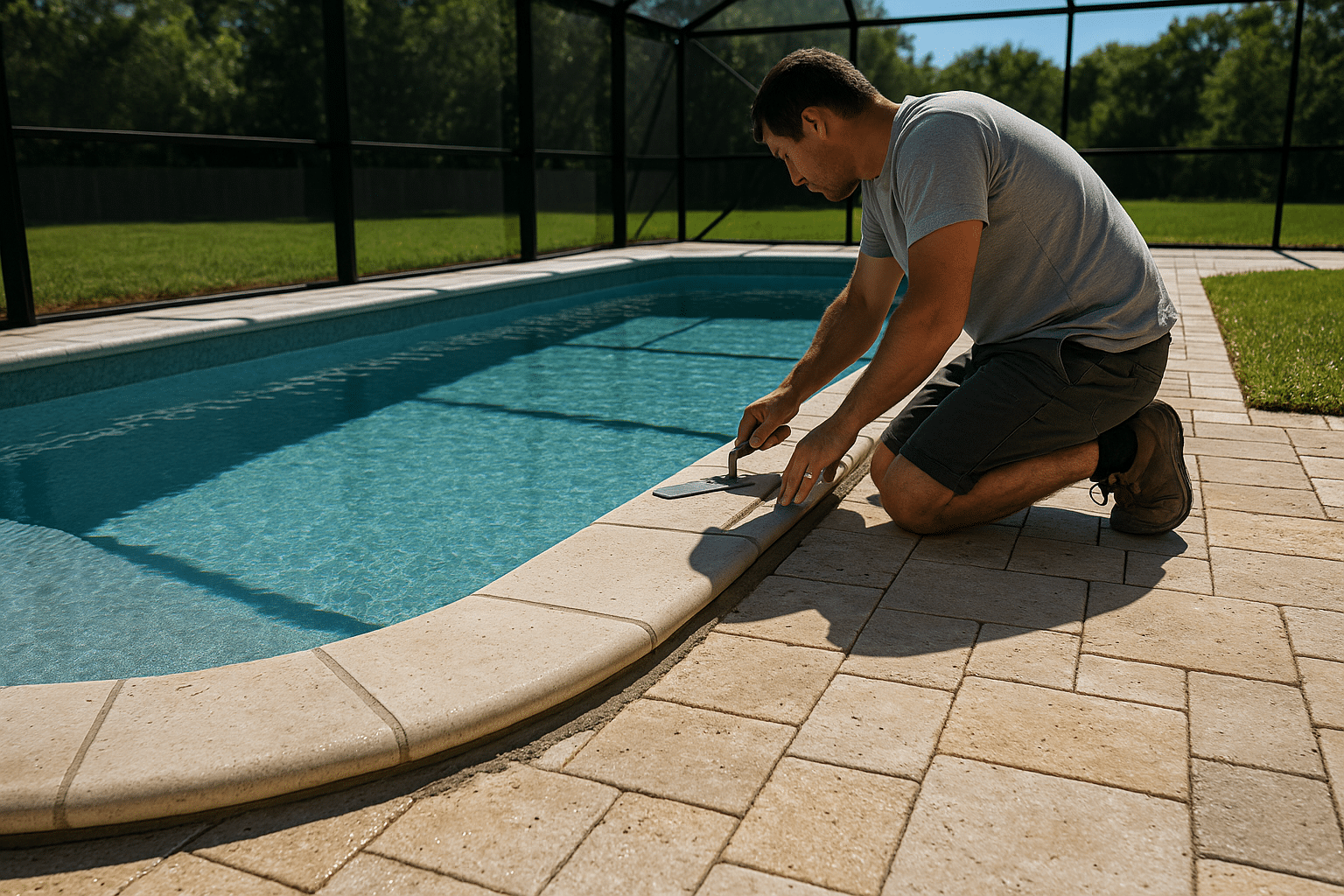
TL;DR: In Central Florida, the pool decks and coping that hold up best are light-colored, have a textured surface for grip, and are sloped so heavy summer rain drains off. Travertine, concrete pavers, and a spray-on textured finish over poured concrete are the most common picks. Your coping should match the deck and be planned around your pool shell. Cost depends on deck size, the material, base prep, and drainage.
What are the best pool decking and coping options in Florida?
The best pool decking and coping options in Florida are light-colored, textured materials. They stay cooler in the sun, give good grip when wet, and drain heavy summer rain. For most Lake County homes, that means travertine, concrete pavers, or a textured spray finish over poured concrete. Pick coping that matches the deck and fits your pool shell.
Below are seven options that work in Central Florida yards, how they compare, and what drives the price. You won’t find price figures here. Deck cost depends on your yard, how many square feet you cover, and the material you pick.
Which 7 deck and coping materials hold up in Central Florida?
These seven options cover most of what homeowners ask about, from The Villages down to Clermont. Numbers 1 through 5 are deck surfaces, and 6 and 7 are coping styles.
1. Travertine pavers
Travertine is a natural stone that comes in ivory, beige, walnut, and silver tones. Light colors reflect more sun than dark ones, so a pale travertine deck usually feels easier on bare feet than plain gray concrete. It costs more than most options, and it should be sealed to resist stains. Tumbled or honed finishes grip better than polished stone.
2. Concrete pavers
Concrete pavers are factory-made blocks laid over a compacted base and a sand bed. Trade guidance from Concrete Network calls for 6 to 8 inches of well-compacted base and a 1-inch sand setting bed under a paver pool deck. Pavers come in many colors and shapes. If a pipe below needs work, single pavers can be lifted out and set back in place.
3. Spray-on textured finish over concrete
This is a thin coat sprayed onto a poured slab and then knocked down flat with a trowel. Many Florida owners call it cool deck. It usually costs less than stone, comes in light colors, and adds grip. If the slab under it shifts, cracks can show through, and the surface needs resealing from time to time.
4. Stamped concrete
Stamped concrete is poured, colored, and pressed with a pattern that looks like stone, slate, or brick. You get a stone look on one solid slab. Darker colors heat up fast. Glossy sealers can get slick unless a grit additive goes in. A crack is also harder to hide than one broken paver.
5. Porcelain pavers
Outdoor porcelain pavers are thin, dense tiles made for exterior use. They come in wood, stone, and concrete looks and clean up easily. Choose a textured outdoor grade, not a smooth indoor tile. The material usually costs more than concrete pavers.
6. Bullnose coping in stone or paver
Bullnose coping has a rounded front edge that hangs slightly over the water. It’s comfortable to sit on and easy to grab from the water. It can match your deck material exactly or contrast with it, such as travertine coping set against a paver deck.
7. Poured cantilever coping
Cantilever coping is formed and poured in place so the deck seems to run right up to the water’s edge. It gives a clean, simple look and works well with spray-finish or stamped decks. Because it’s one continuous pour, it doesn’t have the joints that paver or stone coping has.
How hot do pool decks get in a Florida summer?
Plain concrete pool decks get hot enough in a Florida summer to hurt bare feet. The U.S. Environmental Protection Agency reports that conventional pavements can reach peak summer surface temperatures of 120 to 150°F. The EPA says cool pavements are materials that reflect more sunlight or let more water evaporate, so they stay cooler than standard paving.
For a pool deck, color matters most. Lighter colors reflect more sun. A textured surface also feels better than a glossy one. Here’s how the five deck surfaces compare:
| Deck option | Feel in full sun | Grip when wet | Upkeep | Main cost drivers |
|---|---|---|---|---|
| Travertine pavers | Cooler in light tones | Good with tumbled or honed finish | Sealing, joint care | Stone grade, tile size, cuts |
| Concrete pavers | Depends on color | Good | Joint sand, sealing | Base prep, pattern, borders |
| Spray-on textured finish | Cooler in light colors | Good | Periodic reseal, crack repair | Slab size, color, prep |
| Stamped concrete | Hot in dark colors | Fair unless grit is added | Reseal, crack repair | Pattern, colors, sealer |
| Porcelain pavers | Depends on color | Good in outdoor textured grades | Low, occasional cleaning | Material cost, setting method |
What is pool coping, and how do you choose it?
Coping is the cap that finishes the top edge of the pool wall, between the water and the deck. It covers the shell edge, gives swimmers a handhold, and helps send splash water away from the pool.
Choose coping based on four things:
- Comfort: A rounded edge is kinder to legs and arms than a sharp square edge.
- Grip: Wet coping gets lots of foot traffic, so skip polished or glossy finishes.
- Look: Match the deck for a calm look, or contrast it to frame the water.
- Shell fit: The edge detail has to tie into the pool shell, so plan it with your builder early.
What drives pool deck cost in Lake County?
Pool deck cost in Lake County mostly comes down to four things: square footage, the material, base prep, and drainage. Curves and odd angles add cutting time. Removing an old deck adds labor on remodels. Extras like steps, seat walls, or a wider lounge area add material.
Drainage deserves more attention here than in many places. The Southwest Florida Water Management District says central Florida’s rainy season runs June through September and brings about 60 percent of the year’s average rainfall. A deck that isn’t sloped away from the pool will hold puddles and push water where you don’t want it. For the full picture, see our guide to inground pool costs in Central Florida.
Pavers vs. poured finishes: pros and cons
- Paver pro: Single pieces can be swapped out or lifted for repairs underneath.
- Paver pro: Joints let the deck flex a little, so you don’t get one long crack.
- Paver con: Upfront cost tends to run higher than stamped and colored concrete.
- Paver con: Joint sand needs topping up, and weeds or ants can work into the gaps.
- Poured pro: One smooth surface with no joints to maintain.
- Poured con: Cracks are harder to repair so they blend in.
If deck upgrades push your budget, our Florida pool financing guide explains how loans work.
Why R & R Swimming Pools is a good fit for your deck and coping
R & R Swimming Pools is family-owned and has built pools in Lake County and Central Florida since 1985.
We have completed over 1,000 pools and spas.
We build custom gunite concrete pools and, as an authorized Latham Pool dealer, factory-built fiberglass pools.
Our team handles design, engineering, permitting, excavation, plumbing and electrical, finishing, and final walkthrough in-house.
That means your deck and coping are planned together with the pool from day one.
Both pool types carry a limited lifetime shell warranty.
Financing is available through Lyon Financial and Viking Capital.
Want to compare deck and coping options for your yard in Leesburg, Clermont, or nearby? Call R & R Swimming Pools at (352) 432-8843 or request a free estimate.
Frequently Asked Questions
What color pool deck stays the coolest in Florida?
Lighter colors stay cooler because they reflect more sunlight than dark surfaces. Ivory, beige, and light gray decks are the most comfortable picks for barefoot use in a Central Florida summer.
Should I seal my pool deck pavers?
Sealing helps pavers resist stains and fading, and a UV-resistant sealer is a good match for strong Florida sun. Pick a sealer that won’t leave a slick, glossy film on a wet walking surface.
Can I change my deck material after the pool is built?
Yes, decks can be resurfaced or replaced later. It’s usually simpler to choose during the build, while grading and drainage are being set.
Does a saltwater pool change which coping I should pick?
Concrete pavers are generally resistant to chlorine and salt. If you want natural stone coping with a salt system, ask how it will be sealed, and rinse splash-out off the deck now and then.
Recommended Reads
- How to Finance a Pool in Florida: Loan Options, Lenders, and What to Expect
- Pool and Spa Combos in Florida: Design Options, Costs, and Benefits
- Fiberglass vs. Concrete Pool Cost in Florida: A Side-by-Side Breakdown
