
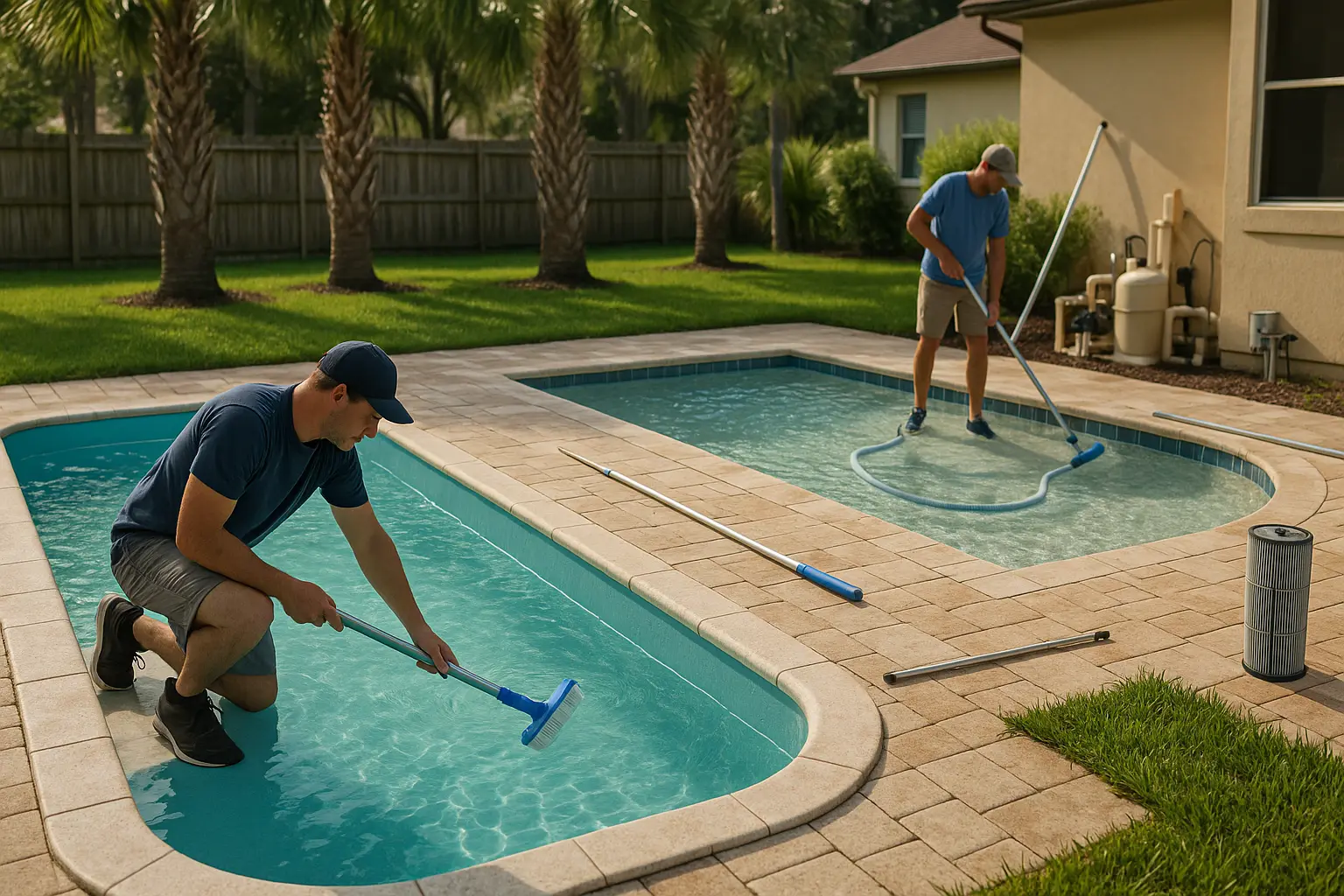
TL;DR: Most Florida owners find a fiberglass pool easier to maintain because its smooth, non-porous surface needs less brushing and never goes through a resurfacing cycle. A gunite concrete pool needs more brushing, tighter control of pH, alkalinity and calcium, and a new interior finish now and then. In exchange, you get full design freedom. Central Florida’s year-round swim season and hard aquifer water make good water balance important for both types.
Fiberglass vs. concrete pool maintenance: which is easier?
For most Florida owners, a fiberglass pool is easier to maintain than a concrete pool. Its smooth surface gives algae less to grip, and it never needs the periodic resurfacing a cement-based finish does. A gunite concrete pool needs more brushing and tighter water balance. In return, you get full design freedom.
Below, we compare fiberglass vs. concrete pool maintenance for Lake County, where pools run all year and fill water comes from a limestone aquifer. We cover weekly chores, water chemistry, long-term upkeep, and which type fits which kind of owner.
Why does Central Florida make pool upkeep a bigger job?
Pools here never close for winter, so the work never takes a season off. Up north, a pool might sit under a cover for five months. In Lake County, you are skimming, brushing and testing 12 months a year. Spring pollen, oak leaves and summer storms all add to the load.
Sun and heat also eat up your sanitizer. The CDC lists sunlight as one of the things that lower chlorine levels, along with sweat and dirt from swimmers. That means more frequent testing on a July afternoon than in January.
Then there is the water itself. The Floridan aquifer sits under all of Florida. According to the U.S. Geological Survey, it is made of limestone and dolomite, and calcium and magnesium are among the most common minerals in its water. That mineral content affects both pool types, just in different ways. More on that below.
What does weekly care look like for each pool type?
Weekly care is similar for both pools: skim, empty baskets, run the pump, and test the water. The difference shows up in brushing and in how closely you watch the chemistry. Here is a side-by-side look.
| Task | Fiberglass pool | Gunite concrete pool |
|---|---|---|
| Brushing | Light brushing with a soft brush. Dirt and algae wipe off easily. | Full brushing of walls, steps and floor. The textured finish holds dirt and algae more readily. |
| Water chemistry focus | Keep sanitizer and pH in range. Keep calcium balanced to protect metal parts and the heater. | Same basics, plus close watch on pH, alkalinity and calcium to protect the finish. |
| Algae | Non-porous gelcoat resists algae. | Algae can take hold in corners, steps and shady spots if chemistry slips. |
| Stains and scale | Clean with soft tools only. Skip abrasive pads. | Most stains brush off. Stubborn ones may need a mild acid wash. |
| Surface renewal | No replastering cycle. | The cement-based finish wears over time and eventually gets resurfaced. |
The safe-water targets are the same for both pools. The CDC recommends pH 7.0–7.8 and a chlorine level of at least 1 ppm, or at least 2 ppm if you use stabilizer (cyanuric acid). Pumps, filters, heaters and salt cells need the same care whichever shell you choose.
What long-term upkeep should you plan for?
The biggest long-term difference is the interior finish. A gunite pool is lined with a cement-based coat, such as plaster or a quartz or pebble blend. That coat reacts with the water over time. The National Plasterers Council says soft, low-calcium water is aggressive and can pull calcium out of plaster. It recommends keeping calcium hardness in the 200–400 ppm range. Low pH and low alkalinity can also etch the surface and leave it rough. Even with good care, the finish will eventually need to be resurfaced.
A fiberglass shell skips that cycle, but it still needs balanced water. The same council notes that low-calcium water can attack metal fittings and heat exchangers in fiberglass pools. Scale can also build up at the waterline of either pool when calcium and pH run high.
We don’t quote resurfacing prices here, because the cost depends on pool size, the finish you pick, tile work, and draining and refilling. Build costs are a separate question. In Central Florida, the two types cost about the same to build. Our fiberglass vs. concrete pool cost breakdown walks through what drives the price.
Maintenance pros and cons at a glance
- Fiberglass pro: Less brushing and fewer algae battles.
- Fiberglass pro: No replastering cycle to budget for.
- Fiberglass con: The gelcoat can scratch from abrasive tools or harsh scrubbing.
- Fiberglass con: Shapes and sizes are set by the factory molds.
- Concrete pro: Any shape, size or depth, and you can change the color or texture when you resurface.
- Concrete pro: A thick, strong shell built on site for your yard.
- Concrete con: More weekly brushing and closer attention to calcium and pH.
- Concrete con: The interior finish will need resurfacing someday.
Which pool type fits the way you live?
If fewer chores is your top goal, fiberglass is usually the better fit. Many retirees and active adult residents want a pool they can enjoy without a long weekly to-do list. If that sounds like you, our page on fiberglass pool installation in Leesburg shows how we handle those projects.
If you want a custom shape, a deep end for diving, or a pool that fills an odd-shaped lot, gunite is the way to go. The extra brushing is the trade-off for that freedom. Families in Tavares and around Lake County often pick concrete for exactly this reason. Learn more about custom concrete pool building in Tavares.
One more thing to consider: if you plan to hire a weekly pool service, the gap between the two gets smaller. The service handles the brushing either way. What remains is the long-term finish cost, which only applies to concrete.
Why work with R & R Swimming Pools?
We build both pool types, so we can give you a straight answer about which one fits your yard and your routine.
- R & R Swimming Pools is family-owned and has built pools in Lake County and Central Florida since 1985.
- We have completed over 1,000 pools and spas.
- We are an authorized Latham Pool dealer for factory-built fiberglass shells.
- Our in-house gunite crew builds custom concrete pools with shells 6 to 12 inches thick.
- Both pool types carry a limited lifetime shell warranty.
- We handle design, engineering, permitting, excavation, plumbing, electrical, finishing and the final walkthrough in-house.
- Financing is available through Lyon Financial and Viking Capital.
Want to talk through which pool fits how you spend your weekends? Call (352) 432-8843 or request a free estimate from R & R Swimming Pools.
Frequently Asked Questions
Does a fiberglass pool use fewer chemicals than a concrete pool?
Latham says its smooth, algae-resistant fiberglass surface takes fewer chemicals to keep the water and pH balanced. You still need to test sanitizer and pH regularly, because sun, swimmers and rain lower chlorine in any pool.
Can I add a saltwater system to either pool type?
Yes, both fiberglass and gunite pools can run on salt. With a new plaster finish, the National Plasterers Council startup procedure says to wait 28 days before adding salt.
Does Central Florida’s hard water hurt a fiberglass pool?
Hard water can leave scale at the waterline of any pool when calcium and pH run high. Water that is too low in calcium can attack metal fittings and heater parts in a fiberglass pool, so you need balance in both directions.
Do fiberglass and concrete pools cost about the same to build in Central Florida?
Yes, the two types cost about the same to build here. The bigger cost difference shows up over time, because a concrete pool’s interior finish will eventually need resurfacing.
Recommended Reads
- Fiberglass vs. Concrete Pool Cost in Florida: A Side-by-Side Breakdown
- Custom Concrete Pool Building in Tavares, FL | R & R Pools
- Concrete Pool Building Eustis FL | R & R Pools
