
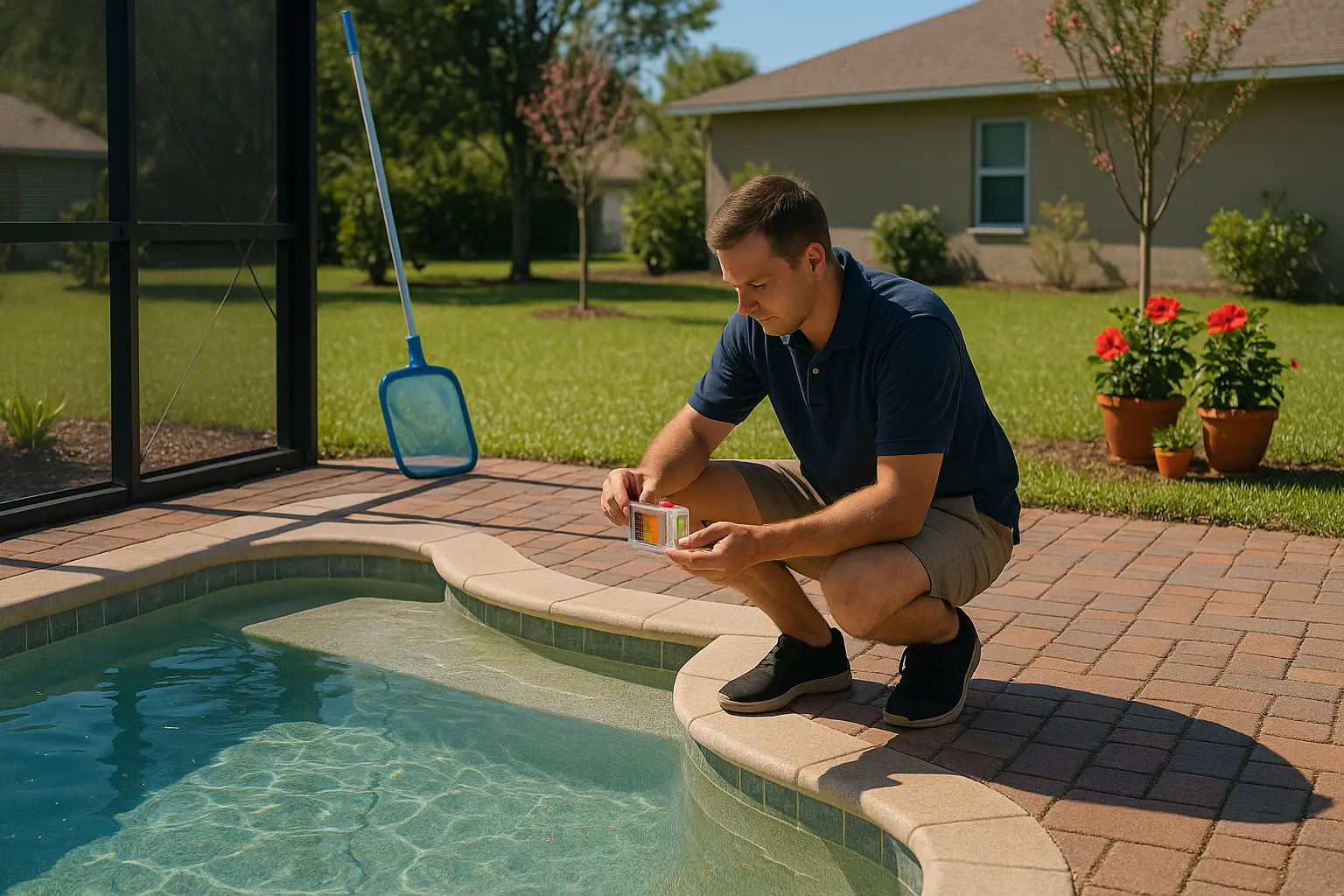
TL;DR: Florida pool care has three parts: keep chlorine and pH in range, keep the water moving through the filter, and change your routine with the seasons. Strong sun, summer rain and hurricane season mean a Lake County pool needs more attention from June through October. Before a storm, never drain the pool.
What does pool maintenance in Florida’s climate actually involve?
Pool maintenance in Florida’s climate comes down to three jobs: keep chlorine and pH in range, keep water moving through the filter, and change your routine with the seasons. Strong sun, daily summer storms and hurricane season mean a Lake County pool needs closer watching from June through October than it does in winter.
The CDC sets the basic targets. It recommends a pH of 7.0 to 7.8 and at least 1 ppm of chlorine in home pools. If you use stabilizer, or chlorine tablets that contain it (dichlor or trichlor), the CDC raises that minimum to at least 2 ppm free chlorine. Sun, sweat, dirt and swimmers all use up chlorine, so the CDC also says chlorine needs to be tested regularly.
What you need
- A test kit that reads free chlorine, pH, total alkalinity and cyanuric acid (CYA, also called stabilizer)
- A telescoping pole with a leaf net and a wall brush
- Chlorine (liquid or tablets) and a pH adjuster
- A notebook or phone app to log your readings
- The owner’s manuals for your pump and filter
How do you keep a Florida pool balanced week to week?
Do it in the same order every time: clean first, test second, adjust third. In summer, we suggest going through these steps two or three times a week. In the cooler months, once or twice a week is usually enough.
- Skim and empty the baskets. Pull leaves and bugs off the surface, then empty the skimmer and pump baskets. Debris left in the water eats up chlorine.
- Brush the walls, steps and benches. Brushing loosens algae before it can take hold, especially in shady corners and on steps.
- Check the water level. It should sit about midway up the skimmer opening. After a heavy storm, lower it back to normal. In a dry spell, top it off.
- Test the water. Check free chlorine and pH every time. Check alkalinity and CYA about once a month.
- Fix pH first. Chlorine works best when pH is in range, so adjust pH before you add chlorine.
- Bring chlorine up to target. Add enough to stay above the CDC minimum, with a little room to spare for a sunny day.
- Watch the filter gauge. When the pressure climbs well above its clean reading, clean or backwash the filter as your manual says.
- Shock after heavy rain or a busy weekend. A big rain or a pool party can drain chlorine fast. Shocking resets it.
How should your pool care change with Florida’s seasons?
Florida really has two pool seasons, plus hurricane season on top of the hot one. Most of the change from season to season is about sun, rain and debris.
| Season | Typical months | What changes | What to adjust |
|---|---|---|---|
| Cool, dry season | About November to March | Cooler water, less rain, chlorine lasts longer | Test once or twice a week; shorter pump run times are often fine |
| Spring warm-up | About March to May | Water warms, pollen and leaf drop pick up | Empty baskets more often; start testing more |
| Rainy summer | About June to September | Daily storms thin out chemicals, wash in debris and raise the water level | Test two to three times a week; check after every big storm |
| Hurricane season | June 1 to November 30 | Risk of power loss, flooding and wind-blown debris | Have a storm plan ready (see below) |
Stabilizer matters most in our sun. According to the Pool and Hot Tub Alliance’s cyanuric acid fact sheet, bright sunlight can break down most of the chlorine in unstabilized water within about an hour. The same fact sheet lists 30 to 50 ppm as the ideal CYA range. Too little and the sun burns off your chlorine. Too much and the chlorine you add does less work.
If you leave for part of the summer, whether from The Villages or a home near Ocala, have someone test and adjust the water at least weekly. One week of afternoon storms with nobody watching can turn a clear pool green.
What should you do with your pool before a hurricane?
Keep the pool full, shock it, and shut off the power to the equipment. The Florida Swimming Pool Association notes that hurricane season runs June 1 to November 30. It warns that draining a pool can let pressure from Florida’s high water table push the shell up out of the ground.
- Before: Super-chlorinate in case the power goes out and the pump can’t run. Turn off breakers and cover the equipment. Bring furniture and toys inside.
- After: Make sure the equipment is dry and check the wiring before you turn the power back on. Remove large debris by hand so it doesn’t clog the system.
- Water level: If rain overfilled the pool, drain it only back down to its normal level. Never empty it.
What are the most common Florida pool care mistakes?
Most problems come from skipping tests in summer or guessing at chemicals. These are the ones we see most often:
- Adding chlorine without fixing pH first
- Testing only chlorine and never checking stabilizer, so CYA quietly climbs too high
- Letting storm water sit above the skimmer for days
- Running the pump on a winter schedule all summer long
- Draining the pool to clean it without professional advice
Signs it’s time to call a pro
- You can’t see the bottom after a storm
- Your equipment was underwater during a flood
- Cracks, bulges or a shifting deck around the pool
- Water loss that topping off doesn’t explain
- Chlorine that won’t hold no matter how much you add
Why work with R & R Swimming Pools?
R & R Swimming Pools is family-owned and has built pools in Lake County and Central Florida since 1985. We have completed over 1,000 pools and spas. We are an authorized Latham Pool Products dealer, and our own gunite crew builds custom concrete pools. Both pool types carry a limited lifetime shell warranty. We handle design, permitting, plumbing, electrical and the final walkthrough ourselves.
Still choosing a pool? Shell type affects your long-term upkeep, so read our fiberglass vs. concrete pool cost breakdown for Florida. You can also weigh routine care against the benefits in our honest look at whether a pool is worth it in Florida.
Have questions about building a pool that fits your Florida routine? Call R & R Swimming Pools at (352) 432-8843 or request a free estimate.
Frequently Asked Questions
What stabilizer (CYA) level should a Florida pool have?
The Pool and Hot Tub Alliance lists 30 to 50 ppm as the ideal range when stabilizer is used. Check it about once a month, because tablets keep adding CYA over time.
Should I drain my pool before a hurricane?
No. The Florida Swimming Pool Association warns that an empty pool can be pushed up out of the ground by pressure from a high water table. Keep it full, shock it and turn off the power to the equipment.
How often should I shock my pool in Central Florida?
Shock after heavy rain, a busy pool weekend, or any time the water looks cloudy. Summer usually calls for it more often than winter because of the heat, sun and storms.
Can I leave my pool alone while I’m away for the summer?
It’s risky. Daily storms and strong sun can throw off the water chemistry within days, so have someone test and adjust the pool at least once a week while you’re gone.
Recommended Reads
- Fiberglass vs. Concrete Pool Cost in Florida: A Side-by-Side Breakdown
- How Much Does an Inground Pool Cost in Central Florida? (2025 Pricing Guide)
- How to Finance a Pool in Florida: Loan Options, Lenders, and What to Expect
Sources
