
TL;DR:
- Choosing the right pool entry is essential for safety, accessibility, and compliance with Florida’s strict codes.
- Integrating features such as traditional steps, beach entries, or in-wall steps requires understanding their space, safety, and maintenance implications.
Picking the right pool entry is one of the most practical decisions you’ll make when designing or renovating a custom inground pool in Central Florida. Style matters, but so does how easily your kids can climb in after a rainy afternoon, how safely your parents can exit when the deck is wet, and whether your choices hold up to Florida’s strict safety codes. This guide breaks down every major entry option available, from traditional steps to beach entries, and explains how to match each one to your yard, your family, and the local rules that govern every pool built in the Sunshine State.
Table of Contents
- How to evaluate your pool entry choices
- Top pool entry options for custom inground pools
- Pool ladders and handrails: Safety features that matter
- Comparing pool entry options: Space, safety, and code at a glance
- Situational recommendations: Choosing for your family
- What most homeowners miss about pool entry choices
- Ready to customize your Florida pool entry?
- Frequently asked questions
Key Takeaways
| Point | Details |
|---|---|
| Safety comes first | Every entry choice must meet local barrier and safety code requirements in Florida. |
| Entry style impacts space | Beach entries need significantly more room while steps and benches fit compact yards. |
| Upgrade for accessibility | Handrails and anti-slip features make pools safer for all ages and abilities. |
| Plan for your family | Match entry types to your household’s stage and future needs, not just current trends. |
| Renovations require code updates | Remodeling your pool means updating entries and barriers to the latest Florida safety standards. |
How to evaluate your pool entry choices
Every great pool entry decision starts with a clear checklist. Before you fall in love with a specific look or material, you need to know what the law requires, what your family actually needs, and what your Central Florida climate will do to that entry over time.
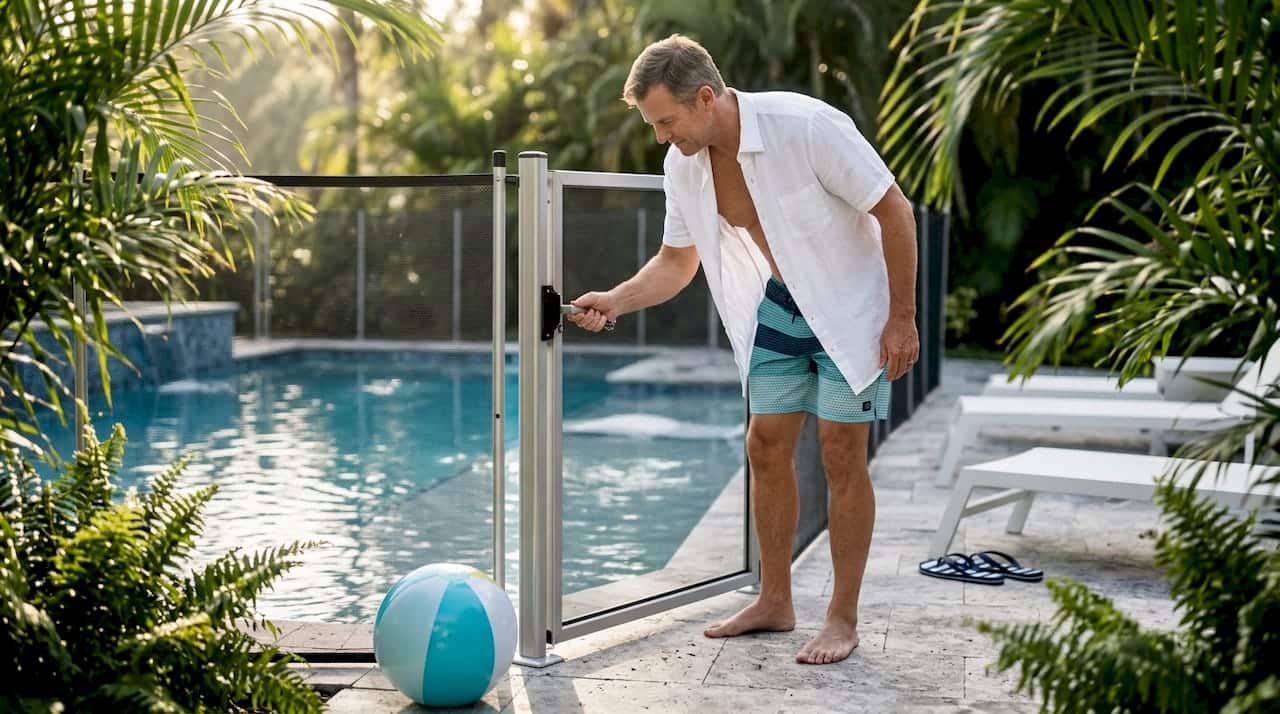
Florida has some of the most detailed residential pool safety laws in the country. The Florida Residential Swimming Pool Safety Act requires barriers at least 48 inches high with no openings that allow a 4-inch sphere to pass through, along with self-closing, self-latching gates that open outward with the latch positioned at least 54 inches above grade on the pool side. These requirements exist because Florida leads the nation in child drowning rates, and the data is sobering. Empirical evidence confirms that a 4-foot barrier combined with a self-latching gate is the single most effective drowning prevention tool, far more effective than alarms or supervision alone. Renovations must also be upgraded to meet current code, not the standards from when the pool was first built.
Beyond the legal baseline, here are the main criteria to weigh for every entry option:
- Safety: Non-slip surfaces, secure handrails, and visibility from the house
- Accessibility: Ease of use for children, older adults, and guests with mobility challenges
- Available space: Some entries consume much more pool and deck real estate than others
- Aesthetics: How the entry fits your overall yard design and pool shape
- Budget: Both installation costs and long-term maintenance
- Code compliance: Local county requirements that may exceed state minimums
Florida’s heat and humidity create unique wear patterns. Wet decks, UV exposure, and heavy rainfall all affect which materials hold up and which become slippery hazards. Your pool decking options should coordinate with your entry choice, since textured, heat-resistant surfaces reduce both slipping and burns on bare feet.
“Choosing pool entry features without reviewing your county’s specific code is one of the most common and costly mistakes we see during renovations.” Review local requirements before finalizing any design.
Pro Tip: Always pull your county’s specific rules before buying materials or signing a design contract. Seminole and Orange counties both have requirements that go beyond state minimums, and catching those early saves real money.
Read our full pool safety guide for a detailed breakdown of what Central Florida counties require beyond the state baseline.
Top pool entry options for custom inground pools
With your priorities clear, explore each entry style and how it might work in your backyard. Understanding the actual mechanics and real-world tradeoffs of each type will help you avoid expensive design regrets.
Traditional steps are the most common entry found in Central Florida pools. They typically sit in one corner of the pool, require minimal footprint, and provide clear, defined footing for swimmers of all ages. Most builders integrate them with a wide landing at water level, which doubles as a shallow sitting area for adults supervising children. They work in almost every yard size and pool shape, and they pair naturally with handrails to boost safety.
Beach or zero entry (also called a sloped entry) mimics the gradual incline of a natural shoreline. This design is welcoming for toddlers and older adults because there is no step to navigate. However, zero entry requires substantial space, typically more than 21 feet of pool length to reach just 3 feet of depth. That makes it impractical for smaller yards or standard-sized lots, and it reduces total swim area. It also needs more frequent cleaning because the shallow slope collects debris and algae faster than vertical steps.
Corner benches are built-in seating areas positioned at the pool entry corner. They give adults a comfortable place to ease in and out of the water and provide a natural resting spot during swim sessions. They work especially well in family pools where adults spend as much time relaxing as swimming. Corner benches add visual depth to the entry area without consuming excessive floor space.
In-wall steps with handrails are installed within the pool wall itself, minimizing the footprint inside the pool and keeping the swim area open. These work particularly well in smaller or narrower pools where traditional corner steps would crowd the layout. The handrails extend above the deck, giving swimmers a firm grip as they enter or exit at any depth.
Here is a quick overview of how each entry performs across key priorities:
- Traditional steps: Best for all yard sizes, most code-friendly, easiest to retrofit
- Beach/zero entry: Best accessibility, requires large space, higher maintenance
- Corner benches: Great for adults and families, minimal extra space needed
- In-wall steps: Saves swim space, ideal for smaller pools, requires handrail pairing
Pro Tip: If your household includes both young children and older adults, consider combining traditional steps with a corner bench. You get safe defined footing for kids and comfortable assisted entry for adults, all within a compact footprint.
Planning the physical construction of your entry correctly from day one matters more than most homeowners realize. Review the full pool installation steps to understand how entry design is integrated into the overall build timeline.
Pool ladders and handrails: Safety features that matter
Each main entry type can be upgraded with ladders or handrails, and these additions make a real difference for families and guests. Many homeowners treat them as cosmetic add-ons, but they are genuinely critical safety equipment.
Dual handrails extending above the deck are the gold standard for residential pool safety. Anti-slip treads on every step surface reduce the risk of falls on wet surfaces. Rails should be tall enough that a swimmer can grip them before their feet leave the deck, not after. Stainless steel is the preferred material in Florida because it resists the corrosive combination of pool chemicals, saltwater systems, and the high humidity environment.
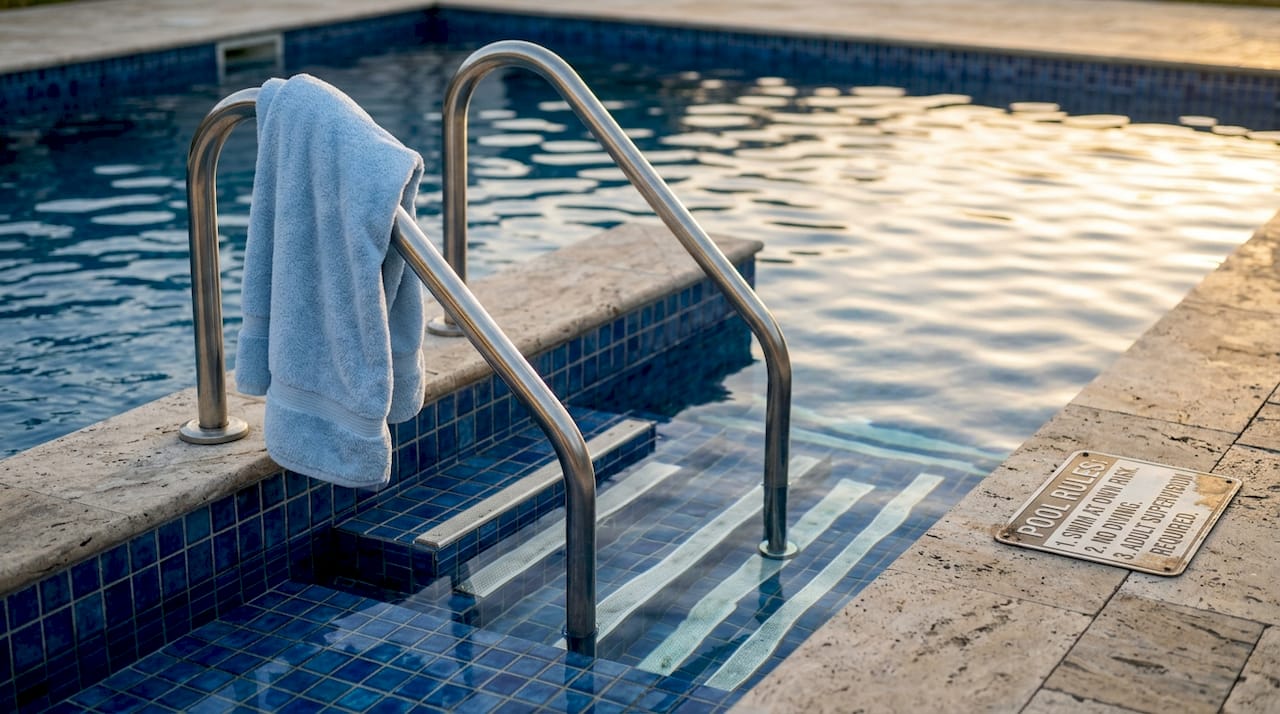
Ladders serve a slightly different function than steps. Deck-mounted inground ladders with pivot bottoms are designed to handle sloped pool floors, which are common in pools with deep ends that transition gradually. A-frame ladders provide both entry and exit access and are often placed at the deep end of the pool where no steps exist. Wide-step ladders are significantly safer than traditional narrow-rung designs because they allow a full foot placement with each step, reducing slipping risk on wet surfaces.
Key features to prioritize when selecting ladders and handrails:
- Stainless steel construction for corrosion resistance and longevity in Florida’s climate
- Anti-slip treads on every step surface, not just at water level
- Rails extending 12 inches or more above the deck so users have support before stepping down
- Wide steps rather than narrow rungs for better foot placement and stability
- Secure deck anchors that meet local load requirements
“Stainless steel ladders with textured treads are not a luxury upgrade in Florida — they are the minimum standard for a pool that will be used regularly by families.” Maintenance matters too; rinse hardware after heavy rain or saltwater use to extend its life significantly.
For households with young children or elderly family members, these features are not optional. Visit our guide on pool safety fencing for how to build a full safety system around your pool entry setup.
Comparing pool entry options: Space, safety, and code at a glance
Now, here is a quick comparison showing which entry styles will fit best based on your priorities, available space, and local regulations.
| Entry type | Space required | Best for | Safety notes | Code watch-outs |
|---|---|---|---|---|
| Traditional steps | Small to medium | All family types | Pair with dual handrails | Barrier must be 48 in. min. |
| Beach/zero entry | Large (21+ ft) | Toddlers, seniors | Low tripping risk, algae prone | Sloped edge needs clear barrier |
| Corner benches | Small to medium | Adults, multi-gen | Comfortable entry/exit | Count as pool area, check zoning |
| In-wall steps | Minimal | Smaller pools | Great with mounted rails | Confirm load specs with builder |
| Deck ladder | Minimal | Deep-end access | Wide steps preferred | Must be secured, not freestanding |
Central Florida counties like Seminole enforce stricter rules than state minimums, including prohibitions on double gates, a maximum 2-inch bottom gap under barriers, and screen doors that must be self-closing and self-latching at 54 inches. These requirements apply to the barrier system surrounding every entry, not just the steps themselves.
Understanding these distinctions before you pick an entry type saves significant rework during inspection. The pool building guide walks through how code compliance fits into each phase of a custom pool project.
Situational recommendations: Choosing for your family
You know your space and options; now find the match that fits your family’s lifestyle and safety needs. Most real-world pool entry decisions are not about finding the single best option but about matching the right combination to a specific household situation.
- Families with young children: Choose traditional steps with dual handrails plus a 48-inch compliant barrier with a self-latching gate. Keep steps visible from the main seating area of the home.
- Multi-generational households: Combine traditional steps with a corner bench. The bench provides an easy transition for older adults who need to lower themselves slowly into the water.
- Small yard or compact pool: In-wall steps with deck-mounted handrails preserve the most swim area. Avoid zero entry entirely if your yard is under 400 square feet.
- Luxury renovation or large lot: Beach entry with integrated landscape lighting and wide steps creates a resort feel. Budget for the additional maintenance and cleaning required.
- Budget-conscious update: Retrofit existing steps with new stainless steel handrails and add non-slip tread overlays. This is the most affordable way to bring an older pool up to current safety expectations.
Florida law is clear that removable ladders and steps must be secured when not in use, horizontal rails on fences must be avoided to prevent climbing, and textured non-slip surfaces are essential, especially in Florida’s consistently wet climate. These rules apply to above-ground pools but inform best practices for inground designs as well.
Pro Tip: Think five to ten years ahead. Many homeowners install the entry that fits their family today but regret not planning for aging in place or a growing household. Adding a corner bench or wider steps during initial construction costs far less than retrofitting later.
Explore smart renovation ideas and pool planning steps to see how these decisions integrate into a full project plan.
What most homeowners miss about pool entry choices
After building and renovating custom pools across Central Florida since 1985, we have watched the same pattern repeat itself. Homeowners spend hours choosing tile colors, waterfall features, and deck materials, then make a rushed decision on entry design because it seems like a minor detail. It is not.
The entry is the most-used part of your pool. Every swim session starts and ends there. It is where kids slip. It is where elderly guests hesitate. It is what the inspector scrutinizes first. And it is the feature most likely to require costly updates if you choose something that does not meet current code or fails to serve your household five years down the road.
The uncomfortable truth is that trend-driven designs regularly create practical problems. Zero-entry looks stunning in photos but demands real commitment to cleaning and ongoing maintenance. Minimalist in-wall steps look sleek but become frustrating without proper handrail support for guests who are less mobile. We have seen beautiful pools that families enjoy less than expected simply because the entry was difficult for half the household.
Our honest advice, grounded in decades of local work: start with code requirements, then user needs, then aesthetics. That order produces pools that are safer, easier to maintain, and genuinely more enjoyable over the long run. You can read more pool tips from our team to continue building your knowledge before committing to a design direction.
Ready to customize your Florida pool entry?
Choosing the right pool entry involves real tradeoffs between space, safety, accessibility, and code compliance. Getting it right from the start is far easier than fixing it later.
At R&R Swimming Pools, we have been designing and building custom inground pools in Central Florida since 1985. Whether you are starting a new build or updating an older pool to meet current code, our team can help you choose and install the entry system that fits your yard, your family, and your budget. Explore our inground pool installation guide to understand the full build process, browse best inground pool types to see your structural options, or review our pool remodeling guide if you are planning a renovation. Contact us today for a free quote and let us bring your ideal pool to life.
Frequently asked questions
Do Florida pool entry options require special permits or inspections?
Yes, most entry changes must meet state and local codes and may require inspection for safety barrier compliance. Florida law sets minimum barrier heights of 48 inches with self-closing, self-latching gates, and local counties often add their own requirements on top of that.
Which pool entry is safest for families with children?
Traditional steps paired with dual handrails and a compliant four-foot safety barrier are considered the safest combination for families. Florida data confirms that physical barriers with self-latching gates are the most effective drowning prevention measure available.
Can I install a beach or zero entry in a small backyard pool?
Beach entries require much more space than most small yards offer, typically more than 21 feet of pool length just to reach a 3-foot depth, making them impractical for compact properties.
Are there special materials recommended for pool steps and ladders in Florida?
Yes, stainless steel with textured non-slip surfaces is strongly recommended due to Florida’s heat, humidity, and pool chemical exposure, all of which accelerate corrosion and increase slip risk.
What should I do if renovating an older pool with out-of-date entry features?
Update your pool entries and barriers to current Florida code during renovation. Renovations trigger the requirement to bring all safety features up to present standards, not the original installation codes.
