
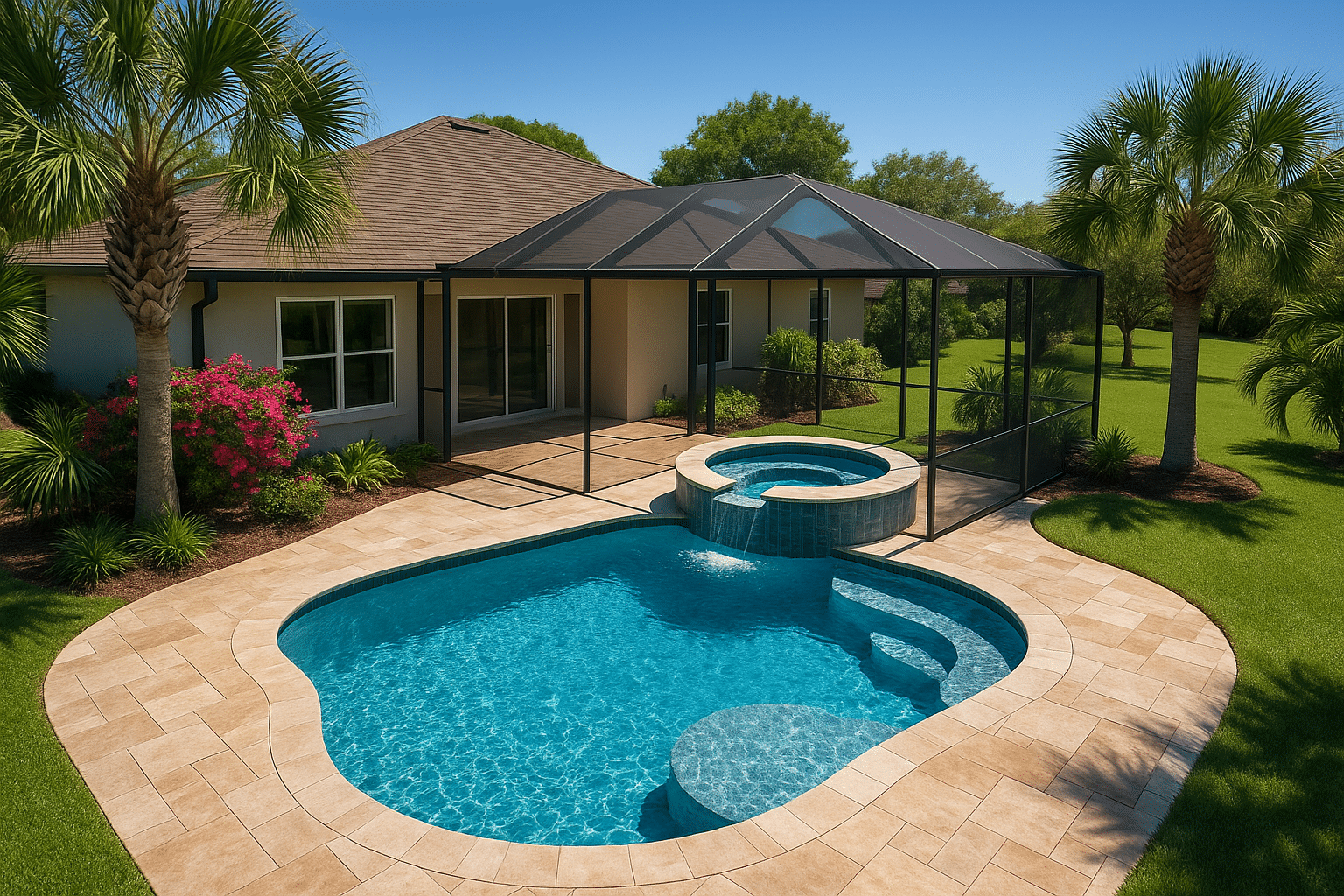
TL;DR: In Florida, a pool is one of the strongest lifestyle and real estate investments you can make — but only if you go in with realistic expectations. Central Florida homeowners enjoy 10–11 months of usable pool weather, meaningful home-value gains, and genuine daily enjoyment, but they also take on year-round maintenance costs, safety compliance responsibilities, and upfront build costs that rarely come back dollar-for-dollar at resale.
The question comes up constantly: Is a pool worth it in Florida? The short answer is yes — for most homeowners who will actually use it. But that answer comes with real numbers you need to see first.
Below is a clear-eyed look at the pros, the cons, the ROI data, the ongoing costs, and the safety rules so you can decide with confidence.
Florida’s Pool Season: The Foundational Advantage
The single biggest reason a pool makes more financial and lifestyle sense in Florida than almost anywhere else is the length of the season. Pools in northern states sit covered and idle for half the year — or more. Here, the math is completely different.
Central Florida offers 10–11 months of comfortable pool weather, and even north Florida typically provides 8–9 months. That means a pool in Lake County or The Villages is not a seasonal luxury — it’s a feature you use nearly every day of the year.
This extended usability dramatically increases the perceived value of owning a pool, turning it from a seasonal luxury into a functional part of daily life. Compare that to the Northeast, where pools operate for only 4–5 months, and the value proposition in Florida becomes obvious.
The Honest ROI: What a Pool Actually Adds to Your Home Value
Let’s start with what the data actually shows — not marketing spin.
In warm-climate states like Florida, Arizona, Texas, California, and Nevada, pools can add 10–15% or more to home value and may even be expected in certain price ranges. That’s a materially different picture from the national average.
Inground pools deliver 50–70% ROI in Florida, with mid-range installations costing $35,000–$65,000 potentially adding $25,000–$40,000 to home value. That sounds great — until you remember the gap between what you spend and what you get back.
The typical ROI is 40–60% of installation cost, meaning most homeowners don’t fully recoup their pool investment through resale alone. A pool is not a dollar-for-dollar return. It never has been.
What it is, however, is a competitive advantage. Pools serve as tie-breakers in competitive suburban markets. When two similar homes are priced comparably, the one with a well-maintained pool sells first — and that speed advantage has real financial value, especially in a market where carrying costs add up monthly.
In Central Florida specifically, swim season is effectively year-round. In many neighborhoods, pools are not considered luxury add-ons reserved for high-end properties — they are expected amenities that directly influence buyer perception, property value, and competitive positioning in the real estate market.
For a deeper look at what different pool types cost and how they compare at resale, see our guide to fiberglass vs. concrete pool cost in Florida.
The Real Costs of Pool Ownership in Florida
This is where most homeowners underestimate what they’re signing up for. Florida’s year-round season is a feature — but it also means year-round expenses.
Annual Maintenance Costs
Total pool upkeep costs run from $3,000 to $6,000 annually, including maintenance, minor repairs, electricity, and water. Florida pools cost more to maintain than pools in most other states because the work never stops.
Here’s why Florida is uniquely demanding: Florida’s year-round growing season means algae, bacteria, and debris accumulation never stops — northern pools get a winter break, but Florida pools don’t. Chlorine and other chemicals break down 30–40% faster under Florida’s intense sun, requiring more frequent additions. Summer thunderstorms dilute pool chemicals weekly, necessitating constant rebalancing.
For professional weekly service in Central Florida markets like Clermont and surrounding communities, professional weekly pool cleaning and maintenance runs $100 to $175 per month.
Periodic Major Expenses
Beyond routine upkeep, budget for these over the life of the pool:
- Fixing or replacing pumps, filters, or heaters can cost $200 to $1,000 per repair.
- Resurfacing a pool can range from $5,000 to $10,000 and should be done every 10–15 years (concrete pools; fiberglass pools typically do not require resurfacing).
- Even minor tropical systems can fill pools with leaves, branches, and dirt, requiring emergency cleaning services at $100 to $300 per visit.
The bottom line: over 10 years, pool ownership can total $40,000 to $70,000 in cumulative maintenance and repair costs. Plan for it upfront so it doesn’t catch you off guard.
Insurance Implications
A pool changes your homeowner’s insurance picture. Most experts recommend a minimum of $300,000 in liability coverage if you own a pool. Pools are legally considered ‘attractive nuisances,’ which could increase your liability exposure.
Talk to your insurer before you break ground to understand how your premium will change and what barriers or safety features your policy requires.
Florida Pool Safety Law: What the State Requires
This is non-negotiable. Florida enacted the Residential Swimming Pool Safety Act specifically to reduce child drowning incidents, and compliance is required on every new pool build.
Under Florida Statute 515, every residential swimming pool in the state must have an approved barrier. Homeowners must choose at least one of the following options:
- A barrier or fence at least 4 feet in height, with no gaps or openings that would allow a small child to crawl under or squeeze through, placed far enough from the water’s edge to prevent direct falls.
- A safety pool cover that complies with state regulations and is strong enough to support the weight of a child or adult and prevent accidental submersion.
- Exit alarms on doors or windows that provide direct access from the home to the pool area, which must sound when the door or window is opened.
Most Florida homeowners insurance policies require a compliant pool barrier as a condition of coverage. A non-compliant or uninspected fence can result in denied claims, mid-term policy changes, or significant premium increases.
At R & R Swimming Pools, we handle all permitting, safety compliance, and final inspections in-house, so every pool we deliver meets Florida Building Code and Lake County requirements from day one.
Pros and Cons: The Honest Summary
Reasons a Pool IS Worth It in Florida
- Near-year-round use. Central Florida’s climate gives you 10–11 months of swimming weather — dramatically more than virtually any other state.
- Real home value gains. A well-maintained inground pool adds 5–15% to your home value in warm-climate markets like ours, where pools are an expected amenity.
- Market competitiveness. Homes with pools sell faster than comparable non-pool homes in suburban Central Florida neighborhoods.
- Lifestyle return. Daily use, family time, exercise, and entertaining — these are real returns that don’t appear on an appraisal but matter enormously to quality of life.
- No winterization costs. Florida pools don’t need winterization — the cold-climate process of draining pipes, blowing out lines, adding antifreeze, and covering for months of complete unusability simply doesn’t apply here.
Reasons to Think Carefully Before Building
- No dollar-for-dollar return. Most homeowners recover 40–60% of their build cost at resale. The rest is absorbed as the cost of enjoyment.
- Year-round maintenance costs. Expect $3,000–$6,000 per year — and potentially more after storms or major equipment failures.
- Insurance and liability exposure. You’ll need to increase your liability coverage and comply strictly with Florida’s pool safety laws.
- Safety responsibility with young children. A pool on a property with toddlers requires fencing, alarms, constant supervision, and swim education — all of which have real costs.
- Value depends on your neighborhood. In budget-friendly Florida neighborhoods, a pool may not provide ROI. In areas with lower home values, buyers may see an older or poorly maintained pool as a liability rather than an asset.
Fiberglass vs. Concrete: Does Pool Type Affect the Decision?
Yes — and it affects both your upfront cost and your ongoing maintenance budget.
From lowest to highest overall costs, the order is fiberglass pools, vinyl liner pools, and concrete pools. Fiberglass pools cost less to maintain because their smooth, non-porous surface naturally resists algae and uses fewer chemicals. Concrete pools offer unlimited customization and a thicker, fully custom shell, but demand more in chemicals, cleaning, and eventual resurfacing.
At R & R Swimming Pools, we build both — factory-built fiberglass shells through our Latham Pool Products dealership, and fully custom gunite concrete pools with shells 6 to 12 inches thick. Both carry a limited lifetime shell warranty. The right choice depends on your budget, your timeline, and how much customization matters to you.
See the full breakdown in our Central Florida inground pool cost guide to compare both options side by side with 2025 pricing.
What About Financing?
Sticker shock is real. But most homeowners in Central Florida don’t pay for their pool in cash — they finance it. R & R Swimming Pools works with Lyon Financial and Viking Capital, two pool-industry-specialist lenders, to make monthly payments manageable for a wide range of budgets.
Spreading the cost over time also changes the ROI conversation. When your monthly payment is comparable to what you might spend on a gym membership, resort visits, or vacation rentals, the value calculation shifts significantly in the pool’s favor.
Learn how pool loans work and what to expect in our guide to financing a pool in Florida.
Who Should Build a Pool in Central Florida?
A pool is worth it if:
- You plan to stay in your home for at least 5–7 years
- You and your family will use it regularly — not occasionally
- Your home value and neighborhood support the investment
- You’ve budgeted honestly for ongoing maintenance, not just the build
- You’re prepared to meet Florida’s safety and insurance requirements
A pool may not be the right call if you’re building primarily for resale, if your home sits in a lower-value market tier, or if you’re not ready to commit to year-round maintenance.
The Bottom Line
A pool is worth it for homeowners who will use it regularly and are prepared for year-round maintenance, safety, and ongoing costs. In Central Florida — with our climate, our outdoor culture, and our real estate market — that description fits a large number of homeowners.
R & R Swimming Pools has been building custom inground pools across Lake County and Central Florida since 1985. We’ve completed over 1,000 pools and spas in communities from The Villages to Clermont, Mount Dora to Minneola, and every community in between. When you’re ready to talk through what the right pool looks like for your property and your budget, we’re here.
Recommended Reads
- Fiberglass vs. Concrete Pool Cost in Florida: A Side-by-Side Breakdown
- How Much Does an Inground Pool Cost in Central Florida? (2025 Pricing Guide)
- How to Finance a Pool in Florida: Loan Options, Lenders, and What to Expect
