
If you need clear audio while fully submerged, for swim coaching, lap training, or aquatic therapy, you need a purpose-built underwater transducer, not a waterproof Bluetooth speaker. If you just want music to carry across the water during a pool party, a floating Bluetooth speaker is cheaper, easier, and good enough. True underwater sound systems require:
- A piezoelectric or moving-coil transducer rated for submersion, not a “water-resistant” consumer speaker
- A matched amplifier and an isolation transformer sized correctly for the unit
- GFCI-protected wiring, typically installed by a licensed electrician familiar with pool code
The gap between these two categories is bigger than most retailers let on, and it changes what you should buy first.
Key Takeaways
Underwater sound only works with purpose-built transducers and matched amplification; floating Bluetooth speakers cover ambient use but never deliver true submerged audio.
| Point | Details |
|---|---|
| Match solution to use case | Choose a transducer system for coaching or therapy; choose floating Bluetooth for party ambiance. |
| Plan for two units minimum | Standard residential pools generally need two speakers for even coverage, based on the 37 square meter rule. |
| Budget for electrical work, not just hardware | Full installed systems commonly exceed $2,500 once electrician hours and niche work are included. |
| Never skip GFCI and transformers | Isolation transformers and GFCI protection are non-negotiable safety steps on every underwater audio circuit. |
| Build niches in during construction | Adding a wet niche during a new build or renovation avoids costly cut-and-patch retrofit work later. |
Table of Contents
- What Are Underwater Speakers and How Do They Differ From Waterproof Ones
- Do You Actually Need Underwater Audio, or Will a Floating Speaker Do?
- How Many Speakers You Need and Where They Go
- Amplifier Matching, Voltage Limits, and Electrical Safety
- In-Wall Niche vs. Portable Drop-In: Costs and Trade-offs
- How a Pool Contractor Fits Into an Underwater Audio Project
- Ready to Build Underwater Audio Into Your Pool Plans?
- The Case for Prioritizing Function Over Novelty
- Frequently Asked Questions
- Sources
What Are Underwater Speakers and How Do They Differ From Waterproof Ones
A speaker marketed as “waterproof” is usually built to survive splashes or brief dunking, not to project sound while sitting on the bottom of a pool. Water is roughly 800 times denser than air, and a standard cone driver simply can’t move enough of it to produce usable sound. Underwater speakers solve this with specialized transducers, piezoelectric ceramic elements or electrodynamic shakers, that convert electrical signals directly into mechanical vibrations, agitating water molecules instead of pushing air. That mechanical coupling is why air-designed drivers fail once submerged, no matter how well-sealed the housing is.
Three categories dominate the market:
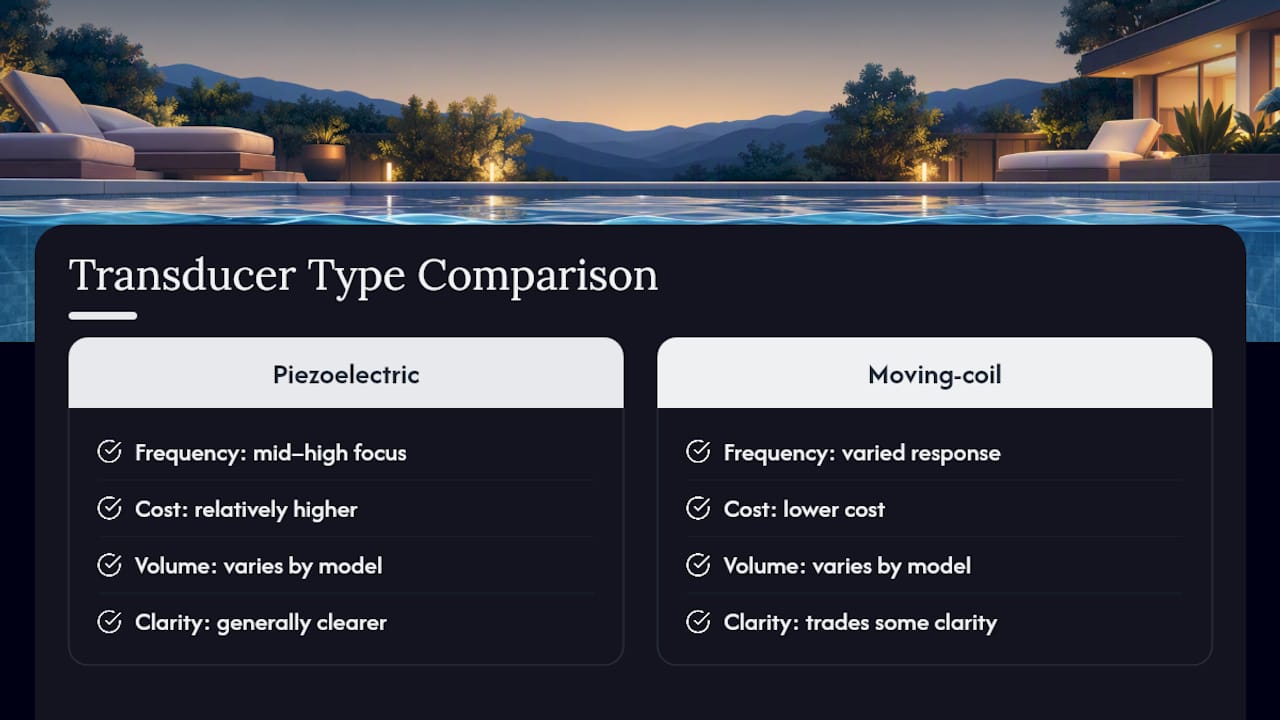
- Piezoelectric (Tonpilz) transducers. Best sound clarity, widely used in training and therapy pools, higher cost.
- Moving-coil submersibles. More affordable, but limited output and less mid-frequency detail.
- Floating Bluetooth speakers. Surface-only audio, no true underwater transmission, but plug-and-play simplicity.
Depth rating matters more than IP rating here. An IP68 speaker might resist a dunking, but that says nothing about whether it’s engineered to project sound underwater or survive continuous submersion at pool depth.
Do You Actually Need Underwater Audio, or Will a Floating Speaker Do?
Ask yourself one question first: does the sound need to be intelligible while someone’s head is underwater? If yes, you need a transducer system. If no, save your money.
- Swim coaching and lap training. Coaches often use underwater speakers to deliver pacing cues or stroke feedback swimmers can hear mid-lap. A floating speaker is useless here since sound doesn’t transmit well across the air-water boundary.
- Aquatic therapy. Therapists sometimes use submerged audio for rhythm-based movement or relaxation cues delivered directly to a submerged patient.
- Backyard parties and ambient music. Most homeowners fall here. You want music playing while people swim, lounge, and talk. A floating Bluetooth speaker handles this fine, and setup takes minutes, not days.
If your use case is entertainment rather than function, skip the electrical work and buy a floating unit. If it’s function, keep reading.
How Many Speakers You Need and Where They Go
A widely used manufacturer guideline puts one underwater speaker’s effective coverage at about 37 square meters, roughly a 6-meter by 6-meter area, or one unit per 6-meter section in a lap pool. A typical 30 by 15 foot residential pool usually needs two units for even sound distribution; anything longer than a standard lap lane needs a third.
Placement rules that actually matter:
- Mount on side walls, not end walls, since end-wall speakers sit in flip-turn zones and take repeated physical abuse from swimmers
- Depth placement generally falls around 18 to 30 inches below the surface for balanced projection without excessive attenuation
- Leave clearance from skimmers, returns, and steps so the housing doesn’t interfere with existing plumbing runs
If you’re retrofitting an existing pool without a light niche already in place, you’ll need to decide between cutting a new wet niche, running a suspension-mounted drop-in transducer, or fabricating a custom recessed housing. Each carries different cost and code implications, which is worth discussing with your contractor before committing to a speaker model.
Pro Tip: Walk your pool’s dimensions before calling anyone for a quote. Knowing your exact length and width lets a contractor tell you immediately whether you need two speakers or three, which changes the amplifier size and wiring plan from day one.
Amplifier Matching, Voltage Limits, and Electrical Safety
Underwater transducers need amplification matched to their impedance and RMS wattage rating, not whatever amp happens to be lying around. Manufacturer documentation for popular models specifies amplifier output in the 35 to 50 watt range paired with a properly sized isolation transformer, and running an underspecified amp usually just means weak, distorted sound rather than a safety issue. Running an overpowered amp without a transformer is a different story entirely.
Manufacturers and technical FAQs recommend keeping speaker-cable voltage within manufacturer limits, typically not exceeding 30 volts RMS, and using an isolation transformer plus GFCI protection on every underwater audio circuit. This isn’t a suggestion you can skip to save money on installation.
Before signing off on any underwater audio project, confirm these are in place:
- GFCI protection on the entire circuit, no exceptions
- An isolation transformer sized to the amplifier and speaker load
- Bonding that complies with your local electrical code, which in most U.S. jurisdictions references NEC Article 680 for pool and spa electrical installations
- A licensed electrician who has actually wired pool audio before, not just residential circuits
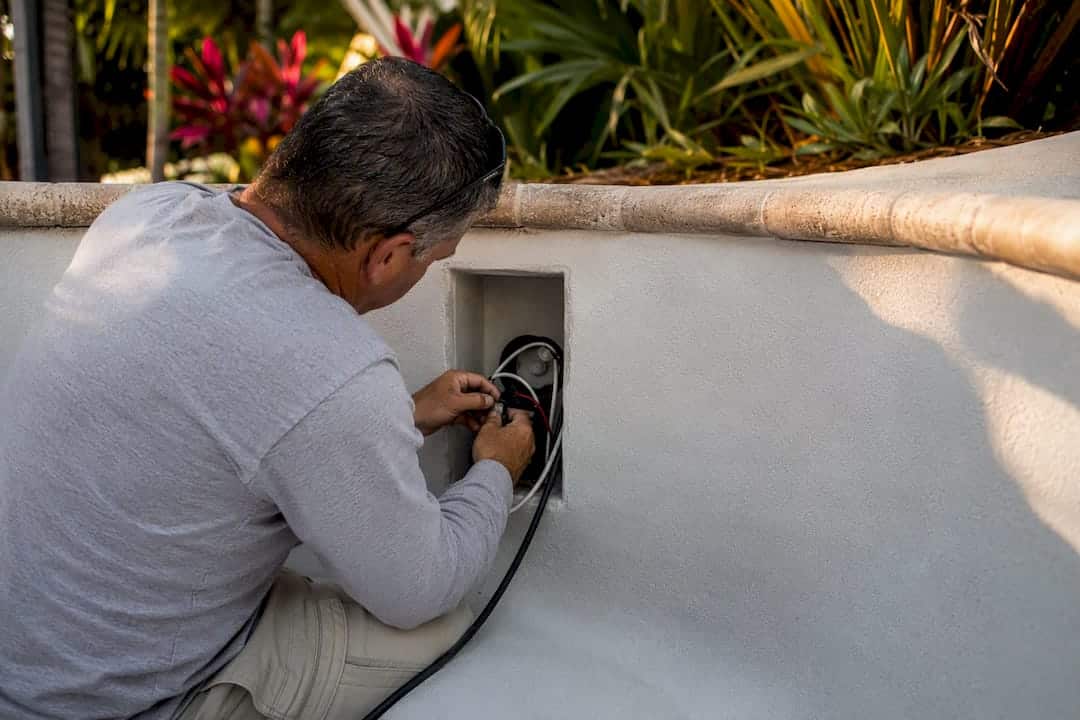
This is the point where DIY ambition should stop. A licensed electrician working alongside an audio integrator, ideally one who has coordinated with electrical services familiar with wet-location wiring, is the difference between a system that works for a decade and one that trips a breaker every time it rains.
In-Wall Niche vs. Portable Drop-In: Costs and Trade-offs
Two installation paths exist, and they solve different problems.
- Permanent in-wall niche installation. The speaker sits flush in a cut niche in the pool wall, wired through conduit with a trim ring finishing the surface. This gives the cleanest look and the most consistent sound coverage, but it requires cutting into the shell, which is far easier during new construction or a full renovation than as a standalone retrofit.
- Portable drop-in transducers. These sit on the pool floor or hang from a suspension rig, no wall cutting required. They’re easier to install and relocate, but securing them against pool cleaners or foot traffic takes some creativity, and output tends to run lower than a properly seated niche unit.
Budget expectations vary widely by installation type. Floating Bluetooth speakers run $25 to $70, entry-level portable transducer kits with a basic amp typically land around $1,800 to $2,500, and fully integrated in-wall systems with professional electrical work commonly exceed $2,500 once you factor in niche fabrication, conduit routing, and electrician hours. The speaker itself is rarely the biggest line item. Labor and electrical infrastructure usually cost more than the hardware.
How a Pool Contractor Fits Into an Underwater Audio Project
Randrswimmingpools has built and renovated custom inground pools across Central Florida since 1985, and underwater audio retrofits touch nearly every trade a full pool build involves: shell work, conduit routing, and electrical coordination.
What a contractor typically handles on your behalf:
- Coordinating conduit runs from the equipment pad to the speaker niche during construction or renovation
- Verifying bonding and grounding meet code before final inspection
- Finishing niche trim rings so the installation looks intentional, not bolted on
Before hiring anyone, ask for references on niche retrofits specifically, not just general pool work, and confirm they’ll provide a written, code-compliant electrical plan. If you’re planning a new custom pool installation, this is far cheaper to design in from the start than to retrofit later.
Ready to Build Underwater Audio Into Your Pool Plans?
Adding a wet niche, running conduit, and coordinating electrical bonding is dramatically simpler when it’s part of the original construction plan rather than bolted onto a finished pool years later. Randrswimmingpools has spent decades building custom concrete and fiberglass pools across Central Florida, and folding in features like underwater audio niches during the design phase avoids the cut-and-patch costs a retrofit demands. If you’re weighing a new pool build or a full renovation, start with our inground pool installation guide to see how electrical and niche planning fits into a typical project timeline, and ask about financing options if you’re budgeting for added features alongside the pool itself.
The Case for Prioritizing Function Over Novelty
Most of the marketing around underwater speakers sells them as a luxury add-on, all ambiance, no substance. That framing undersells what these systems actually do well. The real value shows up in functional use, coaching cues delivered mid-lap, therapy sessions synced to rhythm, not as background noise at a barbecue.
Conventional advice treats speaker selection as the hard part. It isn’t. The electrical work, the transformer sizing, the GFCI circuit, the code compliance, is where most DIY attempts go sideways, and it’s also where a floating Bluetooth speaker quietly wins for casual use by avoiding the entire problem.
If you’re building or renovating a pool anyway, this is the moment to plan for a niche, not after the shell is poured. Retrofitting later means cutting into finished concrete or fiberglass, which costs more and never looks quite as clean. Talk to your contractor about conduit routing before construction starts, not after you’ve bought a speaker and discovered you have nowhere clean to put it.
Frequently Asked Questions
Can I install underwater speakers in an existing pool without draining it?
Portable drop-in transducers can sometimes be installed without draining, depending on wiring access. Permanent in-wall niches almost always require the pool to be drained and the shell cut, which is why many owners wait for a planned renovation.
Do underwater speakers work with a regular pool sound system?
No. Standard poolside speakers and amplifiers aren’t built for the impedance and voltage requirements of submerged transducers. You need equipment specifically matched to the underwater unit, per manufacturer specs.
Are underwater speakers safe with kids swimming?
Yes, when installed correctly with GFCI protection, proper bonding, and voltage kept within manufacturer limits. The risk isn’t the speaker itself, it’s improperly wired or unpermitted electrical work.
How loud can underwater speakers actually get?
Sound behaves differently underwater than in air, so volume perception varies by transducer type. Piezoelectric systems generally produce clearer mid-to-high frequency output, while moving-coil units trade some clarity for lower cost.
Will a floating Bluetooth speaker work for a pool party?
For ambient music while people swim and socialize, yes. It won’t deliver intelligible audio to someone with their head underwater, but for surface-level entertainment it’s the simplest and cheapest option available.
Sources
Share these with your electrician or pool contractor before finalizing a plan:
- How to get in the groove with underwater speakers for pools — Pools & Spas News
- Lubell Labs product / coverage guidance
