
TL;DR:
- A pool skimmer is a built-in device that removes floating debris and protects the circulation system. Proper maintenance and placement extend the life of the skimmer, reduce chemicals, and improve water clarity. Professional design and installation are key for optimal performance and safety.
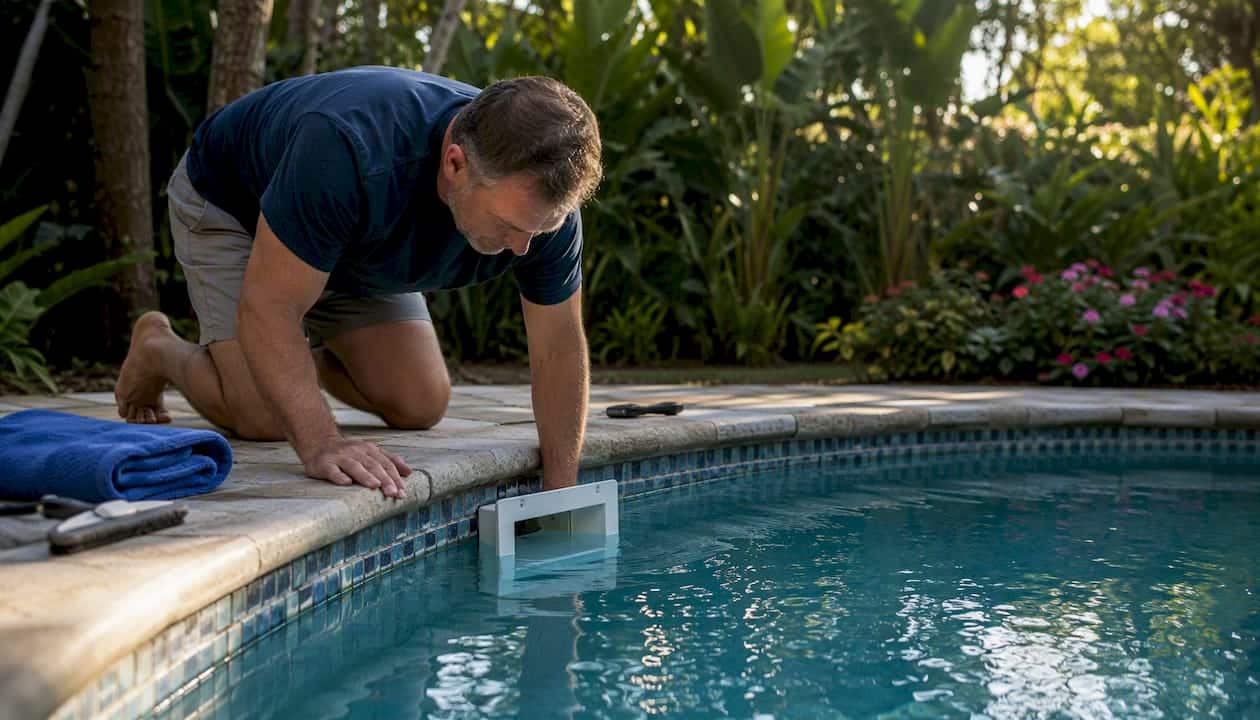
A pool skimmer is a built-in intake mounted at the waterline that continuously pulls the top layer of water into a debris-catching basket before it reaches your pump. Every inground pool has at least one. Its two jobs are simple but critical:
- Capture floating debris (leaves, insects, sunscreen, body oils, pollen) before it sinks and becomes harder to remove
- Serve as the suction-side entry point for your pool’s circulation system, protecting the pump from blockages and feeding clean water to the filter
The Pool and Hot Tub Alliance (PHTA) recommends sizing and placing skimmers based on surface area, and NSF flow standards set the performance targets every properly designed system should meet. Randrswimmingpools has been installing skimmers in Central Florida pools since 1985, and the guidance below reflects both industry standards and real-world contractor experience.
Table of Contents
- What does a pool skimmer actually do for your water?
- What are the main parts of a pool skimmer?
- What types of pool skimmers are there?
- How does a skimmer fit into pool circulation, and how is it different from the filter?
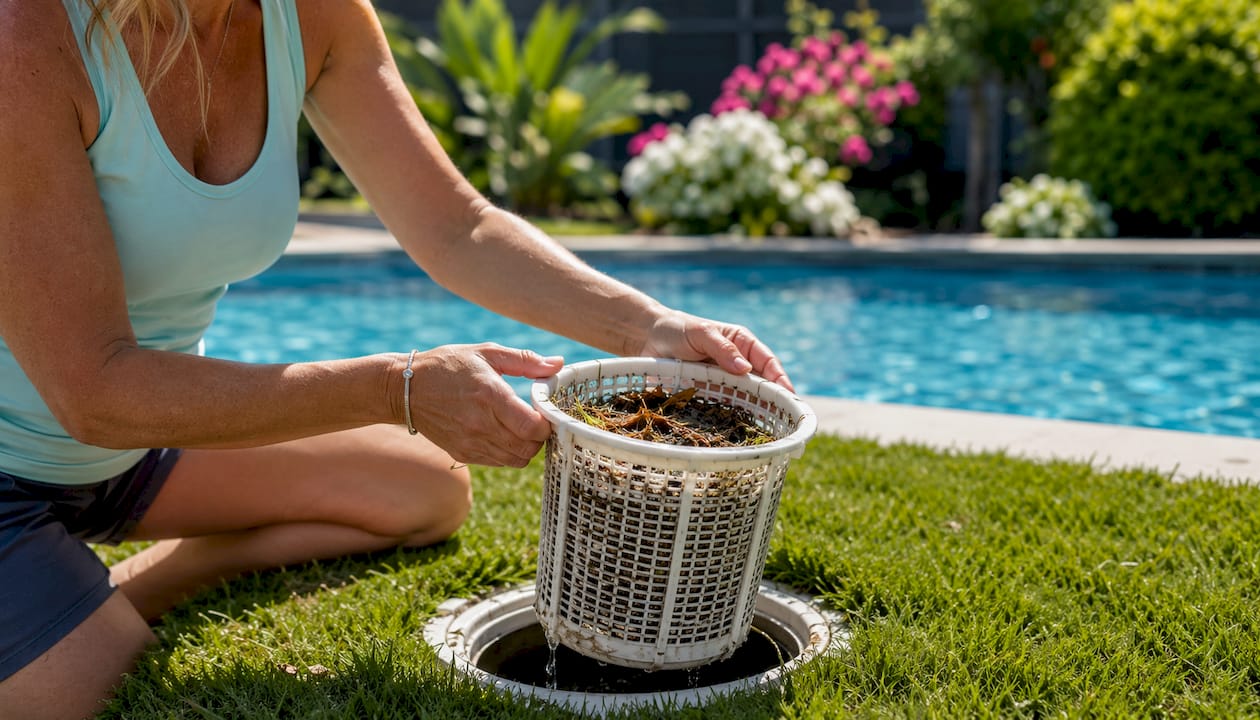
- How do you clean and maintain a pool skimmer?
- What are the most common skimmer problems and how do you fix them?
- How many skimmers does your pool need, and where should they go?
- When should you replace a skimmer, and what safety rules apply?
- Contractor tips from Randrswimmingpools: what actually works in Central Florida
- Key Takeaways
- Why skimmer placement is the decision most homeowners underestimate
- Randrswimmingpools builds pools with skimmer systems designed to last
- Useful sources and further reading
What does a pool skimmer actually do for your water?
A skimmer’s most underappreciated job is chemical protection. Oils, sunscreen residue, and organic matter float. If they sit on the surface long enough, they break down and consume chlorine, driving up your chemical costs and clouding the water. Pulling them off the surface early, before they sink, reduces chlorine demand and cuts the load on your filter.
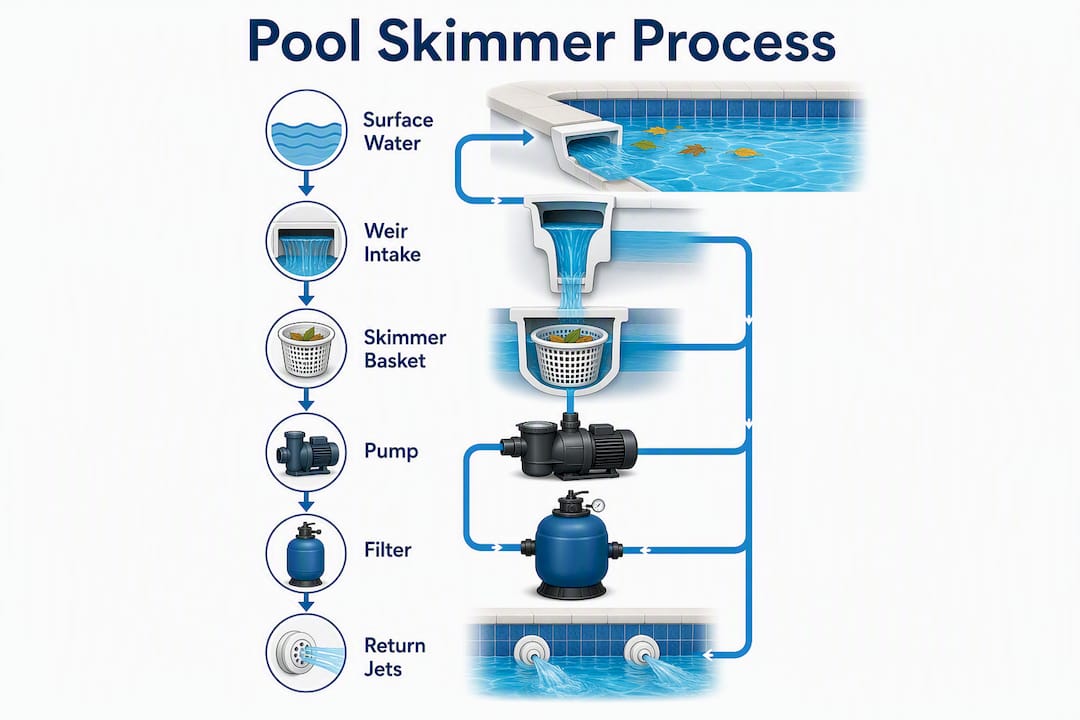
The flow path looks like this: surface water → weir → skimmer basket → pump → filter → return jets. The skimmer is the first line of defense. By the time water reaches the filter, the large debris is already gone, so the filter handles only fine particles. This division of labor extends filter media life and keeps backwash cycles less frequent.
Protecting the pump is the other half of the story. A clogged skimmer basket starves the pump of suction, which can cause cavitation, overheat the motor, and eventually crack the pump housing. A two-minute basket check prevents a repair bill that can run into hundreds of dollars.
What are the main parts of a pool skimmer?
Understanding the parts makes inspection and troubleshooting straightforward. Here is what you will find inside a standard inground skimmer:
- Lid/cover: The deck-level cap that protects the skimmer from foot traffic and keeps debris from falling in directly. Cracked or missing lids are a safety hazard.
- Throat/body: The rectangular housing built into the pool wall. Water enters here from the pool side.
- Weir (floating door): A hinged flap that sits at the waterline and regulates intake. It restricts the draw to the top inch or two of water and swings shut when the pump is off to keep debris in the basket.
- Skimmer basket/strainer: The removable plastic basket that catches leaves, insects, and large debris. This is the part you clean most often.
- Bottom ports: One or two openings at the base of the skimmer body. The suction port connects to the pump line. The second port (equalizer or back port) ties to the main drain or a safety line to prevent the pump from losing prime if the water level drops.
- Skimmer lid screws or locking clips: Secure the cover to the deck. Loose lids on an inground pool can be a code issue.
Pro Tip: Check the weir every month. It should swing freely with light finger pressure. A weir that is stuck open draws water from deeper in the pool instead of the surface, which guts your skimming efficiency. While you are there, run your fingers around the basket rim — a torn or warped basket lets debris bypass straight to the pump.
What types of pool skimmers are there?
Skimmer styles break down by pool type and how much automation you want. Here is a quick comparison:
| Skimmer Type | Best For | Installation | Power Source | Cost Range |
|---|---|---|---|---|
| Built-in wall skimmer (inground) | Concrete, fiberglass, vinyl liner pools | Permanent, built into pool wall | Pool pump (suction-side) | Included in pool build |
| Aboveground wall skimmer | Aboveground pools with flat walls | Attaches to pool wall, hose to pump | Pool pump | ~$20 |
| Floating/hanging skimmer | Any pool, heavy-debris areas | No installation, floats on surface | Pool pump (suction hose) | ~$30 |
| Robotic/automatic skimmer | Any pool as a supplement | Minimal setup, solar or battery | Solar or battery | up to ~$1,000 |
Built-in wall skimmers are the standard for inground pool types because they integrate directly with the circulation system and require no separate power source. Aboveground skimmers work the same way but clamp onto the pool wall and connect via a flexible hose.
Floating skimmers are useful during heavy-debris seasons or in areas with lots of tree cover. They adjust automatically to water level, which is an advantage floating skimmers have over fixed-wall units when water levels fluctuate. Robotic skimmers are increasingly popular as supplements — they reduce how often you need to manually skim, but they do not replace a built-in skimmer’s role in the circulation system.
How does a skimmer fit into pool circulation, and how is it different from the filter?
These two components are often confused, but they do completely different jobs. The skimmer is a surface intake that catches large, visible debris. The filter is a fine-particle processor that treats the entire pool volume over multiple turnovers. You need both, and neither substitutes for the other.
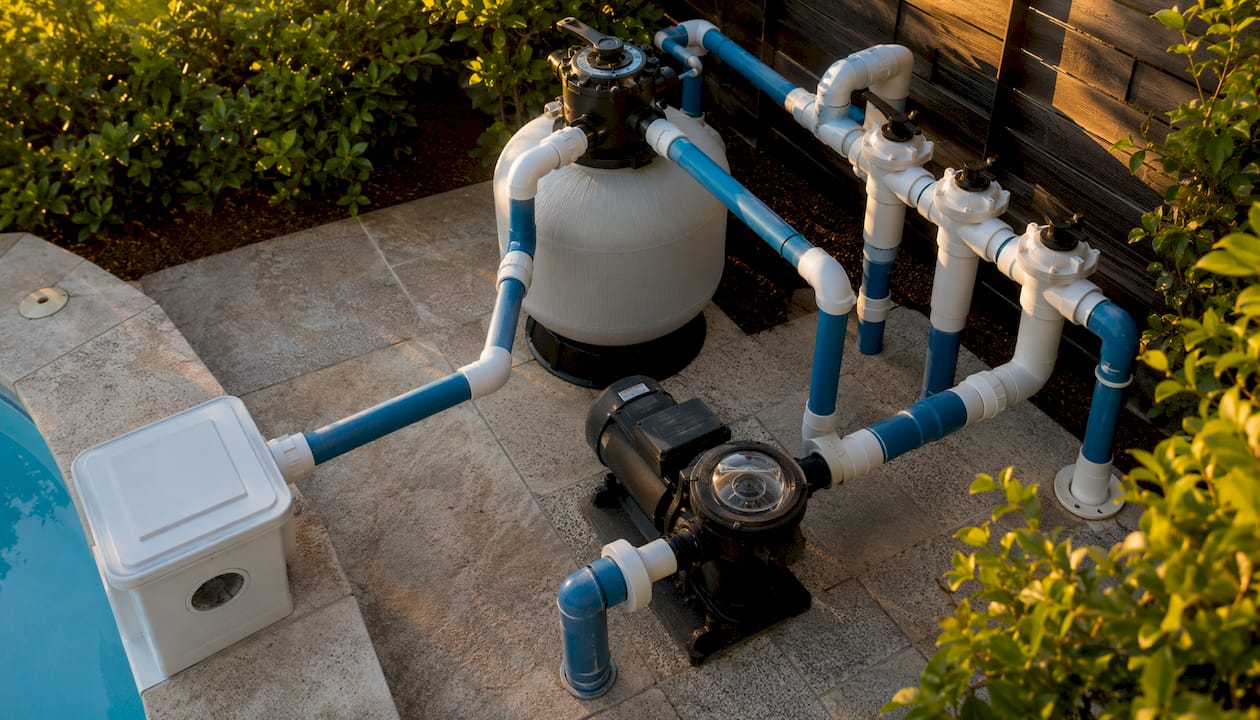
The skimmer captures large floating debris while the filter removes fine particles — algae spores, fine dirt, and microscopic contaminants — that pass right through the skimmer basket. Removing the skimmer from the equation and relying solely on the filter would clog filter media within days during a Florida summer.
Hydraulically, the skimmer sits on the suction side of the pump. That matters because any air leak at the skimmer (cracked throat, low water level exposing the opening) gets pulled directly into the pump and can cause air locks. The filter sits on the pressure side, after the pump. For deeper reading on how these two systems divide the work, the pool filters explained guide covers filter types and their interaction with skimmer flow.
Flow rate is where the two systems connect. Each skimmer is designed to handle a specific volume of water. Push too much flow through one skimmer and the weir gets overwhelmed; too little and surface debris barely moves toward the opening.
How do you clean and maintain a pool skimmer?
Skimmer maintenance is the simplest task in pool care and the one most often skipped until something breaks. Here is the standard cleaning sequence:
- Turn off the pump (or close the skimmer valve if your system allows isolated shutoff).
- Remove the skimmer lid by unscrewing or unclipping it.
- Lift out the basket — grip the handle and pull straight up.
- Empty the basket into a trash bag or compost bin. Shake out fine debris.
- Inspect the basket for cracks, tears, or missing clips. A damaged basket lets debris through to the pump.
- Rinse the basket with a garden hose if needed.
- Check the weir for free movement and the throat for visible cracks or staining.
- Replace the basket and lid, making sure the lid seats flush.
- Restart the pump and watch for normal prime — no gurgling or air bubbles at the return jets.
Frequency guidance:
- Daily or after storms: During heavy-debris periods (Florida storm season, fall leaf drop), check the basket every day. A full basket in 24 hours is common after a thunderstorm.
- Weekly: Standard cleaning interval during normal swim season.
- Monthly: Full inspection of weir, throat, and lid condition.
- Seasonal/winterizing: In climates where pools are closed for winter, blow out the skimmer line, plug the throat, and remove the basket for storage. Central Florida pools typically stay open year-round, but seasonal maintenance planning still matters after hurricane season.
For a full list of tools that make basket cleaning faster, the pool homeowner maintenance tools guide covers what to keep on hand.
Pro Tip: Never restart the pump with the skimmer lid off. Air pulled into an open skimmer throat can air-lock the pump and require a manual prime to fix. Always replace the lid before switching the system back on.
What are the most common skimmer problems and how do you fix them?
Most skimmer issues have straightforward causes. Here is what to look for:
- Clogged basket: The most common issue. Symptoms include reduced return jet pressure and a gurgling pump. Fix: clean the basket (see above). If it clogs within hours, check for a nearby debris source.
- Stuck or broken weir: The weir hangs open or is missing entirely. Result: the skimmer draws from deeper water instead of the surface, and skimming efficiency drops sharply. Fix: free a stuck weir by hand; replace a broken one (inexpensive part, usually under $20).
- Air in the pump/gurgling returns: Often caused by low water level exposing the skimmer throat, a cracked skimmer body, or a loose lid. Fix: raise water level to the midpoint of the skimmer opening; inspect throat and lid for cracks.
- Low or no suction at the skimmer: Could be a clogged basket, a closed valve, or a blocked equalizer port. Fix: clear the basket first, then check valve positions.
- Scum line at the waterline: Oils and sunscreen accumulating at the skimmer throat or pool tile. Fix: clean with a tile enzyme cleaner; check that the weir is functioning so surface film is being pulled in.
- Cracked skimmer throat or body: Visible cracks in the plastic housing. This is a structural issue. Epoxy patches are a temporary measure at best and can fail under water pressure.
When to call a professional: Persistent pump cavitation noise (a grinding or rattling sound under load), a cracked skimmer that requires cutting into the pool deck or shell, any concern about electrical bonding at the skimmer, or a situation where the equalizer line may be compromised. The PHTA consumer guidance is clear that skimmer problems integrated with pump and safety systems warrant professional inspection, not DIY guesswork.
How many skimmers does your pool need, and where should they go?
The industry rule of thumb is to have one skimmer for each moderate area of the pool’s surface. Larger pools often need multiple skimmers; smaller pools can function with a single skimmer. PHTA guidance and local building codes may set minimums, and some jurisdictions require skimmers in all new pool construction.
Sizing note: The 400-sq-ft-per-skimmer guideline is a starting point. Pools with heavy tree cover, high bather loads, or irregular shapes often benefit from an additional skimmer beyond the minimum.
Placement matters as much as count. Effective placement follows three principles:
- Opposite the return jets: Returns push surface water toward the skimmer. Placing them on opposite walls creates a circulation pattern that sweeps debris across the pool.
- Downwind: Position skimmers on the side of the pool that prevailing winds blow toward. Debris drifts downwind; the skimmer should be waiting for it.
- Away from corners and obstructions: Dead zones form in corners and behind steps. Skimmers placed too close to corners miss the debris that collects there.
On the flow side, each skimmer is designed for a specific range. NSF-referenced flow data puts the typical operating range at 15–75 gpm, with the optimal band for effective surface skimming at 25–55 gpm per skimmer. Running a single skimmer on a pump sized for two skimmers pushes flow well above that range and reduces skimming quality while increasing wear on the weir.
When should you replace a skimmer, and what safety rules apply?
Signs that warrant replacement rather than repair:
- Visible cracks in the skimmer body or throat that cannot be sealed with a manufacturer-approved repair kit
- A warped or collapsed throat that prevents the basket from seating properly
- Persistent leaks at the skimmer-to-shell joint despite resealing attempts
- A damaged or missing lid that creates a foot-entrapment or fall hazard
Safety and code items every homeowner should know:
- Electrical bonding: Inground pool skimmers must be bonded to the pool’s equipotential bonding grid. This is a code requirement in the U.S. under the National Electrical Code (NEC). Never replace a skimmer without confirming the bonding wire is reconnected properly.
- Secure lids: A loose or missing skimmer lid on a deck-level skimmer is a trip and entrapment hazard. Replace cracked lids immediately.
- Equalizer line: Double-port skimmers offer a significant safety and hydraulic advantage. The second port ties to the main drain or a dedicated equalizer line, which prevents the pump from losing prime and creating dangerous suction at the skimmer throat if the water level drops. For new concrete construction, double-port skimmers are strongly preferred.
- Pool enclosures in Florida: A screened pool enclosure reduces debris load on skimmers significantly. If you are weighing enclosure options, Florida pool enclosure privacy screens are worth reviewing for how they affect both debris management and skimmer workload.
Upgrade options: Higher-flow skimmers, wide-angle skimmers (up to 24 inches wide versus the standard 12 inches), and adding a robotic skimmer as a supplement all extend your system’s capacity without a full replumb.
Contractor tips from Randrswimmingpools: what actually works in Central Florida
Central Florida pools face specific pressures that most generic maintenance guides ignore. Palm fronds, oak catkins, and afternoon thunderstorms can fill a skimmer basket in hours. Here is what Randrswimmingpools’s installation and service experience has shown to matter most:
Do:
- Check weir movement every month. It takes ten seconds and catches the most common efficiency killer before it becomes a problem.
- Schedule basket cleaning during heavy-use weeks (spring break, summer) at least every two days.
- Align pump runtime with peak skimming hours. Running the pump during the day, when debris is actively falling and bathers are in the water, gets more surface film removed per kilowatt-hour than running it overnight.
- During new installs, Randrswimmingpools positions skimmers on the downwind wall and opposite the primary return jets, which creates a natural debris sweep across the pool surface.
Don’t:
- Run the pump with a badly clogged basket. The restricted suction strains the motor and can cause cavitation damage within a single pump cycle.
- Ignore persistent air or gurgling sounds at the pump. That sound means air is entering the suction line, usually at the skimmer throat or a loose fitting. It does not self-correct.
- Use epoxy as a permanent fix for a cracked skimmer body. Epoxy patches fail under hydrostatic pressure and thermal cycling, which Florida’s temperature swings accelerate.
Pro Tip: If your pool sits under a large oak or palm, consider a pool enclosure or screen to cut debris load by a significant margin. Less debris in the water means longer intervals between basket cleanings and a measurably lighter load on your filter.
For deeper guidance on pool maintenance in Central Florida, including seasonal prep and equipment checks, Randrswimmingpools’s Pool School covers the full picture.
Key Takeaways
A properly sized and maintained pool skimmer is the single most cost-effective way to protect your pump, reduce chemical use, and keep your water clear.
| Point | Details |
|---|---|
| Skimmer sizing rule | One skimmer per 400 sq ft of pool surface area is the industry starting point; add more for heavy debris or irregular shapes. |
| Optimal flow range | Each skimmer performs best within an optimal flow rate range; exceeding this range reduces surface capture and increases weir wear. |
| Basket cleaning frequency | Clean weekly during normal season, daily after storms, and inspect the weir and basket condition every month. |
| When to call a pro | Persistent pump cavitation, cracked skimmer body, bonding concerns, or equalizer line issues all require professional repair. |
| Randrswimmingpools | Central Florida’s custom pool builder since 1985; handles skimmer placement, retrofits, and new builds across the region. |
Why skimmer placement is the decision most homeowners underestimate
Most pool owners think about skimmers only when something goes wrong. That is backwards. The placement and sizing decisions made during construction determine how well the skimmer performs for the life of the pool, and getting them wrong creates a maintenance burden that no amount of basket cleaning can fully offset.
A skimmer positioned on the wrong wall, or a pool built with one skimmer when two are warranted, will always underperform. You will spend more on chemicals, clean the basket more often, and run the pump longer to compensate. The fix at that point is a retrofit, which means cutting into the pool deck or shell.
The conventional wisdom is that skimmers are simple and interchangeable. They are not. Flow rate, port configuration, weir design, and placement relative to returns and prevailing wind all interact. A double-port skimmer with a properly sized equalizer line is a meaningfully safer and more reliable system than a single-port unit, especially in a pool that sees fluctuating water levels. That detail rarely appears in homeowner guides, but it is the kind of thing a contractor who has built pools for four decades notices immediately.
The maintenance side is genuinely simple: clean the basket, check the weir, watch for air in the pump. The design side is where professional judgment pays for itself.
Randrswimmingpools builds pools with skimmer systems designed to last
Forty years of Central Florida pool construction means R and R Swimming Pools has seen every skimmer failure mode there is, and designs new pools to avoid them. Whether you are planning a new inground pool, retrofitting an older skimmer, or just trying to figure out why your pump keeps losing prime, the team at Randrswimmingpools can walk you through it.

New builds include skimmer placement engineered for your yard’s specific wind patterns and debris load, with double-port configurations standard on concrete pools. Retrofits and inspections are available across Central Florida for homeowners dealing with cracked skimmers, low suction, or aging equipment. The custom pool installation guide covers what to expect from a full new build, including equipment selection. Ready to talk specifics? Request a quote and a Randrswimmingpools consultant will assess your yard and recommend the right skimmer setup for your pool size and site conditions.
Useful sources and further reading
- Pool & Hot Tub Alliance — Maintaining Your Pool: PHTA consumer guidance on skimmer maintenance, water chemistry, and circulation best practices.
- The Skinny on Skimmers — Pool Inspections Manual: Technical reference covering flow rates, NSF standards, port configurations, and skimmer hydraulics.
- Pool Skimmer — Wikipedia: Overview of skimmer types, construction standards, and how skimmers are regulated in U.S. pool construction.
- What Does a Pool Skimmer Do? — The Spruce: Homeowner-focused explanation of weir function and skimmer operation.
- Skimmers — SwimmingPool.com: Product and sizing guidance including the PHTA-referenced skimmer-per-surface-area rule.
