
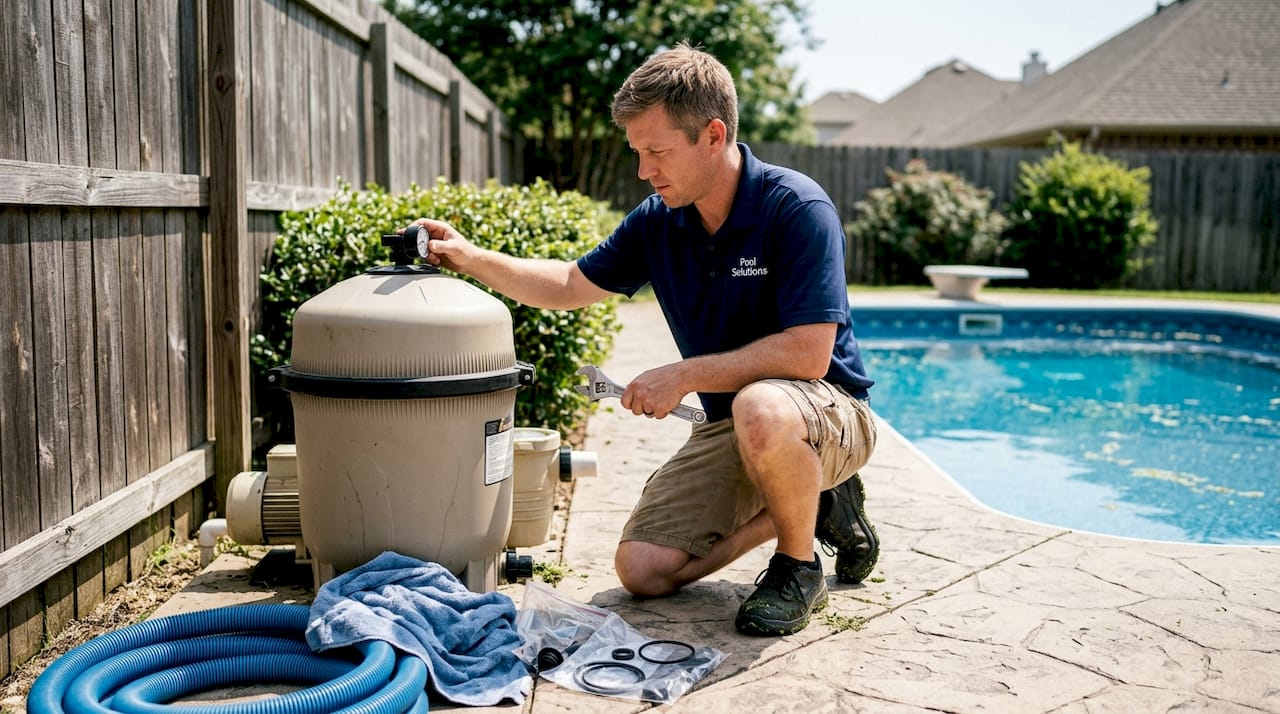
TL;DR:
- Pool filters remove fine debris and particles, ensuring clear and safe water.
- There are three main types: sand, cartridge, and DE, each with different filtration qualities.
- Proper maintenance and choosing the right filter for your pool’s needs are essential for water quality.
Many Central Florida homeowners spend a lot of time balancing chemicals and skimming leaves, yet overlook the one piece of equipment doing the heaviest lifting: the pool filter. A pool can look crystal clear on the surface while still harboring fine debris, oils, and microscopic particles that no net or chemical treatment can fully address. Understanding how your filter works, which type fits your pool, and how to keep it running well is the difference between a pool you love and one that becomes a headache. This guide breaks down everything you need to know, from the basics of filtration to choosing and caring for the right system.
Table of Contents
- What does a pool filter actually do?
- Types of pool filters: Sand, cartridge, and DE compared
- How to choose the right pool filter for your home
- Caring for and maintaining your pool filter
- Our perspective: What most pool owners miss about filtration
- Ready for the next step? Get expert help with your pool
- Frequently asked questions
Key Takeaways
| Point | Details |
|---|---|
| Essential for safe water | A pool filter removes invisible particles and contaminants, keeping swimming water clear and safe. |
| Know your options | Sand, cartridge, and DE filters each offer unique benefits matched to different pool needs and maintenance styles. |
| Florida pools need smart filter choices | Florida’s weather and debris loads mean cartridge or DE filters can outperform sand for many homes. |
| Maintenance matters most | Regular filter care and cleaning are key to enjoying a healthy, hassle-free pool and protecting your investment. |
What does a pool filter actually do?
Think of your pool filter as the kidneys of your pool. Just as kidneys process everything that passes through the body, your filter processes every gallon of water in your pool, pulling out what does not belong. Without it, even a chemically balanced pool would quickly become murky and unsafe.
A pool filter removes dirt, debris, oils, and microscopic particles from the water by passing it through a filter medium, working with the pump in a closed-loop cycle. That closed loop is key. Your pool is not a static body of water. It is a constantly moving system.
Here is how the filtration cycle works step by step:
- Intake: Water is drawn from the pool through skimmer baskets and main drains.
- Pumping: The pump pushes that water under pressure toward the filter.
- Filtration: Water passes through the filter medium, which traps particles.
- Return: Clean water flows back into the pool through return jets.
This cycle runs continuously while your pump is on, typically six to eight hours a day for most residential pools. The filter medium is what actually does the trapping. Depending on the filter type, that medium might be sand, a pleated cartridge, or a powder called diatomaceous earth (DE).
It is also important to understand what a filter does versus what chemicals do. Chemicals like chlorine sanitize the water by killing bacteria and algae. Skimming removes large surface debris. But neither of those processes removes the fine particles suspended in the water column. That job belongs entirely to the filter.
Common contaminants that filters trap include:
- Dirt and fine sand
- Sunscreen, body oils, and lotions
- Pollen and plant matter
- Dead algae cells after a chemical treatment
- Fine dust and airborne particles
For Central Florida pools especially, maintenance tips always circle back to the filter because our environment throws a lot at your water. Pollen seasons, afternoon thunderstorms, and nearby landscaping all add to the debris load your filter handles daily. If you want to understand why filtration is so central to pool health, the maintenance importance guide offers a deeper look at how all the systems connect.
“A pool filter is a mechanical device that removes dirt, debris, oils, and microscopic particles from the water by passing it through a filter medium, working with the pump in a closed-loop cycle.”
Types of pool filters: Sand, cartridge, and DE compared
With the basics covered, it is time to break down the most popular filter types and see how they stack up for Central Florida pools.
There are three main filter types: sand (filters particles 20 to 40 microns), cartridge (10 to 20 microns), and DE (2 to 5 microns, requiring backwash plus recharge powder). A micron is one millionth of a meter. For reference, a human hair is about 70 microns wide, so even sand filters are catching particles invisible to the naked eye.
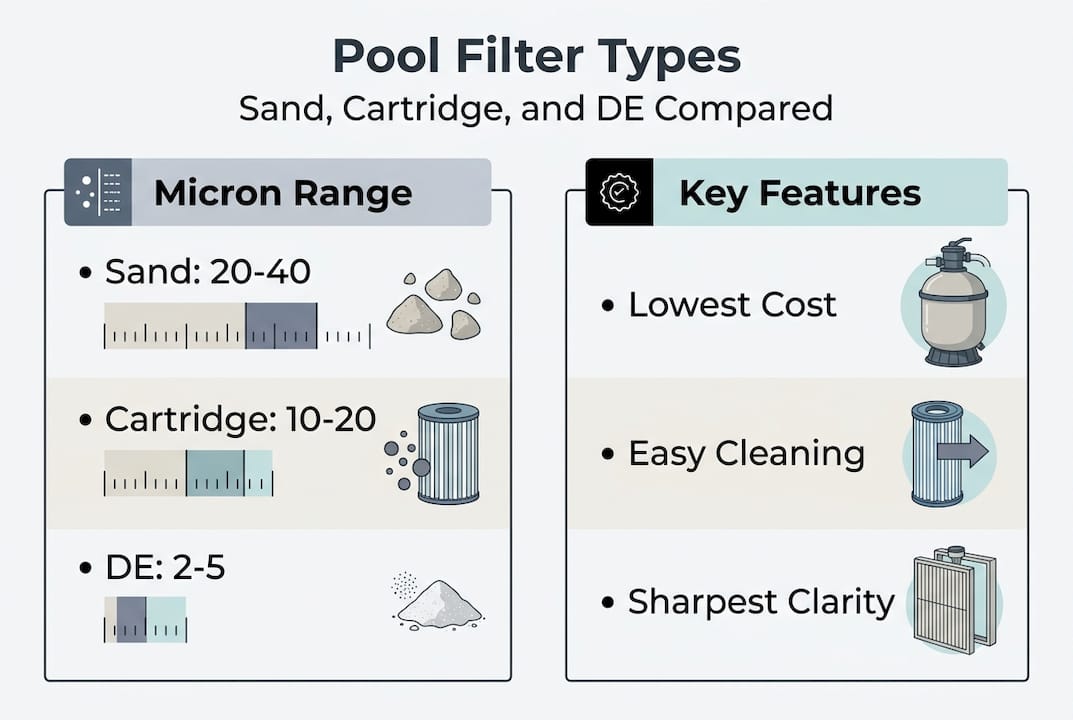
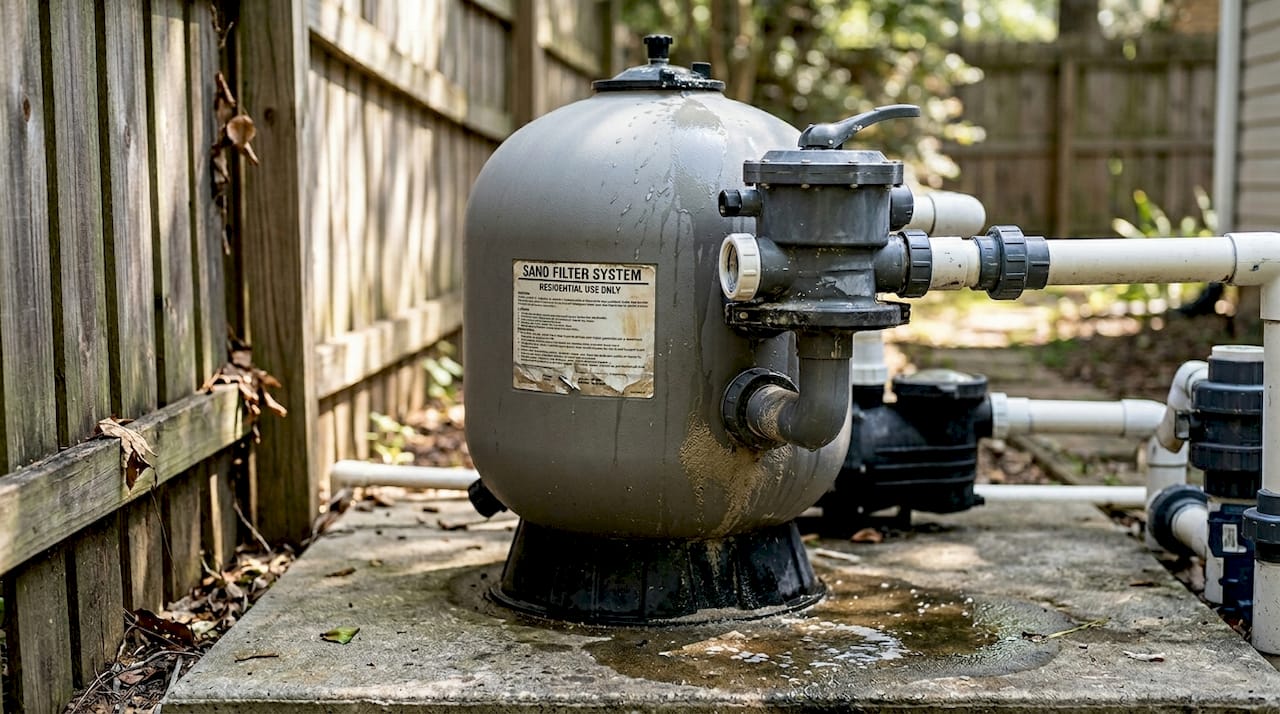
Sand filters are the most common and the most affordable upfront. They use a tank filled with specially graded sand. When the sand gets dirty, you backwash it, meaning you reverse the water flow to flush the trapped debris out through a waste line. They are durable and low effort, but they offer the coarsest filtration of the three.
Cartridge filters use a pleated polyester element, similar in concept to a car’s air filter. You remove the cartridge and rinse it with a garden hose. No backwashing needed, which saves water. They filter more finely than sand and are a popular choice for mid-size residential pools.
DE filters deliver the sharpest water clarity you can get from a residential system. DE powder coats internal grids and traps particles as small as 2 microns. They require backwashing and then recharging with fresh DE powder. They cost more and take more effort, but the water quality difference is noticeable.
| Filter type | Filtration range | Cleaning method | Upfront cost | Best for |
|---|---|---|---|---|
| Sand | 20 to 40 microns | Backwash | Low | Large pools, low maintenance |
| Cartridge | 10 to 20 microns | Rinse cartridge | Medium | Mid-size pools, water savings |
| DE | 2 to 5 microns | Backwash + recharge | Higher | Max clarity, fine debris |
When choosing, consider these factors:
- Pool size and bather load
- Type and volume of debris common in your yard
- How much time you want to spend on maintenance
- Your budget for upfront cost versus long-term upkeep
Pro Tip: Florida’s pollen seasons and frequent afternoon storms push a lot of fine material into your pool. If your yard has large trees or your pool gets heavy use, a cartridge or DE filter will handle that load far better than sand alone. Check the maintenance checklist for a full breakdown of what your filter schedule should look like season by season.
How to choose the right pool filter for your home
Knowing the options is just the start. Here is how to zero in on the right pool filter for your specific needs.
There is no single best filter for every pool. Sand suits low-maintenance or large pools, cartridge offers efficiency, and DE delivers maximum clarity. Florida professionals tend to favor cartridge and DE for pools dealing with heavy debris loads. That local preference is worth noting.
Use this decision framework to find your fit:
- Assess your pool size and use. Larger pools and pools used frequently by many people generate more debris and demand more filtration capacity. A DE or large cartridge system handles that volume better than a basic sand filter.
- Identify your debris type. Fine pollen, sand tracked in from the yard, and algae remnants after a bloom all require finer filtration. If your pool sits under oak trees or near a garden, go with cartridge or DE.
- Be honest about maintenance effort. Sand filters are the most forgiving if you are not going to stay on top of a schedule. Cartridge filters require periodic removal and rinsing. DE filters demand the most attention. Choose what you will actually do.
- Set a realistic budget. DE filters cost more upfront and require ongoing purchases of DE powder. Cartridge elements need replacement every one to three years. Sand is cheap to maintain but may cost more in water usage from backwashing.
For Central Florida homeowners specifically, the climate adds a layer to every decision. Afternoon thunderstorms from June through September drop organic material into pools almost daily. Pollen peaks in spring. Fine construction dust is common in growing neighborhoods. These are real factors that push most local pool professionals toward recommending cartridge or DE over sand for most residential installs.
Understanding regular pool maintenance also helps you see how your filter choice affects everything downstream, from chemical costs to how often you need to vacuum.
Caring for and maintaining your pool filter
No matter what filter you choose, proper care is what keeps your water sparkling and safe in the long run.
A filter must be maintained and cleaned regularly as part of your pool’s overall care. A clogged or neglected filter does not just reduce water clarity. It forces your pump to work harder, shortens equipment life, and can drive up your energy bill.
Here are the key do’s and don’ts for filter upkeep:
- Do check your filter pressure gauge weekly. A rise of 8 to 10 PSI above the clean baseline means it is time to clean.
- Do backwash sand and DE filters when pressure rises, not on a fixed calendar.
- Do soak cartridge elements in a filter cleaning solution once or twice a year to remove oils that rinsing alone cannot clear.
- Don’t run your pump without the filter in place.
- Don’t ignore a filter that keeps clogging quickly. That is a sign of an underlying water chemistry problem.
- Don’t use a pressure washer on cartridge elements. It damages the pleats and reduces filtration efficiency.
Warning signs your filter may need professional attention or replacement include persistent cloudy water after cleaning, cracks in the filter tank or cartridge housing, broken internal grids (in DE filters), and a pressure gauge that no longer returns to its normal baseline after cleaning.
Pro Tip: In Central Florida, schedule a thorough filter inspection right before rainy season starts in June. Heavy summer storms will push your filter harder than any other time of year. Going into that season with a clean, fully functional filter makes a real difference in how your pool holds up through the summer.
A well-maintained filter also protects your investment. Pools are a significant part of your home’s value, and equipment that runs efficiently keeps repair costs down over time. Understanding the pool maintenance role your filter plays helps you see it not as a chore but as protection for everything you have put into your backyard.
Our perspective: What most pool owners miss about filtration
After decades of installing pools across Central Florida, we have seen a pattern that frustrates us a little. Homeowners invest in beautiful custom pools, then focus almost entirely on chemicals when something goes wrong. Green water? Add more shock. Cloudy water? Dump in clarifier. The filter gets ignored until it completely fails.
Here is the uncomfortable truth: no amount of chemicals compensates for a neglected or mismatched filter. We have seen pools with perfect chemical readings turn green within days because the filter was undersized or overdue for cleaning. The chemistry and the filtration have to work together.
We also challenge the idea that “low maintenance” always means “better.” Sand filters are marketed as easy, and they are. But in Florida’s environment, easy often means you are accepting lower water quality and more chemical use to compensate. Sometimes a cartridge or DE filter that requires a bit more hands-on care actually saves you money and frustration over a full season.
Our Florida pool care tips consistently come back to one point: the right filter, properly maintained, is the foundation of a pool you actually enjoy using.
Ready for the next step? Get expert help with your pool
If you want your pool filter and your backyard to work smarter, not harder, here is how we can help.
At R&R Swimming Pools, we have been helping Central Florida homeowners build and maintain exceptional pools since 1985. Whether you are trying to decide which filter type fits your new pool or you are upgrading an existing system, our Pool School resource gives you personalized guidance on filtration, care schedules, and everything in between.
If you are thinking about a new pool altogether, our inground pool installation guide walks you through every decision from design to equipment selection. And if you want the full picture before committing, our expert pool installation guide covers what to expect at every stage. Reach out today and let us help you build a pool that stays beautiful for years to come.
Frequently asked questions
How often should I clean my pool filter in Central Florida?
Most filters need cleaning every one to four weeks, but filter care frequency increases during heavy rain, wind events, or high pollen periods common in Florida.
Which pool filter type is best for heavy debris or Florida storms?
Cartridge and DE filters capture finer particles, and Florida pros favor these types for pools dealing with frequent storms or fine debris loads.
Can I use my pool if the filter is broken or off?
Swimming without filtration is not recommended because a filter removes microscopic particles that make water unsafe even when it appears visually clean.
Do pool filters remove bacteria and algae?
Filters trap many particles including some algae cells, but filters do not disinfect water, so pool chemicals remain essential for killing bacteria.
How do I know if my pool filter needs to be replaced?
Frequent clogging, poor water clarity, and a pressure gauge that stays elevated after cleaning are reliable signs your filter needs replacement.
