
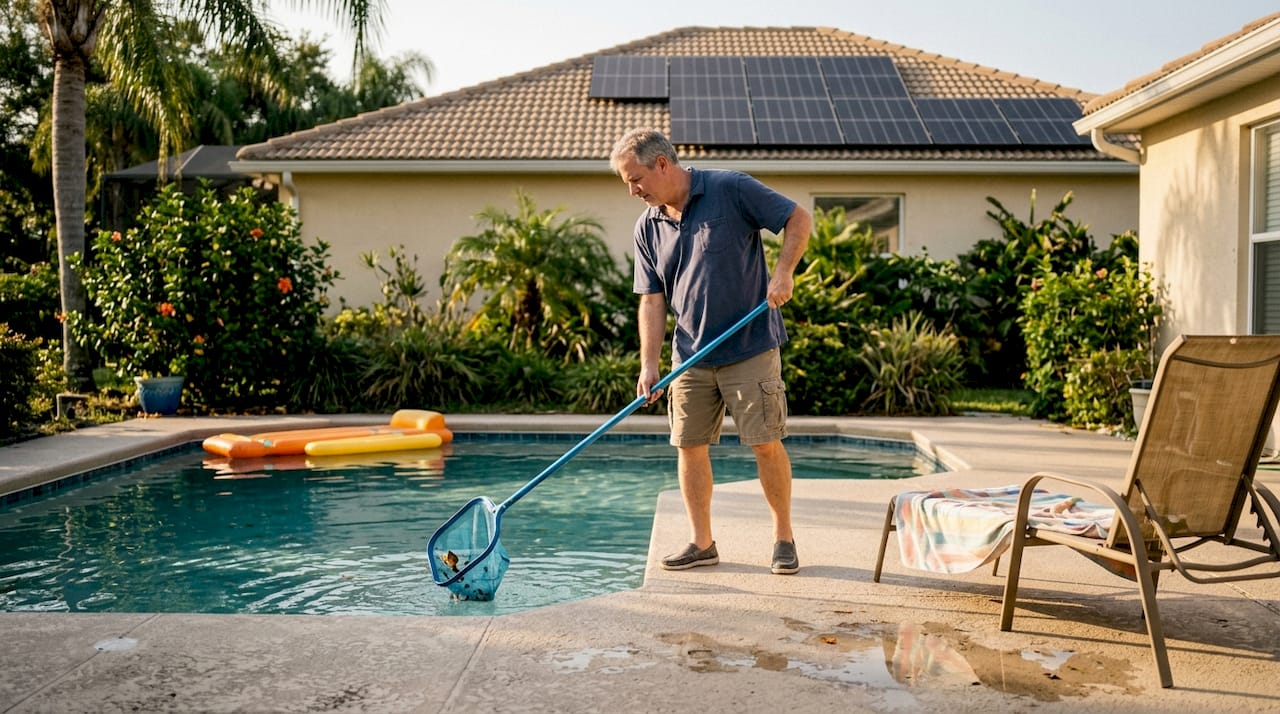
Running a pool in Central Florida costs more than most homeowners expect. Between heating, filtration, lighting, and sanitation, annual pool energy bills can easily climb past $1,500 or higher depending on equipment age and usage habits. The good news is that solar pool heaters require 50 to 100% of pool surface area in collectors and deliver near-zero operating costs after installation, making Florida’s sunshine one of your biggest financial assets. This guide walks you through every major energy-efficient pool option, gives you a clear framework for comparing them, and helps you decide which combination makes the most sense for your home, budget, and lifestyle.
Table of Contents
- How to evaluate energy efficient pool options
- Solar pool heaters: Harnessing Florida’s sunshine
- Heat pump pool heaters: High efficiency for mild winters
- Variable speed pool pumps: The new standard
- Saltwater chlorinators and LED lighting: Simple upgrades for big savings
- Pool automation: Maximize efficiency year-round
- Comparing your pool energy efficient options
- Which energy efficient pool option should you choose?
- Upgrade your pool for maximum efficiency in Central Florida
- Frequently asked questions
Key Takeaways
| Point | Details |
|---|---|
| Solar heating saves most | Solar pool heaters deliver nearly zero operating costs and long swim seasons in Central Florida. |
| Variable speed pumps required | Upgrading to a variable speed pump is now mandatory for new pools and unlocks substantial utility rebates. |
| Automation boosts savings | Smart scheduling and automated controls further cut energy bills and optimize all your pool equipment. |
| LED and saltwater upgrades | Switching to LED lights and saltwater systems reduces ongoing energy and chemical costs. |
| Tailor your solution | The best pool efficiency upgrades depend on your budget, climate, and how you use your pool. |
How to evaluate energy efficient pool options
Not every upgrade delivers the same return in Central Florida. Before spending a dollar, you need a clear set of criteria to judge each option fairly. Here is what actually matters when comparing pool equipment:
- Upfront cost: What does installation and equipment cost today?
- Operating cost: What will you pay monthly and annually to run it?
- Available rebates and incentives: Can you offset the purchase price?
- Climate suitability: Does it perform well in Florida’s heat and humidity?
- Maintenance requirements: How much time and money does upkeep take?
- Regulatory compliance: Does it meet current Florida and federal rules?
- Impact on home value: Will buyers see it as an asset?
On the compliance front, Florida utilities offer rebates of $200 to $400 for variable speed pumps, up to 26% federal tax credits for solar, and the Department of Energy has mandated variable speed pumps for new pools since 2021. Ignoring these rules on a new build is not an option, and skipping the rebates on an upgrade is simply leaving money on the table. You can also explore available pool upgrade incentives specific to Central Florida homeowners.
Pro Tip: Contact your Florida utility provider before purchasing any equipment. Many offer rebate programs that change annually, and a quick call can save you hundreds of dollars.
Solar pool heaters: Harnessing Florida’s sunshine
With the evaluation framework in mind, let’s look at the top energy-efficient options, starting with solar. Flat-plate solar collectors circulate pool water through panels mounted on your roof, using the sun’s heat to warm the water before returning it to the pool. There are no fuel costs and almost no moving parts to break.
“Solar pool heaters extend the swim season to 10 to 11 months in Florida with near-zero operating costs after installation.” — Sarasota County Pool Authority
| Cost factor | Typical range |
|---|---|
| Upfront installation | $2,500 to $5,000 |
| Annual operating cost | $50 to $100 |
| Payback period | 2 to 5 years |
Pros and limitations of solar pool heating:
- Low lifetime cost after payback
- Eco-friendly with zero emissions during operation
- Extends swim season across most of the year
- Minimal maintenance beyond occasional panel cleaning
- Requires adequate south-facing roof space
- Less effective during extended cloudy or rainy stretches
- High-wind coastal areas need wind-rated collectors specifically designed for those conditions
Pro Tip: Size your solar system to cover at least 50% of your pool’s surface area. Going larger improves performance on cooler days and extends your comfortable swimming season even further. Pairing solar with smart pool feature upgrades can also increase your home’s resale appeal.
Heat pump pool heaters: High efficiency for mild winters
While solar is a favorite in the Sunshine State, many homeowners choose heat pumps for their flexibility. A heat pump does not generate heat directly. Instead, it pulls warmth from the surrounding air and transfers it to your pool water, which is far more efficient than burning fuel.
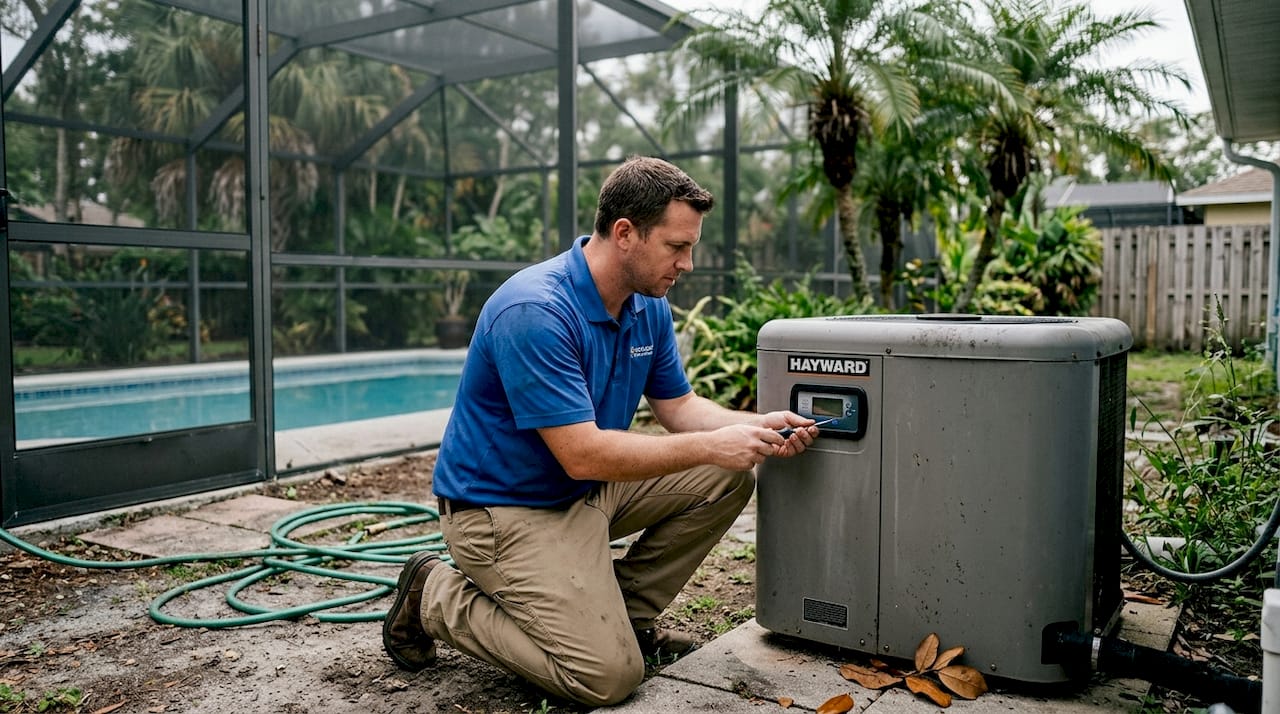
The efficiency of a heat pump is measured by its coefficient of performance, or COP. A COP of 6 means the unit produces six units of heat for every one unit of electricity consumed. Heat pump pool heaters offer a COP of 5 to 10 or higher in Florida’s mild climate, making them ideal for steady, low-cost heating.
In practical terms, that translates to roughly $50 to $150 per month in operating costs compared to $100 to $200 or more for gas heaters. Heat pumps do lose efficiency below 50°F, but that temperature is rare in Central Florida, making them an excellent fit for this region.
Pros and cons of heat pump pool heaters:
- Consistent water temperature regardless of cloud cover
- Highly efficient in Florida’s climate year-round
- Eligible for utility rebates in many service areas
- Higher upfront cost than solar panels
- Slower to heat a cold pool than gas (plan ahead for events)
Learn more about the benefits of pool heaters and how they fit into a broader pool energy savings strategy.
Pro Tip: Use a pool automation system to run your heat pump during off-peak energy hours, typically late night to early morning. This alone can reduce your monthly electricity bill noticeably.
Variable speed pool pumps: The new standard
Efficient heating is just one part of the equation. Circulation costs add up fast, and here is why variable speed pumps are now sweeping Florida. A traditional single-speed pump runs at full power all the time, even when your pool only needs gentle circulation. A variable speed pump, or VSP, adjusts its motor speed to match actual demand.
The result is dramatic. VSPs use up to 80% less energy than single-speed pumps, and the DOE banned single-speed pumps over 0.5 HP for new pools starting in 2021.
| Pump type | Avg. annual energy cost | Rebate eligible | Noise level |
|---|---|---|---|
| Single-speed | $600 to $1,200 | No | High |
| Two-speed | $400 to $700 | Sometimes | Medium |
| Variable speed | $120 to $300 | Yes ($200 to $400) | Low |
Key reasons to upgrade to a variable speed pump:
- Meets current Florida and federal compliance requirements
- Cuts annual pump energy costs by hundreds of dollars
- Runs quieter, which neighbors and family will appreciate
- Programmable schedules let you automate filtration cycles
- Qualifies for rebates for VSP pumps through many Florida utilities
Saltwater chlorinators and LED lighting: Simple upgrades for big savings
Once core equipment is upgraded, a few simple add-ons can deliver big savings too. Saltwater chlorinators convert dissolved salt into chlorine automatically, reducing your chemical purchases by 50 to 70%. LED pool lights use 80% less energy than incandescent bulbs and last up to 10 times longer, according to Sarasota County Pool Authority.
Benefits of saltwater and LED upgrades:
- Gentler on skin and eyes compared to traditional chlorine
- Lower ongoing chemical costs with saltwater systems
- LED lights pay for themselves quickly through energy savings
- Longer bulb life means fewer replacement headaches
- Immediate reduction in monthly operating costs
- Explore your energy-saving lighting options for a full breakdown of what is available in Central Florida
Pool automation: Maximize efficiency year-round
The most efficient pool is one that runs only when it needs to, and automation makes this a reality. Modern pool automation systems let you control pumps, heaters, lights, and sanitizers remotely from a smartphone app or wall panel. You can set schedules, monitor energy use, and adjust settings without walking outside.
Here is how automation directly reduces your costs:
- Scheduled filtration: Run your VSP at low speed overnight when electricity rates are lower.
- Off-peak heating: Program your heat pump to reach target temperature before peak rate hours begin.
- Lighting timers: Automatically shut off pool lights at a set time to eliminate waste.
- Integration alerts: Get notified if equipment runs longer than expected, catching problems early.
“Smart scheduling can cut annual pool energy bills by up to 30%.” — Altamonte Springs Pool Service
Automation also increases pool value in the eyes of buyers who want a low-maintenance backyard. If you are considering upgrading an old pool, adding automation is one of the highest-return improvements you can make.
Pro Tip: Set your filtration cycle to run from midnight to 6 a.m. Cooler overnight temperatures reduce evaporation, and off-peak electricity rates lower your bill at the same time.
Comparing your pool energy efficient options
With so many options, a side-by-side look lets you make the best choice for your situation.
| Option | Upfront cost | Monthly operating cost | Payback period | Best use case |
|---|---|---|---|---|
| Solar heater | $2,500 to $5,000 | Near zero | 2 to 5 years | Year-round heating, max savings |
| Heat pump | $2,000 to $4,500 | $50 to $150 | 3 to 6 years | Consistent temp, cloudy days |
| Variable speed pump | $800 to $1,500 | $10 to $25 | 1 to 2 years | All pools, required for new builds |
| Saltwater and LED | $1,500 to $3,000 | Minimal | 2 to 4 years | Convenience and chemical savings |
| Automation system | $1,000 to $3,500 | Reduces other costs | 2 to 5 years | Whole-system optimization |
| Gas heater | $1,500 to $3,000 | $100 to $300 | Never pays back | Rapid heating for special events only |
For daily use and long-term savings, solar combined with a VSP and automation delivers the strongest return. For entertaining guests on short notice, a heat pump with automation handles the job without the fuel cost of gas.
Which energy efficient pool option should you choose?
Armed with comparisons and expert tips, here is how to match the right option to your specific situation.
- Tightest budget: Start with a variable speed pump. The payback is fastest, rebates are available, and compliance is immediate.
- Maximum long-term savings: Combine solar heating, a VSP, and automation. This trio covers heating, circulation, and scheduling for the lowest possible annual cost.
- Frequent entertaining: A heat pump with automation lets you pre-heat the pool on a schedule without the high fuel bills of gas. Gas heaters are best reserved for rapid heating during special events, not everyday use in Florida’s warm climate.
- Coastal or high-wind homes: Choose wind-rated solar collectors and pair them with a heat pump as a backup for days when solar output drops.
- Selling your home soon: Prioritize automation and LED lighting. These upgrades are visible, marketable, and immediately appealing to buyers.
Every home is different. Roof orientation, pool size, usage patterns, and local utility rates all affect which combination delivers the best return. A conversation with a pool professional who knows Central Florida’s conditions will give you numbers specific to your property.
Upgrade your pool for maximum efficiency in Central Florida
Ready to stop overpaying on pool energy bills? R&R Swimming Pools has been helping Central Florida homeowners build and upgrade pools since 1985, and we know exactly which equipment combinations deliver the best results in this climate.
Whether you are planning a new build or upgrading existing equipment, our team can walk you through every option, connect you with available rebates, and design a system that fits your budget and goals. Start with our inground pool installation guide for a full overview of what to expect, or visit our local pool experts resource center to learn more before your first consultation. Professional upgrades pay for themselves through years of lower energy bills, and we are here to make sure you get every dollar of that return.
Frequently asked questions
How much can I save with energy efficient pool equipment in Central Florida?
Upgrading to energy-efficient options can cut pool energy costs by 60% or more, depending on which equipment you replace and how you use your pool. Combining a variable speed pump, solar heater, and automation delivers the largest savings.
Are solar pool heaters effective during Florida’s rainy season?
Solar pool heaters are highly efficient for most of the year in Florida, but performance drops during extended cloudy or rainy stretches. Pairing solar with a heat pump backup ensures consistent water temperature year-round.
Do I need a variable speed pump for my existing pool?
The DOE mandates VSPs for new pools since 2021, and Florida utility rebates of $200 to $400 make upgrading an existing pool financially smart. Most homeowners recover the upgrade cost within one to two years.
How do saltwater pool systems reduce costs?
Saltwater chlorinators generate chlorine automatically from dissolved salt, cutting chemical purchases by up to 70%. The result is lower monthly spending and less time managing chemical levels manually.
When should I consider a gas pool heater in Florida?
Gas heaters are best for rapid heating before a party or special event, not for everyday use. Their high operating costs make them impractical as a primary heating solution in Florida’s warm climate.
