
TL;DR:
- Proper pool lighting is crucial for safety, visibility, and compliance with Florida regulations. Well-designed lighting ensures every corner, step, and edge is readable at night, enhancing user experience and safety. Prioritizing coverage, clarity, and glare management before adding decorative effects creates a safer, more inviting pool environment.
Most homeowners treat pool lighting as the finishing touch, something to add after the big decisions are already made. But the reality is that lighting shapes whether your pool is genuinely usable after sunset, whether it meets Florida’s legal standards, and whether guests feel safe and comfortable during evening swims. Get it right, and your pool becomes a year-round centerpiece. Get it wrong, and even a beautifully designed pool can feel unwelcoming, potentially unsafe, or out of code compliance.
Table of Contents
- Why pool lighting is more than decoration
- How pool lighting shapes experience and safety
- Comparing pool lighting options: Features and best uses
- Maintaining your pool lighting for maximum impact
- The real secret: Focus on clarity and comfort first
- Transform your Central Florida pool with expert lighting guidance
- Frequently asked questions
Key Takeaways
| Point | Details |
|---|---|
| Lighting boosts safety | Proper pool lighting ensures safe swimming and clear navigation, especially at night. |
| Follow state guidelines | Florida regulations require specific pool illumination levels to protect swimmers. |
| Glare management matters | Smart fixture placement and shielding prevent discomfort and improve usability. |
| Get basics right first | Prioritize clarity and coverage before adding mood lighting or color effects. |
| Routine checks save headaches | Regular cleaning and maintenance keep your pool lighting compliant and reliable. |
Why pool lighting is more than decoration
When people imagine upgrading their pool, they picture vivid colors dancing across the water or a dramatic glow reflected on a travertine deck. Those visuals are appealing, and there is real value in aesthetics. But the foundational role of pool lighting is visibility, and that is where most homeowners misplace their focus.
Proper illumination lets swimmers see the pool floor, steps, depth markers, and edges clearly after dark. Without adequate lighting, the shallow end shelf or the pool steps become invisible hazards. Even experienced swimmers misjudge depth and distance in poorly lit water. Lighting is not just ambiance; it is the difference between a safe night swim and a dangerous one.
Florida does not leave this to chance. Florida health pool guidance specifies minimum illumination levels on the wet deck and in the pool, reflecting the state’s recognition that inadequate lighting is a genuine public safety concern. Pool owners who skip this step are not just making a design mistake; they are potentially out of compliance.
Beyond the regulatory side, think about the user experience. Misplaced or underpowered fixtures create unexpected dark zones that frustrate swimmers and discourage nighttime use entirely. Common problems include:
- Lights aimed directly at eye level, creating glare instead of visibility
- Single-point fixtures that illuminate one zone while leaving steps or corners dim
- Older fixtures that have faded or yellowed, dramatically cutting light output
- Underwater lights positioned too high in the niche, reducing their coverage angle
“A well-lit pool is not about the most dramatic effect; it is about making every corner of the water and deck feel safe, readable, and welcoming at any hour of the night.”
Pro Tip: Before investing in color-changing technology or decorative landscape lighting, verify that your current fixture layout meets Florida’s minimum illumination standards. Start with coverage, then layer in effects.
If you are thinking about installing pool lighting for the first time or replacing older fixtures, understanding the regulatory baseline will save you costly do-overs. And if you want a broader look at water safety in your backyard, our Florida pool safety guide covers everything from fencing requirements to lighting code.
How pool lighting shapes experience and safety
Florida’s climate means pools get used well into the evening, and that is especially true in Central Florida where summer heat often makes the late hours the most pleasant time to swim. This is exactly why getting the technical side of lighting right pays off so consistently here.
The state’s pool code sets a clear baseline. Florida’s minimum standards require 3 foot-candles of illumination on the wet deck and 1/2 watt per square foot inside the pool. Those numbers are not suggestions; they are the floor. A foot-candle measures how much light falls on a surface, and 3 foot-candles on a wet deck means enough illumination to see clearly, move without tripping, and identify the pool edge without guesswork.
Glare is a separate but equally important problem. Bright, poorly positioned lights can actually make a pool harder to use at night, not easier. Expert guidance recommends keeping fittings low and appropriately positioned, focusing beams away from viewers, and using shielding or reflectors to prevent glare. A light that hits swimmers directly in the eyes reduces visibility instead of improving it.
Here is a practical breakdown of the key lighting metrics for Florida pools:
| Requirement | Standard | Why it matters |
|---|---|---|
| Wet deck illumination | 3 foot-candles minimum | Prevents slips and falls around the pool edge |
| In-pool illumination | 1/2 watt per sq. ft. | Ensures swimmers can see floor, steps, and depth changes |
| Fixture condition | Clean, intact, secured | Maintains consistent light output and prevents hazards |
| Glare management | Shields, low mounting, beam aim | Reduces eye strain and improves nighttime visibility |
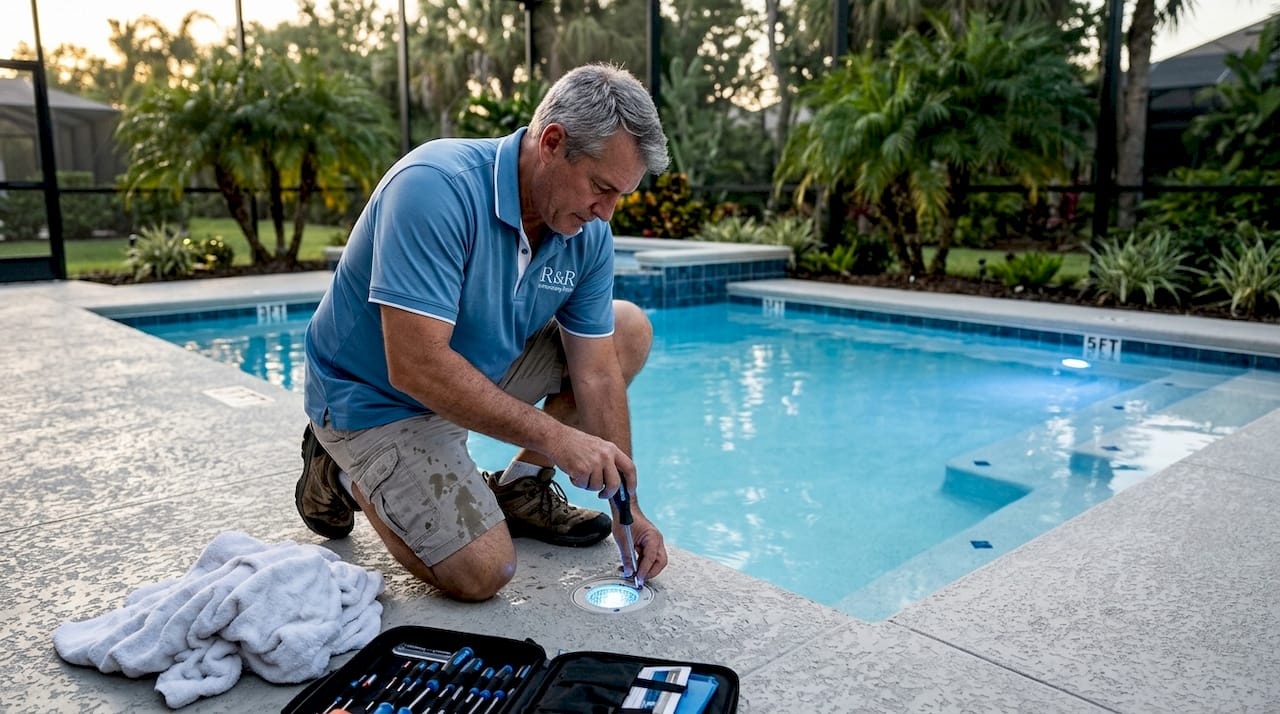
Fixture maintenance plays a role here too. Pool health guidelines require that lights be secured into the niche, that the light rim be free of algae and intact, and that the fixture be free of water or debris. A light that is technically on but clogged with algae or sitting behind a cracked lens is not doing its job.
The best approach to positioning and installation follows a clear sequence:
- Map your pool’s layout and identify all zones including steps, shallow end, deep end, and deck transitions.
- Calculate required wattage based on pool surface area to meet the 1/2 watt per square foot threshold.
- Position in-pool fixtures low on the wall, angled slightly downward toward the floor rather than upward toward swimmers.
- Add deck lighting at a height that illuminates the surface without shining directly into seated or standing guests’ eyes.
- Use shielded or hooded fixtures along walkways to direct light downward and reduce scatter.
- Test the full setup at night before finalizing installation, checking for dark zones and glare points.
Pro Tip: If your pool has a spa or raised water feature, treat it as a separate lighting zone. Spas are often used independently at night and need their own dedicated fixture, not just light borrowed from the main pool.
For a full breakdown of what meets code and what looks great in Central Florida specifically, our Florida pool lighting guide walks through both the regulatory requirements and design-forward solutions that work in this climate.
Comparing pool lighting options: Features and best uses
Once you understand the safety baseline, you can make smarter decisions about the type of lighting that fits your pool, your lifestyle, and your budget. The market has shifted significantly over the past decade, and today’s options are better in almost every way than what was available even five years ago.
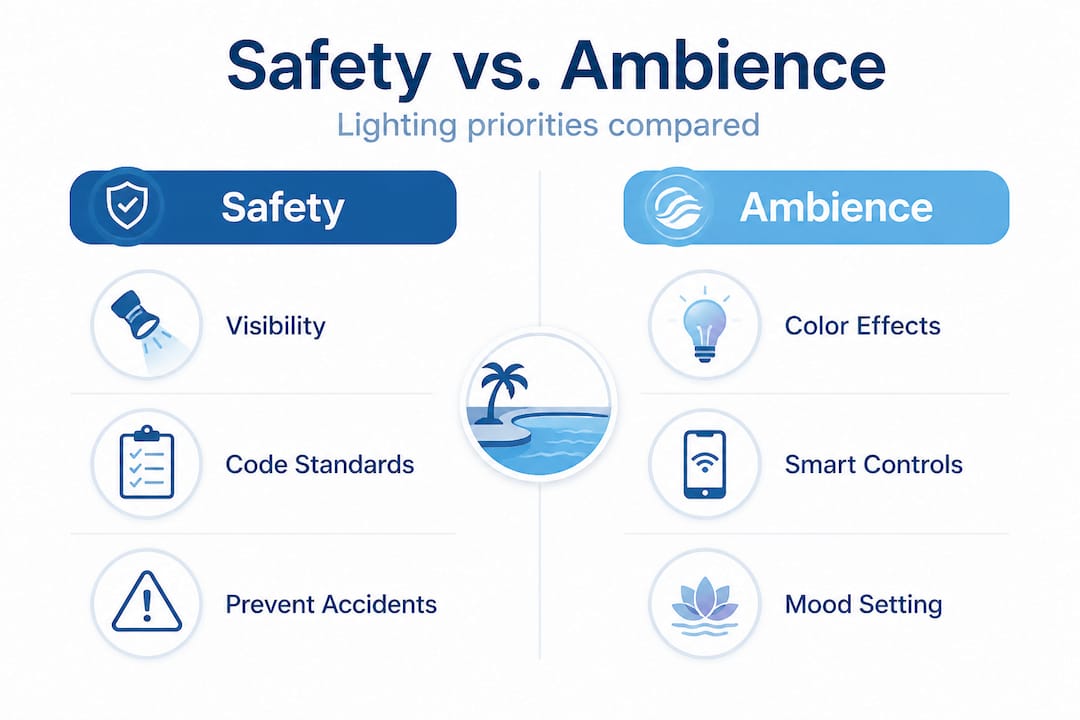
The principle that good lighting design prioritizes legibility and safe movement first, then layers in ambience, is the smartest framework for evaluating your choices. Here is how the main options stack up:
| Lighting type | Energy use | Color options | Lifespan | Best use case |
|---|---|---|---|---|
| LED | Very low | Full spectrum | 25,000+ hours | Best overall, new and retrofit |
| Halogen | High | White only | 1,000 hours | Replacement in older systems |
| Fiber optic | Low | Limited | Moderate | Accent lighting, no electrical in water |
| Smart/color-changing LED | Low | Millions of colors | 25,000+ hours | Entertainment-focused pools |
LED lighting is the current standard for a reason. It uses roughly 75% less energy than halogen, lasts dramatically longer, and produces consistent, bright illumination without the color distortion that older bulbs caused. For most Central Florida homeowners upgrading or building new, LED is the straightforward choice.
Halogen fixtures are largely legacy technology now. They are still found in pools built before the 2010s, and while they can be maintained, every repair cycle is an opportunity to consider switching to LED instead. The operating cost difference adds up quickly in a climate where pools run year-round.
Fiber optic systems use a remote light source and carry light through flexible cables to points around or in the pool. Because there is no electrical component at the water’s edge, they are often used in water features, fountains, or as accent highlights. They are not a replacement for full in-pool illumination, but they work well as layered elements.
Smart and color-changing LED systems are the feature that gets the most attention in showrooms and on social media. They allow you to cycle through colors, set scenes, and even sync lighting with music. These systems genuinely deliver on their promise, but only when the foundational lighting is already dialed in. A pool bathed in blue light looks stunning in photographs. It is less useful if the steps are dark or the deck edge is hard to see.
Key considerations when choosing your system:
- Compatibility: Some older pool shells and niches require adapters for modern LED fixtures. Confirm compatibility before purchasing.
- Wiring and voltage: Most modern in-pool LEDs run on 12-volt systems for safety. Older pools may have 120-volt systems that require evaluation by a licensed electrician.
- Coverage vs. drama: Prioritize even coverage over color saturation. A well-lit pool with neutral white light is more functional than one with dramatic colors and unlit corners.
Explore the full range of Central Florida pool lighting options to find the best fit for your home. If you are also considering other upgrades alongside lighting, our guide to top pool add-ons covers waterfalls, spillovers, and other features that pair well with a solid lighting plan.
Maintaining your pool lighting for maximum impact
Installing quality lighting is a strong investment. Keeping it working correctly is what protects that investment over time. Pool lighting maintenance is straightforward but easy to neglect, especially when lights seem to be working well on the surface.
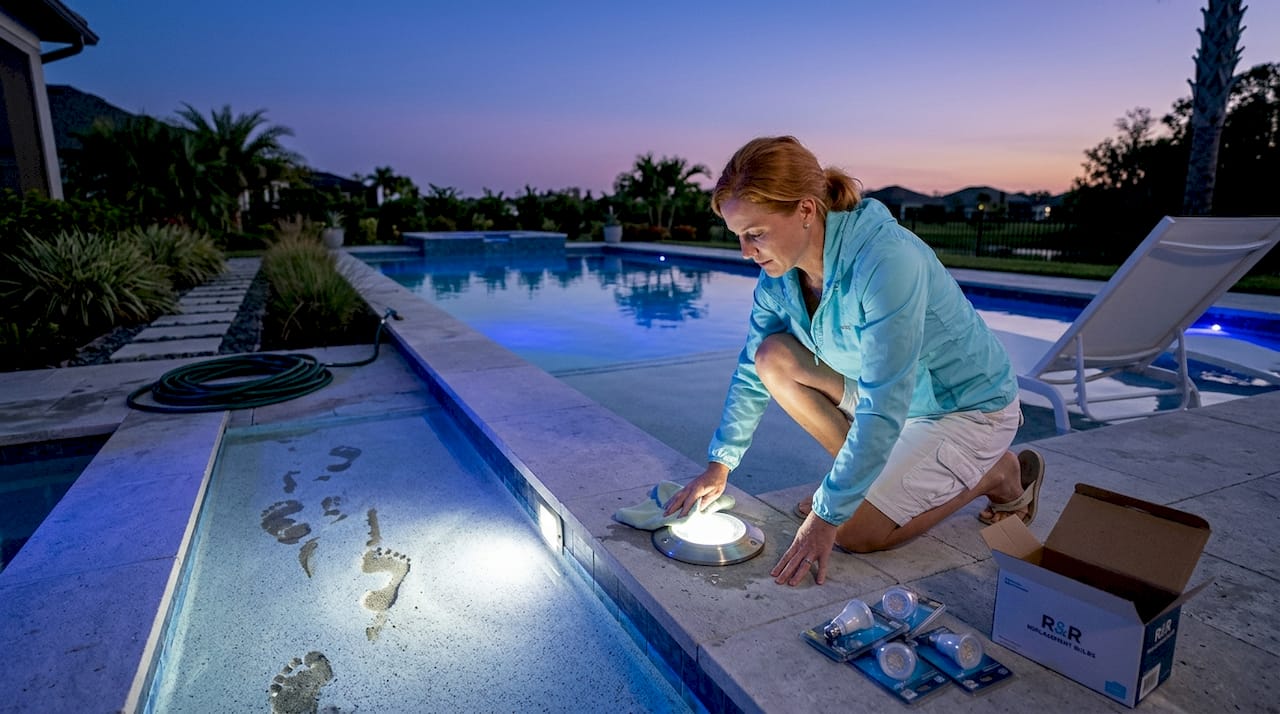
Florida pool code requirements make clear that lights must be in good working order with clean, intact niches and lenses. That is not just a compliance issue; it directly affects how much light your fixtures actually produce. A fixture coated in algae, mineral buildup, or debris from a recent storm can lose 30 to 50 percent of its effective output while still technically functioning.
Follow this maintenance sequence to keep your lighting performing reliably:
- Monthly visual check: Look at each fixture from the water’s edge at night. Dim, flickering, or discolored lights signal a problem that needs attention.
- Quarterly cleaning: Clean the lens and niche of each in-pool fixture using a soft brush and appropriate pool-safe cleaner. Remove algae from the light rim carefully.
- Inspect the conduit seal: Where the electrical conduit enters the pool wall, check for signs of moisture intrusion or cracking. This is a safety issue, not just a maintenance one.
- Check the GFCI protection: Ground fault circuit interrupter devices protect against electrical shock in wet environments. Test them monthly using the test/reset button on the outlet or breaker.
- Assess fixture color output: LED lights that have shifted in color temperature or brightness may indicate aging components. A fixture producing noticeably warmer or dimmer light than its neighbors needs evaluation.
- Schedule professional inspection annually: A licensed pool technician can check wiring, connections, and compliance in ways that a visual check cannot capture.
Pro Tip: After any major storm in Central Florida, do a full lighting check before your next night swim. Debris in the water can damage fixture lenses, and power surges during storms are a leading cause of premature LED failure.
Knowing when to call a professional matters too. If a fixture is filling with water, if the breaker trips repeatedly when lights are on, or if you notice any discoloration in the water near a fixture, stop using the pool lighting and call a licensed electrician with pool experience. These are not DIY fixes.
For more guidance on keeping your pool in top condition throughout the year, our Central Florida pool maintenance tips cover chemical balance, equipment care, and seasonal prep. You can also find quick reference advice in our pool maintenance tips resource, which is helpful for new pool owners building their routine.
The real secret: Focus on clarity and comfort first
After nearly four decades of designing and building pools across Central Florida, one pattern stands out clearly. Homeowners who chase dramatic effects before getting the fundamentals right consistently end up less satisfied with their pools than those who build from the ground up with coverage, comfort, and clarity as priorities.
The best pool lighting principles consistently frame the goal as first restoring legibility and safe movement, then layering in ambience. That sequence matters. A pool where you can clearly see the steps, the floor, and the edges at 9 pm on a warm evening in July is genuinely more enjoyable than one with a color light show and dim, uneven coverage.
The trend toward elaborate smart lighting systems is not inherently wrong. Those systems can be beautiful and add real value to your backyard experience. The mistake is treating them as a replacement for foundational design rather than an enhancement of it.
We have seen pools with thousands of dollars invested in programmable color-changing LEDs where the deep end is still darker than it should be and the deck edge lighting falls well short of Florida’s 3 foot-candle minimum. The light show is impressive for five minutes. The coverage gap is noticeable every single night. Spending money to fix the basics after the dramatic features are already in place is always more expensive and more disruptive than getting the sequence right from the start.
If you are planning a new pool or a lighting upgrade, resist the pressure to prioritize the visual spectacle. Ask first: can every swimmer see clearly at every depth and in every corner of this pool after dark? Can guests walk the deck safely without tripping or misjudging the edge? Is glare managed so that nobody is squinting into a fixture? Answer those questions first, and then build your ambiance on top of that solid foundation.
The good news is that modern LED systems make it genuinely achievable to get both: full coverage, clean illumination, and color effects, without compromise. You just have to prioritize them in the right order. Explore the full range of lighting options for Florida homes with that framework in mind, and you will make choices you will be happy with for years.
Transform your Central Florida pool with expert lighting guidance
If everything in this article has made you want to take a closer look at your current pool lighting or plan a new installation the right way, the next step is working with a team that understands both the technical requirements and the design possibilities specific to Central Florida.
At R&R Swimming Pools, we have been designing and building custom inground pools in Central Florida since 1985. Our team handles every aspect of pool lighting from compliance review through installation and upgrade, so you never have to wonder whether your setup meets code or whether your choices are the right fit for your pool type. Whether you are starting fresh with our custom pool planning guide, comparing the best inground pool types for your backyard, or considering a fiberglass pool installation with a complete lighting plan built in, we are ready to help you make confident, informed decisions. Contact us today for a free quote and let us help you build a pool that looks just as good at night as it does during the day.
Frequently asked questions
What are Florida’s minimum pool lighting standards for night swimming?
Florida requires 3 foot-candles on the deck and 1/2 watt per square foot inside the pool, and all fixtures must be clean and in working order to meet state health guidelines.
What is the best way to prevent pool lighting glare?
Positioning fixtures low and using shielded or hooded housings with beams aimed away from swimmers and seated guests is the most effective way to manage glare.
How often should I check and maintain my pool lighting?
Inspect your lighting monthly for clean and intact fixtures, and schedule a professional inspection once a year to catch wiring or compliance issues before they become bigger problems.
Is it worth investing in color-changing pool lights?
Color-changing LED systems add genuine entertainment value, but prioritize coverage and clarity first so that ambience enhances a well-lit pool rather than compensating for an underlit one.
