
TL;DR:
- Choosing an indoor pool requires careful planning of space, ventilation, lighting, and materials to ensure longevity and enjoyment. Structural integration and moisture control are essential, with concrete pools offering maximum customization and flexibility. Thoughtful decor, lighting, and systems create a relaxing, functional, and visually stunning indoor swimming environment.
Choosing an indoor pool is one of the most significant design decisions a homeowner can make, and getting it right means balancing far more than just aesthetics. Your indoor pool ideas list needs to account for space constraints, ventilation, lighting mood, material durability, and how the pool actually fits your lifestyle. Whether you are dreaming of a serene plunge retreat, a serious lap pool, or a resort-style wellness sanctuary, the options are wider and more creative than most people realize. This guide breaks down what actually works, what to avoid, and what will leave you loving your indoor pool for decades.
Table of Contents
- Key takeaways
- What makes a great indoor pool ideas list
- 1. Infinity edge indoor pool
- 2. Naturalistic pool with plants and stone
- 3. Plunge pool with wellness zone
- 4. Lap pool with swim current system
- 5. Glass-enclosed pool room
- 6. Movable floor pool
- 7. Mediterranean-style tiled pool
- Comparing popular indoor pool types
- Indoor pool decor tips that actually make a difference
- Practical tips for planning and maintaining your indoor pool
- My honest take on indoor pool design after years of experience
- Bring your indoor pool ideas to life with Randrswimmingpools
- FAQ
Key takeaways
| Point | Details |
|---|---|
| Size shapes everything | Small pools (2.0–2.4m wide, 4–6m long) can still deliver full fitness function with swim current systems. |
| Lighting sets the mood | Use 2700–3000K lighting for spa ambiance; 3500–4000K for fitness-focused pools. |
| Ventilation is non-negotiable | Dedicated dehumidification maintaining 50–60% humidity protects your home structure and air quality. |
| Decor drives experience | Color palettes, acoustic panels, and moisture-tolerant plants transform a pool room into a living space. |
| Plan structure from day one | Integrating architectural and mechanical systems early prevents expensive moisture and structural problems later. |
What makes a great indoor pool ideas list
Before you collect inspiration images or start sketching layouts, you need a framework for evaluating what will actually work in your space. Every design choice connects to a chain of structural and mechanical consequences, and understanding the criteria upfront saves you from expensive backtracking.
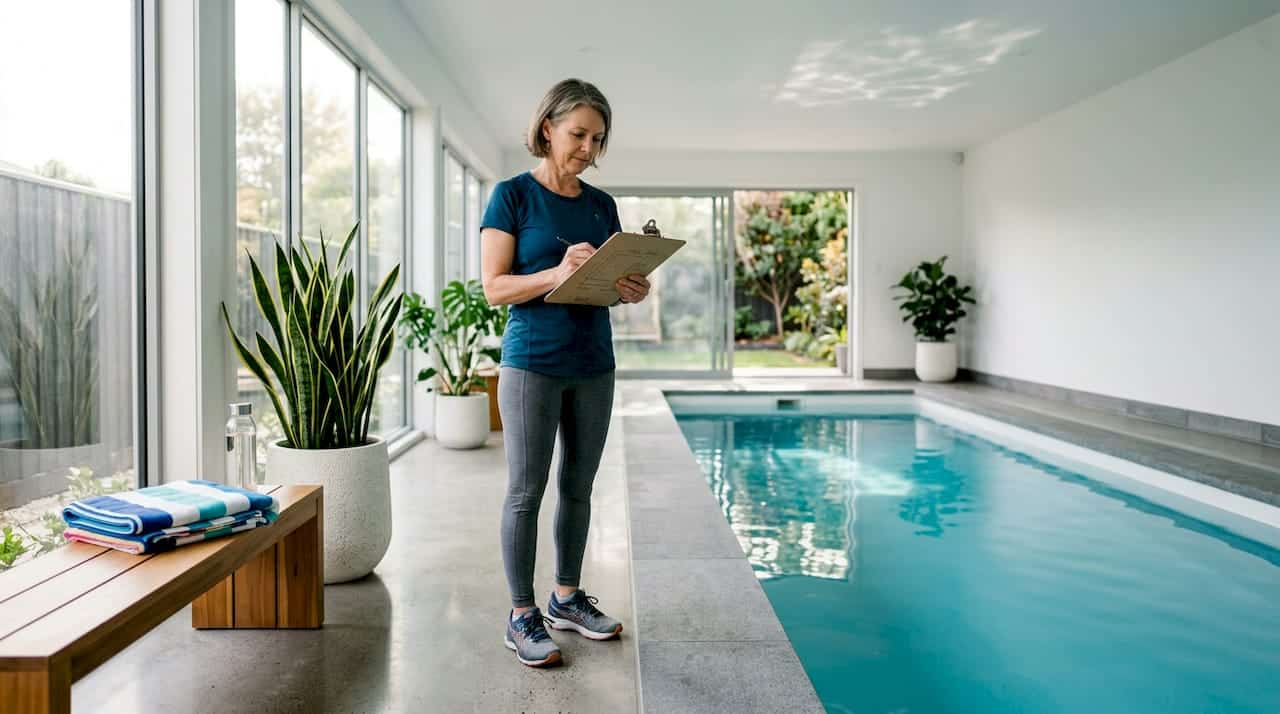
Pool size and shape. Small indoor pools optimally measure 2.0–2.4m in width and 4.0–6.0m in length with a depth of 1.2–1.4m, making them practical for plunge-lap hybrid designs even in tighter homes. Swim current systems let you do continuous laps in basins as short as 3–4m without enlarging the footprint. For larger spaces, lap pools, infinity edges, and multi-zone wellness pools all become feasible.
Material choices. Natural stone, large-format porcelain, and polished concrete are the gold standard for indoor pools because they hold up against constant moisture while looking genuinely luxurious. You can explore pool material options that balance visual appeal with long-term durability. Timber accents around the pool deck add warmth but must be sealed with waterproof finishes rated for humid environments.
Lighting strategy. Residential pool lighting works best at 2700–3000K for a spa-like ambiance, while 3500–4000K suits pools used primarily for exercise. Layering indirect cove lighting with low-glare wall washers keeps harsh reflections off the water surface.
- Slip-resistant flooring with certified slip ratings around the pool edge
- Steps designed with 150–175mm risers and tactile edge cues for safe entry and exit
- Pool safety design including access controls and barriers to protect children
- Dedicated dehumidification units maintaining humidity at 50–60% to prevent structural moisture damage
Pro Tip: Maintain slight negative air pressure in the pool room relative to adjoining spaces. This keeps moisture and chlorine odors contained within the pool room rather than migrating into the rest of your home.
1. Infinity edge indoor pool
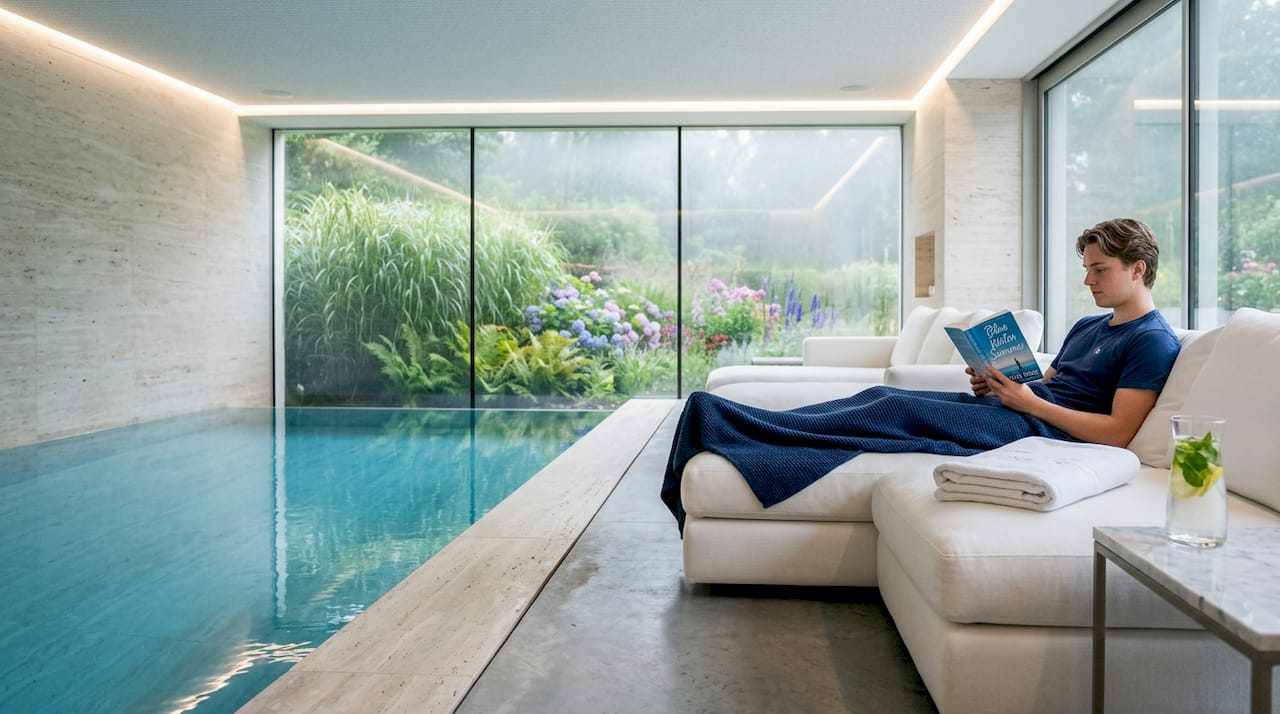
An infinity edge pool creates the visual illusion of water extending to the horizon, and it works brilliantly indoors when positioned against a floor-to-ceiling glazed wall. You get the drama of a seamless water line without needing an outdoor setting. The catch is structural: the collection trough and recirculation pump need to be planned into the building’s foundation, not added later. Done right, it is genuinely one of the most striking indoor swimming pool designs available.
2. Naturalistic pool with plants and stone
Bringing the outdoors in transforms a pool room from a functional space into a living environment. Natural materials like stone and timber, paired with large sliding or bi-fold doors, create seamless visual connections to the garden and prevent that closed-up feeling that plagues poorly designed indoor pools. Tropical plants like bird of paradise, bamboo, and peace lily thrive in humid pool environments and add a resort quality that no tile pattern can replicate on its own.
3. Plunge pool with wellness zone
A plunge pool paired with a separate seating or sauna zone creates a compact but deeply satisfying wellness circuit in your home. Plunge pools typically sit at 3–4m in length, which makes them realistic even for moderately sized interior spaces. The contrast between cold plunge therapy and a heated adjacent sauna or hot tub is something once purely reserved for high-end spas. Pair this with a heated floor, steam-resistant timber seating, and soft ambient lighting for an experience that genuinely rivals a professional facility.
4. Lap pool with swim current system
If fitness drives your vision, a dedicated lap pool is the classic choice. However, if your floor plan cannot accommodate a 15m run, a swim current or counter-current system solves the problem elegantly. Swim current systems enable continuous laps in basins as short as 3–4m without increasing pool size. You get a serious workout in a pool that looks refined, not industrial.
Pro Tip: Position your lap pool parallel to a north-facing skylight or clerestory window. Natural daylight without direct glare keeps the pool room from feeling like a basement, and it dramatically reduces your lighting costs during daytime use.
5. Glass-enclosed pool room
A fully glazed pool enclosure solves one of indoor pool design’s hardest problems: making the space feel open rather than confined. Floor-to-ceiling glass walls and a glazed roof flood the space with natural light and outdoor views, which genuinely changes how the room feels to swim in. Thermally broken aluminum framing or structural glass systems maintain energy efficiency while delivering that greenhouse-like sense of openness. The enclosure also simplifies moisture management since the glass room functions as its own thermal zone.
6. Movable floor pool
This is one of the more forward-thinking entries on any creative pool ideas list. Movable pool floors are a growing trend that transforms pool depth and turns the space into a multifunctional wellness environment. At full depth, you have a standard pool. With the floor raised, the space converts to a level entertainment or exercise area. The technology is well-proven in commercial aquatic facilities and is increasingly appearing in high-end residential builds. The cost premium is significant, but the flexibility it adds to a dedicated pool room is unmatched.
7. Mediterranean-style tiled pool
Hand-painted ceramic or encaustic tiles bring color, texture, and cultural richness to an indoor pool in a way that modern materials simply cannot match. Deep cobalt blues, terracotta, and white create a palette that feels both vibrant and timeless. This style pairs naturally with arched niches, rendered walls, and warm timber accents for a cohesive Mediterranean environment. The key is consistency: tile the pool floor, the surrounding deck, and select accent walls to unify the space rather than using tile as a single feature element.
Comparing popular indoor pool types
| Pool type | Best for | Space needed | Customization | Relative cost |
|---|---|---|---|---|
| Concrete | Full custom shapes and finishes | Any size | Highest | High |
| Fiberglass | Faster install, smooth finish | Standard sizes | Moderate | Moderate |
| Vinyl liner | Budget-friendly option | Medium to large | Low | Lower |
| Lap pool | Fitness-focused use | Long and narrow | Moderate | Moderate |
| Plunge pool | Wellness and compact spaces | Small footprint | Moderate | Moderate |
| Infinity edge | Statement aesthetic | Requires structural depth | High | High |
| Hybrid lap-plunge | Fitness and relaxation combined | 3–6m length | Moderate to high | Moderate to high |
Concrete pools offer the greatest design freedom for indoor settings because they can be formed into any shape and finished with virtually any surface material. Fiberglass pools install faster but come in manufacturer-set shell shapes, which can limit creative options. For home pool renovation ideas, concrete is also the most practical choice when adapting existing structures since walls and depth can be modified.
Indoor pool decor tips that actually make a difference
Decor is where most indoor pool projects either come alive or fall flat. The pool itself can be technically perfect, but if the surrounding room feels harsh or sterile, you will not enjoy being in it.
- Color palette: Desaturated blues and greens promote relaxation and a sense of cleanliness. Avoid high-contrast patterns or busy visuals, which create visual noise that works against the calm you are trying to build.
- Plants: Moisture-tolerant species like pothos, monstera, and bird of paradise thrive in pool environments and require minimal maintenance. Group them in large planters at pool corners rather than scattering small pots, which looks cluttered.
- Acoustics: Moisture-resistant acoustic panels on ceilings and upper walls dramatically reduce echo and reverberation in pool rooms. This is one of the most overlooked indoor pool decor tips, yet it has an outsized impact on how livable the space feels.
- Furniture: Choose powder-coated aluminum, teak, or UV-stable polypropylene for poolside seating and loungers. Standard indoor furniture will deteriorate quickly in the humid environment.
- Smart lighting controls: Programmable LED systems let you shift color temperature and intensity to match the time of day or activity. Check out smart lighting upgrades that integrate safety and ambiance into a single system.
Practical tips for planning and maintaining your indoor pool
How to design an indoor pool that lasts starts with decisions made before a single shovel breaks ground.
- Integrate structure and systems early. Indoor pools require architectural and mechanical planning from the outset. Ventilation loads, structural reinforcement, and drainage must be built into the design, not retrofitted.
- Invest in dehumidification. A dedicated air handling unit maintaining humidity between 50–60% is not optional. Without it, moisture migrates into walls, ceilings, and adjoining rooms, causing mold and structural decay.
- Use automatic pool covers. Automatic pool covers cut evaporation by up to 70%, which significantly reduces heating and dehumidification demands. This single investment pays back quickly in energy savings.
- Plan for accessibility. Wide steps, handrails, and a gradual entry slope make the pool safer and more enjoyable for every family member, regardless of age.
- Schedule maintenance routines. Tile grout, waterproofing membranes, and filter systems need periodic inspection. A maintenance log kept from day one extends the life of every component.
Pro Tip: Energy-efficient heat pumps paired with a pool cover are the most cost-effective combination for keeping an indoor pool heated year-round. Heat pumps use ambient air temperature rather than direct combustion, cutting operating costs significantly in climates like Central Florida.
My honest take on indoor pool design after years of experience
I’ve worked on enough pool projects to say this clearly: most homeowners underestimate how integrated an indoor pool really is. It is not a pool dropped inside a room. It is an architectural system that touches your structure, your HVAC, your waterproofing, your acoustics, and your electrical plan all at once.
The projects that go wrong almost always skip the integrated planning phase. Ventilation gets treated as an afterthought. Dehumidification gets undersized to save money. Then the walls start showing moisture damage within three years, and suddenly the renovation costs dwarf what proper planning would have cost upfront.
What I’ve found actually works is treating the pool room as its own building within a building. Every surface, every system, and every material decision should be made with that humid, chlorinated environment in mind from the very beginning. Natural light is your single biggest ally against the enclosed feeling that plagues poor designs. If you can run a skylight or clerestory above the pool, do it without hesitation.
The most satisfying indoor pools I’ve seen blend technical precision with genuine personality. They reflect who the homeowner is, whether that is serene minimalism or bold Mediterranean character. Get the structure right, and the decor becomes the enjoyable part rather than the patch for deeper problems.
— Randrswimmingpools
Bring your indoor pool ideas to life with Randrswimmingpools
If this indoor pool ideas list has sparked a clear vision for your space, the next step is connecting with professionals who have the experience to execute it correctly. R and R Swimming Pools has been designing and installing custom inground pools across Central Florida since 1985, with deep expertise in concrete and fiberglass construction, custom finishes, and structural integration.
Whether you are exploring inground pool types that suit an indoor setting or ready to begin the custom pool design process, Randrswimmingpools guides you through every decision with clarity and craftsmanship. From your first concept sketch to final installation, the team handles design, structural planning, material selection, and feature integration. Schedule a free quote and take the first real step toward the indoor pool your home deserves.
FAQ
What size should a small indoor pool be?
Small indoor pools work best at 2.0–2.4m wide and 4.0–6.0m long with a depth of 1.2–1.4m. Swim current systems allow continuous lap swimming in basins as short as 3m.
How do I control humidity in an indoor pool room?
A dedicated dehumidification system maintaining humidity at 50–60% is the standard for professional indoor pools. Maintaining slight negative air pressure in the pool room prevents moisture from spreading into the rest of your home.
What lighting color temperature works best for indoor pools?
Use 2700–3000K for a relaxing spa atmosphere and 3500–4000K for a fitness-focused pool environment. Layering cove lighting with low-glare wall washers prevents harsh reflections off the water surface.
Are pool covers worth it for indoor pools?
Absolutely. Automatic pool covers reduce evaporation by up to 70%, which directly cuts heating costs and reduces the workload on your dehumidification system.
What is the best pool type for a home renovation?
Concrete pools offer the most flexibility for home pool renovation ideas because they can be shaped, resized, and finished in almost any configuration. Fiberglass shells install faster but come in fixed manufacturer dimensions.
