
TL;DR:
- Pool covers significantly reduce heating costs and water and chemical expenses through evaporation control and debris blockage. Only ASTM-certified safety covers provide effective drowning prevention, while choosing a cover depends on safety, energy savings, and convenience priorities. Consistent use of properly fitted covers maximizes their benefits, especially for safety and energy conservation in residential pools.
A pool cover may be the single most underused tool in residential pool ownership, and most homeowners don’t realize what skipping it actually costs them. If you’ve ever wondered why use pool covers beyond just keeping leaves out, the answer involves real money, real safety, and a significantly longer pool life. The industry term you’ll encounter is “pool safety cover” for structural covers and “solar blanket” for heat-retention types. Understanding the difference between these categories changes every decision you make about your pool.
Table of Contents
- Key takeaways
- Why use pool covers to stop energy waste
- Water and chemical savings that add up fast
- Safety covers and what they actually protect against
- How to choose and use a pool cover effectively
- My honest take on why most homeowners get this wrong
- Ready to protect and get more from your pool?
- FAQ
Key takeaways
| Point | Details |
|---|---|
| Covers cut heating costs dramatically | Pool covers can reduce heating costs by 50%–70% by stopping evaporation. |
| Water and chemical savings are significant | Covers reduce water make-up needs by 30%–50% and cut chemical use by 35%–60%. |
| Not all covers provide safety | Only ASTM-certified covers prevent drowning. Solar blankets offer zero physical safety protection. |
| Cover type should match your priorities | Choose based on safety, energy savings, or debris control rather than price alone. |
| Consistent use drives the actual savings | A cover that stays in the garage saves nothing. Daily use is where the return happens. |
Why use pool covers to stop energy waste
The single biggest reason to cover your pool is heat loss, and the culprit is evaporation. Every pound of water that evaporates from the surface of an 80°F pool removes 1,048 Btu of heat from that water. On a warm Florida evening with a light breeze, your pool can lose enormous amounts of heat in just hours, meaning your heater runs longer, burns more energy, and costs you more every month.
Physical pool covers interrupt this cycle by placing a barrier directly over the water surface. The result is that heating costs drop by 50%–70% for covered pools compared to uncovered ones. That is not a marginal improvement. For Central Florida homeowners running a heater through cooler months, those savings translate to hundreds of dollars per season.
Solar blankets vs. opaque covers: what the difference means for you
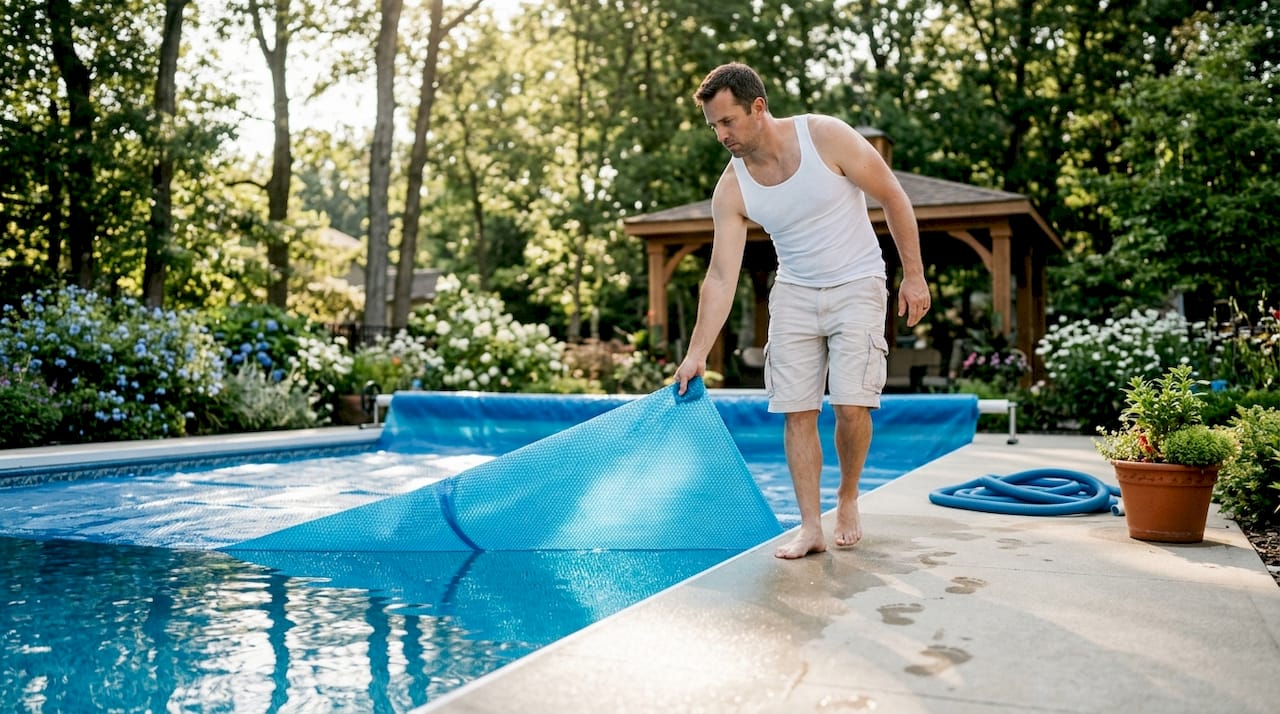
Bubble-style solar blankets, which look like oversized bubble wrap, let sunlight pass through and actually add heat to the water during the day. Transparent models reduce solar energy absorption by only 5%–15%, meaning they pass most solar heat into the pool while still blocking evaporation. Opaque covers block 20%–40% of solar gain. If you heat your pool primarily with solar energy or live in a sunny climate, an opaque cover used during daylight hours works against you.
Wind also accelerates evaporation significantly. Windbreaks reduce evaporation, but if they also shade the pool, they reduce solar gain at the same time. No single environmental solution replaces the physical cover. The cover is the one tool that addresses both heat retention and evaporation simultaneously.
Pro Tip: In Central Florida, the best strategy is to use a solar blanket during the day in cooler months to maximize solar gain, then leave it on overnight when temperatures drop and evaporation accelerates. That timing shift alone makes a measurable difference in your heating bill.
Water and chemical savings that add up fast
Beyond energy, covers dramatically reduce two of the most annoying recurring costs of pool ownership: water refills and chemical treatments. Pool covers reduce water make-up needs by 30%–50% and cut chemical consumption by 35%–60%. In a state like Florida where water costs and conservation restrictions are real concerns, that water savings is both a financial and a civic win.
Here is why the chemical savings happen:
- Less dilution from refills. Every time you add water to replace what evaporated, you dilute your chlorine, pH adjusters, and stabilizers. Covers reduce that cycle dramatically.
- Less UV degradation. Sunlight breaks down chlorine and other chemicals at the surface. A cover shields the water from direct UV exposure, slowing chemical degradation and extending the life of each treatment.
- Less debris contamination. Leaves, grass clippings, insects, and airborne dirt all consume chlorine and feed algae. Covers can reduce debris entry by up to 70%, which means your filtration system works less and your chemical balance stays stable longer.
- Fewer algae outbreaks. Solid and opaque covers block sunlight from the water surface, which is one of the three conditions algae need to bloom. Less light means fewer outbreaks and less shock treatment.
The practical outcome is that you spend less time testing water, adding chemicals, and vacuuming the bottom. For busy homeowners, that time savings alone justifies the cover purchase.
Safety covers and what they actually protect against
This is where the most dangerous misconceptions live. Many homeowners assume that any cover placed over a pool prevents accidental drowning. That assumption is wrong, and it creates a false sense of security.
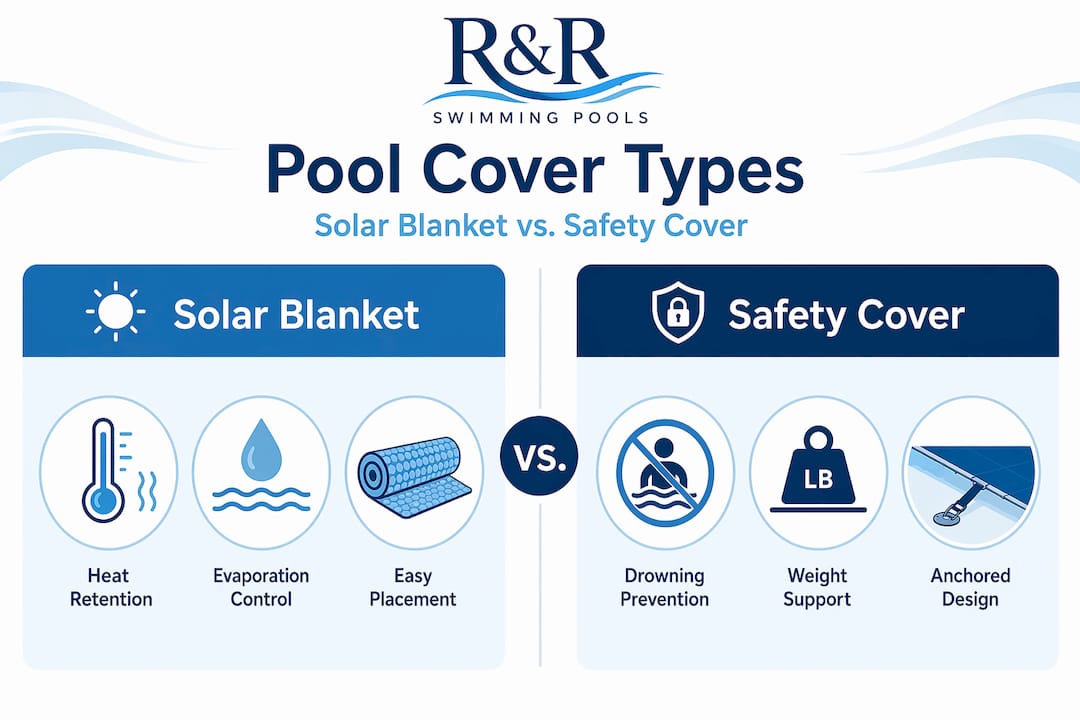
A standard solar blanket floats on the water surface. It is not anchored, cannot support weight, and if a child or pet falls onto it, they can become trapped underneath. Solar blankets are heat and evaporation tools, not safety devices. Using one as a substitute for proper pool protection is a serious hazard.
Here is how the major cover types compare on safety:
| Cover type | ASTM safety certified | Weight support | Anchored to deck |
|---|---|---|---|
| Solar blanket | No | No | No |
| Winter tarp | No | No | Sometimes |
| Mesh safety cover | Yes (when certified) | Yes | Yes |
| Solid safety cover | Yes (when certified) | Yes | Yes |
| Automatic cover | Varies by model | Varies | Yes |
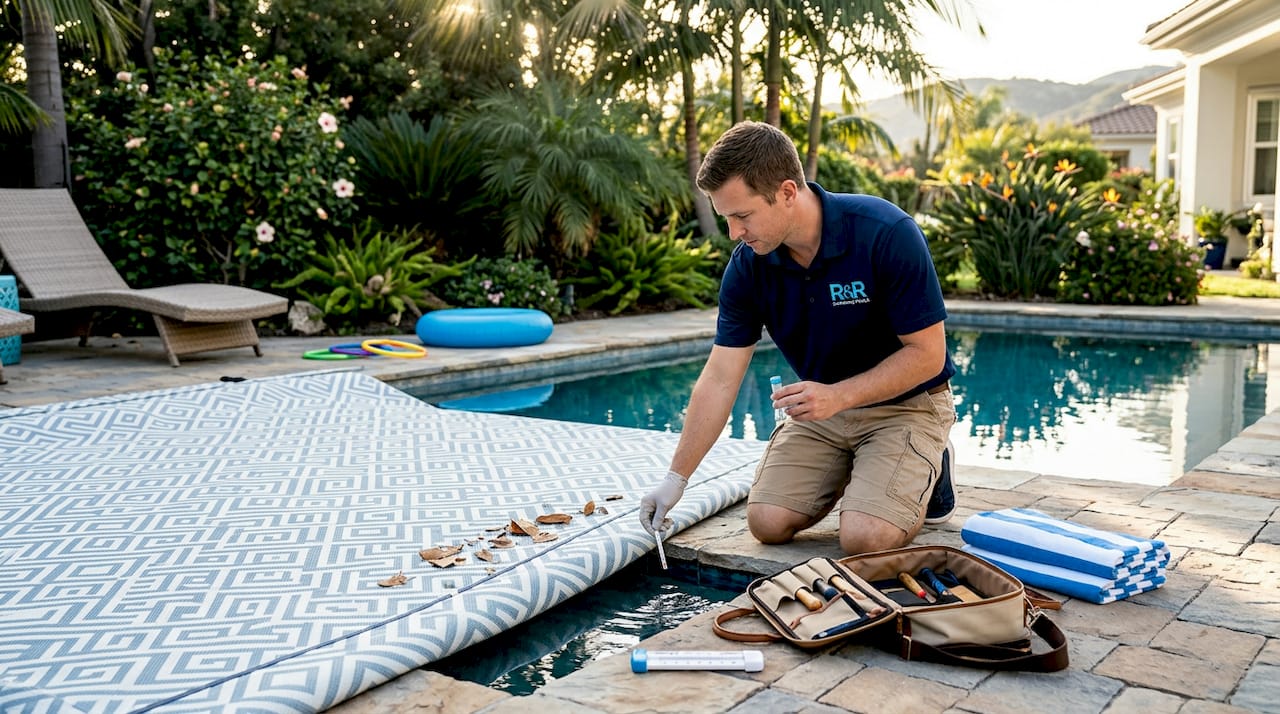
Only ASTM-certified covers provide genuine drowning prevention. Mesh safety covers allow water to drain through while supporting the weight of a child or adult. Solid safety covers block debris and light completely while also providing that same structural support. Both types use anchor points drilled into the pool deck to create tension across the entire surface.
Automatic pool covers occupy an interesting middle ground. They combine safety and energy benefits with the ease of a motorized system, but not all automatic covers carry ASTM safety certification. If you have young children or pets, check the certification label before assuming convenience equals protection. You can learn more about pool safety standards specific to Central Florida homes before making a purchase.
How to choose and use a pool cover effectively
Knowing the benefits of pool covers is one thing. Translating that knowledge into a cover that actually gets used consistently is another problem entirely. Convenience directly drives whether a cover gets deployed every day or sits folded in a corner. Here is how to match cover type to your real-life priorities:
- If family safety is your top concern, invest in a mesh or solid ASTM-certified safety cover with deck anchors. It is the only category that protects against accidental drowning and should be treated as non-negotiable if young children are present.
- If energy and heating cost reduction is the priority, a solar blanket used consistently, especially overnight, delivers the most direct return on investment. The purchase price is low and the payback period is short.
- If you want both safety and convenience, an automatic cover is worth the higher upfront cost. Its ease of use means you will actually deploy it every day, and consistent cover use impacts heating costs more than upgrading your heater equipment alone.
- If winterization and debris control matter most, a solid safety cover or quality winter cover protects water chemistry through the off-season and dramatically reduces spring opening costs.
- If budget is tight, even a basic solar blanket outperforms no cover at all. Avoid liquid pool covers as a substitute. They reduce evaporation modestly but provide zero safety benefit and far less effectiveness than physical covers.
Once you have the right cover, fit and installation determine how well it actually works. Uncovered gaps cause disproportionate heat loss even when the rest of the pool is covered. A cover that does not fit your pool shape properly defeats a large portion of the benefit.
Pro Tip: When ordering a custom-shaped cover, have the pool dimensions measured professionally rather than estimating. A gap as small as a few inches near the steps or a rounded edge can become a significant source of evaporation that undercuts your savings.
For additional help with energy-efficient pool care, including cover selection guidance specific to Central Florida’s climate, Randrswimmingpools has resources tailored to the region.
My honest take on why most homeowners get this wrong
I’ve watched homeowners spend thousands on upgraded pool heaters and then leave the water completely uncovered at night. The heater runs for hours just to recover the heat lost between 10 PM and 7 AM. The cover would have cost a fraction of the heater upgrade and done more to hold that heat than any equipment change.
What I’ve learned from talking with pool owners over many years is that the barrier is almost never financial. It’s behavioral. Covers get skipped because they feel like a hassle, because the reel is in the wrong spot, or because pulling a blanket across a large pool feels like work at the end of a long day. That is why the selection process matters as much as the product itself. A cover you will not use consistently is a purchase that does not pay back.
My actual recommendation: if you have kids or pets, start with an ASTM-certified safety cover as the baseline. Add a solar blanket on a reel system for daily energy management. You do not need the fanciest automatic system to get 80% of the benefit. You need something simple enough that you deploy it every single time. The savings from pool cover advantages compound over years, and the safety protection is not something you want to discover was missing after the fact.
— Randrswimmingpools
Ready to protect and get more from your pool?
If this article clarified what pool covers can actually do for your home, the next step is making sure your pool itself is set up to take full advantage. R and R Swimming Pools has been building and advising on custom inground pools across Central Florida since 1985, and the team understands exactly how cover choices interact with different pool types, shapes, and equipment systems.
Whether you are planning a new installation or maximizing the value of an existing pool, the inground pool installation guide from Randrswimmingpools walks through every decision point homeowners face. For broader pool ownership education, the Pool School resource center covers maintenance, safety, and seasonal care in one place. Contact Randrswimmingpools for a free consultation and get advice tailored to your specific pool setup and Central Florida climate.
FAQ
Why use pool covers if the pool is already heated?
Heating a pool and retaining that heat are two separate problems. Without a cover, a heated pool loses the majority of its heat overnight through evaporation, forcing the heater to run continuously and driving up energy costs.
Do pool covers reduce evaporation noticeably?
Yes. Physical pool covers reduce water loss by 30%–50%, which directly cuts the frequency of water refills and the chemical treatments needed to rebalance diluted water.
What is the difference between a safety cover and a solar blanket?
A solar blanket floats on the water and reduces heat loss but cannot support weight and provides no drowning protection. A safety cover is anchored to the deck, ASTM-certified, and can physically support the weight of a child or adult.
How do pool covers save money on maintenance?
Covers block debris, slow UV-driven chemical breakdown, and reduce evaporation, all of which lower cleaning frequency, reduce chemical usage by up to 60%, and cut the time you spend maintaining water balance.
How do I choose a pool cover for my family?
Start with safety certification if you have children or pets, then layer in energy benefits. ASTM-certified mesh or solid covers are the safest foundation, and adding a solar blanket on a reel system handles daily heat retention without extra hassle.
