
TL;DR:
- A zero entry pool features a gradual, sloped entry from deck level that mimics natural shoreline and eliminates stairs. It provides increased accessibility, safety, and resort-like aesthetics but requires significant space, precise grading, and textured surfaces for slip prevention. Proper planning with experienced builders ensures optimal functionality, compliance, and long-term satisfaction.
A zero entry pool is a swimming pool with a gradual, sloped entrance that begins at deck level, allowing you to walk directly into the water without stairs, ladders, or a sudden drop. Also called a beach entry pool or walk-in pool, this design mimics the natural shoreline of a lake or ocean, making it one of the most accessible and visually striking pool styles available to homeowners today. If you are planning a custom inground pool in Central Florida or anywhere with generous backyard space, understanding what separates a zero entry pool from a standard pool is the first step toward making the right investment.
What is a zero entry pool and how does it work?
A zero entry pool, also known by the industry term sloped entry pool or beach entry pool, starts completely dry at deck level with zero water coverage and progresses gradually deeper as you walk in. This is a critical distinction: a true zero entry is not simply a flooded tanning ledge or a shallow shelf. The water level begins at your feet and rises naturally with each step forward, exactly like wading into the ocean.
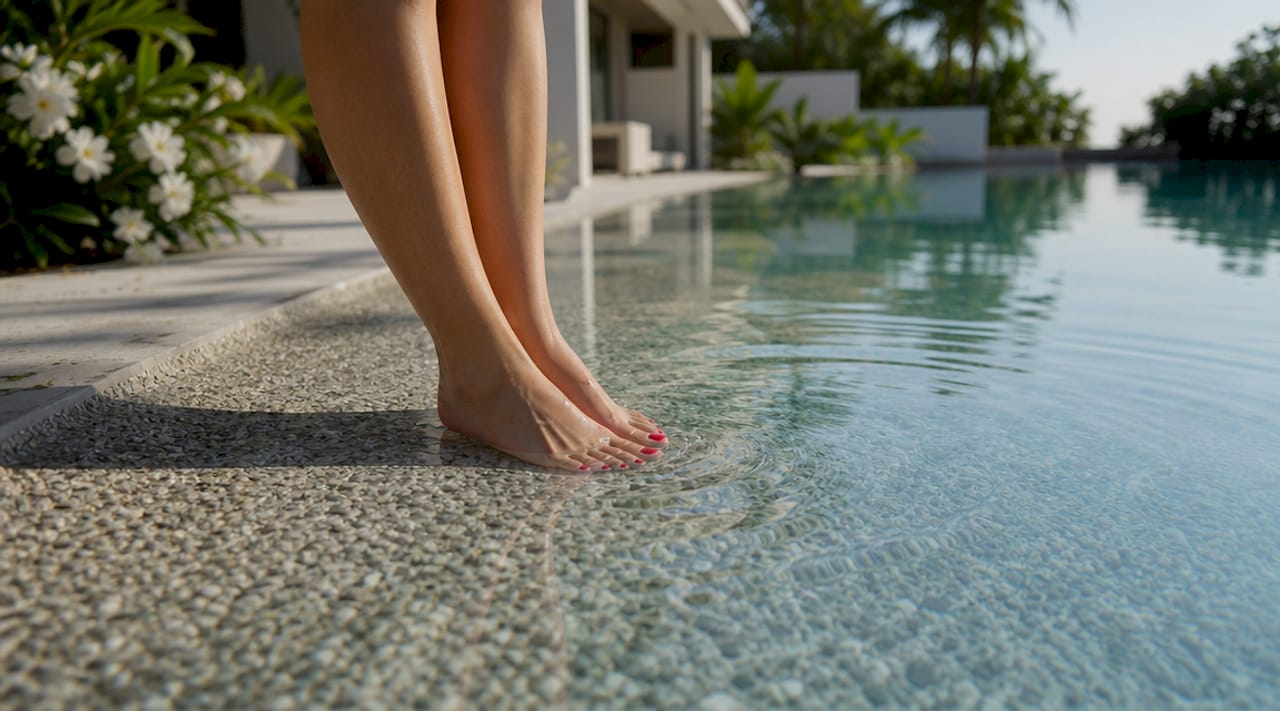
The slope is the defining engineering feature. For private residential pools, the standard maximum slope is 1:7, meaning the depth increases by 1 foot for every 7 feet of horizontal run. To reach a usable swimming depth of 3.5 feet, the slope requires nearly 24.5 feet of horizontal space. That number surprises most homeowners during the planning phase, and it is the single biggest factor shaping whether a zero entry design fits your yard.
Builders treat this sloped section as an engineered apron, not just a decorative feature. Precise grading is required to maintain the correct slope ratio, which affects both the visual result and the pool’s long-term functionality. Get the grade wrong and the entry either feels too steep, defeating the purpose, or too shallow, turning the entire entry zone into an oversized tanning shelf with no real swimming depth.
Pro Tip: Ask your pool builder to show you the slope layout drawn to scale on your actual lot dimensions before finalizing any design. What looks generous on a rendering can feel cramped once staked out in your backyard.
How zero entry compares to tanning ledges and traditional stairs
| Feature | Zero Entry Pool | Tanning Ledge | Traditional Stairs |
|---|---|---|---|
| Entry style | Gradual slope from deck level | Flat shallow shelf, fixed depth | Fixed steps descending into pool |
| Horizontal space needed | 15 to 25+ feet | 4 to 6 feet | 3 to 5 feet |
| Accessibility | Highest, no steps required | Moderate | Lower, requires step clearance |
| Resort aesthetic | Strong, natural shoreline look | Moderate | Standard |
| Depth progression | Continuous and gradual | None, fixed shallow depth | Stepped, not gradual |
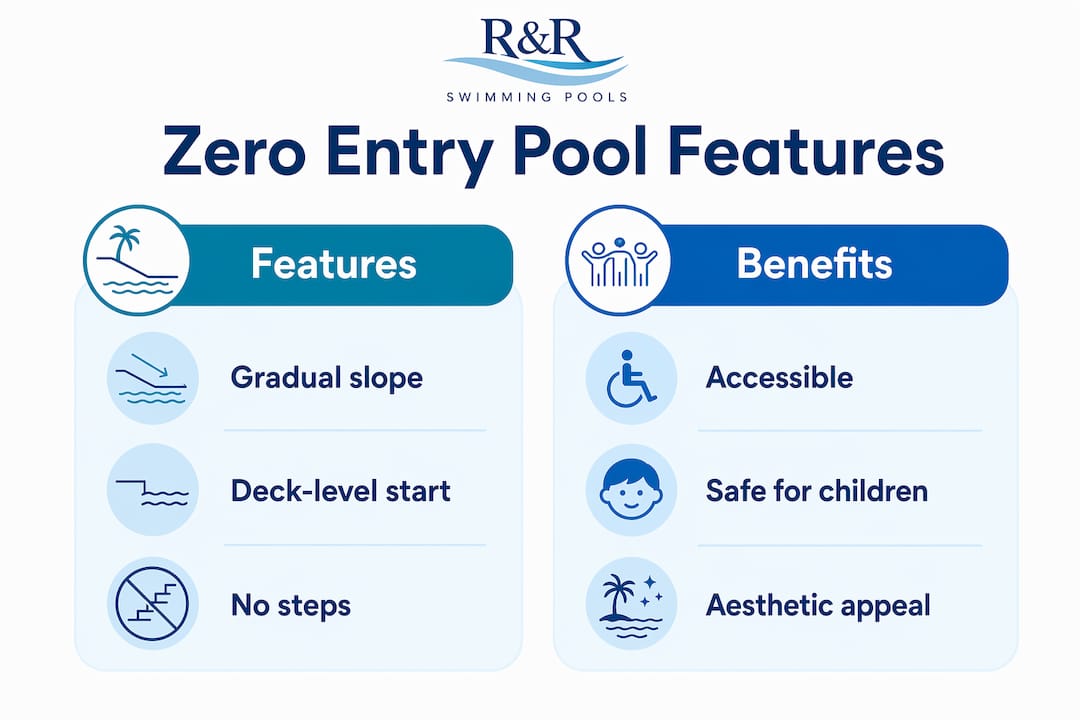
Traditional stairs drop you into the pool in three or four fixed steps. A tanning ledge sits at a fixed shallow depth, typically 6 to 12 inches, and does not progress deeper. A zero entry pool does both things differently: it starts dry and deepens continuously, which is what creates the beach-like experience.
What are the benefits of zero entry pools?
Zero entry pools deliver advantages that go well beyond aesthetics. The gradual, natural entry removes the physical barrier of ladders and steps, making the pool genuinely usable for children, elderly family members, and anyone with limited mobility or joint pain. That accessibility is not a minor feature. It changes who in your household actually uses the pool regularly.
The specific benefits that homeowners consistently report include:
- Child safety. Young children can enter the water at their own pace without being lifted over a ladder or navigating steep steps. Parents can supervise from the deck with a clear sightline to the water’s edge.
- Senior and mobility access. Adults with arthritis, hip replacements, or balance concerns can walk in steadily without gripping a rail or lowering themselves onto a step. This is a real quality-of-life difference for multigenerational households.
- Shallow lounging zone. The entry slope naturally creates a cool, shallow area where adults can sit in a few inches of water, toddlers can splash safely, and pets can wade. It functions as a built-in wading pool within the main pool.
- Resort-style visual appeal. The visual appeal of zero entry pools mimics natural shorelines, giving residential backyards a relaxed, resort-like atmosphere that standard rectangular pools cannot replicate.
- No ladder maintenance. Removing ladders and step inserts eliminates hardware that corrodes, loosens, and requires periodic replacement.
For families with young children, pairing a zero entry pool with in-home swim safety practices creates the safest possible aquatic environment at home. The design reduces risk, but supervision and swim education remain non-negotiable.
What are the challenges of building a zero entry pool?
Zero entry pools are not the right fit for every yard or every budget. Understanding the real constraints before you commit saves significant time and money.
- Space demand is non-negotiable. The slope length required by a 1:7 ratio means you need a yard with enough horizontal depth to accommodate 20 to 25 feet of entry zone before the pool even reaches swimming depth. Smaller lots in dense suburban neighborhoods often cannot support a true zero entry design without sacrificing the rest of the pool’s usable length.
- Cost runs higher than standard pools. The additional excavation, precise grading, and surface finishing required for the sloped entry add to the overall project cost. You are paying for more square footage of finished pool surface and more engineering work than a comparably sized pool with stairs.
- Surface selection is a safety decision. Glossy surfaces are slippery when wet, especially on the barely wet upper section of the slope where barefoot traction matters most. Builders strongly recommend textured, non-glossy finishes like exposed aggregate, brushed concrete, or pebble surfaces. This is not an aesthetic preference. It is a slip-prevention requirement.
- Maintenance requires more attention. The shallow sloped entry collects debris, algae, and sediment more readily than vertical pool walls. You will need a surface-compatible brush and a cleaning routine that specifically addresses the entry zone. Water chemistry management in the very shallow entry area also requires monitoring since that water heats up faster and loses sanitizer more quickly.
Pro Tip: Specify a textured pebble or exposed aggregate finish for the entire slope during the design phase. Retrofitting a surface texture after construction is expensive and disruptive.
What accessibility and compliance standards apply?
For public pools, hotels, and HOA community pools, ADA 2010 Standards set binding requirements that directly shape zero entry pool design. Public pools with 300 or more linear feet of wall must provide two accessible entry points. Smaller public pools require at least one, which can be a sloped entry or a pool lift.
The ADA slope standard for public pools is stricter than the residential standard: a maximum of 1:12, meaning 1 foot of depth change over 12 feet of horizontal run. This gentler grade requires even more horizontal space than the residential 1:7 standard, which is why public zero entry pools often span 30 to 40 feet before reaching swimming depth.
| Pool type | Maximum slope | Accessible entries required | Landing requirements |
|---|---|---|---|
| Public pool (300+ ft wall) | 1:12 | Two | Yes, specified dimensions |
| Public pool (under 300 ft wall) | 1:12 | One | Yes |
| Private residential pool | 1:7 | None mandated | Recommended |
For private residential pools, ADA compliance is not legally required. However, early design coordination of sloped entries, handrails, and landings significantly reduces the risk of costly redesigns if your needs change later. Building to a more accessible standard from the start is almost always cheaper than retrofitting.
How to build and plan a zero entry pool for your home
Planning a zero entry pool starts with your yard, not a design catalog. Before selecting any finish or feature, measure the available horizontal depth of your backyard and subtract the space you want to preserve for landscaping, patio furniture, and safety clearance around the pool edge. What remains tells you whether a full zero entry design is feasible or whether a partial slope entry is the better choice for your property.
The key planning steps include:
- Survey your lot. Confirm the actual usable dimensions with a tape measure or a site survey. A slope requiring 24 feet of horizontal run needs at least 30 to 35 feet of total pool length to include a meaningful deep end.
- Select your surface material early. Textured pebble finishes, exposed aggregate, and brushed concrete all provide traction and durability on a wet slope. Confirm your builder’s recommended options before the design is finalized.
- Discuss slope ratio and code compliance with your builder upfront. Changing the slope angle after excavation begins triggers expensive rework. Lock in the ratio during the design phase.
- Plan your drainage and water management. The shallow entry zone needs proper drainage to prevent standing water on the deck surface when the pool is not in use.
- Review pool entry options specific to your region. Central Florida’s soil conditions, water table, and climate affect both the construction method and the surface materials that perform best long term.
Working with an experienced builder who has completed multiple zero entry projects is the most reliable way to avoid the common pitfalls of slope miscalculation and surface selection errors.
Key takeaways
A zero entry pool is the most accessible inground pool design available, but it demands more yard space, more precise engineering, and more maintenance planning than a standard pool with stairs.
| Point | Details |
|---|---|
| Definition is specific | A true zero entry starts dry at deck level and deepens gradually, not just a shallow shelf. |
| Space requirement is significant | Reaching 3.5 feet depth at a 1:7 slope requires nearly 24.5 feet of horizontal run. |
| Surface texture is a safety requirement | Textured, non-glossy finishes prevent slips on the wet upper slope where traction is most critical. |
| ADA standards differ by pool type | Public pools must meet a 1:12 slope maximum; private residential pools follow a 1:7 standard. |
| Early planning prevents costly changes | Locking in slope ratio, surface choice, and handrail placement before excavation avoids expensive redesigns. |
Why zero entry pools are worth the planning effort
After working with homeowners across Central Florida for decades, I have seen the same pattern repeat: families fall in love with the look of a zero entry pool in a showroom photo, then get surprised by the space and cost realities on their actual lot. The ones who end up happiest are the ones who treated the slope as the centerpiece of the design from day one, not as an afterthought.
The most common mistake I see is underestimating how much of the pool’s total length the entry slope consumes. A 40-foot pool with a proper zero entry slope can end up with only 15 feet of actual swimming depth. That is a real trade-off, and it is one worth making deliberately rather than discovering after the concrete is poured.
What I find genuinely underappreciated about zero entry pools is how they change the way families use a pool over time. A household that installs one when the kids are young will still be using it comfortably when grandparents visit. The design ages well with the people who own it. That long-term usability is worth more than any single aesthetic feature.
The safety surface question is the one I push hardest on with every client. A beautiful glossy finish on a zero entry slope is a liability. The highest slip risk is at the barely wet upper section where the slope meets the deck. Textured aggregate is not glamorous, but it is the right call every time.
— Randrswimmingpools
Build your zero entry pool with the right team
R and R Swimming Pools has designed and installed custom inground pools across Central Florida since 1985, including beach entry and zero entry designs built to both residential and ADA-informed standards. If you are evaluating whether a zero entry pool fits your yard and budget, the right starting point is a detailed review of your inground pool options alongside a professional site assessment.
Our team handles every phase from slope engineering and surface selection to final finishing, with the experience to get the grade right the first time. Use our pool installation guide to understand the full process, or contact Randrswimmingpools directly to schedule a free consultation and find out exactly what a zero entry pool would look like on your property.
FAQ
What is the difference between a zero entry pool and a beach entry pool?
Zero entry pool and beach entry pool refer to the same design: a pool with a gradual slope starting at deck level with no water at the entry point. Both terms are used interchangeably in the pool industry.
How much space does a zero entry pool require?
A residential zero entry pool following the standard 1:7 slope needs nearly 24.5 feet of horizontal run to reach 3.5 feet of depth, so most designs require a total pool length of 35 to 45 feet to include a functional swimming area.
Are zero entry pools safe for children?
Zero entry pools are among the safest pool designs for young children because they eliminate ladders and allow gradual, supervised wading entry. Pairing the design with textured surfaces and consistent adult supervision maximizes safety.
Do zero entry pools cost more than standard pools?
Yes. The additional excavation, precise slope grading, and larger surface area of a zero entry design typically increase construction costs compared to a standard pool of similar overall dimensions.
Are zero entry pools required to meet ADA standards?
Private residential zero entry pools are not legally required to meet ADA standards. Public pools must comply with ADA 2010 requirements, including a maximum slope of 1:12 and specified landing dimensions.
