
TL;DR:
- Pool zoning compliance ensures your pool meets local setback, easement, impervious surface, and safety requirements before construction. Failing to obtain the proper permits can lead to fines, construction delays, insurance issues, and potential pool removal. Verify compliance early by consulting local ordinances, securing a property survey, and coordinating municipal and HOA approvals to protect your investment.
Pool zoning compliance is the legal process of confirming that your swimming pool’s placement, size, and construction meet all local zoning ordinances before a single shovel breaks ground. In Central Florida, this means satisfying setback distances from property lines, avoiding easements, staying within impervious surface limits, and meeting safety barrier standards. Skipping this step does not just slow your project. It can trigger fines, stop-work orders, voided insurance, and even forced pool removal. Understanding what is pool zoning compliance before you design your pool is the single most effective way to protect your investment.
What is pool zoning compliance and why it matters
Pool zoning compliance is the formal approval process confirming your pool meets local land-use rules before construction begins. It is legally distinct from a building permit. Zoning approval must come first, or your building permit application will be rejected outright. Many homeowners assume these two approvals are the same thing. They are not, and confusing them is one of the most common and costly mistakes in pool projects.
Zoning rules govern where your pool can sit on your property. Building permits govern how it gets built. Both are required, but zoning comes first. In Central Florida, municipalities like Orange County, Lake County, and Seminole County each maintain their own zoning ordinances, so the rules vary by location. The core purpose of these rules is to maintain neighborhood harmony, protect emergency access routes, and prevent environmental damage.
Failure to obtain proper permits can lead to fines, stop-work orders, voided insurance, and mandated pool removal. That last consequence is not rare. Municipalities in Florida actively enforce compliance, and unpermitted pools discovered during a property sale create serious legal and financial problems for sellers.
What are the core zoning regulations for pool placement?
Florida residential pools require zoning approval as a first step, with setbacks typically between 5 and 10 feet from property lines. That range sounds simple, but the details matter. Setbacks are measured from the water’s edge, not the pool deck. Your deck, coping, and equipment pad all add distance, so a pool that looks like it fits on paper may not clear the setback once the full footprint is calculated.
Here are the core placement rules you need to verify before finalizing your pool design:
- Setback distances: Most Central Florida municipalities require 5–10 feet from rear and side property lines. Some require greater distances from the primary structure.
- Easement restrictions: Pools cannot be built over utility, drainage, or ingress/egress easements. Violating this rule causes automatic permit denial.
- Rear yard placement: Most pools must be located in the rear yard. Front yard pools are almost universally prohibited under residential zoning codes.
- Impervious surface limits: Total impervious surface coverage, including pool surface, decking, and ancillary structures, must not exceed the municipality’s maximum ratio. Exceeding this limit means permit denial regardless of setbacks.
- Property survey requirement: You need a current, certified property survey before designing your pool. Surveys reveal easements, lot dimensions, and existing impervious coverage that directly affect what you can build.
Pro Tip: Order your property survey before meeting with a pool designer. Designers who work from outdated surveys or rough lot sketches often produce plans that fail zoning review, wasting weeks of design time.
Impervious surface calculations catch many homeowners off guard. Your pool counts as impervious surface. So does your deck, your existing driveway, your patio, and your home’s footprint. If your lot is already close to the municipality’s coverage limit, a large pool and deck combination may push you over the threshold. Scaling back the deck or choosing a smaller pool footprint is often the only path forward without a variance.
How does the pool permit and variance process work?
The permitting process for a pool in Central Florida follows a specific sequence. Skipping steps or reversing the order adds weeks to your timeline.
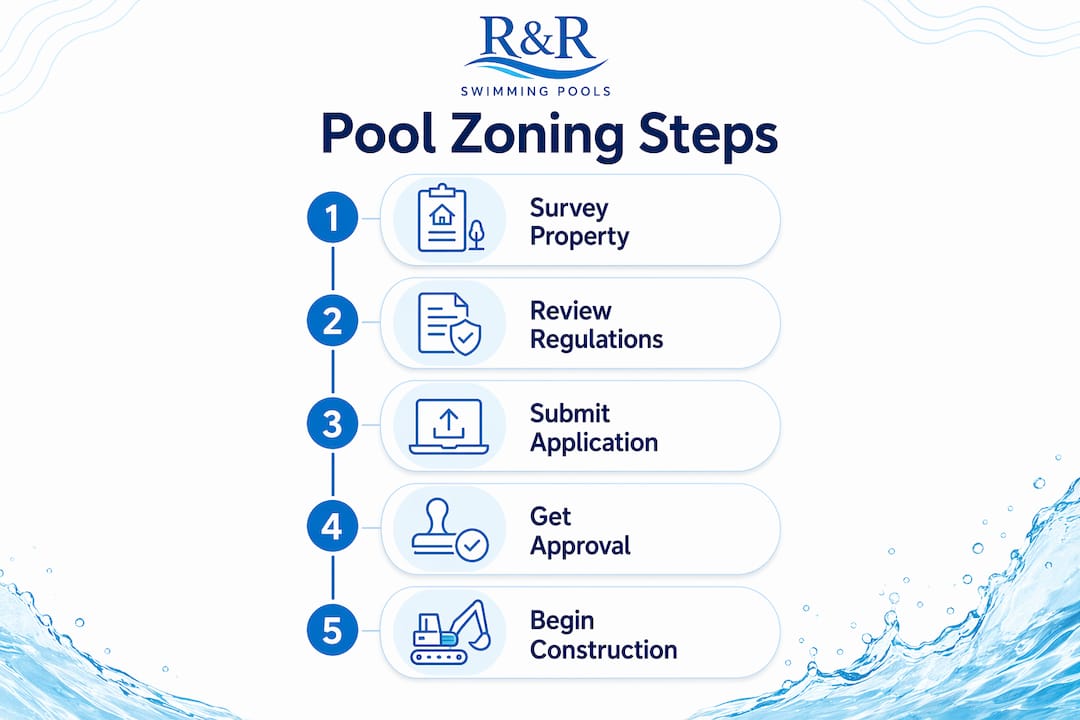
- Confirm zoning eligibility. Contact your local zoning or planning department to verify setbacks, easement locations, and impervious surface limits for your specific parcel.
- Commission a property survey. A licensed surveyor produces a site plan showing all measurements needed for the zoning application.
- Submit a zoning clearance application. This is the formal request for zoning approval. It is reviewed before any building permit is issued.
- Apply for a building permit. Once zoning is cleared, submit your pool construction plans to the building department. Permit packages cost $500 to $2,500, with review timelines ranging from 4 to 12 weeks.
- Obtain HOA approval. If your property falls under a homeowners association, HOA approval can add 2 to 6 weeks and may impose stricter design rules than municipal zoning.
- Begin construction. Work starts only after all approvals are in hand.
When Your Design Does Not Meet Setbacks
A variance is a formal request to deviate from a zoning requirement. To qualify, you must demonstrate legal hardship, meaning the standard rule creates an unreasonable burden specific to your property’s physical characteristics. Variance applications cost $300 to $1,000 and require a formal hearing before a zoning board. Success rates run 40%–60%, and the process adds 4–12 weeks to your project timeline.
| Factor | Standard Permit Path | Variance Required Path |
|---|---|---|
| Timeline | 4–12 weeks | 8–24 weeks |
| Cost | $500–$2,500 | $800–$3,500 |
| Approval certainty | High | 40%–60% success rate |
| Design flexibility | Limited to compliant designs | Allows non-standard placement |
Pro Tip: The HOA approval process often creates more project delays than municipal permitting. Submit your HOA application at the same time as your zoning application, not after. Running both processes in parallel can save a month or more.
What safety and environmental requirements apply to pool zoning?
Pool safety zoning is not separate from land-use zoning. Safety requirements are embedded directly into the permit approval process, and failing to meet them blocks construction approval just as surely as a setback violation.
The key safety and environmental compliance requirements include:
- Minimum fencing height: All residential pools deeper than 24 inches must have a 48-inch minimum fence enclosing the pool area. This is a state-level requirement under Florida law, and local codes may be stricter.
- Secondary safety mechanisms: Self-latching gates, door alarms, and pool covers are required as secondary safeguards. These are not optional upgrades. They are permit conditions.
- Drainage compliance: Drainage systems must direct pool runoff into approved municipal stormwater systems. Discharging water onto a neighboring property is prohibited and enforceable by fines.
- Code evolution: Pools built under older codes may require upgrades when they undergo renovation or when the property is sold. Compliance is not a one-time event. It is an ongoing obligation.
- Environmental restrictions: Some Central Florida parcels near wetlands or conservation areas carry additional environmental review requirements. These can affect pool placement even when standard setbacks are satisfied.
Zoning rules also serve a purpose that goes beyond individual properties. Zoning aims to maintain neighborhood harmony and protect emergency access routes, not just property aesthetics. A pool placed too close to a property line can block fire department access or create drainage conflicts that affect neighbors. These are the real-world problems that pool zoning regulations exist to prevent.
How can you verify and maintain pool zoning compliance?
Verifying pool compliance requirements before construction is straightforward if you follow the right sequence. Maintaining compliance over time requires a bit more attention, especially if you renovate or sell the property.
Steps to verify compliance before construction:
- Visit your county or municipal planning department’s website and download the current zoning ordinance for your parcel. Orange County, Seminole County, and Lake County all publish these online.
- Cross-reference your property survey with the setback map to confirm your proposed pool location clears all required distances.
- Check your property deed and title report for recorded easements. Utility companies hold easements that do not always appear on standard lot maps.
- Confirm your total impervious surface calculation with a licensed contractor or surveyor before finalizing your pool and deck design.
- Review your HOA’s architectural guidelines separately from municipal zoning. HOA rules can be stricter, and homeowners remain responsible for obtaining HOA approvals even when a licensed contractor manages the municipal permit process.
Pro Tip: Use a licensed pool contractor who is familiar with your specific municipality’s zoning office. Local relationships and experience with local reviewers can speed up approval by weeks.
For ongoing compliance, keep copies of all permits, inspection reports, and approval letters in a dedicated home file. When you renovate your pool, check whether the planned changes trigger a new permit requirement. Adding a spa, waterfall, or expanded deck often requires a fresh zoning review. After-the-fact permit applications risk destructive inspections, where inspectors require decking or pool elements to be dismantled to verify compliance. That outcome is far more expensive than getting the permit upfront.
Unpermitted pools carry one more serious risk that many homeowners overlook. Insurance companies may deny liability claims related to an unpermitted pool. If someone is injured in a pool that was built without proper permits, your homeowner’s insurance may refuse to cover it. That exposure alone makes compliance non-negotiable.
Key takeaways
Pool zoning compliance requires securing zoning clearance before permits, meeting setback and impervious surface limits, and satisfying safety barrier standards to avoid fines, removal orders, or voided insurance.
| Point | Details |
|---|---|
| Zoning before permits | Zoning approval must be secured before any building permit application will be accepted. |
| Setbacks and easements | Pools must clear 5–10 foot setbacks and cannot be built over utility or drainage easements. |
| Impervious surface limits | Pool, deck, and all hard surfaces combined must stay within your municipality’s coverage ratio. |
| Safety barriers required | A 48-inch fence and secondary safeguards like alarms or self-latching gates are mandatory for all pools deeper than 24 inches. |
| HOA adds time | HOA approval can add 2–6 weeks and impose stricter rules than municipal zoning codes. |
What i’ve learned after decades of pool projects in central florida
The most common mistake I see is homeowners assuming their contractor handles everything. Licensed contractors manage permit pulls, but misconceptions about permit handling can delay or jeopardize compliance. The homeowner is the responsible party. The contractor is the agent. That distinction matters when something goes wrong.
The second pattern I see constantly is late HOA engagement. A homeowner gets municipal zoning clearance, celebrates, and then discovers their HOA requires a completely different deck material or fence style. Now they are redesigning a plan that already passed municipal review. Submit to both simultaneously. It costs nothing extra and saves weeks.
The third issue is treating compliance as a one-time checkbox. Florida’s pool safety codes have evolved significantly over the past two decades, and they will keep evolving. A pool built in 2005 may not meet 2026 standards for fencing or drainage. When you renovate or sell, those gaps become your problem. Staying current with code changes is not bureaucratic overhead. It protects your property value and your liability exposure.
My honest advice: start with your property survey and your municipality’s zoning map before you talk to a single designer. Know your constraints first. Design within them second. That sequence saves more money and time than any other single decision in the pool planning process.
— Randrswimmingpools
Start your pool project right with Randrswimmingpools
R and R Swimming Pools has been building custom inground pools across Central Florida since 1985. That experience means we know the zoning ordinances, setback requirements, and permit timelines for Orange, Lake, Seminole, and surrounding counties. We handle the coordination between your property survey, municipal zoning office, and HOA so you are not managing three separate approval tracks on your own.
If you are ready to move from planning to building, our inground pool installation guide walks through every step from zoning clearance to final inspection. You can also explore our custom pool planning guide to see how we design pools that meet compliance requirements without sacrificing the features you want. Contact Randrswimmingpools for a free quote and start your project with a team that knows Central Florida’s rules inside and out.
FAQ
What is pool zoning compliance?
Pool zoning compliance is the process of meeting local land-use regulations that govern where and how a swimming pool can be built on a residential property. It covers setbacks, easements, impervious surface limits, and safety barriers.
How do i check pool zoning rules for my property?
Visit your county or municipal planning department’s website to download the current zoning ordinance for your parcel, then cross-reference it with a certified property survey to confirm setbacks and easement locations.
Do pool zoning regulations apply to pool renovations?
Yes. Pools built under older codes may require upgrades to current safety and drainage standards when they undergo renovation or when the property is sold, so compliance must be re-verified before any significant modification.
What happens if i build a pool without zoning approval?
Building without zoning approval can result in fines, stop-work orders, voided homeowner’s insurance, and in serious cases, a municipal order to remove the pool entirely.
Does my HOA have separate pool compliance requirements?
Yes. HOA architectural committees can impose stricter rules than municipal zoning, including specific fence styles, deck materials, and equipment screening. Homeowners are responsible for obtaining HOA approval independently of their municipal permits.
