
TL;DR:
- Landscape integration is essential for creating luxurious pools that blend seamlessly with the environment.
- Thoughtful site analysis and material continuity enhance both aesthetic appeal and long-term functionality.
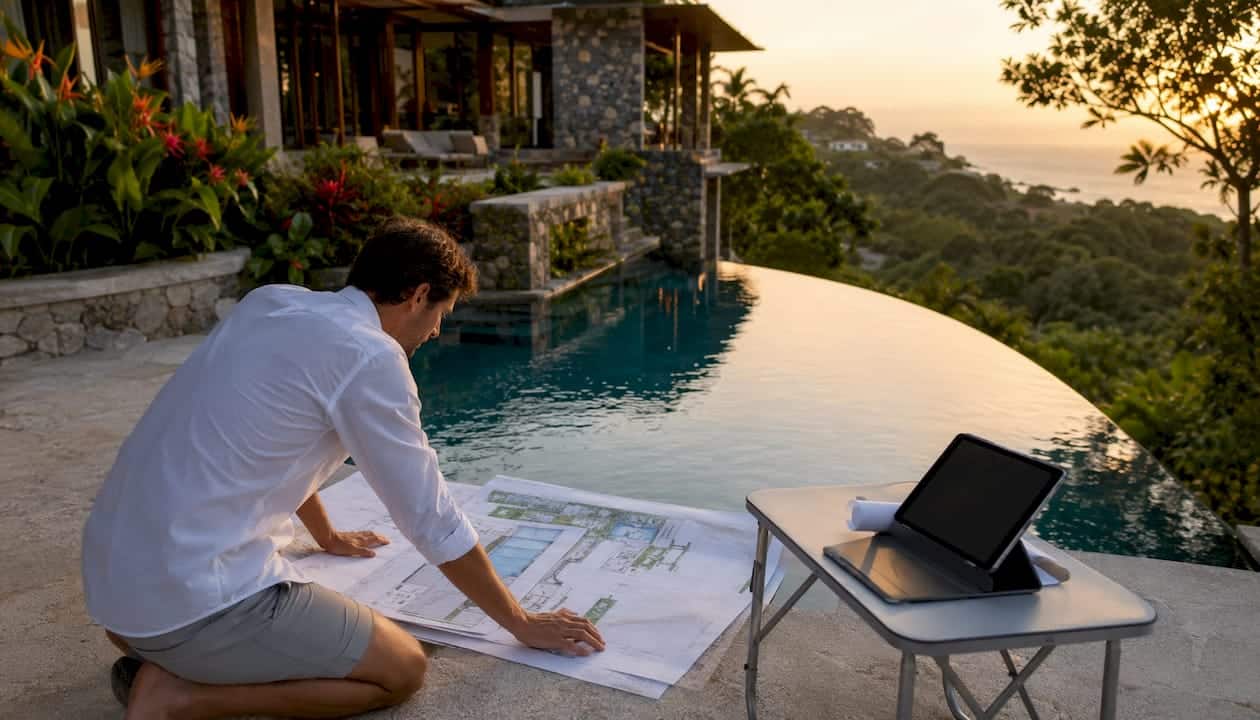
Landscape integration is the single most important decision you make when planning a luxury pool. Not the tile. Not the finish. Not even the shape. A pool that sits disconnected from its surroundings, dropped into a yard like an afterthought, will always feel like exactly that, regardless of how much it cost. The deliberate practice of blending a pool with its surrounding environment, aligning it with your home’s architecture, natural topography, and outdoor living zones, is what separates a beautiful backyard from a truly extraordinary one. A majority of homeowners upgrading outdoor areas do so specifically to extend their living space, and the most successful projects treat the pool as one element in a larger, unified outdoor environment rather than the centerpiece around which everything else reacts.
The benefits of landscape integration go well beyond aesthetics. A well-integrated pool extends usable living space, increases property value, and creates an environment you actually want to spend time in, not just photograph. Key elements include material continuity between the pool deck and surrounding hardscape, thoughtful planting that softens edges and frames views, lighting that connects the pool to patios and garden beds after dark, and transitional zones that guide movement naturally from house to water.
Pro Tip: Before you discuss pool shapes or finishes with any designer, walk your property and identify the three best views from inside your home. Those sightlines should anchor every placement decision that follows.
How landscape integration shapes luxury pool design
The role of landscape integration in luxury pools is not decorative. It is structural. A pool that ignores its site, its relationship to the house, the slope of the land, the direction of prevailing wind, and the views from key interior rooms, will create problems that no amount of expensive tile can fix. Landscape architect Scott Lewis puts it plainly: a pool needs to be part of a whole plan, with size, shape, and location drawn from the specific project rather than any formula.
That site-first thinking is what distinguishes luxury pool landscape design from standard pool installation. The best integrated designs start by analyzing sightlines from inside the home, sun and shade patterns throughout the day, wind movement across the yard, and the architectural language of the house itself. Only after that analysis does shape selection make sense.
The principles that govern landscape architecture, rhythm, balance, proportion, and scale, apply equally to pool design. A pool that respects those principles reads as intentional. One that ignores them reads as installed.
1. Prioritize whole-site analysis before choosing a shape
Starting with the entire site means understanding sun paths, shade patterns, wind direction, privacy exposure, and the architectural axes of the home before a single dimension is drawn. This prevents the “dropped-in” look that plagues pools designed in isolation. The placement of the pool relative to indoor rooms, outdoor dining areas, and garden views determines how the space feels in daily use, not just in photographs.
2. Choose pool geometry that respects your home’s architecture
Rectangular pools work best for architectural harmony because clean lines echo the geometry of most homes. Complex freeform shapes tend to call attention to themselves, creating visual tension rather than calm. A rectangle also accommodates pool covers more cleanly and supports lap swimming. When a softer edge is genuinely appropriate, a geometric pool on the house side transitioning to a more naturalistic form at the far end can bridge both worlds without sacrificing coherence.
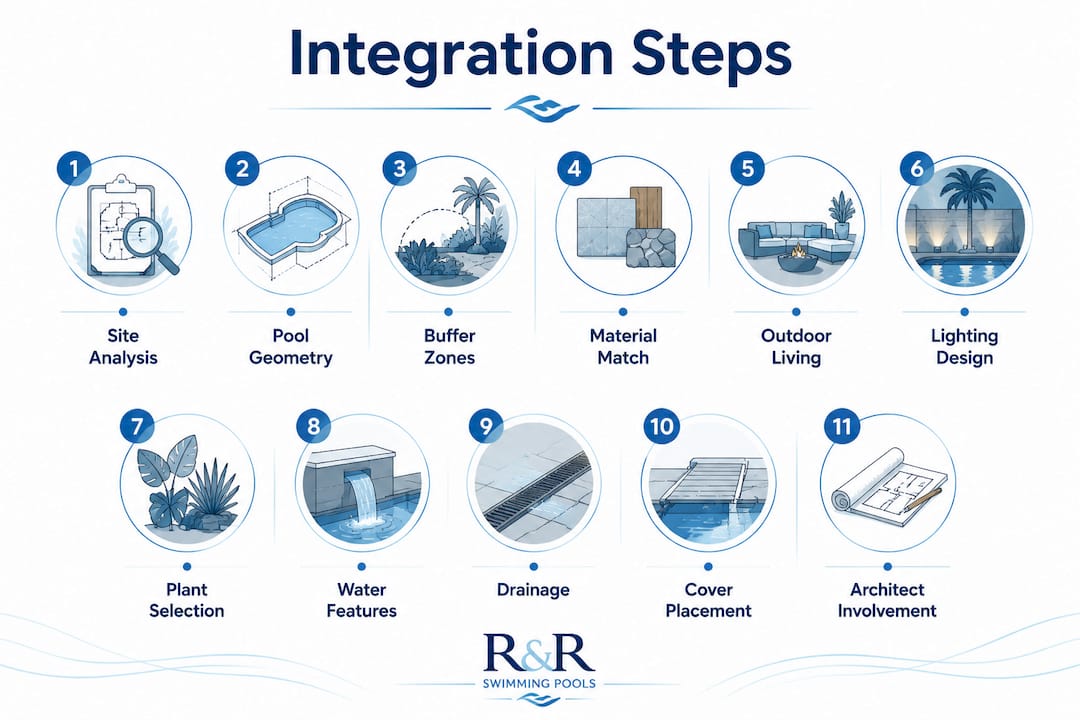
3. Use transitional buffer zones between house and pool
Transitional spaces are the connective tissue of a well-integrated backyard. A direct hard edge from sliding door to pool deck feels abrupt. Buffer zones, created with coordinated plantings, low walls, pergolas, or a change in paving material, slow the transition and make the journey from house to water feel deliberate. Ornamental grasses work particularly well here: they are debris-free, move softly in the breeze, and read as natural without requiring intensive maintenance.
Pro Tip: Place a partial structure like a pergola or shade sail at the midpoint between your home and pool. It creates a destination within the journey, not just a path to the water.
4. Match materials across the entire outdoor environment
Material continuity is one of the fastest ways to make a pool feel integrated or disconnected. Coping, pavers, retaining walls, and adjacent surfaces should share a common palette, even if they do not match exactly. Coordinating outdoor kitchen, fireplace, and patio materials with the pool area creates aesthetic coherence that reads as intentional design rather than accumulated decisions. When the same material is impractical across all surfaces, coordinating color temperature achieves a similar result.
The table below summarizes the most effective material pairings for common architectural styles.
| Home style | Pool coping | Deck/patio surface | Accent material |
|---|---|---|---|
| Modern/minimalist | Honed limestone | Large-format concrete pavers | Dark pool finish, flush spa |
| Mediterranean | Travertine | Tumbled travertine or brick | Natural stone walls |
| Traditional | Bluestone or brick trim | Concrete pavers resembling brick | Wrought iron or wood accents |
| Tropical/Florida | Coral stone or sandstone | Textured concrete | Native plantings, tiki elements |
| Naturalistic | Irregular flagstone | Decomposed granite or gravel | Boulders, native grasses |
5. Integrate outdoor living zones as part of the pool plan
2026 design trends have moved decisively away from pools as standalone features. Homeowners now expect patios, fire pits, outdoor kitchens, and seating areas to function as one connected environment, not a collection of separate purchases. Matching paver systems that extend from the pool deck into dining and lounge zones create a single architectural flow. Fire elements define zones within the space and extend usability well beyond swimming season.
Homeowners prioritize integrated environments with fire features, dining areas, and spa elements over standalone pools. That shift means the pool plan and the outdoor living plan need to be the same plan.
6. Design lighting to connect pool and landscape after dark
Lighting is where many otherwise well-designed pools fall short. A pool lit in isolation, glowing blue against an unlit yard, looks like a hotel amenity rather than a residential feature. A coordinated lighting plan connects the pool to nearby patios, walkways, and planting beds, creating a unified environment that extends usable hours and improves safety. Uplighting trees near the pool reflects on the water surface and produces dynamic effects visible from inside the home. LED systems now allow color temperature adjustments that shift the mood from active entertaining to quiet evening use.
Pro Tip: Specify warm-white landscape lighting (2700K–3000K) around the pool perimeter and save color-changing LED capability for the pool interior. The contrast between warm ambient light and the pool’s glow reads as sophisticated rather than theatrical.
7. Select plantings that enhance flow without creating maintenance problems
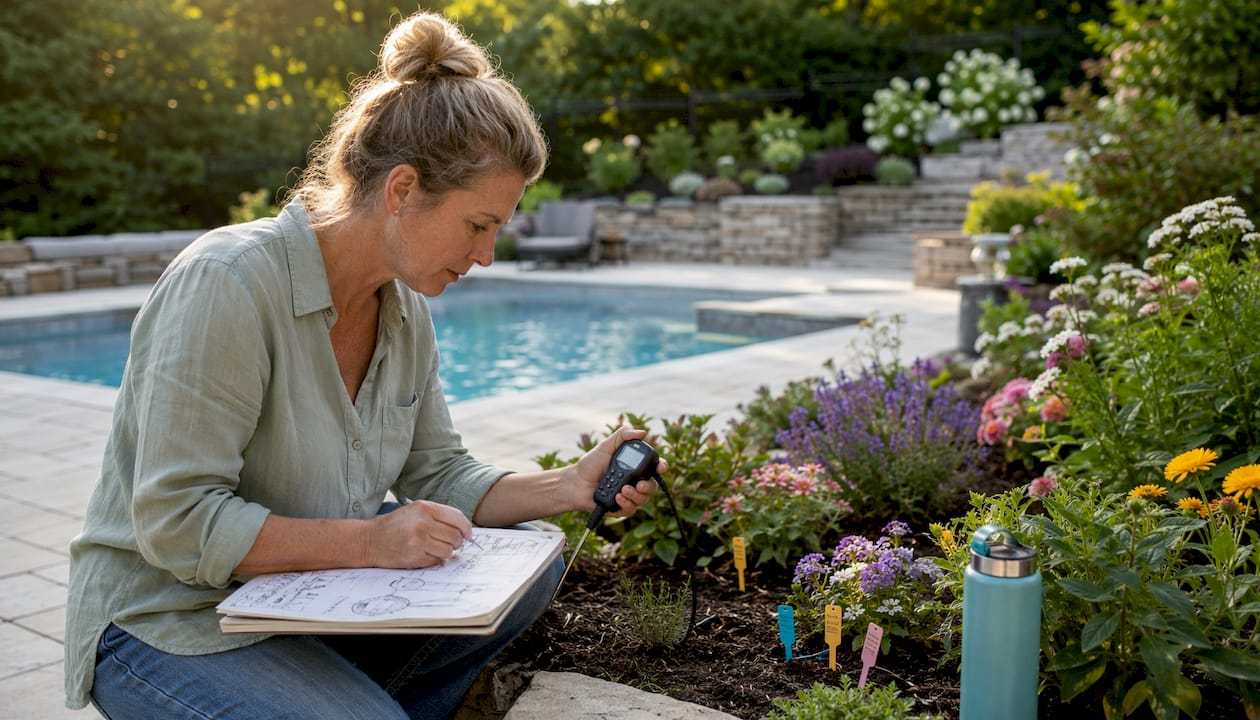
Plants do more work in a pool environment than most homeowners expect. They soften hard edges, frame views, provide privacy, and signal the transition between zones. The wrong choices, however, create constant maintenance: large-leafed trees drop debris into the water, plants that attract bees create safety concerns, and species with aggressive root systems can damage pool shells and underground plumbing over time.
Low-litter ornamental grasses, native shrubs, and perennials that tolerate heat and reflected light perform best in integrating gardens with pools. Poolside palm trees enhance a tropical setting naturally; they look out of place in a formal garden. The planting palette should reflect the region’s indigenous character, which is both a design principle and a practical maintenance advantage.
8. Incorporate water features that complement rather than compete
A well-placed water feature adds ambient sound and a visual focal point without overwhelming the space. The key word is “complement.” A sheet waterfall that spills quietly into the pool from a natural stone wall reads as part of the landscape. A collection of mismatched fountains and grottos reads as a theme park. Water features that add visual focus work best when they respond to something already present in the site, a grade change, a garden wall, or a view axis.
Subtle features often outperform dramatic ones. Water flowing from a piece of architectural stone, appearing to disappear into the deck, creates intrigue without visual noise.
9. Address drainage and grading as design decisions, not afterthoughts
Poor drainage is the most common and most expensive mistake in pool integration. Water should move away from the pool deck, away from the house foundation, and away from planting beds that cannot tolerate standing water. Grade changes affect every part of the integration: retaining walls, steps, and terracing must be planned alongside the pool, not added reactively after the shell is installed.
When a yard slopes, that slope is an opportunity. Terracing creates distinct outdoor zones at different elevations, and the retaining walls that hold those terraces can carry the same stone or brick used on the house, extending the material language of the architecture into the landscape.
10. Plan pool cover placement to preserve landscape aesthetics
A pool cover in the wrong location can dominate the view from the house for months. When safety codes or climate require a cover, specifying a neutral color rather than bright blue allows it to recede into the landscape rather than announce itself. More importantly, the pool’s placement within the yard should account for how it looks when covered. A pool positioned where it does not dominate the primary view from the main living areas is a better design decision than one placed for maximum visual impact when the water is open.
11. Involve a landscape architect from the first conversation
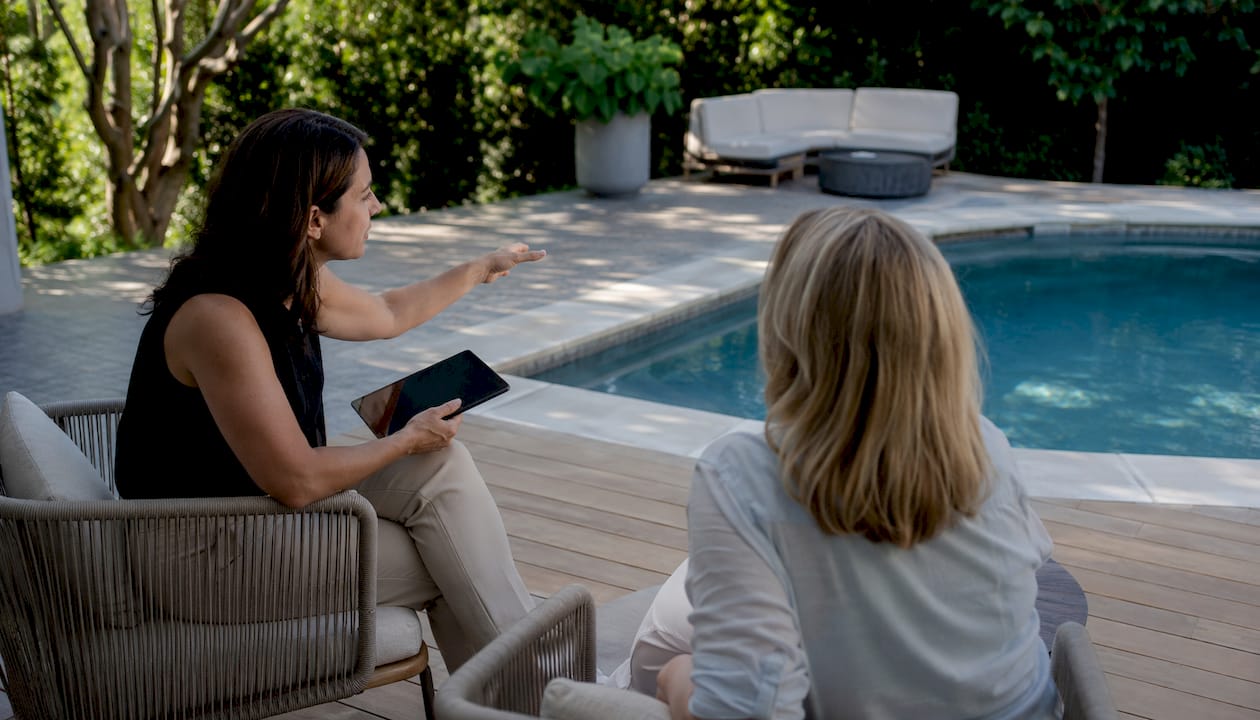
A landscape architect sees the pool as part of the entire outdoor environment, which prevents the most common and costly integration failures. Their expertise addresses proper grading and drainage, structural coordination, municipal permitting, and material selections that hold up over time. They also manage the relationship between the pool designer, the architect, and the interior designer, ensuring that themes flow from one setting to another rather than colliding at the back door.
Whole-site planning prevents drainage and elevation conflicts that become expensive to correct after construction. It also produces outdoor spaces that feel balanced and naturally connected rather than assembled from separate decisions.
Pro Tip: Bring your landscape architect into the conversation before you meet with pool builders. The placement and orientation decisions made in the first site visit will constrain every choice that follows.
Expert insights from Florida luxury pool projects
Florida’s climate makes outdoor living a year-round reality, which raises the stakes for integration considerably. A pool that works for three months of summer entertaining is a different design problem than one that anchors daily life from January through December. Florida luxury pool design integrates native landscaping and outdoor entertainment zones specifically to accommodate that year-round use pattern, with attention to humidity, intense sun, afternoon rain, and the particular character of Florida’s natural plant communities.
Native plantings in Florida, including ornamental grasses, saw palmetto, and flowering perennials adapted to sandy soils, require far less irrigation and maintenance than imported species while contributing to the ecological character of the site. That alignment between design and environment is what makes a Florida pool feel genuinely at home rather than transplanted from a different climate.
R and R Swimming Pools has built custom inground pools across Central Florida since 1985, working with homeowners who want pools that belong to their properties rather than sitting on top of them. That depth of regional experience shapes every recommendation, from pool placement relative to afternoon shade patterns to material choices that hold up under Florida’s UV intensity.
Pro Tip: In Florida, orient your primary lounge area to catch the prevailing southeast breeze while keeping the pool deck in afternoon sun. That combination extends comfortable outdoor use well into the evening during summer months.
The pool landscaping process works best when it begins with a site visit that reads the property as it actually exists, not as it appears on a survey drawing. Mature trees, existing drainage patterns, and the views from key interior rooms all shape the design in ways that no plan can fully capture until someone stands on the site.
Sustainable and eco-friendly design practices for integrated pools
Sustainability in luxury pool design is not about compromise. The most durable, lowest-maintenance integrated pool environments are almost always the most ecologically thoughtful ones, because they work with the site rather than against it.
Native and regionally adapted plantings reduce irrigation demand significantly. Species selected for the local climate establish faster, require less supplemental water once mature, and support local pollinators and wildlife, adding ecological value without adding maintenance burden. In Florida, replacing turf grass around pool areas with native groundcovers or decomposed granite reduces both water use and the weekly labor of mowing right up to the pool edge.
Variable-speed pool pumps consume dramatically less energy than single-speed models and qualify for utility rebates in many Florida counties. Pairing them with LED pool and landscape lighting, which uses a fraction of the energy of older halogen systems, reduces the operating cost of an integrated outdoor environment without any visible change to the experience.
Permeable paving materials, including certain pavers and decomposed granite, allow rainwater to infiltrate rather than run off, reducing the drainage burden on the pool area and recharging groundwater. In Florida’s sandy soils, this approach works particularly well and can reduce the need for complex drainage infrastructure. Choosing locally quarried stone or regionally manufactured pavers also reduces the carbon footprint of material transport while producing a result that reads as native to the place.
Salt water pool systems, now standard in most luxury installations, eliminate the need for chlorine storage and reduce chemical inputs over the life of the pool. Combined with a pool automation system that adjusts chemistry and filtration based on actual use rather than fixed schedules, they represent the most practical path to a lower-maintenance, lower-impact pool environment.
Key Takeaways
Landscape integration transforms a luxury pool from an isolated feature into a cohesive outdoor living environment that enhances both daily life and long-term property value.
| Point | Details |
|---|---|
| Site analysis comes first | Study sightlines, sun paths, wind, and grade before selecting pool shape or finish. |
| Material continuity unifies the space | Match coping, pavers, and outdoor structure materials to create one coherent environment. |
| Outdoor living zones belong in the pool plan | Fire features, dining areas, and seating should be designed alongside the pool, not added later. |
| Landscape architects prevent costly mistakes | Early involvement addresses drainage, grading, and permitting before construction begins. |
| Sustainable choices reduce long-term costs | Native plantings, variable-speed pumps, and permeable paving lower maintenance and operating expenses. |
Randrswimmingpools has spent four decades building custom inground pools across Central Florida that are designed to belong to their sites. If you are planning a pool that works with your landscape rather than against it, the conversation starts with your property, not a catalog.
Contact Randrswimmingpools to schedule a site consultation and begin with the decisions that actually shape the result.
