
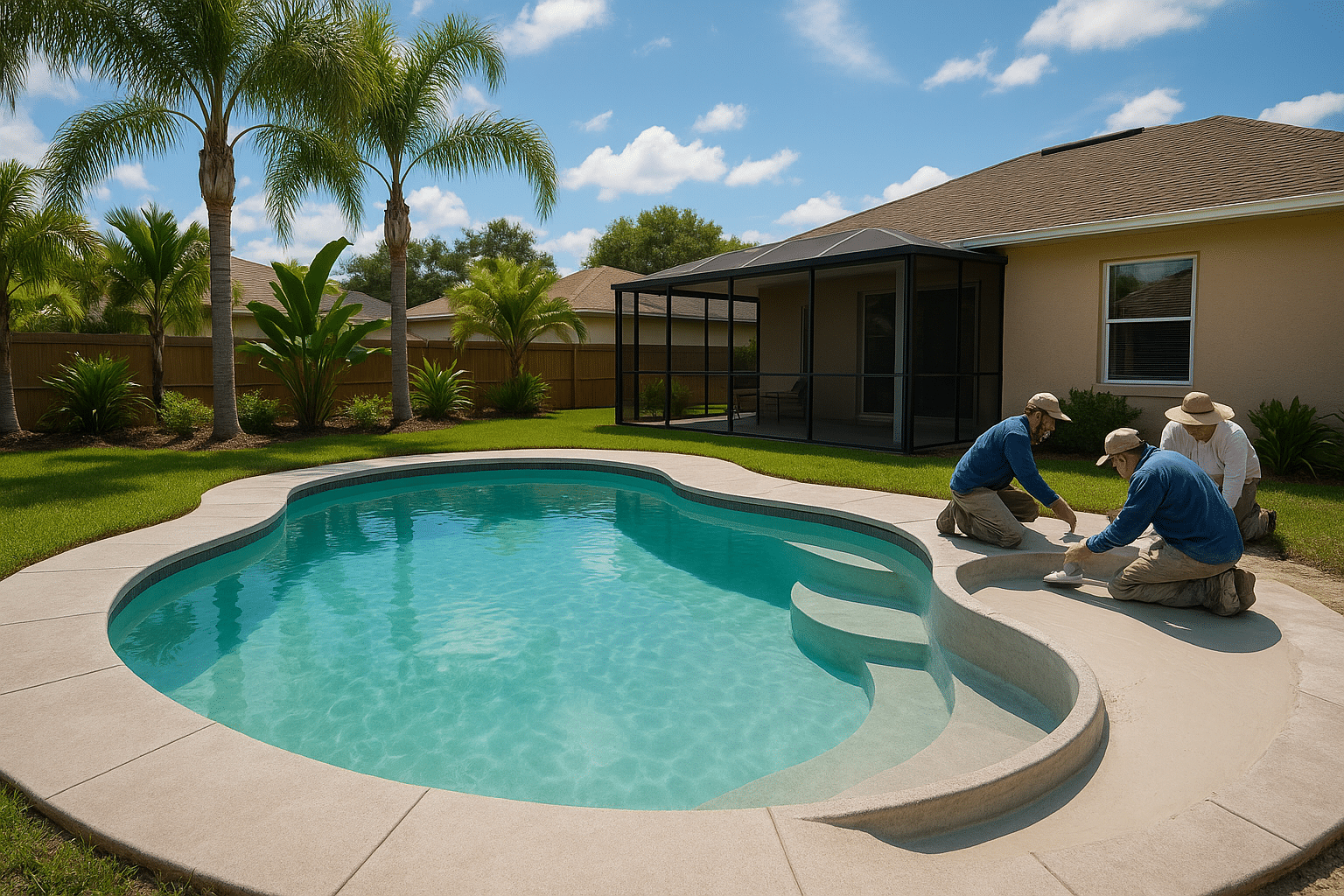
TL;DR: Gunite concrete pools offer unmatched design freedom and a lifespan that can exceed 50 years, making them the go-to choice for large, fully custom backyard projects. The trade-offs are real: longer build timelines (4–6 months), higher ongoing maintenance costs, and a required resurfacing cycle every 8–15 years. This guide covers every major pro and con so Central Florida homeowners can decide with confidence.
If you’ve started researching inground pools, you’ve probably landed on the gunite vs. fiberglass question more than once. Gunite—sometimes called concrete—pools dominate the custom pool market for a reason. But they come with real trade-offs that matter in a Florida yard.
R&R Swimming Pools has built both pool types in Lake County and Central Florida since 1985. Here’s an honest breakdown of every major concrete pool pro and con, backed by industry data.
Comparing both pool types side by side? See our Fiberglass vs. Concrete Pool Cost in Florida guide for a full dollar-for-dollar comparison.
1. PRO: Virtually Unlimited Design Freedom
This is the headline advantage of gunite, and it’s genuine. HomeAdvisor notes that concrete pools offer “unlimited design options” in shape and size, letting you create a truly unique backyard centerpiece.
Want a freeform lagoon with a tanning ledge, a zero-entry beach entry, a vanishing edge, an attached spa, and a swim-up bar? All of it is achievable. Kidney shapes, L-shapes, geometric lap pools, and irregular resort-style designs are all built on-site to your exact specifications.
Fiberglass shells are manufactured in molds, which caps their width at roughly 16 feet and limits depth options. A gunite pool has no such ceiling.
2. PRO: Multiple Finish Options Let You Control the Look
The concrete shell is just the canvas. Once the structure is in place, you choose the interior finish—and the range is wide. Options include standard white plaster, colored plaster, quartz aggregate, pebble finishes (such as Pebble Tec), glass tile, and full ceramic tile.
Each finish carries different aesthetics, price points, and durability. According to HomeGuide, standard plaster lasts roughly 10 years at a lower cost per square foot, while pebble and aggregate finishes can last 20+ years at a higher upfront price—often making them the better long-term financial decision.
3. PRO: Long Structural Lifespan
A well-built gunite shell is genuinely durable. HomeAdvisor reports that concrete pools “are built to last,” with many reaching a lifespan of 50 to 100 years with proper maintenance. That’s a multi-generational asset, not just a backyard feature.
At R&R, our in-house gunite crew builds shells 6 to 12 inches thick—significantly more robust than the industry minimum—and every pool we build carries a limited lifetime shell warranty.
4. PRO: No Width or Depth Restrictions
Fiberglass pools are typically no more than 16 feet wide, which rules out large pools for entertaining. Concrete has no factory-imposed size limits. If your Lake County property can accommodate a 20-by-50-foot pool with a 12-foot deep end for diving, gunite can deliver it. Families who want true lap pools, competitive diving wells, or resort-scale designs will almost always land on gunite.
5. PRO: Works Well in Florida’s Climate (No Freeze Concerns)
One common gunite disadvantage—susceptibility to freeze-thaw cracking—simply doesn’t apply here. In colder climates, builders sometimes need extra steel reinforcement to guard against ice pressure. In Central Florida, that’s not a factor. Our year-round warmth is actually one of the best environments for a concrete pool to perform at its best.
6. CON: Higher Ongoing Maintenance Costs
This is the most important con to understand before signing a contract. Gunite is porous, which means algae can attach to the surface more easily and water chemistry is harder to hold in balance.
According to Latham Pool Products (an industry manufacturer), the 10-year maintenance cost for a gunite pool can run between $15,000 and $27,000—substantially higher than the roughly $4,000 estimated for a fiberglass pool over the same period. The porous nature of concrete means more chemical use, more frequent brushing, and more professional water-balance corrections over time.
Budget for maintenance as a real line item, not an afterthought.
7. CON: Resurfacing Is a Required, Recurring Expense
The gunite shell itself lasts decades, but the interior finish does not. Standard plaster typically needs a full redo every 8–12 years. In the Tampa/Central Florida market, resurfacing a concrete pool runs approximately $6,500 or more per 1,000 square feet of pool surface, according to Angi’s Tampa-area data—so a standard-size pool can cost $10,000–$15,000+ to resurface each cycle.
Upgrading to a pebble or quartz finish at resurfacing time can push that interval to 20+ years and reduce the total number of resurfacing cycles over the pool’s life. Plan for it either way.
8. CON: Longer Build Timeline
Concrete pools are built entirely on-site, layer by layer. The process—excavation, rebar framework, gunite application, curing, plumbing, electrical, finishing, and decking—cannot be rushed without risking structural integrity.
At R&R, our custom gunite projects typically run 4 to 6 months from permit to final walkthrough. By comparison, our fiberglass projects run 2 to 4 months. If you’re planning around a specific season or event, timeline matters—start planning early.
9. CON: Higher Weekly Maintenance Time
The porous, textured surface of a concrete pool demands more hands-on attention than a smooth fiberglass gel coat. Industry data cited by Thursday Pools suggests concrete pool owners may spend around four to five hours per week on maintenance, compared to roughly one hour for fiberglass owners. That’s a meaningful difference for busy families or retirees who want to enjoy the pool, not just manage it.
10. CON: Salt Systems Require Extra Care
Saltwater pools are popular in Florida—and understandably so. But gunite and salt don’t mix without proper precautions. Salt can gradually erode the plaster finish, and if salt crystals sit on the surface without fully dissolving, staining can occur quickly. This doesn’t make a saltwater gunite pool impossible, but it does require more careful water management and may shorten your finish’s lifespan if not handled correctly.
If a low-maintenance saltwater system is your top priority, a fiberglass pool is worth a close look. See our Fiberglass Pool Pros and Cons guide for a full breakdown.
11. CON: Florida Safety Barrier Requirements Apply—Plan Ahead
This isn’t a con of gunite specifically, but it’s a real planning factor for any new pool in Florida. Under Florida Statute 515 (the Residential Swimming Pool Safety Act), every new residential pool must include at least one approved safety feature. The most common is a perimeter barrier (fence) at least 48 inches tall, with a self-closing, self-latching gate.
Budget for the barrier as part of your total project cost. Local Lake County and surrounding municipality requirements may be stricter than the state minimum, so our team handles permitting and code compliance in-house to keep your project on track.
Is a Gunite Pool Right for Your Yard? A Quick Decision Guide
- Choose gunite if: You want a fully custom shape, a large pool (wider than 16 feet), a deep diving end, a beach entry, or a fully integrated outdoor living space with spa and water features.
- Choose gunite if: You’re building for the long haul and plan to stay in the home for 15+ years, making the lifetime shell value worth the higher ongoing costs.
- Consider fiberglass instead if: Lower lifetime maintenance costs, faster installation, and salt-system compatibility are your top priorities.
- Consider fiberglass instead if: Your ideal pool fits within a standard model footprint (up to ~16 feet wide, standard depths).
Not sure which type fits your budget and yard? Our Central Florida Inground Pool Cost Guide breaks down pricing for both pool types so you can plan with real numbers.
How R&R Swimming Pools Builds Gunite Pools in Central Florida
R&R has been building custom gunite concrete pools in Lake County and Central Florida since 1985—over 1,000 pools and spas completed. Our in-house gunite crew applies shells 6 to 12 inches thick, and we handle every phase in-house: design, engineering, permitting, excavation, plumbing, electrical, finishing, and final walkthrough.
Every gunite pool we build carries a limited lifetime shell warranty. Financing is available through Lyon Financial and Viking Capital for qualified buyers.
We serve The Villages, Clermont, Mount Dora, Leesburg, Eustis, Fruitland Park, Lady Lake, Tavares, Minneola, Wildwood, Okahumpka, Groveland, Montverde, Sorrento, Yalaha, Bassville Park, and 30+ surrounding Central Florida communities.
Ready to get started? Contact R&R Swimming Pools for a free design consultation and site evaluation.
Recommended Reads
- Is a Pool Worth It in Florida? Honest Pros, Cons, and ROI
- Fiberglass Pool Pros and Cons Every Florida Homeowner Should Know
- Fiberglass vs. Concrete Pool Cost in Florida: A Side-by-Side Breakdown
