
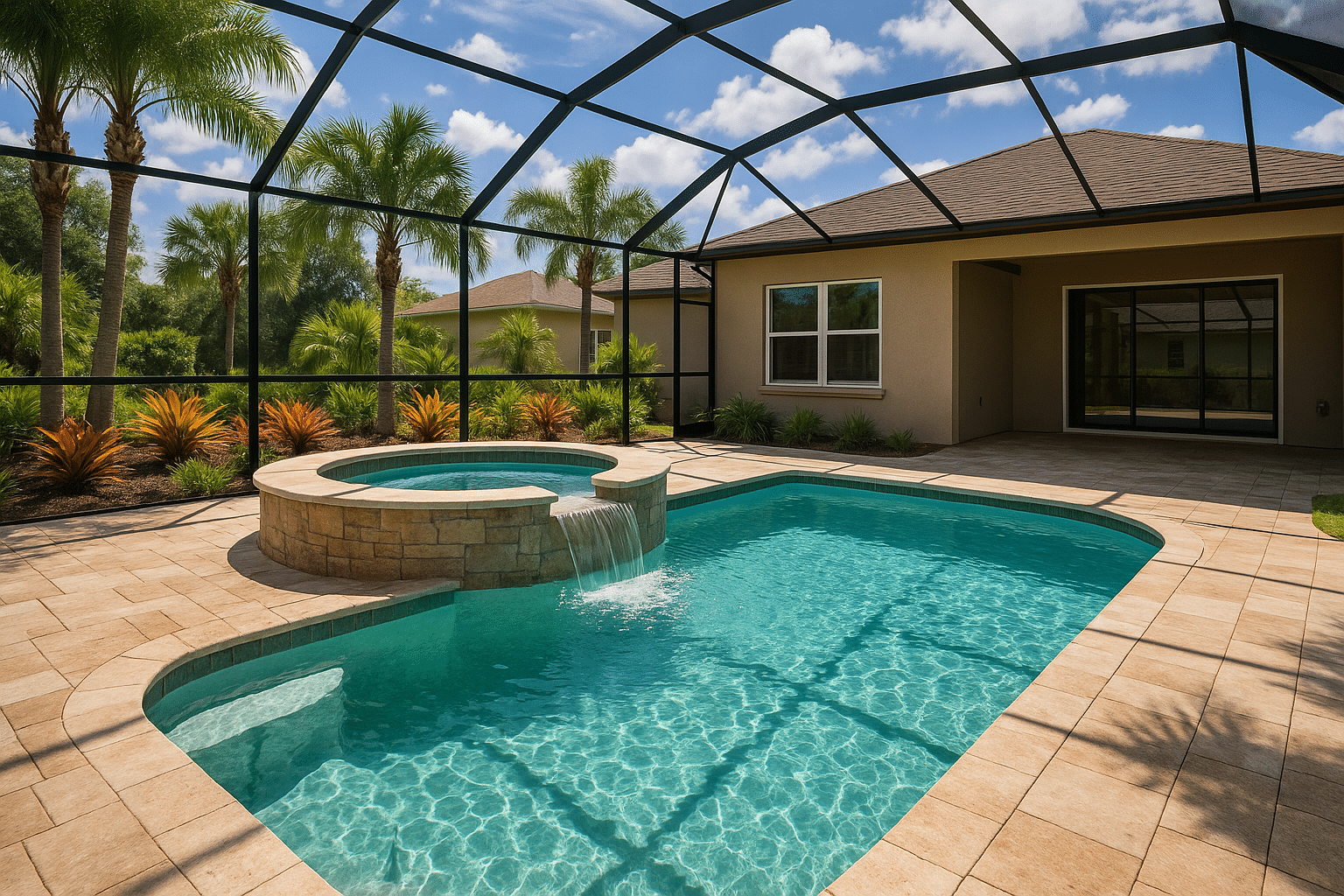
TL;DR: An attached spa combines a heated soaking spa with your swimming pool, sharing equipment and deck space while operating at separate temperatures. In Central Florida, where mild winters make year-round spa use practical, both fiberglass and gunite builds support spa combos, with gunite offering more design flexibility and fiberglass offering a faster, lower-maintenance build. This guide breaks down design options, costs, heating, and when a combo makes sense for your Lake County backyard.
A pool with an attached spa, sometimes called a spool combo or spa-pool combination, pairs a swimming pool with a smaller heated spa that shares the same footprint, equipment pad, and often the same water. For Central Florida homeowners, where warm evenings stretch from March through November, an attached spa turns a seasonal backyard pool into a year-round retreat. This guide explains how pool-and-spa combos work, the design options available, what they cost in Lake County and the surrounding Central Florida market, and how to decide if one is right for your property.
What Is a Pool with an Attached Spa?
An attached spa is a separate heated vessel built directly against (or integrated into) the pool structure, rather than a standalone hot tub placed elsewhere in the yard. The spa typically runs its own heater and plumbing zone so it can reach 100-104°F while the main pool stays in the mid-80s, even though both share a wall, a deck, and often a single equipment pad.
There are two common configurations:
- Spillover spa: Water cascades over a shared wall from the spa into the pool, creating a visual water feature while keeping the two bodies of water thermally separate.
- Attached (non-spillover) spa: The spa sits adjacent to the pool with its own wall and steps, connected by shared decking and equipment rather than overflowing water.
How a Spa Combo Works: Fiberglass vs. Gunite
Both of the shell types R&R builds support attached spas, but the design flexibility differs.
Fiberglass Pool-Spa Combos
As an authorized Latham dealer, we install factory-molded shells that already include an integrated spa in certain collections.
An inground or spillover spa makes a complement for a fiberglass pool, and some fiberglass models, like the Astoria collection, feature a built-in spa.
The Astoria series is a sleek, rectangular fiberglass model with a built-in spa, combining the pool and spa in one shell.
If your heart is set on a model that doesn’t include a spa in the mold,
a spa can be added alongside the pool as a standalone or spillover model.
Fiberglass combos are popular with buyers who want a faster build and lower long-term maintenance. For a deeper cost comparison between shell types, see our fiberglass vs. concrete pool cost breakdown.
Gunite Pool-Spa Combos
Because our in-house gunite crew builds each shell on-site, 6 to 12 inches thick, a concrete spa can be engineered at any elevation, shape, or position relative to the pool — raised, sunken, round, or tucked into a corner. Industry comparisons consistently note that gunite construction allows
integrated spas at any elevation among other custom features like vanishing edges, beach entries, and swim-up bars
that pre-formed fiberglass shells can’t replicate. If you’re planning a highly custom spillover design, a raised spa with a rock waterfall, or a free-form pool shape, gunite is typically the better fit.
Design Options for Central Florida Backyards
- Raised spillover spa — elevated spa wall with water cascading into the pool; strong visual and sound element for entertaining spaces in communities like The Villages or Clermont’s golf-course lots.
- In-line attached spa — spa built flush with the pool at the same deck level, sharing a straight party wall; a practical, lower-cost option for narrower Lake County lots.
- Corner or detached-look spa — positioned at a corner of a free-form gunite pool so it reads as a separate feature while still sharing plumbing and the equipment pad.
- Swim-up or sunken seating near the spa — common in larger gunite builds where the spa doubles as an entertaining bar area.
Why an Attached Spa Makes Sense in Lake County’s Climate
Central Florida’s mild winters are a big part of why combo pools are so popular here. Electric heat pumps, the heating technology most pool builders and energy experts recommend for this climate, pull warmth from the surrounding air rather than generating it, which is why
heat pumps operate efficiently nearly year-round since Florida rarely experiences extremely cold air temperatures.
That means your attached spa can stay in regular rotation well into what passes for a Lake County winter, while the main pool runs on its own schedule.
Many owners pair a heat pump for the pool with a dedicated gas or electric heater sized specifically for the smaller spa volume, since
a higher-capacity heat pump is appropriate for large swimming pools with an attached spa where you want consistent power without pushing the unit hard, making it ideal for large pools and attached spas with the same heater.
Running that equipment efficiently matters: an ENERGY STAR-certified variable-speed pump can cut pump energy use significantly because
reducing pump speed by one-half allows the pump to use just one-eighth as much energy
, which adds up fast when you’re running two heated bodies of water on one pad.
Cost of a Pool with an Attached Spa
Adding a spa increases the overall project cost, but the premium is often smaller than homeowners expect once it’s engineered into the original design rather than bolted on later. Industry pricing data shows that
a fiberglass pool with a bolt-on spa attached costs roughly the same as a gunite pool with an integrated spillover spa, and the gunite version is designed specifically for your lot and positioned relative to the home and sun angle.
In other words, building the spa in from day one — whichever shell type you choose — tends to be more cost-effective than retrofitting one after the fact.
Expect the spa itself to add a meaningful line item for the extra excavation, plumbing, a dedicated heater, and additional equipment, on top of your base pool cost. For current Central Florida pricing ranges on the base pool build, see our inground pool cost guide, and compare how shell material affects your total budget in the fiberglass vs. concrete cost breakdown.
Permits and Timeline in Lake County
A pool-and-spa combo still goes through the same local permitting process as a standalone pool in Lake County and the surrounding municipalities — it just includes an additional heater circuit and plumbing zone on the plans. Our in-house team handles design, engineering, and permitting, so you’re not coordinating between separate contractors. For a full breakdown of what permitting costs and how long it takes locally, see our Lake County pool permit guide.
Build timelines for a combo generally track with the base shell type: fiberglass projects typically run 2 to 4 months, while gunite projects run 4 to 6 months, since the spa wall, spillover detailing, and extra plumbing are built into the same construction sequence rather than added afterward.
Pros and Cons of an Attached Spa
Pros
- Independent temperature control lets you soak at 100°F+ without heating the whole pool.
- Shared equipment pad and plumbing keep the project more efficient than a separate standalone spa.
- Extends usable backyard time into cooler months, especially with a heat pump sized correctly for Florida’s mild winters.
- Adds a strong visual and resale feature, particularly with a spillover design.
Cons
- Higher upfront cost than a pool alone, due to extra excavation, plumbing, and a second heater.
- A dedicated spa heater adds another piece of equipment to maintain long-term.
- Retrofitting a spa onto an existing pool later is usually more expensive than building it in from the start.
Is a Pool and Spa Combo Worth It?
For retirees and active-adult community residents in places like The Villages or Fruitland Park, a spa that stays usable through the cooler months often gets more daily use than the pool itself. For families with young kids, the spa doubles as a shallow, contained soaking area while the kids swim laps or play in the main pool. If you’re still weighing whether a pool pencils out for your household at all, our pool ROI and value guide walks through the honest pros and cons before you commit to a combo design.
Financing is also available for the full combo project through Lyon Financial and Viking Capital, so the spa addition can be rolled into one loan rather than financed separately. Details on how that process works are in our pool financing guide.
Serving Lake County and Central Florida
R&R Swimming Pools has built custom inground pools and spas across Lake County and Central Florida since 1985, including The Villages, Clermont, Mount Dora, Leesburg, Eustis, Fruitland Park, Lady Lake, Tavares, Minneola, Wildwood, Okahumpka, Groveland, Montverde, Sorrento, Yalaha, and Bassville Park, with additional projects reaching Ocala, Belleview, Summerfield, Silver Springs, and Webster. Whether you want a factory-built Latham fiberglass combo or a fully custom gunite spillover spa, our in-house design, permitting, and construction crew handles the entire project from first sketch to final walkthrough.
FAQ
Recommended Reads
- Fiberglass vs. Concrete Pool Cost in Florida: A Side-by-Side Breakdown
- How Much Does an Inground Pool Cost in Central Florida? (2025 Pricing Guide)
- How to Finance a Pool in Florida: Loan Options, Lenders, and What to Expect
