

TL;DR:
- Pool coping serves essential structural, safety, and aesthetic functions, protecting the pool from water infiltration and providing a safe edge for swimmers. Proper installation with flexible expansion joints and regular maintenance of sealant are critical to prevent costly failures and lasting damage. Decades of experience show that treating coping as a structural component and choosing the right materials and profiles ensure durability and visual harmony.
Most homeowners assume pool coping is just the decorative trim that makes a pool look finished. That assumption ends up costing them thousands of dollars. The role of pool coping goes far beyond aesthetics. It protects your pool’s structure from water infiltration, gives swimmers a safe gripping edge, and creates the visual transition between water and deck that defines how your entire backyard looks. Understanding what pool coping actually does, before you build or renovate, puts you in a much stronger position to make smart decisions about materials, style, and long-term maintenance.
Table of Contents
- Key takeaways
- The role of pool coping: what it is and why it matters
- Popular pool coping styles and what they look like
- Installation best practices that prevent costly failures
- Maintenance essentials and troubleshooting coping problems
- My honest take on pool coping after decades in this industry
- Ready to get your pool coping right from the start?
- FAQ
Key takeaways
| Point | Details |
|---|---|
| Coping protects pool structure | It seals the bond beam and prevents water from penetrating the pool shell. |
| Safety is a core function | A properly profiled coping edge gives swimmers a reliable grip when entering or exiting. |
| Style affects the whole backyard | Coping choice sets the visual tone for how your pool integrates with your home and deck. |
| Rigid connections cause failure | Coping and deck must be separated by a flexible expansion joint, not bonded together. |
| Maintenance is on a schedule | Expansion joint sealant needs inspection and replacement every 3 to 5 years. |
The role of pool coping: what it is and why it matters
Pool coping is the cap material that sits along the top edge of your pool’s bond beam. The bond beam is the uppermost structural element of the pool shell, whether it’s concrete or fiberglass. Coping covers and protects that beam while creating the finished edge between the pool water and the surrounding deck.
The three primary functions of pool coping are protecting the pool from water infiltration, providing a safe grip for swimmers, and defining the visual transition between pool and deck. Each of those functions is doing real work every day.
Structural protection is the most underappreciated function. When water gets behind the pool wall, it can erode the shell, cause freeze-thaw damage in climates that see temperature swings, and compromise the bond beam over time. Properly installed coping creates a seal that directs water away from the pool structure rather than into it.
Safety is the second function, and it’s one most homeowners never consider until something goes wrong. The coping edge is where swimmers grip when they’re treading water, pulling themselves out, or catching themselves on the edge. A rounded, textured, or slightly beveled edge makes that interaction safe. A sharp or slippery edge does not.
Aesthetics rounds out the trio. The coping line is the most visible design element of any pool. It’s the first thing the eye goes to when looking at a pool from across a yard. It frames the water and connects the pool to the deck and surrounding hardscape.
Common materials used for pool coping include:
- Natural stone (travertine, limestone, bluestone): Known for durability and a high-end look
- Precast concrete: Cost-effective, available in many profiles, and consistent in color and shape
- Porcelain pavers: Low maintenance and resistant to fading and staining
- Brick: Classic look, widely used in traditional home styles
- Composite and poured-in-place concrete: Budget-friendly options with good customization potential
Pro Tip: If you’re building in Central Florida, travertine is one of the most popular natural stone options because it stays cooler underfoot than dense materials like granite, which matters when your deck gets direct sun for eight hours a day.
Popular pool coping styles and what they look like
The profile of your coping, meaning its cross-sectional shape, affects both safety and visual style. Choosing the right profile is one of the more consequential decisions in the whole pool design process.
Bullnose vs. modern edge profiles
Bullnose coping has a fully rounded edge that rolls over the pool wall. It’s been the standard for decades, and it’s genuinely comfortable to grip. But bullnose is falling out of favor for modern pools because its rounded, heavy profile clashes with the clean lines that define contemporary architecture.
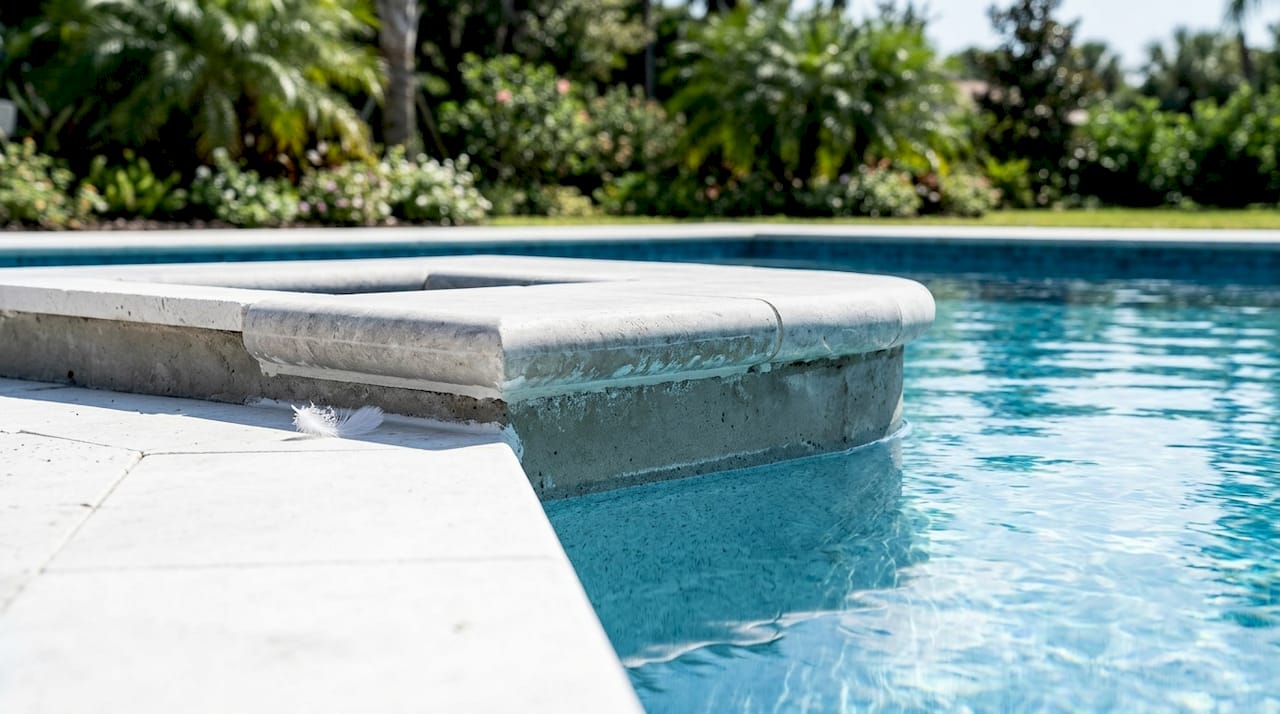
The industry is clearly moving toward eased-edge and drop-edge profiles. An eased edge has a gently softened corner rather than a full curve, giving a clean, geometric look while still being safe to the touch. A drop edge, sometimes called a cantilever or raised edge, extends past the pool wall and creates a shadow line below it. That shadow line makes the water look deeper and gives the whole pool a more refined, architectural appearance.
| Profile | Visual Style | Best For | Trade-off |
|---|---|---|---|
| Bullnose | Traditional, rounded | Classic home styles | Visually heavy, outdated look |
| Eased edge | Clean, geometric | Modern and transitional homes | Less grip than bullnose |
| Drop edge | Architectural, refined | Contemporary designs | More complex installation |
| Cantilevered deck | Seamless, minimal | Minimalist pools | Requires precise forming |
Material and style pairing
Travertine and limestone pair naturally with drop-edge profiles because their texture softens the sharp geometric look. Precast concrete works well with bullnose for traditional builds. For a modern build, porcelain pavers in a large format with an eased edge create a look that ties the pool to the home’s indoor tile and flooring in a way that feels intentional. Knowing how to choose pool materials for your region and home style will narrow your options considerably before you even talk to a contractor.
Installation best practices that prevent costly failures
Good coping looks identical to bad coping on day one. The difference shows up at year two or year five, when stones start to shift, tiles crack, or water damage appears in the pool shell. Installation quality is everything.
The most critical rule: never bond coping to the deck
Coping and deck must never be rigidly connected. This is where most DIY and low-quality installations fail. Concrete decks expand and contract with temperature changes. If your coping and your deck are bonded together, that movement causes cracking, loosening, and eventually structural failure. A flexible, pool-grade expansion joint between the two elements acts as a shock absorber, letting each section move independently.
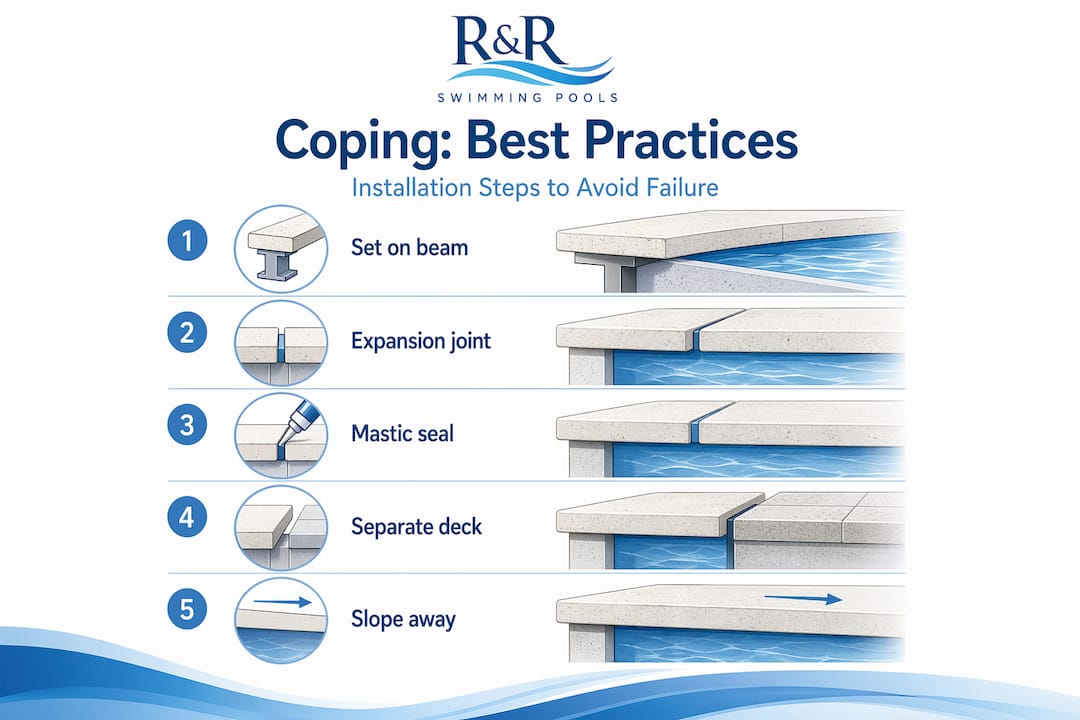
Expansion joints must use pool-grade mastic, specifically polysulfide or polyurethane sealant, not standard caulk. Standard caulk degrades quickly in pool environments and offers none of the flexibility required.
Step-by-step installation overview
- Prepare the bond beam by cleaning it thoroughly and removing any debris, old mortar, or loose material.
- Apply polymer-modified mortar in a controlled bed between 1/2 and 3/4 inch thick. Too thick and you risk shrinkage cracks in the mortar bed.
- Set coping stones or units with consistent spacing and level alignment, pressing firmly into the mortar.
- Allow full cure time before any foot traffic or deck work begins.
- Install the expansion joint between the coping edge and the adjacent deck using pool-grade mastic sealant.
- Slope the deck correctly: pool decks should slope at least 1/4 inch per foot away from the pool edge to direct water away from the coping joint.
Pro Tip: Ask any contractor you’re considering to show you how they handle the expansion joint. A contractor who plans to use standard caulk or mortar across the joint doesn’t understand modern installation standards. Walk away.
| Coping type | How it’s installed | Best use case |
|---|---|---|
| Bonded coping | Set with mortar on bond beam | Natural stone, precast units |
| Poured-in-place | Formed and poured as part of deck | Custom shapes, budget builds |
| Cantilevered deck | Deck overhangs pool wall with no separate unit | Minimalist modern designs |
When decks slope incorrectly, flat or tilted inward, water back-ponds against the coping and accelerates erosion and joint failure. This is a preventable error that shows up in pool renovations constantly.
Maintenance essentials and troubleshooting coping problems
Once your coping is installed correctly, it needs periodic attention. Ignoring it leads to the most common pool repair issues contractors see.
The expansion joint sealant is your first maintenance priority. Mastic sealant lasts 3 to 5 years before it begins to harden, crack, and lose its flexibility. Once it fails, water infiltrates the joint, erodes the material beneath, and the coping stones start to shift. Replacement is straightforward when caught early. When ignored for years, you’re often looking at full coping removal and reset.
Watch for these signs that your coping needs attention:
- Coping stones that rock or feel loose when you step on them
- Visible gaps or cracks in the joint between coping and deck
- Dried-out or crumbling sealant along the expansion joint line
- Waterline tile cracks or delamination, which often trace back to coping movement
- Staining or efflorescence on the coping surface, which can indicate water is moving through the material
A failed mastic expansion joint is the single most common cause of coping stones coming loose. It’s also the most preventable. Budget for joint inspection every three years and replacement every five as standard operating procedure.
For repairs beyond sealant replacement, always hire a contractor with documented experience in pool coping work specifically. General concrete contractors often lack the knowledge of pool-grade materials and the critical relationship between coping and waterline tile. The cost factors for pool projects vary widely based on material and scope, but catching small coping failures early almost always costs less than the structural repairs that follow delayed action. Labor for a standard coping installation typically runs $600 to $1,600 per project, and targeted maintenance stays well below that.
My honest take on pool coping after decades in this industry
I’ve watched homeowners spend $60,000 on a beautiful pool and then cut corners on coping installation to save a few hundred dollars. Within three years, they’re back paying for repairs that cost more than the savings. That pattern repeats itself constantly, and it comes from not understanding what coping is actually doing.
What I’ve learned is that the homeowners who get coping right are the ones who treat it as structural, not cosmetic. They choose a contractor who talks about expansion joints and mortar thickness before talking about colors and profiles. Those conversations are the sign of someone who knows what they’re doing.
I’ve also seen the design side go wrong in the other direction. People choose a coping style because it looks great in a photo without asking whether it suits the home’s architecture or the way they actually use the pool. A drop-edge profile looks stunning on a contemporary home with clean lines. On a traditional brick home surrounded by lush landscaping, it can look out of place. The best coping decisions combine technical soundness with design honesty about what the house actually calls for.
The expansion joint question is the one I’d drill home to any homeowner. If your contractor skips it or minimizes it, you’re not getting a pool that will hold up. Every other element of the project depends on that flexible connection doing its job through years of temperature cycles.
— Randrswimmingpools
Ready to get your pool coping right from the start?
Understanding the role of pool coping is the first step. The second step is working with a team that has the experience to do it correctly from day one.

R and R Swimming Pools has been building custom inground pools across Central Florida since 1985, and coping installation is one of the details we treat as non-negotiable. Whether you’re starting a new pool project or renovating an older one, our team brings the technical knowledge and design experience to get both the structure and the aesthetics right. Read our inground pool installation guide to understand the full process, or explore pool remodeling options if you’re upgrading an existing pool. Contact us for a free consultation and let’s build something that holds up for decades.
FAQ
What is pool coping and what does it do?
Pool coping is the cap material installed along the top edge of a pool’s bond beam. It protects the pool structure from water infiltration, provides a safe gripping edge for swimmers, and defines the visual transition between the pool water and the surrounding deck.
What are the most popular pool coping styles right now?
Modern pools favor eased-edge and drop-edge profiles over traditional bullnose because they create a cleaner, more architectural look. Natural stone, porcelain pavers, and precast concrete are the most widely used materials across all styles.
How often does pool coping need maintenance?
The expansion joint sealant between coping and deck should be inspected every three years and replaced every five. A failed sealant is the most common cause of coping stones coming loose and water damage to the pool structure.
Can I install pool coping as a DIY project?
It’s not recommended. Proper coping installation requires controlled mortar bed thickness, pool-grade expansion joint materials, and precise deck slope to prevent premature failure. Mistakes at the installation stage cause structural damage that costs far more to fix than professional installation would have.
Why do coping stones come loose over time?
The most common cause is a failed or missing expansion joint between the coping and the pool deck. When the joint degrades, thermal expansion forces the coping to move and crack, eventually loosening the stones from the mortar bed below.
