
TL;DR:
- Hard water in Central Florida pools often exceeds 200 ppm calcium hardness, leading to persistent scaling issues. Managing this requires regular testing, pH control, sequestrant use, and periodic partial drainage or reverse osmosis treatment. Consistent, early intervention prevents damage to surfaces and equipment caused by high mineral levels.
Hard water in Central Florida pools is defined by calcium hardness levels that routinely reach 200–450 ppm in local source water, well above the EPA’s 120 ppm hard water threshold. That range creates a persistent scaling problem that no single chemical product can fully solve. The Floridan Aquifer, which supplies most of the region’s municipal and well water, dissolves calcium and magnesium from limestone bedrock before the water ever reaches your pool. For Central Florida homeowners, understanding calcium hardness, the Langelier Saturation Index (LSI), and the right treatment sequence is the difference between a clean pool and one coated in white crust.
What causes hard water in Central Florida pools?
The Floridan Aquifer system is the root cause of elevated mineral levels across the region. This massive underground aquifer sits beneath porous limestone bedrock, and as water moves through it, the rock dissolves and releases calcium and magnesium ions into the water supply. By the time that water reaches your tap or well, it already carries a significant mineral load.
Several factors push calcium levels even higher once the water is in your pool:
- Evaporation: Central Florida’s heat and sun cause water to evaporate constantly, but the minerals stay behind. Evaporation concentrates minerals steadily year-round, meaning calcium levels climb even when you never add a drop of calcium product.
- Municipal vs. well water variation: Well water in Lake County, Orange County, and surrounding areas often tests harder than municipal supplies. Seasonal shifts in water table levels also change the mineral content of source water.
- Frequent top-offs: Every time you refill the pool to replace evaporated water, you add a fresh dose of minerals. Over weeks and months, this compounds the problem significantly.
- Splash-out and backwash replacement: Replacing lost water with hard source water repeats the mineral loading cycle with every refill.
The net result is that calcium hardness in Central Florida source water starts at 200–450 ppm before any evaporation or top-off cycles occur. A pool that starts at the high end of that range will exceed safe limits faster than most homeowners expect.
What are the effects of hard water on pool surfaces and equipment?
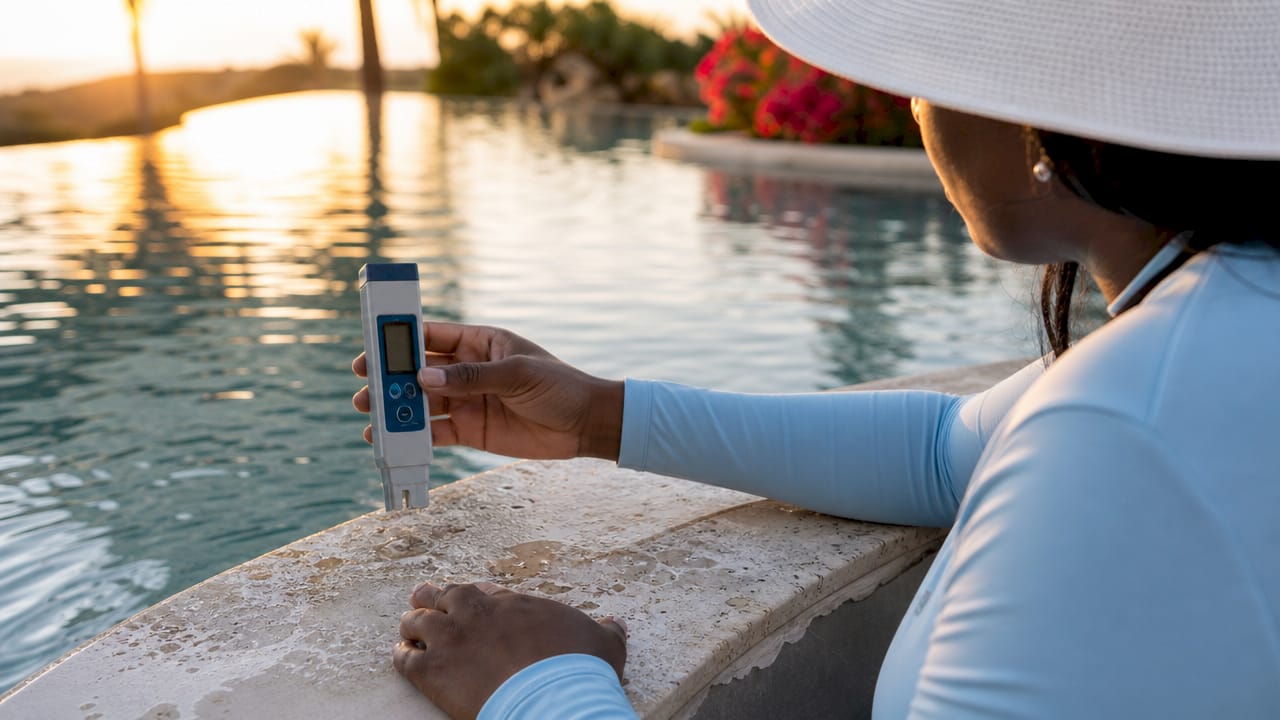
High calcium hardness causes calcium carbonate scaling, the white, crusty deposits that form on tiles, return jets, and pool surfaces when water becomes oversaturated. Calcium carbonate scale appears most aggressively after a rise in pH, because higher pH reduces calcium’s ability to stay dissolved. A single pH spike after a heavy rain or chemical addition can trigger visible deposits within days.
The physical and chemical consequences extend well beyond aesthetics:
- Tile and grout damage: Scale bonds tightly to porous grout and ceramic tile surfaces. Removing it requires acid washing or mechanical scrubbing, both of which wear down surfaces over time.
- Clogged return jets and filter media: Calcium deposits narrow jet openings and coat filter sand or cartridge media, reducing flow rate and forcing your pump to work harder.
- Heater and heat pump damage: Scale inside heat exchanger tubes acts as insulation, reducing efficiency and eventually causing overheating failures.
- Plaster pitting and staining: Calcium deposits embedded in plaster create rough patches that trap algae and accelerate surface wear.
The opposite extreme is equally damaging. Calcium hardness below 150 ppm produces corrosive water that leaches calcium directly from plaster, grout, and metal fittings. Corrosive water etches pool surfaces, pits concrete, and corrodes copper heat exchanger components. Maintaining calcium hardness in the 200–400 ppm range is not optional. It is the boundary between a pool that lasts decades and one that deteriorates prematurely.
Pro Tip: Check your tile line first when diagnosing a water chemistry problem. White, chalky buildup at the waterline is almost always calcium carbonate scale, and it tells you the water has been oversaturated, likely for weeks.
Good pool filtration slows the rate at which scale clogs your system, but it cannot compensate for chronically unbalanced water chemistry.
How can Central Florida homeowners test and monitor hard water levels?
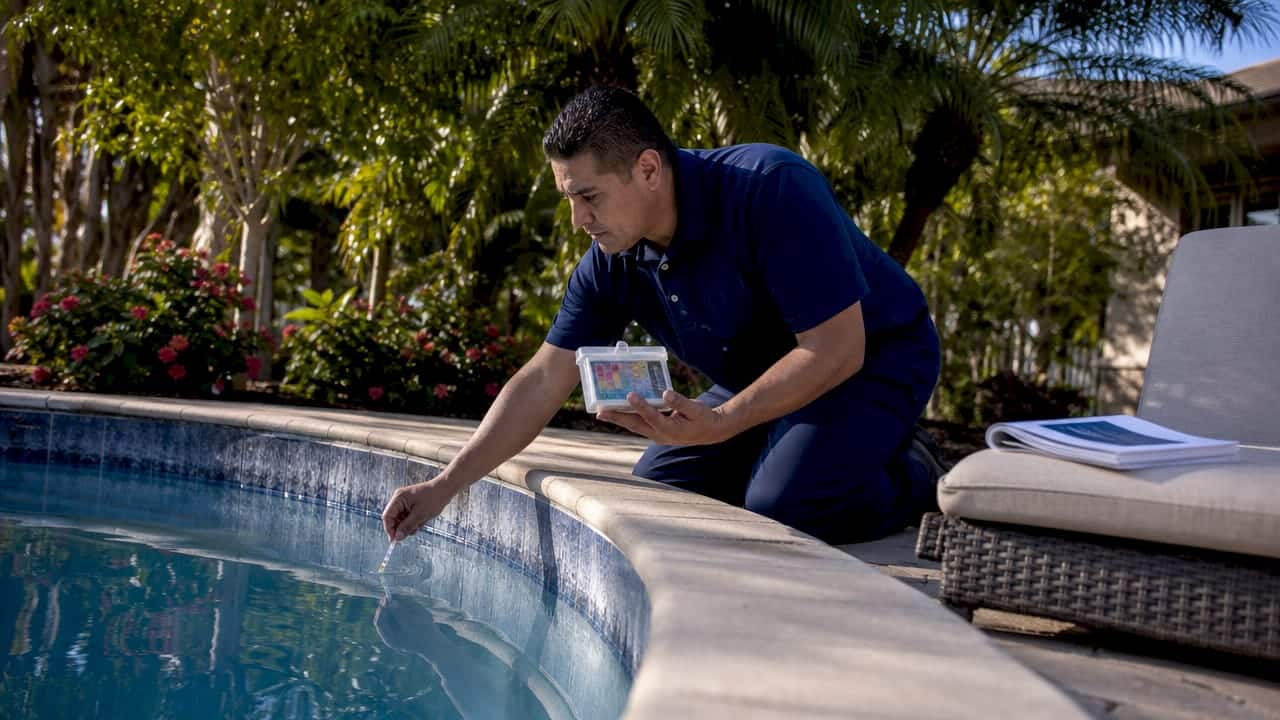
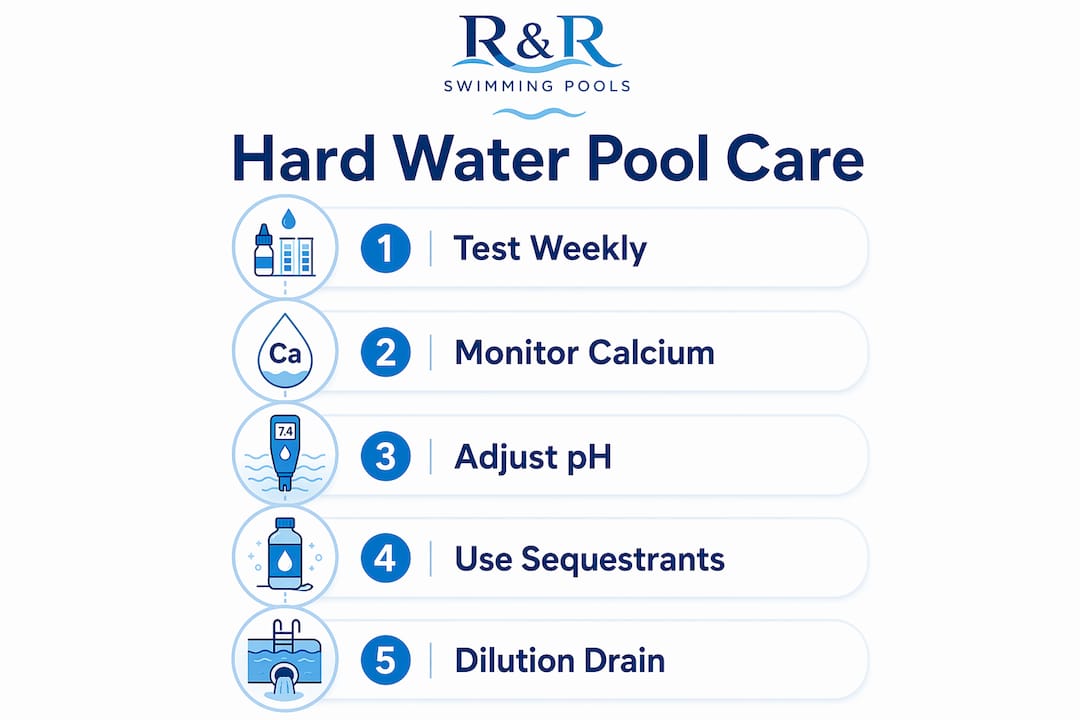
Florida pool water testing is the foundation of hard water management. Without accurate, frequent measurements, you are reacting to visible damage rather than preventing it. The Pool & Hot Tub Alliance recommends testing pool water at least weekly during swim season, and Central Florida’s climate makes biweekly testing the more reliable standard.
Follow this testing sequence to stay ahead of scaling:
- Test calcium hardness using a reliable drop-based test kit or a digital photometer. Strip tests are not accurate enough for calcium hardness readings. Target the 200–400 ppm range.
- Test pH and keep it between 7.4 and 7.6. pH above 7.8 dramatically increases scaling risk, especially in already-hard water.
- Test total alkalinity and maintain it at 80–120 ppm. Alkalinity buffers pH swings and directly affects how stable your calcium levels remain.
- Calculate the LSI (Langelier Saturation Index). The LSI combines calcium hardness, pH, alkalinity, temperature, and total dissolved solids into a single balance score. An LSI between 0 and +0.3 indicates balanced water. Above +0.3, scaling is likely. Below 0, the water is corrosive.
- Record every test result with a date. Tracking trends over weeks reveals how fast your calcium levels climb and helps you time interventions before problems develop.
Routine testing weekly or biweekly with attention to calcium hardness, pH, and total alkalinity is the standard practice for preventing scaling in hard water conditions.
Pro Tip: Test your source water before adding it to the pool. Knowing the calcium hardness of your fill water tells you exactly how much mineral load each top-off adds, so you can plan ahead instead of reacting.
Connecting your testing routine to your pool maintenance schedule makes it easier to catch rising calcium levels before they cross into scaling territory.
What treatment strategies work best for hard water pool maintenance?
Treating hard water in a pool requires understanding one critical fact: no chemical additive removes dissolved calcium. Products marketed as calcium reducers do not lower calcium hardness. Only dilution or professional reverse osmosis treatment can actually reduce calcium concentration. Every other chemical approach manages the symptoms rather than the source.
Chemical management approaches
Sequestering agents, also called chelants, keep calcium suspended in solution rather than allowing it to precipitate out as scale. They are effective long-term management tools, but they require strict pH and LSI control to work properly. If pH drifts above 7.8 while using a sequestrant, calcium can still drop out of solution and form deposits. Sequestrants also degrade over time and need regular re-dosing, typically monthly.
Maintaining pH between 7.4 and 7.6 and alkalinity between 80 and 120 ppm reduces the driving force behind scale formation. These adjustments do not remove calcium, but they keep it dissolved and stable.
Mechanical dilution
| Situation | Recommended action |
|---|---|
| Calcium hardness 200–400 ppm | Maintain with pH/alkalinity control and sequestrants |
| Calcium hardness 400–500 ppm | Increase testing frequency; add sequestrant; monitor LSI closely |
| Calcium hardness above 500–600 ppm | Partial drain and refill of 25–50% of pool volume |
| Calcium hardness below 150 ppm | Add calcium chloride to raise levels into safe range |
When calcium hardness exceeds 500–600 ppm, a partial drain and refill of 25–50% of pool volume is the most reliable way to dilute minerals. Drain during cooler months when possible to reduce evaporation during the refill process. Always retest immediately after refilling.
Reverse osmosis treatment
Reverse osmosis (RO) pool treatment uses a mobile filtration unit that recirculates pool water through a membrane, removing calcium, total dissolved solids, and other minerals without draining the pool. RO is the most thorough treatment available for severely hard water. It preserves your existing water chemistry balance better than a full drain and refill, and it eliminates the risk of introducing fresh hard water from the source. The trade-off is cost. RO service is more expensive than a partial drain, but it is worth considering when calcium levels are extreme or when water restrictions limit draining.
Preventative habits reduce how often you need mechanical intervention:
- Top off with the lowest-hardness water available, such as rainwater collection where permitted.
- Run your pool pump during cooler overnight hours to slow evaporation-driven concentration.
- Brush pool surfaces weekly to prevent scale from bonding permanently.
- Keep your pool’s filtration system clean and operating at full flow rate to reduce mineral deposit opportunities.
How to build hard water management into your regular pool care routine
Sustainable hard water management works best when it runs on a schedule rather than a reaction. Central Florida’s year-round swimming season means there is no off-season to reset your water chemistry. Calcium levels build continuously, so your maintenance routine needs to account for that reality every month.
A practical routine looks like this:
- Weekly: Test pH, alkalinity, and chlorine. Adjust as needed. Brush walls and tile line.
- Biweekly: Test calcium hardness and calculate LSI. Add sequestrant dose if calcium is above 350 ppm.
- Monthly: Inspect tile line and return jets for early scale deposits. Clean filter cartridge or backwash sand filter.
- Quarterly: Pull a full water chemistry panel including total dissolved solids and cyanuric acid. Evaluate whether a partial drain is approaching.
- Annually: Have a professional assess surface condition, equipment performance, and water history. Randrswimmingpools recommends this review as part of any long-term pool ownership plan.
Evaporation in Central Florida’s climate silently concentrates calcium levels over time, making frequent testing beyond seasonal start-up checks a necessity rather than a precaution. Homeowners who test only at the start of summer routinely find calcium levels well above 500 ppm by fall.
Connecting hard water care with your sanitation program also matters. High calcium and high pH reduce chlorine effectiveness, so a pool with scaling problems often also struggles with algae. Keeping water balanced across all parameters, not just calcium, produces consistently clear, safe water. The pool maintenance importance guide for Central Florida covers the full picture of how these chemistry factors interact.
When calcium levels are extreme, surfaces show pitting, or equipment is failing, professional diagnosis is the right call. A pool professional can test total dissolved solids, evaluate equipment wear, and recommend RO treatment or a partial drain with precision that guesswork cannot match.
Key takeaways
Hard water management in Central Florida pools requires combining regular LSI-based testing, sequestrant use, and mechanical dilution when calcium hardness exceeds 500 ppm.
| Point | Details |
|---|---|
| Know your baseline | Central Florida source water starts at 200–450 ppm calcium hardness before evaporation adds more. |
| Test frequently | Test calcium hardness biweekly and calculate LSI to catch scaling conditions before deposits form. |
| Chemicals manage, not remove | Sequestrants and pH control prevent scale but cannot lower calcium; only dilution or RO does that. |
| Act at 500 ppm | Drain and replace 25–50% of pool volume when calcium hardness exceeds 500–600 ppm. |
| Build a routine | Weekly brushing, monthly filter checks, and quarterly full panels keep hard water from compounding. |
Why most homeowners underestimate hard water until it’s too late
The most common mistake I see is homeowners treating hard water as a cosmetic issue. They scrub the tile line, add a clarifier, and consider the problem solved. It is not. The scale on your tiles is a symptom. The real damage is happening inside your heater, inside your filter, and on the surface of your plaster where you cannot see it.
Central Florida’s water is genuinely different from what most pool care guides assume. Generic advice written for pools in the Midwest or Pacific Northwest does not account for an aquifer that delivers water already at the upper edge of the ideal calcium range. By the time a typical homeowner notices a problem, calcium levels have often been elevated for months.
The other misconception I encounter constantly is the belief that adding a chemical product will bring calcium down. It will not. I have seen homeowners spend money on products that promise to “reduce hardness” without any measurable effect on calcium levels. The only tools that actually work are dilution and reverse osmosis. Everything else is maintenance, not correction.
What actually works is consistency. Test biweekly. Keep pH tight between 7.4 and 7.6. Add sequestrant monthly. Drain 25–50% of your water when calcium climbs above 500 ppm. That routine is not complicated, but it requires discipline. The pools I have seen hold up best over 10 and 20 years are not the ones with the most expensive equipment. They are the ones with owners who tested regularly and acted early.
— Results
How Randrswimmingpools supports Central Florida pool owners
Randrswimmingpools has been building and servicing pools across Central Florida since 1985, which means the team understands the region’s water chemistry challenges from the ground up. Hard water is not a surprise to them. It is a standard part of every pool design and maintenance conversation they have with homeowners.
Whether you are managing an existing pool with scaling problems or planning a new build, R and R Swimming Pools brings decades of local expertise to the table. Their inground pool installation guide covers water chemistry considerations from day one, so your pool starts with the right foundation. For homeowners dealing with severe scaling or surface damage, their team can evaluate whether a renovation or professional water treatment is the right next step. Reach out to Randrswimmingpools for a free consultation and get advice built specifically for Central Florida conditions.
FAQ
What is considered hard water in a Florida pool?
Hard water in a Florida pool is water with calcium hardness above 400 ppm. Central Florida source water commonly arrives at 200–450 ppm, meaning many pools start near or above the upper limit of the ideal 200–400 ppm range.
Can I add a chemical to lower calcium hardness in my pool?
No chemical product lowers calcium hardness. Only diluting pool water through a partial drain and refill, or using professional reverse osmosis treatment, can reduce actual calcium concentration.
How often should I test my pool water for hard water issues?
Test calcium hardness and calculate the LSI at least biweekly in Central Florida. Weekly testing of pH and alkalinity is the minimum standard for preventing scaling in a hard water environment.
What does calcium carbonate scale look like on a pool?
Calcium carbonate scale appears as white, chalky, or crusty deposits on tile, return jets, and pool surfaces. It forms most visibly at the waterline and after pH rises above 7.8.
When should I call a professional for hard water problems?
Call a professional when calcium hardness exceeds 500 ppm, when scale deposits appear on equipment or surfaces, or when your LSI stays above +0.3 despite chemical adjustments. A professional can assess whether partial draining or reverse osmosis treatment is the right solution.
