

TL;DR:
- Creating a detailed, signed scope of work with attached plans ensures clear expectations and legal protection in pool construction projects. Payments tied to verified milestones and written change orders help prevent scope creep and disputes. Verifying contractor licenses and insurance before signing minimizes risk and ensures compliance with Florida law.
A custom pool scope of work is the contract section that specifies exactly what will be built, which materials will be used, who is responsible for each phase, and what triggers each payment. Before you sign anything, demand that a signed, dated set of plans be physically attached to the contract as Exhibit A.
Here is what to do right now:
- Demand detailed drawings attached. Signed and dated plans attached to the contract are the strongest protection you have. If the contractor cannot hand you stamped engineering drawings before signing, the scope is not ready.
- Require milestone-based draws with conditional lien waivers. Every payment must be tied to a verifiable, completed construction event, not a calendar date. Require a conditional lien waiver from the contractor, subcontractors, and suppliers at each draw.
- Get a signed change-order procedure in writing. Any deviation from the signed scope must go through a written change order with line-item pricing before work begins.
- Request the scope exhibit and review it line by line against the checklist in this guide.
- Ask for a sample change-order clause and confirm it requires your written approval before any extra cost is incurred.
Pro Tip: Ask the contractor to show you the license number and certificate of insurance before your first meeting ends. Both should appear as attached exhibits in the final contract, per Florida contractor licensing requirements.
Table of Contents
- What should a custom pool scope of work cover phase by phase?
- Who is responsible for what, and what gets excluded?
- How should payments and milestones be structured?
- How do you control cost creep with change orders?
- What timeline and cost factors should you expect?
- A copyable scope of work template you can attach to a contract
- Red flags, questions to ask, and pitfalls to avoid
- Key Takeaways
- Why experienced builders actually want a detailed scope
- Randrswimmingpools makes the scope process straightforward
- Useful sources and where to check state rules
What should a custom pool scope of work cover phase by phase?
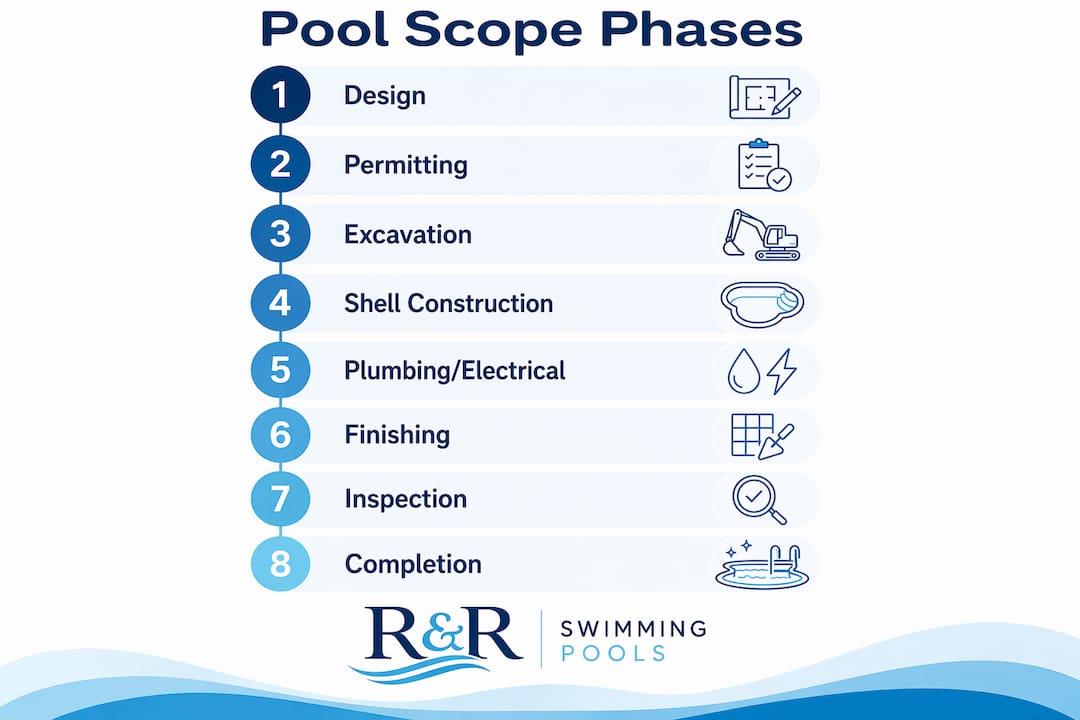
A thorough swimming pool work scope breaks the project into discrete phases, each with its own deliverables, acceptance criteria, and responsible party. Use this checklist to verify that your contractor’s document covers every stage.
Phase 1: Design and documentation
- Signed and dated architectural drawings attached to the contract (plan view, elevation, cross-section)
- Engineered structural plans stamped by a licensed engineer
- Equipment schedule listing brand, model number, and specifications for every mechanical component
- Material selections documented with manufacturer name, product line, color code, and finish code
- Site survey and soil report attached as exhibits
Acceptance criteria: Stamped engineering drawings dated and signed; all material selections confirmed in writing before permit submittal.
Phase 2: Permits and approvals
- Contractor submits building permit application to the local authority having jurisdiction (AHJ)
- Electrical permit pulled separately if required by local code
- HOA approval (see responsibilities section below)
- Permit placard posted on site before excavation begins
Acceptance criteria: Permit number recorded in the scope; no excavation starts without posted permit.
Phase 3: Site preparation and excavation
- Irrigation capping and landscaping removal (confirm which party is responsible)
- Pool layout staked and string-lined; elevations set with laser level
- Excavation to specified dimensions and depth (state exact dimensions in the scope)
- Dirt removal and grading per local drainage standards
- Stabilization rock installed if required by soil conditions
Acceptance criteria: Excavation dimensions verified against stamped plans; county or city inspection passed before steel placement.
Phase 4: Steel and structural work
- Rebar placed to engineered specification (e.g., commonly used rebar with appropriate spacing).
- Pre-plumbing rough-in installed before shell shoot
- Structural inspection by AHJ passed and documented
Phase 5: Shell installation
- Gunite or shotcrete applied per engineered mix design (state minimum PSI in the scope); or fiberglass shell model and manufacturer specified by name
- Shell cured for the manufacturer- or engineer-specified period
- Shell pressure-tested before backfill
Acceptance criteria: Pressure test results documented; AHJ inspection passed.
Phase 6: Plumbing and underground systems
- Minimum pipe size and material specified (such as Schedule 40 PVC of suitable diameter).
- Trenches dug to required depth; pipes pressure-tested before backfill
- Backfill and compaction to local code
Phase 7: Equipment and mechanical systems
- Pump, filter, heater, sanitization system, and automation controller installed per manufacturer spec
- Equipment pad dimensions and material specified
- All equipment labeled and wired; GFCI protection installed per NEC requirements
- Manufacturer warranty registration completed by contractor
Acceptance criteria: Equipment commissioned and operating; manufacturer startup documentation provided to homeowner.
Phase 8: Tile, coping, and decking
- Tile type, manufacturer, color code, and grout color specified
- Coping material, profile, and finish specified
- Decking material (pavers, concrete, natural stone) with finish and pattern documented
- Expansion joints and drainage per local code
Phase 9: Electrical and lighting
- Lighting fixtures specified by brand, model, and color
- Bonding and grounding per NEC and local code
- Final electrical inspection by AHJ
Phase 10: Water features and specialty additions
- Waterfall, spa, tanning ledge, or other features specified with dimensions, materials, and equipment models
- Custom features like waterfalls and spas must be documented with the same specificity as the main pool shell
Phase 11: Interior finish
- Plaster, pebble, or tile finish specified by product name, manufacturer, and color code
- Application method documented
- Soft startup period defined (typically 30 days post-fill) with responsible party named
Phase 12: Startup, balancing, and pool school
- Initial fill method and timeline documented
- Water chemistry startup protocol specified
- Homeowner walkthrough (pool school) included as a deliverable
Phase 13: Final inspection, punchlist, and site restoration
- Final AHJ inspection passed; certificate of completion or occupancy obtained
- Punchlist items identified, documented, and signed off by homeowner
- Site restored to pre-construction condition (define scope of restoration in writing)
- All warranty documents, equipment manuals, and manufacturer registration confirmations handed to homeowner
Pro Tip: Specify exact materials, products, and equipment models in the scope. Vague terms like “premium finish” or “quality pump” are unenforceable. If the contract does not name the brand and model, you have no recourse if the contractor substitutes a cheaper product.
Who is responsible for what, and what gets excluded?
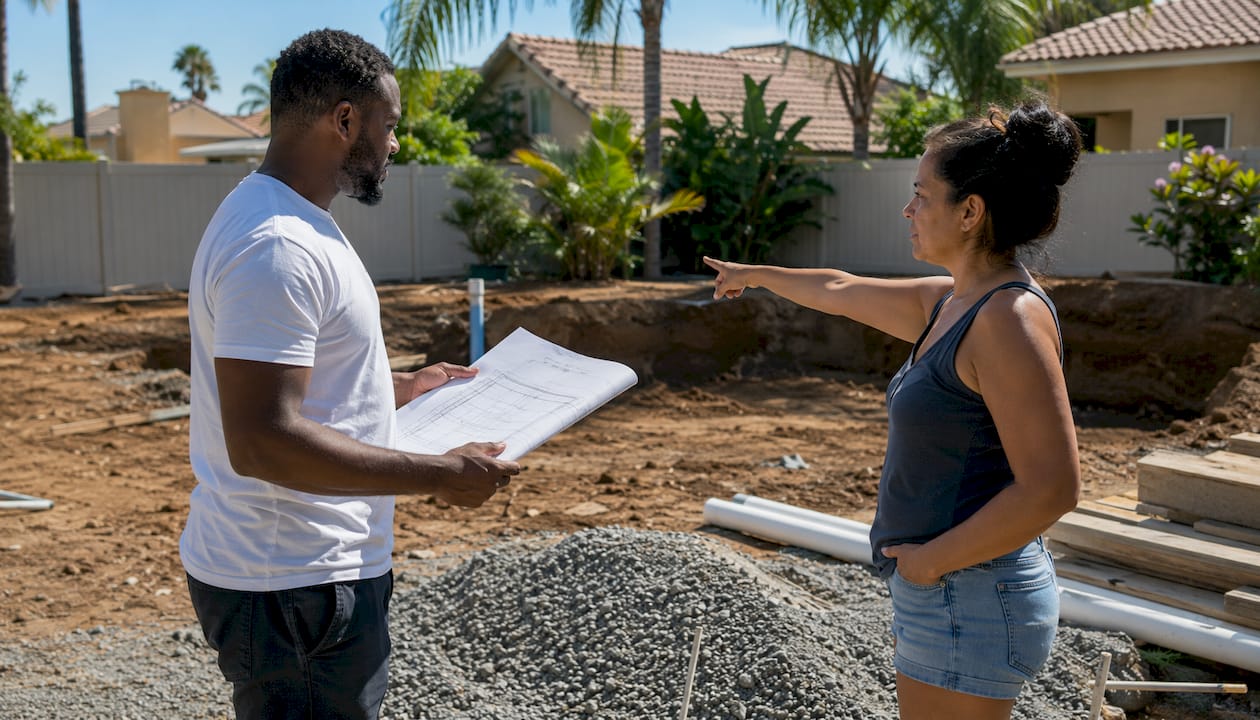
Disputes almost always trace back to a single ambiguous line in the scope. Here is how to split responsibilities cleanly.
| Contractor Responsibilities | Homeowner Responsibilities |
|---|---|
| Building permit application and fees | HOA submission and approval |
| All structural, plumbing, and electrical work | Irrigation capping before excavation |
| Equipment installation and commissioning | Landscaping removal from pool area |
| AHJ inspections throughout construction | Utility service upgrades (if required) |
| Manufacturer warranty registration | Fence or barrier installation (confirm in scope) |
| Site cleanup and debris removal | Owner-supplied décor or furniture |
| Final punchlist completion | Ongoing water chemistry after soft startup |
Common exclusions that must be spelled out in writing:
- Final grading beyond the immediate pool area
- Removal of existing structures (sheds, old patios, tree stumps)
- Irrigation system relocation or tie-ins
- HOA-required landscaping or fencing beyond pool barrier code
- Utility service panel upgrades
- Retaining walls beyond the pool shell footprint (unless explicitly included)
Pool contracts should identify which party is responsible for permits, HOA approvals, and utility upgrades because those are the most common sources of hidden costs and delays.
A sample exclusion line that works: “Contractor’s scope does not include removal of existing concrete patio, irrigation relocation, or HOA submission. These items are the homeowner’s responsibility unless added by written change order.”
Confirm the contractor’s license number and certificate of insurance before signing. Both must appear as attached exhibits in the contract, not just referenced in the body text. Under Florida Statutes 489.105, a residential pool/spa contractor’s scope covers construction, repair, and servicing of residential pools and all associated equipment. Verify the license type matches the work being done.
Pro Tip: Require the contractor to provide a list of all subcontractors and proof of their insurance before heavy civil work begins. If a sub’s employee is injured on your property and the sub is uninsured, you may be liable.
How should payments and milestones be structured?
The best-practice rule is simple: payments must align with measurable construction milestones, not arbitrary dates. A payment schedule tied to calendar dates gives the contractor money before the work is done. Tie every draw to something you can physically verify.

| Milestone | Verification Method | Documents to Collect |
|---|---|---|
| Plans approved by AHJ | Permit number issued | Permit copy, stamped plans |
| Excavation complete | Site inspection by homeowner | AHJ inspection report |
| Steel placed and inspected | AHJ structural inspection passed | Inspection sign-off |
| Shell complete and pressure-tested | Pressure test results documented | Test report, AHJ inspection |
| Equipment installed and commissioned | Equipment operating; startup documented | Manufacturer startup sheet, warranty registration |
| Decking and coping complete | Visual inspection against spec | Photos, AHJ inspection if required |
| Final inspection passed | Certificate of completion issued | Certificate, all lien waivers, punchlist sign-off |
A best-practice payment sequence reserves the largest percentage for final completion, inspection, and documentation, including lien waivers and signed manufacturer warranty registrations. Smaller, verifiable draws cover early civil milestones.
For lien releases, require a conditional lien waiver (similar in structure to AIA Form G706A) from the contractor, each subcontractor, and each major supplier at every draw. A conditional waiver becomes effective only when your check clears, so it protects you without requiring the contractor to waive rights before payment is received.
Pro Tip: Never make the final payment until you hold the certificate of completion, all signed lien waivers, all manufacturer warranty registrations, and a signed punchlist. Once the money is gone, your leverage disappears.
How do you control cost creep with change orders?
Cost creep on pool projects almost always starts with a verbal “while we’re at it” conversation on the job site. The fix is a written change-order process that requires your signature before any extra work begins.
A change-order clause that works:
Process flow for every change:
- Homeowner or contractor identifies a desired or required change.
- Contractor provides a written estimate with line-item pricing and schedule impact within [X] business days.
- Homeowner reviews, negotiates if needed, and signs the change order.
- Contractor updates the project schedule and begins the changed work.
Additional controls to include in the scope:
- Single point of approval: Only one named homeowner representative can authorize change orders.
- Not-to-exceed caps: For trades with allowances (tile, lighting, decking), set a maximum dollar amount. Require the contractor to reconcile allowances against actual costs before the final draw.
- Allowance reconciliation: If the tile allowance is $4,000 and actual cost is $3,200, the $800 credit must appear as a line item on the final invoice.
- Emergency changes: Define what qualifies as an emergency (e.g., unforeseen rock requiring blasting) and set a dollar threshold above which even emergency work requires a phone-authorized change order confirmed in writing within 24 hours.
For pool project planning, the best time to finalize all design decisions is before the permit is submitted. Structural changes after the shell is poured are significantly more expensive and may require amended permits.
What timeline and cost factors should you expect?
A custom inground pool in Central Florida typically takes several months from contract signing to swimming. Permitting is usually the longest variable, taking multiple weeks depending on application volume and plan completeness. Once permits are approved, construction itself lasts several weeks for a standard build.
Main cost drivers to evaluate in the scope:
- Pool type: Concrete pools allow full custom shapes and finishes; fiberglass pools install faster but come in manufacturer-set shapes and sizes.
- Site complexity: Rocky soil, high water tables, or steep grades add excavation cost and time.
- Custom features: Waterfalls, spas, tanning ledges, and automation systems each add to both cost and schedule.
- Decking and landscaping scope: The pool shell is often a smaller portion of the total project cost than homeowners expect.
- Permitting and inspection fees: These vary by county and must be assigned to a party in the scope.
- Utility upgrades: A new pool may require an electrical panel upgrade, which is typically outside the pool contractor’s scope under Florida law.
Contract type comparison
| Contract Type | Price Certainty | Scope Flexibility | Homeowner Cost Risk | Best Use Case |
|---|---|---|---|---|
| Fixed-price | High | Low | Low if scope is detailed | Fully specified custom builds |
| Cost-plus | Low | High | High unless capped | Complex sites, evolving designs |
| Cost-plus with cap | Medium-high | Medium | Medium | Custom projects with unknowns |
| Unit-price | Medium | Medium | Medium | Projects with variable quantities |
Fixed-price contracts offer high price certainty but low flexibility; cost-plus contracts offer more flexibility but higher homeowner risk unless capped. For most custom residential pools, a detailed fixed-price contract or a cost-plus with a guaranteed maximum price is the right structure.
When permit or HOA delays occur, record them in the scope as excused delays that extend the schedule without triggering penalty clauses. Require the contractor to notify you in writing within 48 hours of any delay and state the revised completion date.
A copyable scope of work template you can attach to a contract
Use this as Exhibit A. Have the contractor initial every page.
Exhibit A: Scope of Work
Project address: [Address] | Contract date: [Date] | Contractor license no.: [Number]
- Design and documentation: Contractor shall provide stamped engineering drawings, equipment schedule, and material selections attached hereto. All plans shall be dated and signed by both parties.
- Permits: Contractor is responsible for building permit application and fees. HOA submission is the homeowner’s responsibility.
- Excavation: Pool excavated to dimensions shown on attached plans. Dirt removal and grading included.
- Shell: [Gunite/shotcrete/fiberglass — specify] installed per attached engineering spec. Shell pressure-tested before backfill. AHJ inspection required before next phase.
- Plumbing: Minimum 2-inch Schedule 40 PVC. Pressure-tested before backfill.
- Equipment: [Brand, model, and spec for pump, filter, heater, automation] installed per manufacturer spec. Warranty registration completed by contractor.
- Tile, coping, decking: [Manufacturer, product line, color code] as shown on attached material schedule.
- Interior finish: [Product name, manufacturer, color code] applied per manufacturer spec.
- Electrical and lighting: [Fixture brand and model] installed per NEC and local code. Bonding per code.
- Water features: [Describe each feature with dimensions and equipment model.]
- Startup: 30-day soft startup included. Homeowner walkthrough (pool school) required before final payment.
- Final inspection and punchlist: Contractor obtains certificate of completion. Punchlist items resolved within [X] days of homeowner sign-off.
- Site restoration: Site restored to pre-construction condition as defined in attached site plan.
- Warranty: Equipment warranty per manufacturer terms. Workmanship warranty: [X] years on shell, [X] years on equipment installation.
Sample clause: Substantial completion
Sample clause: Manufacturer warranty registration
Require the contractor to attach manufacturer spec pages and warranty registration instructions as exhibits so you can verify that installed model numbers match what the contract specifies.
Copyable pre-signing checklist (Exhibit A attachment):
- [ ] Stamped engineering drawings attached, dated, and signed
- [ ] Equipment schedule with brand and model numbers attached
- [ ] Material schedule with color and finish codes attached
- [ ] Contractor license number and certificate of insurance attached
- [ ] Milestone-based payment schedule attached
- [ ] Conditional lien-waiver requirement stated
- [ ] Written change-order procedure included
- [ ] Definition of substantial completion included
- [ ] Warranty terms for shell and equipment stated
- [ ] Punchlist process and timeline defined
Pro Tip: Oral assurances must be converted to written scope exhibits. The most common dispute is a mismatch between what the homeowner heard and what the contractor documented. If the salesperson promised a specific tile brand, it belongs in the scope, not in your memory.
Red flags, questions to ask, and pitfalls to avoid
Most pool contract problems are visible before you sign. Here is what to look for.
Red flags in the scope document:
- Finish language like “premium plaster” or “quality tile” with no brand, model, or color code
- No drawings attached, or drawings that are unsigned and undated
- Payment schedule tied to dates (“30 days after signing”) rather than milestones
- No written change-order process
- No lien-release requirement
- Missing contractor license number or insurance certificate
- “Substantial completion” undefined or defined vaguely
Questions to ask during contract review:
- “Can you show me the stamped plans that will be attached to this contract?”
- “Which party is responsible for HOA approvals, and is that in writing?”
- “What is your definition of substantial completion, and where is it in the contract?”
- “What is the change-order process, and who has authority to approve changes?”
- “Will you provide conditional lien waivers from your subcontractors at each draw?”
- “What is your license number, and can I see your certificate of insurance today?”
- “Which equipment brands and models are specified, and are the spec sheets attached?”
Disputes caused by common red flags:
- Vague finish language: Homeowner expects pebble finish; contractor installs standard plaster. No recourse without a product name in the contract.
- Date-based payments: Contractor receives a draw on day 30 but excavation is not complete. Homeowner has paid for work not done.
- No change-order process: Contractor adds a feature verbally; homeowner disputes the cost at final payment.
- Missing lien waivers: Subcontractor places a lien on the homeowner’s property after the homeowner has already paid the general contractor.
For a practical hiring checklist and contract questions, confirm that the contractor’s license type covers the full scope of work. Under Florida law, a residential pool/spa contractor’s scope covers all phases of construction, repair, and servicing of residential pools. Verify the license is active with the Florida Department of Business and Professional Regulation before signing.
Key Takeaways
A complete custom pool scope of work must attach signed, dated plans; tie every payment to a verifiable milestone; require conditional lien waivers; and define substantial completion before you sign the contract.
| Point | Details |
|---|---|
| Attach signed plans | Stamped, dated engineering drawings must be physically attached to the contract as Exhibit A before signing. |
| Milestone-based payments | Every draw must be tied to a verifiable construction event, not a calendar date, with a conditional lien waiver at each stage. |
| Written change orders | Any deviation from the signed scope requires a written change order with line-item pricing and your signature before work begins. |
| Define substantial completion | State measurable criteria: shell installed, pool filled, mechanical systems operating, AHJ certificate issued, and warranty period started. |
| Randrswimmingpools | Randrswimmingpools has built custom inground pools across Central Florida since 1985 and supports homeowners through the full scope, permitting, and build process. |
Why experienced builders actually want a detailed scope
A detailed scope is not paperwork for its own sake. From a builder’s perspective, it is the document that lets a project run without daily disputes.
When every phase has a measurable acceptance criterion, the crew knows exactly what “done” means before they move to the next phase. When materials are specified by brand and model number, there is no argument about substitutions. When the payment schedule is tied to milestones, the builder has a clear incentive to hit each one. The scope protects the homeowner from surprises and protects the builder from scope creep, the slow accumulation of small requests that were never priced.
Randrswimmingpools has operated in Central Florida since 1985, building both concrete and fiberglass pools across the region. That experience shows up in the documentation: detailed pool contract details that specify materials, milestones, and responsibilities from day one. When the scope is thorough, the warranty handover is clean because both parties know exactly what was built, what was installed, and what the manufacturer covers.
Randrswimmingpools makes the scope process straightforward
Forty years of Central Florida pool construction means Randrswimmingpools has seen every scope dispute that can happen and has built its process to prevent them. The team walks homeowners through a detailed custom pool planning guide that covers design, permitting, milestone draws, and material selections before a shovel touches the ground.
For homeowners ready to move from research to a real project, the inground pool installation guide covers every phase of the build in Central Florida, from permit submittal through pool school. Schedule a free consultation with R and R Swimming Pools to get a scope exhibit and accurate quote for your property.
Useful sources and where to check state rules
Use these sources to verify contractor credentials, review standard contract requirements, and find model lien-release forms.
| Source | What to check |
|---|---|
| Florida Statutes 489.105 (Pool Contractor Scope) | Exact legal scope of work for residential and commercial pool/spa contractors in Florida |
| CSLB Before Swimming Pool Construction | What a pool contract must include: plans, license number, start/completion dates |
| Pool Installer Authority: Contract Guide | Contract types, substantial completion definition, material standards |
| JDesigns: Pool Contract Homeowner Guide | Milestone payment best practices, lien-release requirements, common omissions |
| StartMotionMedia: Pool Builder Contract Guide | Signed/dated plan requirements, material specification standards |
Additional steps:
- Verify your contractor’s license: Florida Department of Business and Professional Regulation (myfloridalicense.com) lets you confirm a license is active and covers the work type.
- Check your local AHJ: Contact your county building department for electrical permit requirements, inspection schedules, and local code amendments that affect pool construction.
- Model lien-release forms: The American Institute of Architects publishes standard conditional and unconditional lien-waiver forms (AIA G706A series) widely used in construction contracts. Your real estate attorney can also provide Florida-specific forms.
- Keep a copy of stamped plans: Store the permit set and all signed exhibits somewhere accessible. If a dispute arises years later, the stamped plans are the definitive record of what was contracted.
This guide is general information for homeowners, not legal advice. Confirm current licensing requirements, lien-waiver procedures, and local code requirements with the Florida Department of Business and Professional Regulation, your local building department, or a licensed Florida construction attorney for your specific project.
