
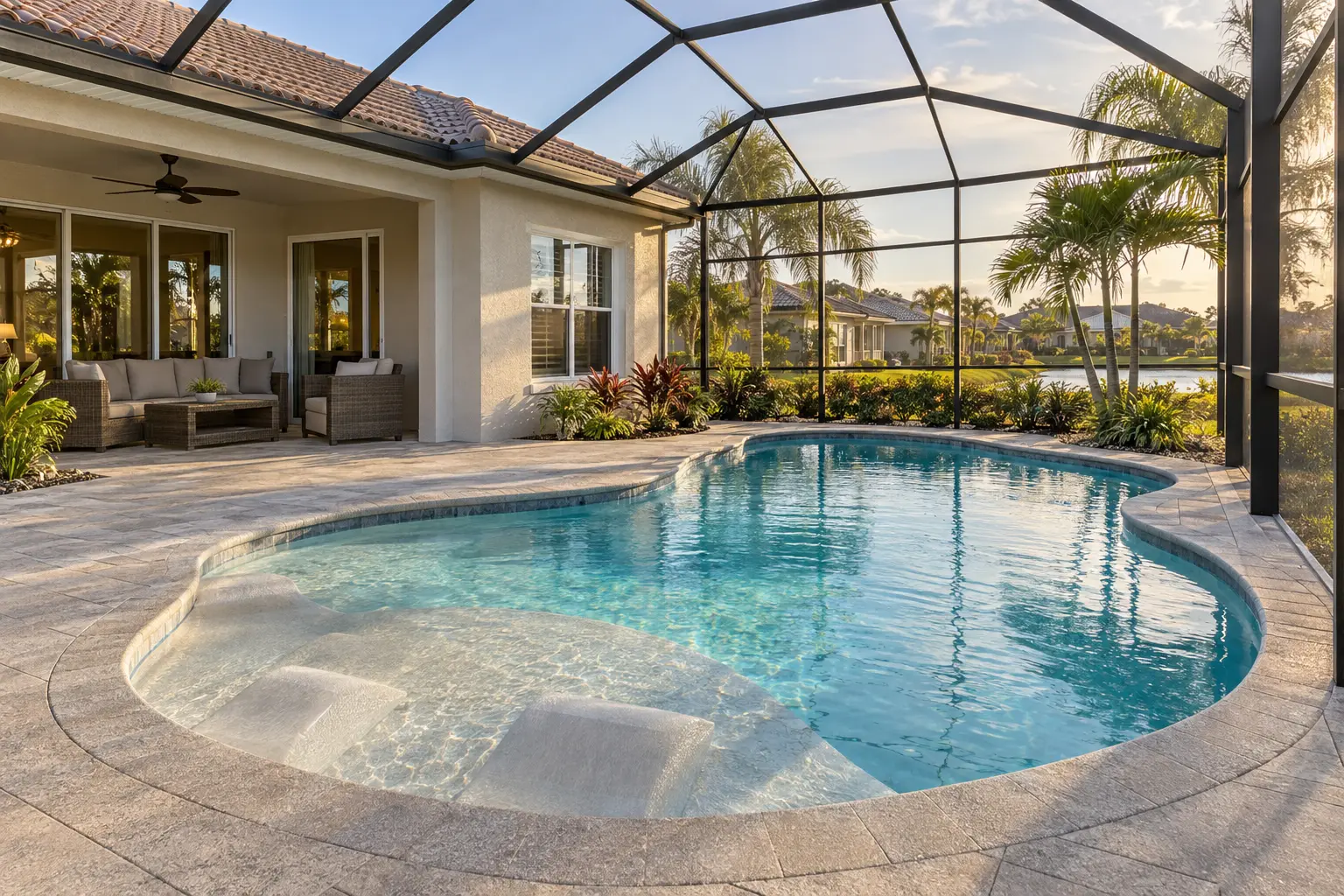
TL;DR: For most Central Florida retirees, the easiest pool to own is a modest fiberglass pool in a screen enclosure, with a saltwater system and a heat pump with a solar cover. Easy steps and a sturdy handrail matter as much as the pool material. A custom gunite pool still makes sense if you need a shape, size or depth that a factory mold can’t give you.
What is the easiest pool to own in retirement?
For most retirees in Central Florida, the easiest pool to own in retirement is a modest fiberglass pool inside a screen enclosure, with saltwater and a heat pump. The smooth shell needs less scrubbing. The screen keeps leaves out, and the heater gives you more months of swimming. Add wide steps and a handrail, and getting in stays easy.
The pool material is only part of the answer. Size, the way you get in and the equipment that runs the pool matter just as much. Here’s how each choice plays out for homeowners in The Villages and the rest of Lake County.
Why is fiberglass usually less work than gunite?
Fiberglass is usually less work because the surface is smooth and non-porous, so algae has a harder time holding on. Latham makes the fiberglass pools we install, and it says its non-porous fiberglass finish resists algae and staining. For you, that means lighter brushing and fewer chemical swings to fix.
The surface also feels smooth on bare feet and hands. That matters if your skin bruises or tears more easily than it used to. A gunite pool’s interior finish has more texture, so it usually takes more brushing to keep clean.
Gunite still has its place. We build custom gunite pools to any shape, depth or size. That helps if you want an unusual layout or a raised spa built to fit your lanai. In Central Florida the two types cost about the same, so price alone rarely decides it. Our fiberglass vs. gunite comparison for Florida homeowners covers the full set of trade-offs.
Fiberglass in retirement: pros and cons
- Pro: The smooth surface resists algae, so weekly brushing is lighter.
- Pro: Active construction is about 2-3 weeks, so heavy work in your yard is over sooner.
- Pro: Many shell designs come with steps and bench seats molded in.
- Con: Shapes and sizes come from factory molds, so you choose from a list instead of drawing your own.
- Con: The shell arrives by truck and is set in place by crane, so the yard needs a clear path for delivery.
- Con: A very tight or oddly shaped lot may not fit a stock shape well.
Which features make a pool easier to live with?
The features that save the most work are the ones that keep debris out, make chlorine for you and hold in heat. Most pools here already sit inside a screen enclosure, and that’s the biggest single chore-saver. The table shows what each choice saves you and what you give up.
| Choice | What it saves you | Trade-off |
|---|---|---|
| Screen enclosure | Keeps out most leaves, needles and bugs, so there’s less skimming | Screens can tear in storms and need patching now and then |
| Saltwater system | Makes chlorine from salt, so there are fewer jugs to haul and pour | The salt cell needs cleaning and will wear out over time |
| Heat pump with a solar cover | Comfortable water in winter, and the cover holds heat overnight | The cover has to go on and off, and the heat pump uses electricity |
| Smaller pool | Less water to treat, heat and clean | Less room for laps or big family days |
| Fiberglass shell | Less brushing, and it’s smooth on skin | Limited to factory shapes and sizes |
Heating deserves a closer look. Winter nights here can drop into the 30s, so many owners heat their pools. The U.S. Department of Energy says heat pump pool heaters run efficiently as long as the outside air stays above about 45°F to 50°F. They also usually cost less to run than gas heaters. DOE calls covering a pool when it’s not in use the single most effective way to cut heating costs, with savings of 50% to 70% possible. That’s why we often pair a heat pump with a solar cover for owners who want to swim year-round.
How do you make a pool easy on your knees and safe for grandkids?
Plan the way in first. Wide, shallow steps and a sturdy handrail help with daily comfort more than almost anything else. For one homeowner with limited mobility, we added extra steps and extended-length handrails so getting in and out felt steady. A bench or sun shelf gives you a place to sit in the water without treading.
Depth matters too. If you mostly wade, walk laps or float, you may not need a deep end. Many homes in The Villages are villas and designer homes on smaller lots with a lanai, so a compact pool is often the natural fit anyway.
If grandchildren visit, safety is part of easy ownership. Under Florida’s Residential Swimming Pool Safety Act, a new home pool needs at least one approved safety feature to pass final inspection. The options include a qualifying barrier, an approved safety cover, exit alarms on doors and windows, self-closing and self-latching doors, or a pool alarm. Many families use more than one. We’ll go over which ones fit your home during design.
What if you only live here part of the year?
If you’re a seasonal resident, lean even harder toward low-chore choices. A screen enclosure keeps most debris out while you’re gone. A saltwater system keeps making chlorine as long as the pump runs. You’ll still want someone to check the water and equipment on a regular schedule, especially in summer, when afternoon thunderstorms roll through almost daily.
Timing helps too. A fiberglass project usually takes 2-4 months from design to final walkthrough, and about 2-3 weeks of that is active construction. A gunite project usually takes 4-6 months. That makes it easier for snowbirds to plan the build around the months they’re in town. If budget is part of the decision, our side-by-side fiberglass vs. concrete cost breakdown explains what drives the price of each.
Why work with R & R Swimming Pools?
- We’re a family-owned builder and have been building pools in Central Florida since 1985.
- We’ve completed more than 1,000 fiberglass and concrete pools.
- We’re an authorized Latham dealer.
- Owner Devin Burch is on site through every phase and keeps you updated.
- Johnny, our pool designer, creates a virtual pool design so you can see the layout before the build.
- Both our fiberglass and concrete pools carry a limited lifetime warranty.
- Financing is available through our lending partners, Lyon Financial and Viking Capital.
One homeowner in The Villages, Craig, put it this way: Devin constantly kept in touch with us and updated us on a daily basis regarding the entire process for the build. You can learn more about our work as pool builders in The Villages, and we also build for homeowners in Leesburg, Lady Lake and across Lake County.
Want to see what an easy-care pool could look like at your home? Call R & R Swimming Pools at (352) 432-8843 or book a free design consultation. Have a recent property survey ready so the design can account for property lines, easements and setbacks.
Frequently Asked Questions
Is a saltwater pool easier for seniors to maintain?
For many owners, yes. A saltwater system makes chlorine from salt in the water, so you buy, carry and add less chlorine. You still need to test the water and keep the salt cell clean.
How long does it take to build a fiberglass pool?
Active construction on a fiberglass pool is about 2-3 weeks. The whole project, from design and permits to the final walkthrough, usually takes 2-4 months.
What do I need before a free pool design consultation?
We ask for a recent property survey first. It shows property lines, easements and setbacks, so the pool design fits your lot from the start.
Can I finance a new pool in retirement?
Financing is available through our lending partners, Lyon Financial and Viking Capital. The lender makes the approval decision and sets the terms.
Is a heated pool worth it in Central Florida?
Many owners think so, because winter nights here can drop into the 30s. A heat pump paired with a solar cover is a common way to keep swimming through the cooler months.
Recommended Reads
- Fiberglass vs. Concrete Pool Cost in Florida: A Side-by-Side Breakdown
- Fiberglass vs. Gunite Pool: Which Is the Better Choice for Florida Homeowners?
- Fiberglass Pool Pros and Cons Every Florida Homeowner Should Know
