

For most families, a shallow end of 3.5–4.0 ft sloping to a deep end of 5.0–6.0 ft is the right starting point. That range lets adults stand comfortably, gives kids learning to swim a bottom to push off from, and still provides enough depth for jumping and water games. If diving is on the table, you need a minimum of 8 ft in the dive zone, and that changes the conversation significantly.
The single best configuration for a mixed-age family: a 3.5 ft entry, a gradual slope to 5.5 ft, and a sun shelf at 6–12 inches near the entry steps.
Quick facts to bring to your first builder meeting:
- Shallow end: 3.5–4.0 ft suits most family use, from toddlers with floaties to adults standing chest-deep
- Deep end: 5.0–6.0 ft for jumping and play; 8 ft minimum if you want a diving board
- Sun shelf: 6–12 inches deep, sized for a lounge chair, placed at the entry end
Key Takeaways
The best family pool depth balances a 3.5–4.0 ft shallow zone with a 5.0–6.0 ft deep end, a gradual slope, and a sun shelf at 6–12 inches for toddlers and lounging adults.
| Point | Details |
|---|---|
| Shallow end target | Build the shallow zone at 3.5–4.0 ft to serve both kids learning to swim and standing adults. |
| Deep end for most families | A 5.0–6.0 ft deep end covers jumping, games, and adult swimming without excessive excavation cost. |
| Diving requires 8 ft minimum | Confirm diving depth with your local building department and homeowner’s insurance before finalizing plans. |
| Sun shelf adds function, not volume | A 6–12 inch sun shelf serves toddlers and lounging adults while keeping total water volume lower. |
| Randrswimmingpools | Central Florida’s custom pool builder since 1985, offering free design consultations that include depth planning for concrete and fiberglass pools. |
Table of Contents
- What are the recommended family pool depth ranges?
- How does pool depth match what your family actually does?
- How do sun shelves and gradual slopes make a pool work for everyone?
- What safety rules and building codes should you check before finalizing depth?
- How do you decide on the right depth for your specific family?
- How does depth affect your pool’s cost, heating, and maintenance?
- What does builder experience tell you about family pool depth?
- Randrswimmingpools can help you get the depth right from the start
- Sources
What are the recommended family pool depth ranges?
Industry guidance consistently points to 3.5–4.0 ft as the shallow-end target for family pools. At 3.5 ft, a child around 4 ft tall can stand with their head above water. At 4.0 ft, most adults are at chest level, which is comfortable for standing, socializing, and supervising younger swimmers. Going shallower than 3.5 ft limits adult use; going deeper than 4.5 ft in the shallow zone starts to feel like the whole pool is the deep end.
Shallow end: the 3.5–4.0 ft rule
The 3.5–4.0 ft range works because it serves two groups at once. Kids learning to swim can touch the bottom and recover their footing. Adults can stand without treading water, which matters when you’re watching children. Some builders offer a 3.0 ft entry point that slopes quickly to 3.5 ft, which adds a few extra feet of very shallow water near the steps without sacrificing the rest of the pool.
Slope and transition
A gradual slope is safer and more comfortable than a sudden drop. A commonly cited ratio is roughly 1 ft of depth change for every 7 ft of horizontal run. That means moving from 3.5 ft to 5.5 ft takes about 14 ft of pool length, which fits comfortably in a standard 30–35 ft pool. Ask your builder to show you the slope ratio on the plan before you sign off.
Deep end by use case
What you plan to do in the deep end determines how deep it needs to be. Popular installer configurations show a 3.0–3.5 ft shallow zone sloping to a 5.0–5.5 ft deep end as a balanced family layout. Here’s how depth maps to specific uses:
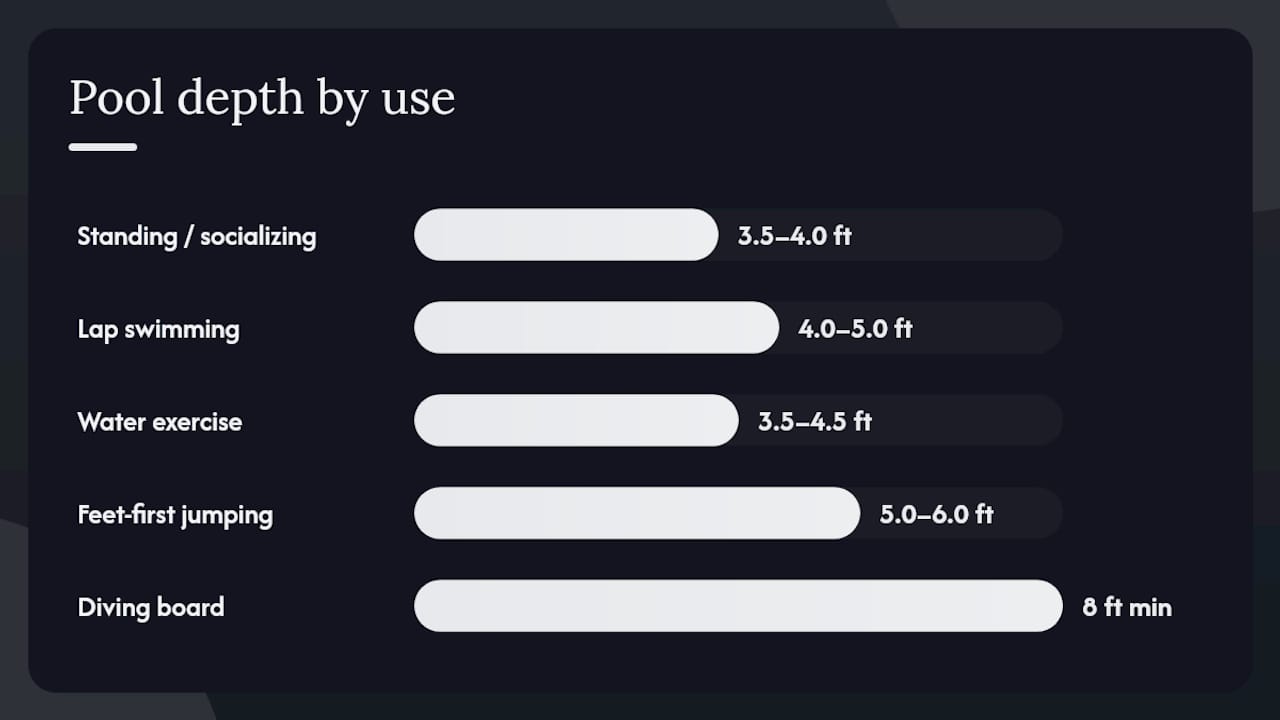
| Use | Recommended depth |
|---|---|
| Standing / socializing | 3.5–4.0 ft |
| Lap swimming | 4.0–5.0 ft |
| Water exercise | 3.5–4.5 ft |
| Feet-first jumping | 5.0–6.0 ft |
| Diving board (basic) | 8 ft minimum |
For diving, industry and code guidance sets the floor at 8 ft, with some designers recommending 9 ft for practical underwater clearance. That extra depth adds significant excavation cost and water volume, so most families without a strong diving interest skip it.
Depth minimum to verify: If you want a diving board, confirm the required minimum depth with your local building department and your homeowner’s insurance carrier before finalizing plans. Many insurers have stopped covering diving boards entirely, regardless of pool depth.
How does pool depth match what your family actually does?
Depth decisions get easier once you map them to real activities. Activity-specific guidelines show that lap swimming works best at a consistent 4–5 ft bottom, water exercise at 3.5–4.5 ft, and feet-first jumping at 5–6 ft. Diving is its own category entirely.
- Toddlers and non-swimmers: Sun shelf at 6–12 inches, or a wading zone at 1.5–2.0 ft near the steps. Never rely on pool depth alone for toddler safety; supervision and barriers are non-negotiable.
- Kids learning to swim (ages 5–10): 3.0–3.5 ft lets them practice strokes while still touching the bottom. This is the zone where confidence builds.
- Teens and adults playing games: Volleyball, basketball, and general splashing work well at 4.0–5.0 ft. Shallow enough to stand, deep enough to jump in.
- Lap swimmers: A consistent 4–5 ft bottom avoids the hand-and-foot scraping that happens in shallower water during a full freestyle stroke. A sport-bottom design (flat at 3.5–4.0 ft throughout) is a growing alternative for families who want the whole pool usable for adults.
- Feet-first jumping: 5.0–6.0 ft is the standard recommendation. A jumping rock or low platform at the deep end gives teens a safe outlet without requiring a full diving setup.
- Head-first diving: 8 ft minimum, full stop. If your family has competitive swimmers or serious divers, plan for it from the start. Retrofitting depth is expensive and sometimes impossible.
Two household profiles that illustrate the trade-offs: A family with toddlers and elementary-age kids usually benefits most from a larger shallow zone (3.0–3.5 ft) with a sun shelf, and a modest deep end around 5.0 ft. A couple in their 50s who want to swim laps and occasionally have grandchildren visit often does better with a sport-bottom at 4.0 ft and a small sun shelf, skipping the deep end entirely.
How do sun shelves and gradual slopes make a pool work for everyone?
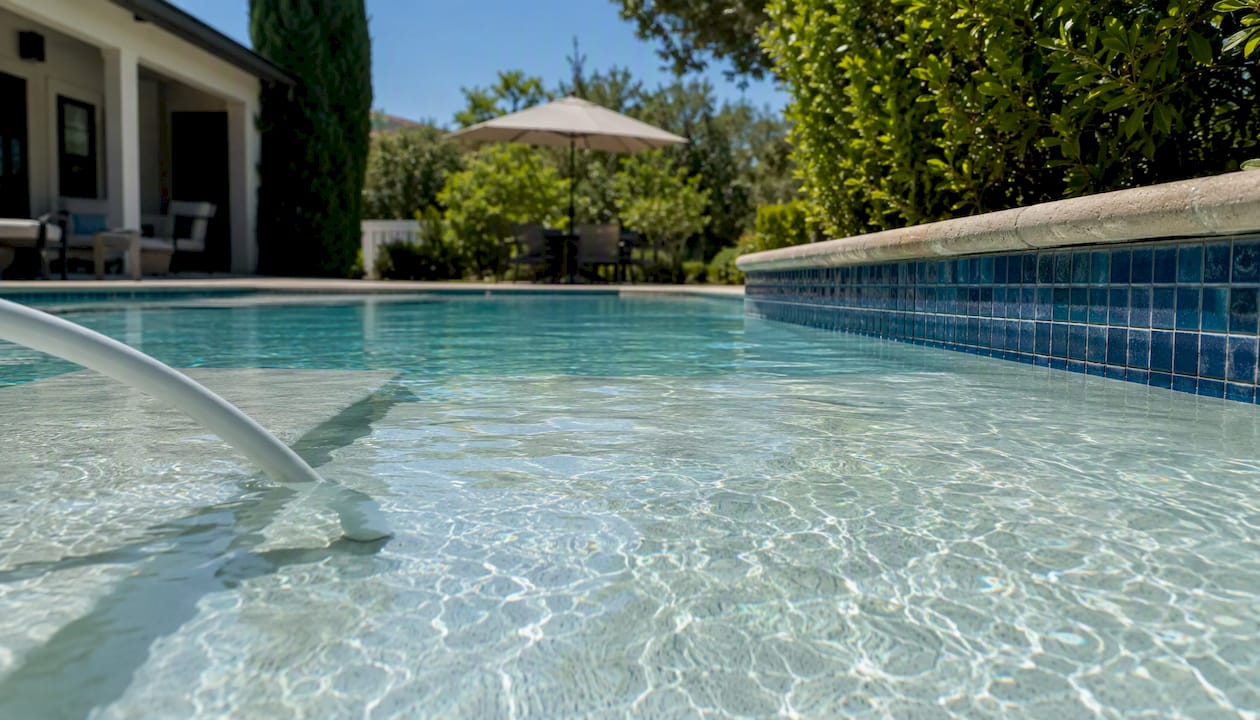
A sun shelf (also called a tanning ledge) is a flat, submerged platform typically 6–12 inches deep, wide enough for a lounge chair. It’s one of the most practical features you can add to a family pool. Toddlers can splash in inches of water while adults recline in the sun. Non-swimmers get a place to be in the pool without being in the pool.
Guidance for toddlers and young children specifically recommends tanning ledges at 6–18 inches as a safe, separate shallow zone. At that depth, a seated toddler has water at waist level and can stand up easily.
- Sun shelf sizing: Aim for at least 6–8 ft wide and 4–6 ft deep (front to back) to fit a full-size lounge chair. Narrower shelves feel cramped and don’t serve their purpose well.
- Underwater bench seating: A bench at 4.0 ft along the pool wall gives adults a place to sit chest-deep. Common in the transition zone between shallow and deep ends.
- Slope placement: The slope should begin after the sun shelf and shallow entry zone, not immediately at the steps. A flat 3.5 ft section of 8–10 ft before the slope begins gives young swimmers a safe runway.
Pro Tip: Ask your designer to place the sun shelf on the south or west side of the pool so it gets afternoon sun. A shaded sun shelf loses most of its appeal in Central Florida’s long swim season.
For a designer conversation, describe it this way: “I want a sun shelf at the entry end, 6–8 ft wide, 4–5 ft front-to-back, at 6–10 inches deep. From the shelf, I want a flat 3.5 ft section for about 8 ft, then a gradual slope to 5.5 ft over the remaining pool length.”
What safety rules and building codes should you check before finalizing depth?
Depth is not just a comfort decision. It’s a code and liability question. U.S. residential pool codes vary by state and municipality, so what applies in Central Florida may differ from what applies in Arizona or New Jersey. That said, several standards are consistent enough to use as planning anchors.
Items to verify with your local building department:
- Minimum depth for diving boards or diving rocks (commonly 8 ft, but check your jurisdiction)
- Required depth markers and signage at the pool edge and on the pool wall
- Fence height and self-latching gate requirements (most Florida jurisdictions require a 4 ft barrier minimum)
- Alarm requirements for pool access doors and gates
- Minimum horizontal dimensions for diving areas (not just depth, but the approach and overhead clearance)
Red-flag checklist for your plans review:
- No depth markers shown on the plan
- A sudden depth drop (more than 1 ft over less than 5 ft horizontal) without a warning feature
- A diving board proposed over a pool shallower than 8 ft
- No shallow zone or sun shelf for a family with young children
The Association of Pool & Spa Professionals (APSP) publishes residential pool standards that many local codes reference directly. Your builder should be familiar with ANSI/APSP-5, the standard for residential inground pools, and should be able to tell you which local amendments apply to your project.
Note: The depth and code information here is general guidance. Verify all requirements with your local building department and permitting office before finalizing any pool design.
How do you decide on the right depth for your specific family?
Start with who uses the pool now, then think two steps ahead. Kids who are 5 today will be teenagers in seven years. A depth that works perfectly for a toddler household may feel limiting when those kids are 16 and want to jump.
Decision steps:
- List everyone who will use the pool and their current swimming ability. Include grandparents, frequent guests, and anyone with mobility considerations.
- Identify the primary activities. Lap swimming, casual play, and diving each pull depth in different directions.
- Future-proof the design. If you have young children, build in a sun shelf now. If you might want lap swimming in five years, don’t go shallower than 4 ft throughout.
- Check your site constraints. Soil type, lot grading, and proximity to utilities affect how deep you can realistically excavate. Your builder will flag these early.
- Confirm insurance and diving goals. If you want a diving board, call your homeowner’s insurance carrier before the design is finalized. Many policies exclude diving boards or require specific depth certifications.
For pool size selection factors beyond depth, lot dimensions, setback requirements, and equipment placement all interact with how deep you can go.
Questions to ask your builder:
- What slope ratio do you use as a default, and can I see it on the plan?
- How does adding a sun shelf affect total water volume and filtration sizing?
- What’s the cost difference between a 5.5 ft deep end and a 6.5 ft deep end in excavation and materials?
- Do you handle the depth-marker signage and code compliance, or is that my responsibility?
Red flags that should prompt a redesign:
- Builder proposes a pool with no shallow zone wider than 6 ft
- Sudden depth change from 3.5 ft to 6 ft with no gradual slope
- No sun shelf or bench seating in a pool designed for a family with children under 10
How does depth affect your pool’s cost, heating, and maintenance?
Every foot of average depth adds water volume, and water volume drives several cost lines simultaneously. Pools deeper than about 6 ft increase excavation, water volume, and long-term heating and maintenance costs. Most families find the 3.5–6.0 ft range covers their needs without those penalties.
A rough illustration: a 12 x 24 ft pool at an average depth of 4.5 ft holds roughly 9,700 gallons. Add one foot of average depth (to 5.5 ft) and that same footprint holds about 11,900 gallons. That’s roughly 2,200 extra gallons to heat, filter, and chemically treat every season.
Sun shelves work in your favor here. Because they sit at only 6–12 inches, they add usable square footage without adding meaningful water volume. A well-sized sun shelf can replace several feet of shallow pool area, keeping the total water volume lower while expanding the pool’s functional footprint.
For the maintenance implications of larger water volumes, filtration run times and chemical consumption both scale with gallons, not just surface area. A deeper pool isn’t dramatically more expensive to maintain, but the difference is real over a 10–15 year ownership period.
Deeper pools also affect pool landscaping decisions: retaining walls, decking elevation, and equipment pad placement all shift when excavation goes deeper than about 5 ft.
What does builder experience tell you about family pool depth?
Randrswimmingpools has been designing and installing custom inground pools in Central Florida since 1985. Over that time, the depth conversations that come up most often follow a predictable pattern: families underestimate how much they’ll use the shallow end, and overestimate how much they need the deep end.
The most common regret from families who built pools with a 7–8 ft deep end without a diving board: they paid for excavation and water volume they never use. The most common regret from families who skipped the sun shelf: they wish they had one within the first summer.
A typical Randrswimmingpools project for a family with school-age children and occasional adult lap swimming looks like this: a sun shelf at 8–10 inches, a 3.5 ft entry zone of about 8 ft, a gradual slope to 5.5 ft, and an underwater bench along one wall at the 4.0 ft transition point. That configuration serves toddlers, kids, lap swimmers, and adults socializing in the water, all in a single pool.
When a family asks us what depth we’d build for ourselves, the answer is almost always the same: a generous sun shelf, a 3.5 ft shallow zone, and a 5.5 ft deep end. That setup works for 90% of what families actually do in a pool, and it keeps costs and maintenance in a reasonable range. The families who push to 8 ft without a diving plan almost always wish they’d stopped at 6.
Builder questions worth asking at your first meeting:
- How does the soil profile on my lot affect how deep we can go?
- What’s your standard slope ratio, and can you show me a cross-section drawing?
- How do depth decisions affect the equipment pad location and plumbing runs?
- What depth do most of your Central Florida clients end up choosing, and why?
For a detailed look at how the custom pool design process works from first conversation to final plan, Randrswimmingpools walks clients through depth decisions as part of a structured design consultation.
The depth configuration most families don’t regret
The conventional wisdom says “go deeper for more versatility.” The experience of building pools for Central Florida families for four decades says the opposite. A 5.5 ft deep end with a well-designed sun shelf and a gradual slope is more versatile than an 8 ft deep end with a cramped shallow zone, because it serves more people more of the time.
The families who get the most use from their pools aren’t the ones with the deepest water. They’re the ones whose pools have a sun shelf where the grandparents can sit, a shallow zone where the kids can play without constant supervision, and enough depth in the middle for adults to actually swim. That’s a 3.5-to-5.5 ft pool with a sun shelf. Build that, and you’ll use every square foot of it.
Randrswimmingpools can help you get the depth right from the start
Getting depth wrong is one of the most expensive mistakes in pool design because it’s built into the ground. Randrswimmingpools has spent nearly 40 years helping Central Florida homeowners avoid it.
The process starts with a free design consultation where depth is one of the first decisions on the table. R and R Swimming Pools builds both concrete and fiberglass pools, handles local permitting, and walks you through the slope, sun shelf, and deep-end trade-offs specific to your lot and your family. Bring site photos, a rough sketch of your backyard, and a list of who uses the pool and how. That’s enough to have a productive first conversation.
For homeowners ready to move from research to planning, the custom pool planning guide for Central Florida covers the full design process, and the inground pool installation guide explains what happens after the design is finalized. If financing is a factor, pool financing options are available to help manage build costs. Request a free quote and bring your depth questions to the first meeting.
Sources
- What is the Ideal Pool Depth for Family Use?
- Pool Depth Guide: How to Choose the Right Swimming Pool…
