
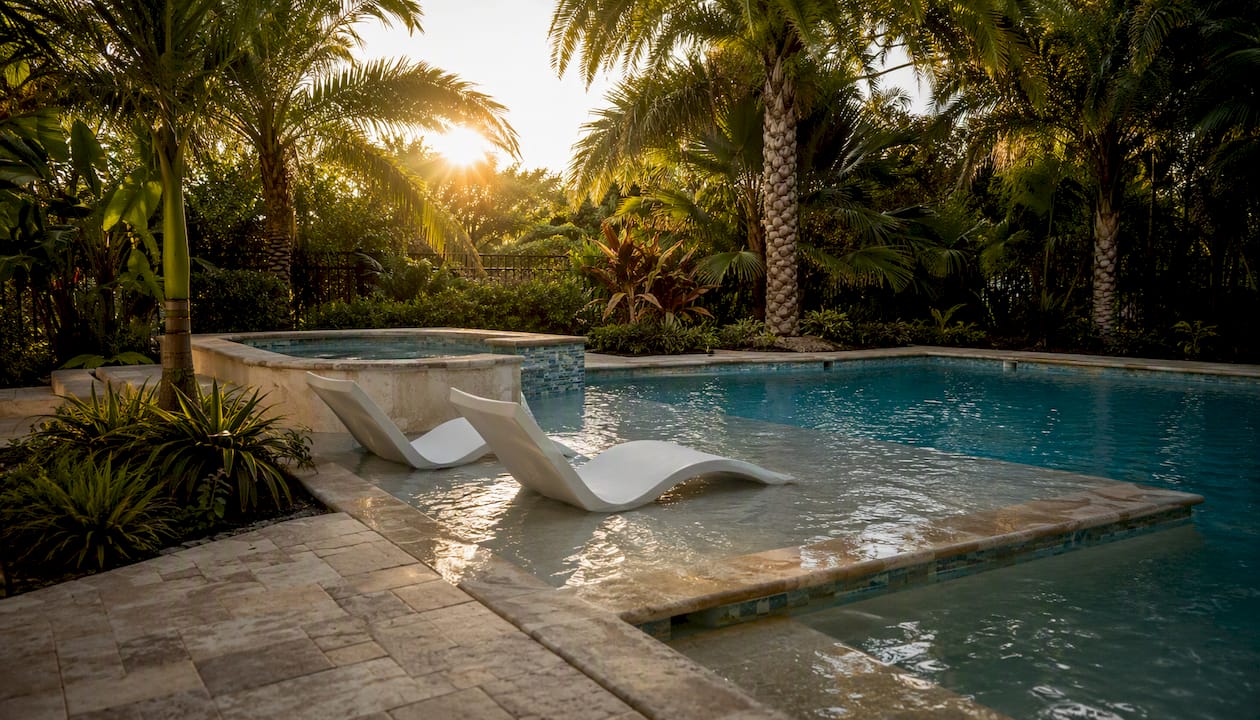
A tanning ledge (also called a sun shelf or Baja shelf) is a shallow in-pool platform, typically holding 6–12 inches of water, that creates a dedicated lounge, play, and visual focal zone right inside your pool. Sun shelves often become the most-used feature in a family pool, outpacing the deep end for casual afternoons. If you have kids, a dog, or simply want to float in a chaise without fully submerging, a tanning ledge earns its footprint. In a small pool where every swim foot counts, weigh that trade-off carefully before committing.
Quick specs to know before you read further:
- Water depth: 6 inches for lying flat without furniture; 6–9 inches for in-pool chaise loungers; 9–12 inches for kids and pets; 12+ inches for a bench-style Baja variation
- Typical footprint: 8–14 feet wide, 5–8 feet deep into the pool
- Common add-ons: weighted chaise lounges, umbrella sleeve, bubblers, LED lighting, accent tile band
Key Takeaways
A tanning ledge built to the right depth and footprint, with plumbing and accessories planned during shell work, consistently becomes the most-used feature in a family pool.
| Point | Details |
|---|---|
| Ideal water depth | 6–9 inches of finished water suits chaise loungers, adults, and most family use cases. |
| Footprint for two chairs | Plan at least 8 feet wide and 6 feet deep; smaller reads as a step, not a ledge. |
| Lock in add-ons early | Umbrella sleeves, bubblers, and LED conduit must be cast during shell work, not added later. |
| Retrofit is possible on concrete | Gunite pools can be cut and extended; fiberglass pools are better ordered with the ledge factory-formed. |
| Randrswimmingpools | Central Florida’s custom pool builder since 1985, integrating tanning ledges into new builds and remodels. |
Table of Contents
- What tanning ledge ideas work best for your backyard?
- How deep should your tanning ledge be, and where should it go?
- Which finish works best on a sun shelf?
- What furniture and accessories make a tanning ledge worth it?
- Can you add a tanning ledge to an existing pool?
- Questions to bring to your pool builder
- What a reputable pool builder actually does
- Randrswimmingpools builds tanning ledges that actually get used
- Sources
What tanning ledge ideas work best for your backyard?
The best sun shelf designs share one trait: they look intentional, not tacked on. Below are eight visual concepts you can describe to a builder or drop into a mood board.
Modern Floating Chaise Shelf. A clean rectangular ledge, 8 feet wide by 6 feet deep, finished in white or light gray plaster. Two weighted chaise loungers sit in 7 inches of water. The ledge aligns flush with the pool’s interior steps so the geometry reads as one continuous line from the patio.
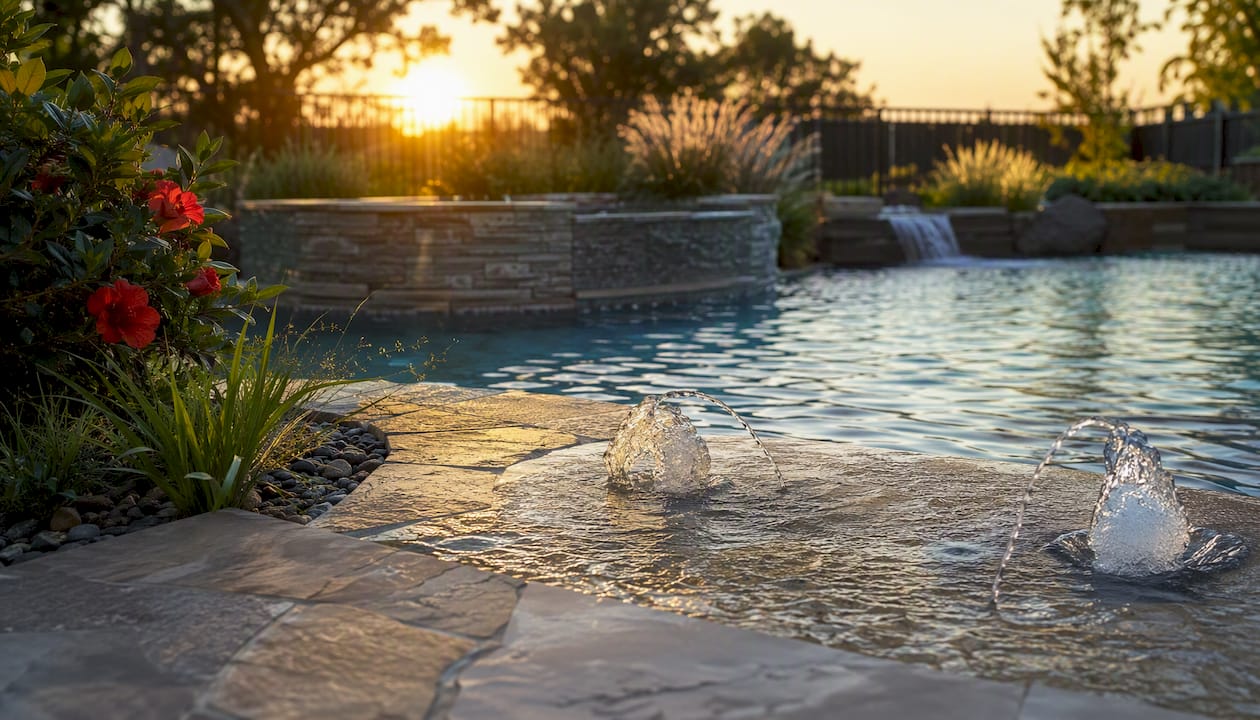
Tropical Flagstone Shelf with Bubblers. Irregular natural stone coping wraps the ledge edge, and two bubblers push gentle arcs of water up from the shelf floor. Surrounding plantings of bird of paradise and ornamental grasses frame the view from the house. This look pairs well with freeform pool shapes.
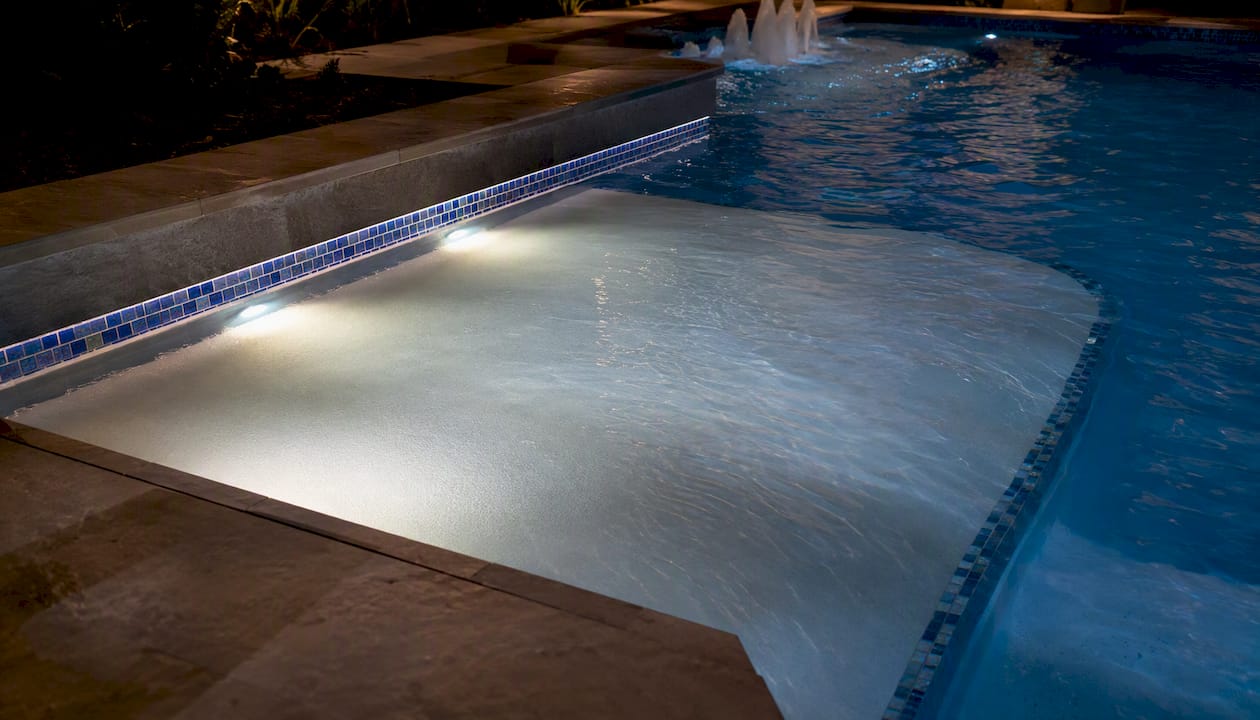
Tile-Accent Contemporary Shelf. A straight ledge with a 4-inch band of glass mosaic tile at the waterline. The tile serves double duty: it marks the edge visually for safety and adds a pop of color against a white pebble interior. Popular in Central Florida new builds.
Curved Resort-Style Shelf. A half-moon ledge, roughly 10 feet across, tucked into the shallow end of a kidney-shaped pool. The curve softens the overall pool shape and creates a natural gathering point. Works especially well when integrated beside a spa or waterfall feature.
Family Wading Shelf. A wider, shallower platform, 12 feet across and 9–10 inches deep, designed for toddlers and dogs. No furniture, just open water. A contrasting tile edge in a darker grout color marks the drop-off clearly.
Rustic Natural Stone Shelf. Travertine or bluestone pavers set into the shelf surface, sealed against pool chemicals. The texture reads as an extension of the patio hardscape, blurring the line between deck and water. Requires a slip-resistance specification from your builder.
Integrated Step-to-Shelf Transition. The entry steps widen on the last tread to become the ledge itself, saving footprint. This design works in smaller pools where a separate ledge would eat too much swim length.
Lit Evening Shelf. LED lights recessed into the shelf floor or along the waterline tile band. At night, the shelf glows as the visual anchor of the pool. Pair with a bubbler for movement and sound.
Pro Tip: Before committing to a style, stand at your back door or main patio seating area and look at where the ledge will sit. A shelf that reads beautifully from the water’s edge can disappear visually from 30 feet away. Ask your builder to mark the ledge outline with spray paint before finalizing placement, then check the sight line from inside the house.
For more luxury pool design examples that incorporate sun shelves, the Randrswimmingpools gallery shows finished Central Florida projects across multiple styles.
How deep should your tanning ledge be, and where should it go?
Depth is the single spec that determines whether your ledge actually works for its intended purpose. Get it wrong and you either have furniture floating away or a platform too shallow to be comfortable.
An industry-favored target is a ledge height that produces water depth suitable for most chaise loungers and comfortable lounging, typically in the mid-range of tanning ledge designs. That range keeps chaise loungers stable, lets kids wade safely, and still feels refreshing on a hot afternoon. Builders plan for evaporation and seasonal variation when specifying finished height, so in Central Florida’s climate, where evaporation runs higher than in northern states, a builder may set the ledge height slightly lower to keep water on the shelf during dry stretches.
Footprint sizing matters as much as depth. Common tanning ledge footprints for chaise use are sized to fit at least two loungers side-by-side with sufficient depth to accommodate furniture comfortably. A single chaise needs roughly 3 feet of width; two side-by-side need at least 7 feet. A children’s wading area benefits from 10–12 feet of width so kids have room to move. If your pool is under 30 feet long, a ledge deeper than 6 feet will noticeably shorten your swim lane, so consider a step-integrated design instead.
Placement follows a simple rule: face the ledge toward the house or main entertaining area. Designers commonly place sun shelves near the pool entry or shallow end, oriented toward the house for maximum sight lines. In a rectangular pool, the shallow end is the natural home. In a freeform pool, the ledge often sits adjacent to the entry steps or beside a spa. Avoid placing it under a tree; leaf debris collects on shallow surfaces faster than anywhere else in the pool.
A tanning ledge placed at the far end of a pool, away from the house, tends to go unused. Proximity to the patio, the grill, and the shade structure is what turns a design feature into a daily habit.
For guidance on matching shelf shape to your pool layout, pool shape customization resources can help you visualize how a ledge fits within different pool geometries.
Which finish works best on a sun shelf?
Shallow, sun-exposed surfaces behave differently than the rest of your pool interior. The water is warmer, UV exposure is constant, and foot traffic is higher. Your finish choice needs to hold up to all three.
- Marcite/white plaster: The most common and affordable option. Smooth, bright, and easy to repair. Shows algae staining faster in shallow water because the surface is porous. Works well for budget-conscious builds.
- Pebble or aggregate (e.g., Pebble Tec, Pebble Sheen): More durable than plain plaster and hides minor staining better. The texture adds natural slip resistance, which matters on a horizontal surface people walk on. A mid-range upgrade worth considering for high-use shelves.
- Porcelain tile: The most durable and easiest to clean. Porcelain is non-porous, so it resists chemical absorption and staining. Requires a slip-resistance rating (look for a Dynamic Coefficient of Friction of 0.60 or higher for wet horizontal surfaces). Higher upfront cost, lower long-term maintenance.
- Natural stone (travertine, bluestone, slate): Visually striking and pairs well with outdoor hardscape. Natural stone must be sealed to withstand pool chemicals and slip resistance must be specified for wet horizontal surfaces. Resealing every 1–2 years is standard maintenance.
Shallow water amplifies color. A white plaster shelf in 7 inches of water reads almost turquoise in sunlight, while a dark pebble finish reads deep teal or charcoal. If you want a bright, airy look, go lighter. If you want drama and depth, a dark aggregate or charcoal tile creates a striking contrast against the sky.
Accent tile bands serve two purposes: they mark the ledge edge for safety and add a design element. A 4–6 inch band of glass mosaic or iridescent tile at the waterline is one of the most cost-effective upgrades on a sun shelf. It costs relatively little compared to tiling the entire surface but delivers a high-end visual result.
What furniture and accessories make a tanning ledge worth it?
The ledge itself is just the platform. What you put on it determines whether it becomes a resort feature or a decorative step.
In-pool chaise loungers are the centerpiece for most homeowners. Standard outdoor loungers float off the shelf in anything over 4 inches of water, so you need weighted designs specifically built for in-pool use. Brands like Ledge Lounger make chairs with ballast systems that keep them planted at 6–9 inches of water depth. Check the manufacturer’s recommended depth range before purchasing; a chair rated for 6–9 inches will float in 12 inches.
Umbrella sleeves are the most commonly forgotten item during construction, and the most expensive to add later. Casting an umbrella sleeve during initial shell work is effectively impossible to retrofit cleanly afterward. If there is any chance you will want shade over the ledge, tell your builder before the shell is poured. A sleeve costs almost nothing to add during construction.
Bubblers are small water jets set into the shelf floor that push a gentle column of water upward. They add sound, movement, and a cooling effect. Bubblers require a dedicated plumbing line tied into the pool’s circulation system, so they must be planned during the build. Adding them during a remodel is possible but adds to the excavation and plumbing scope.
LED lighting recessed into the shelf floor or the riser below the ledge creates a dramatic nighttime effect. Color-changing LEDs let you shift the mood from warm white to blue or green. They also serve a safety function, making the ledge edge visible after dark.
Built-in drink tables or side ledges are small raised platforms, typically 4–6 inches above the shelf floor, that keep drinks and phones above the waterline. Simple to form during construction, nearly impossible to add cleanly later.
Pro Tip: Bring your chaise loungers inside or store them under cover during the off-season. Constant UV exposure and pool chemical contact will fade and degrade most materials within two to three seasons. Resin and powder-coated aluminum hold up better than fabric-sling designs in a pool environment.
Can you add a tanning ledge to an existing pool?
Yes, but the answer depends heavily on your pool’s shell material and how much disruption you are willing to accept.
- Gunite/concrete pools: The most retrofit-friendly. A builder cuts into the existing shell, adds rebar and formwork, shoots new shotcrete or gunite, waterproofs the tie-in, and refinishes the entire pool surface. It is real construction work, not a cosmetic patch. Retrofit costs vary by size and region and can be significant depending on project scope. Scheduling the retrofit alongside a full pool remodel (replastering, new tile, equipment upgrades) almost always reduces the total cost because the pool is already drained and the crew is already mobilized.
- Fiberglass pools: Fiberglass shells are one continuous molded piece. Adding a ledge means either cutting and patching (structurally complex) or replacing the shell entirely. Most fiberglass pool owners who want a tanning ledge order a new shell that includes one from the factory. Fiberglass ledges are durable and furniture-friendly because the surface is one continuous shell, typically integrated during initial shell manufacturing, so if you are buying new, choose a model with the ledge already formed in.
- Vinyl liner pools: Technically possible, but the shelf structure requires additional framing and reinforcement beneath the liner, and the liner itself must be custom-cut and re-welded at the ledge. The result is functional but carries more long-term maintenance risk at the seam. Most vinyl pool owners opt for a full conversion to concrete or fiberglass when adding a ledge.
Main cost drivers for a gunite retrofit:
- Ledge size (footprint and depth)
- Finish choice (plaster vs. pebble vs. tile)
- Plumbing additions (bubblers, umbrella sleeve)
- Waterproofing and tie-in complexity
- Whether the full pool surface is being refinished at the same time
Timeline: A standalone ledge retrofit on a gunite pool typically runs 3–6 weeks from permit to finish, depending on your contractor’s schedule and local permitting speed. Folding it into a scheduled remodel can cut that timeline because the pool is already out of service.
Questions to bring to your pool builder
Walk into a builder consultation with these items confirmed or ready to discuss. It will sharpen the quote and prevent scope surprises.
- Intended use: Will the ledge primarily serve adults lounging, children wading, pets, or all three? This drives the depth spec.
- Finished water depth: Ask the builder to specify the finished ledge height in writing, accounting for evaporation in your climate.
- Furniture plans: Bring the model name and depth rating of any chaise lounger you plan to use. The builder needs that number to set the ledge height correctly.
- Umbrella sleeve: Confirm whether you want one and where. Decide before the shell is poured.
- Bubblers and lighting: Confirm plumbing and electrical rough-in during shell work, even if you add the fixtures later.
- Finish choice: Ask to see physical samples of plaster, pebble, and tile options in natural light. Colors look different on a chip than in 7 inches of water.
- Circulation tie-in: Ask how the ledge affects your pool’s circulation pattern and whether the return jets need repositioning.
- Retrofit specifics (if applicable): Ask about the structural tie-in method, the warranty on the new section, and whether the full pool surface will need refinishing to match.
- Permitting and timeline: Ask what permits are required in your county and what the realistic start-to-finish timeline looks like given current scheduling.
- Cost range: Ask for a line-item breakdown separating ledge construction, plumbing, finish, and any equipment changes. A single lump-sum quote makes it hard to value-engineer if the budget needs adjusting.
A builder who hesitates on any of these questions is worth a second opinion. A reputable contractor should answer depth, tie-in method, and warranty questions without hesitation. For a full step-by-step pool design walkthrough, Randrswimmingpools’s design guide covers the broader process from initial concept to final finish selection.
What a reputable pool builder actually does
Understanding the professional workflow helps you evaluate quotes and spot shortcuts before they become problems.
A qualified builder starts with a site visit: measuring the existing pool or yard, checking soil conditions, and confirming setbacks and utility locations. From there, a layout sketch establishes the ledge position, shape, and depth relative to the pool’s existing geometry. For a new build, the ledge is drawn into the structural plan from day one. For a retrofit, the builder marks the cut line on the existing shell and confirms the tie-in approach with the structural plan.
Shell work is where the critical decisions get locked in. Umbrella sleeves, bubbler plumbing lines, and LED conduit all go in during this phase. Changing any of them after the concrete cures means cutting back into finished work. Waterproofing the tie-in between old and new concrete is the step that separates a durable retrofit from one that cracks or leaks within a few seasons.
In Central Florida, soil movement from seasonal moisture variation puts extra stress on pool shell tie-ins. A builder who skips proper rebar overlap and waterproofing at the ledge joint is setting up a leak that may not appear for two or three years.
Finish selection happens after the shell is complete. Your builder should walk you through physical samples in your actual backyard light, not just a showroom. The final QA walkthrough should confirm water depth at the ledge, bubbler function, lighting operation, and edge tile alignment before the pool is filled.
Randrswimmingpools has been building custom inground pools in Central Florida since 1985, working across concrete and fiberglass builds and remodels throughout the region. That depth of local experience matters when it comes to soil conditions, permitting timelines, and finish availability specific to Central Florida communities.
| Point | Details |
|---|---|
| Site visit first | Measurements, soil check, and setback confirmation before any design work begins. |
| Lock in plumbing during shell work | Umbrella sleeves, bubblers, and LED conduit must go in before concrete cures. |
| Waterproof the tie-in | Proper rebar overlap and waterproofing at the ledge joint prevents leaks in 2–3 years. |
| Finish selection on-site | Review physical samples in your backyard light, not a showroom, before committing. |
What most homeowners get wrong about tanning ledge design
The most common mistake is building the ledge too deep. A homeowner hears “12 inches” and thinks more water means more comfort. What actually happens: furniture floats, toddlers are in over their heads, and the ledge reads more like a wading pool than a lounge. The sweet spot, 6–9 inches of finished water, exists for good reasons.
The second mistake is under-sizing the footprint. A ledge that is only 4 feet deep into the pool looks like a wide step from the patio. It will not fit a full-length chaise, and two adults cannot use it side by side. If the pool is too small for a proper ledge, a better solution is a built-in bench at the shallow end, which takes less footprint and serves a similar social function.
The third mistake is forgetting the umbrella sleeve. Every homeowner who skips it during construction eventually wishes they had not. Retrofitting a sleeve into a finished concrete shelf means core-drilling through cured shotcrete, waterproofing the penetration, and hoping the surrounding finish does not crack. It is a $50 decision during construction that becomes a $500 problem afterward.
One practical fix builders use: a contrasting tile edge, a darker grout line or a different tile color at the ledge perimeter, makes the drop-off visible to anyone approaching the ledge from the pool side. It is a safety detail that also looks intentional and designed.
Randrswimmingpools builds tanning ledges that actually get used
Randrswimmingpools has been designing and installing custom inground pools across Central Florida since 1985, and tanning ledges are one of the most requested features in both new builds and remodels. The difference between a ledge that becomes the heart of your backyard and one that sits unused comes down to depth spec, footprint sizing, and the add-ons locked in during shell work. Randrswimmingpools handles all of it in one integrated process: site visit, structural plan, plumbing rough-in for bubblers and umbrella sleeves, finish selection, and a QA walkthrough before the pool fills.
Whether you are starting from scratch or retrofitting an existing concrete pool, the team brings the regional knowledge that matters in Central Florida: soil conditions, local permitting, and finish options that hold up in the Florida sun. Bring the checklist from this article and three style images to your first consultation. Schedule your free estimate and get a site visit, a rough layout sketch, and a budget range with no obligation.
Sources
- Swimming pool sun shelves: uses, benefits and options (with photos)
- How to Add a Sun Shelf to Your Pool | Shoreline Pools
- Tanning Ledge / Sun Shelf: Everything You Need to Know – Austin Dreamscapes Custom Swimming Pools and Spas
- Tanning Ledge Baja Shelf Pool San Diego | Design, Cost & Construction
- Tanning Ledge, Baja Shelf, or Sun Shelf? The Real Guide – PENTARM POOLS