
TL;DR:
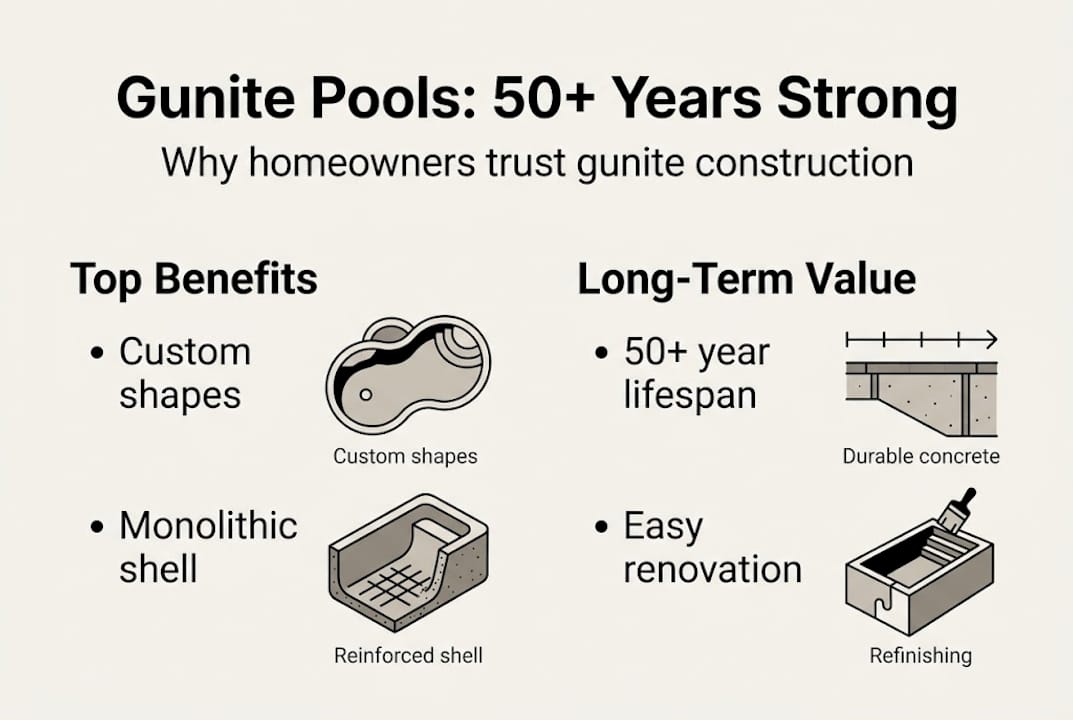
- Gunite pools offer superior design flexibility, strength, and lifespan exceeding 50 years.
- Building a gunite pool involves multiple phases, including rebar framework, spray application, and curing.
- Proper construction and maintenance ensure durability, making gunite a long-term investment in Florida.
Not all concrete pools are created equal, and if you’ve been treating them as interchangeable, you may be leaving serious performance and longevity on the table. Gunite stands apart from other pool types in ways that matter most to Central Florida homeowners: design freedom, structural strength, and a lifespan that can exceed 50 years with proper care. Superior control for custom features is one of gunite’s defining advantages over other pool construction methods. This guide walks you through exactly how gunite pools are built, what they cost, how to maintain them, and why they remain the preferred choice for homeowners who want a pool that’s truly their own.
Table of Contents
- What is gunite construction? Key concepts explained
- Step-by-step: The gunite pool construction process
- Customization, design flexibility, and add-on features
- Cost, maintenance, and long-term value
- The bigger picture: Why gunite still sets the standard
- Ready to plan your dream gunite pool?
- Frequently asked questions
Key Takeaways
| Point | Details |
|---|---|
| Gunite defined | Gunite is a dry-mix, sprayed-on concrete method especially favored for custom inground pools. |
| Step-by-step build | Building a gunite pool involves several stages, from design to curing, spanning 8–24 weeks. |
| Unmatched flexibility | Gunite lets you create intricate shapes and add-ons that are tough with other materials. |
| Longevity and value | A well-maintained gunite pool can last over 50 years, providing strong long-term value. |
| Smart homeowner choices | Understanding gunite helps Central Florida homeowners get a durable, beautiful custom pool tailored to their needs. |
What is gunite construction? Key concepts explained
To lay the groundwork, let’s define what gunite construction actually means and why it matters for your pool project.
Gunite is a specific type of concrete application used to build the shell of an inground pool. Unlike poured concrete, gunite is a dry-mix method where sand and cement travel through a hose separately and mix with water only at the nozzle. This gives the crew precise control over the mix consistency at every point during the spray, which is a big deal when you’re building around curves, ledges, and tight angles.
Here’s why that process matters for Central Florida pools:
- Seamless shell formation: Because gunite is sprayed in layers over a steel rebar framework, there are no seams or joints where water can penetrate.
- Adaptable to any shape: The nozzle can reach corners, overhangs, and curved walls that would be difficult to form with other methods.
- Strong structural bond: The dry-mix process creates a dense, high-strength concrete that bonds tightly to the rebar skeleton.
- On-site flexibility: Crews can adjust the water ratio in real time, which helps account for Florida’s heat and humidity during the spray.
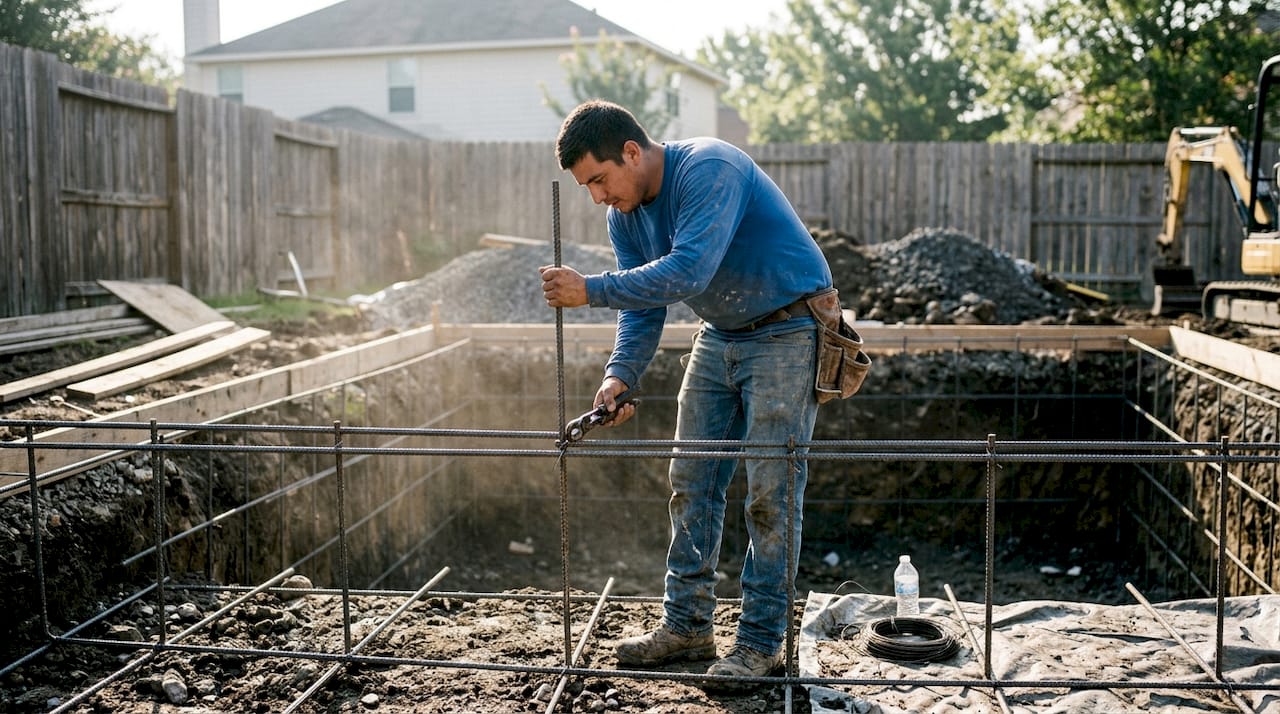
The basic structure of every gunite pool starts with a rebar grid that forms the skeleton of the shell. Workers tie steel bars into the exact shape of your pool design, then a trained nozzle operator pneumatically applies (meaning air-pressure propelled) the gunite mixture over the entire framework.
| Feature | Gunite | Standard poured concrete |
|---|---|---|
| Mix method | Dry, mixed at nozzle | Pre-mixed before pour |
| Seams | None | Possible at form joints |
| Shape flexibility | Very high | Limited by formwork |
| Structural density | High | Moderate |
For homeowners exploring custom concrete pool features, gunite’s seamless shell integration is one of the strongest reasons to choose it over alternatives.
Pro Tip: Ask your builder to show you the rebar layout before gunite is sprayed. Proper rebar spacing, typically every 12 inches in both directions, is what separates a pool that lasts decades from one that cracks prematurely.
Step-by-step: The gunite pool construction process
Now that you know what gunite is, let’s break down the entire construction process so you can plan your pool with confidence.
Building a gunite pool is not a weekend project. The full build process includes design, excavation, plumbing, rebar installation, gunite spraying, curing, and finishing, with total timelines ranging from 8 to 24 weeks depending on complexity. Here’s what each phase looks like:
- Design and permitting (1 to 3 weeks): You finalize your pool’s shape, depth, and features with your contractor. Permits are submitted to your local municipality. In Central Florida, this step can take longer during busy seasons.
- Excavation (1 to 3 days): Heavy equipment digs the pool cavity to the exact dimensions of your design. Soil conditions in Florida, especially sandy or clay-heavy ground, can affect this timeline.
- Plumbing and electrical rough-in (3 to 7 days): Pipes for circulation, drainage, and equipment are laid before the shell is formed. This is a critical step that affects your pool’s long-term efficiency.
- Rebar framework (3 to 5 days): Steel bars are tied into a grid that mirrors your pool’s shape. This skeleton is what gives gunite its structural strength.
- Gunite application (1 to 2 days): The gunite is sprayed over the rebar framework by a certified crew. Speed matters here because the mix begins setting quickly.
- Curing (7 to 10 days): The shell must be kept consistently wet to cure properly. Skipping or rushing this step is one of the most common causes of surface cracking.
- Finishing and tile work (1 to 3 weeks): Plaster, pebble, or quartz finishes are applied. Tile, coping, and decking are installed around the pool.
- Equipment installation and fill (3 to 7 days): Pumps, filters, heaters, and automation systems are connected. The pool is filled and water chemistry is balanced.
For a detailed look at what to expect locally, reviewing custom installation steps and the full inground pool installation guide can help you prepare for each phase.
Pro Tip: During the curing phase, keep the gunite surface wet by misting it several times a day for 7 to 10 days. Florida’s heat speeds up moisture loss, and a properly cured shell can add years to your pool’s life.
Customization, design flexibility, and add-on features
With the construction steps in mind, next let’s explore what makes gunite pools the top choice for unique and customized outdoor spaces.
This is where gunite truly separates itself. Gunite is preferred over shotcrete for complex curves and custom features, giving designers and homeowners far more creative freedom. Because the material is applied by hand with a spray nozzle, your pool can take almost any shape imaginable.
For Central Florida homeowners, that means you’re not choosing from a catalog of preset shapes. You’re designing something that fits your yard, your lifestyle, and your vision. Popular custom features our clients request include:
- Freeform shapes that follow the natural contours of the landscape
- Tanning ledges (also called baja shelves) for lounging in shallow water
- Integrated spas that share the pool’s heating and filtration system
- Grottos and waterfalls for a resort-style atmosphere
- Swim-up bars and seating ledges built directly into the shell
- Beach entries that slope gradually from zero depth
- Raised bond beams for dramatic visual elevation
To understand how these choices affect your overall project, reviewing custom pool design options gives you a clearer picture of what’s possible in Florida’s climate and landscape.
| Feature | Gunite | Shotcrete |
|---|---|---|
| Complex curves | Excellent | Good |
| Custom shapes | Unlimited | Limited by wet mix |
| On-site adjustments | Easy | Difficult |
| Cost range | $60k to $110k+ | Similar, slightly lower |
| Best for | Custom, high-detail builds | Faster, simpler builds |
The concrete pool benefits that come with gunite construction go beyond looks. Because the shell is monolithic (meaning one continuous piece with no seams), it holds up better under Florida’s shifting soils and frequent rain cycles than modular alternatives.
Cost, maintenance, and long-term value
After understanding options for customization, it’s essential to know what kind of investment and upkeep gunite pools actually require.
Gunite pools are not the cheapest option upfront, but they are among the most cost-effective over a lifetime. Installation typically costs between $60,000 and $110,000 or more, with resurfacing needed every 7 to 20 years at a cost of $10,000 to $20,000, and a potential lifespan exceeding 50 years with proper maintenance.
| Cost category | Typical range |
|---|---|
| Initial installation | $60,000 to $110,000+ |
| Resurfacing (every 7 to 20 years) | $10,000 to $20,000 |
| Annual maintenance | $1,500 to $3,500 |
| Major repairs (if needed) | $2,000 to $8,000 |
Understanding the pool cost factors that affect your specific project helps you budget more accurately from the start.
Main maintenance requirements for gunite pools include:
- Weekly water chemistry checks to keep pH, alkalinity, and sanitizer balanced
- Brushing the pool walls and floor at least twice a week to prevent algae buildup on porous surfaces
- Annual equipment inspections for pumps, filters, and heaters
- Periodic acid washing every 3 to 5 years to remove calcium deposits and surface staining
- Resurfacing when the finish shows roughness, staining, or structural wear
“A well-maintained gunite pool can last 50 years or more, making it one of the longest-lasting investments a homeowner can make in their property.”
The brushing requirement is worth noting specifically. Because gunite surfaces are slightly porous, algae can take hold faster than on fiberglass. But this same porosity is what allows plaster and pebble finishes to bond so well, giving you a surface that looks and feels premium for years.
The bigger picture: Why gunite still sets the standard
Stepping back, let’s look at why gunite construction remains so trusted even as new materials and shortcuts are introduced.
We’ve been building pools in Central Florida since 1985, and we’ve seen trends come and go. Fiberglass got faster. Vinyl got cheaper. But when homeowners want something that will still look great in 30 years and hold its structural integrity through Florida’s wet seasons and shifting soils, they consistently come back to gunite.
Here’s the uncomfortable truth about shortcuts: the curing phase is where most problems start. Builders under schedule pressure sometimes rush the cure, or skip adequate misting, and the result shows up as cracks two or three years later. By then, the original crew is long gone and you’re left with repair bills.
The benefits of custom pool design are only fully realized when the construction underneath is done right. A beautiful tanning ledge or waterfall means nothing if the shell beneath it is compromised.
Our honest advice: don’t let price alone drive your builder selection. Ask specifically about their gunite experience, how long they’ve been operating locally, and request references from projects at least five years old. A pool that looks great on day one is not the same as a pool that holds up through a decade of Florida summers. Long-term value always wins over short-term savings when you’re talking about a structure built into your yard permanently.
Pro Tip: Always verify your builder’s gunite experience and ask for local references from projects completed at least five years ago. Florida’s climate is demanding, and only experienced crews know how to account for it.
Ready to plan your dream gunite pool?
When you’re ready to move from learning to building, you don’t have to navigate the process alone.
At R&R Swimming Pools, we’ve been designing and building custom gunite pools across Central Florida since 1985. Our team handles every phase, from your first design consultation through final water fill, so nothing falls through the cracks. Whether you’re drawn to a freeform lagoon or a sleek geometric design with an integrated spa, we build it to last. Explore Florida pool construction options, review the concrete pool advantages that matter most in our climate, or use our inground pool installation guide to start planning your project today.
Frequently asked questions
How does gunite differ from shotcrete in pool construction?
Gunite mixes water at the nozzle for greater on-site flexibility, while shotcrete is premixed before application, making gunite the better choice for complex custom shapes and tight design details.
How long do gunite pools last compared to other pools?
With proper maintenance, gunite pools last 50 years or more, which typically outlasts both fiberglass and vinyl liner alternatives by a significant margin.
What is the average build time for a gunite pool?
A typical gunite pool takes between 8 to 24 weeks to complete from design to final fill, depending on the complexity of your design and local permitting timelines.
How often does a gunite pool need resurfacing?
Gunite pools typically need resurfacing every 7 to 20 years, with costs ranging from $10,000 to $20,000 depending on the finish type and pool size.
Is gunite suitable for saltwater pools?
Yes, gunite pools work well with saltwater systems as long as you use a specialty finish designed to resist salt exposure and keep up with regular water chemistry monitoring to protect the surface long-term.
Recommended
- Concrete Pool Advantages Explained: Florida’s Top Choice
- New Pool Construction Lake County FL | Custom Inground Pools
- Custom Concrete Pool Building | R & R Swimming Pools
- Custom Concrete Pool Building in Montverde, FL | R & R Swimming Pools
- Top Boca Raton Apartments with Pools — What to Look For and Where to Find Them – Luxury Apartments for Rent in Boca Raton | Premium Boca Raton Apartments | Aapartments Boca Raton
