
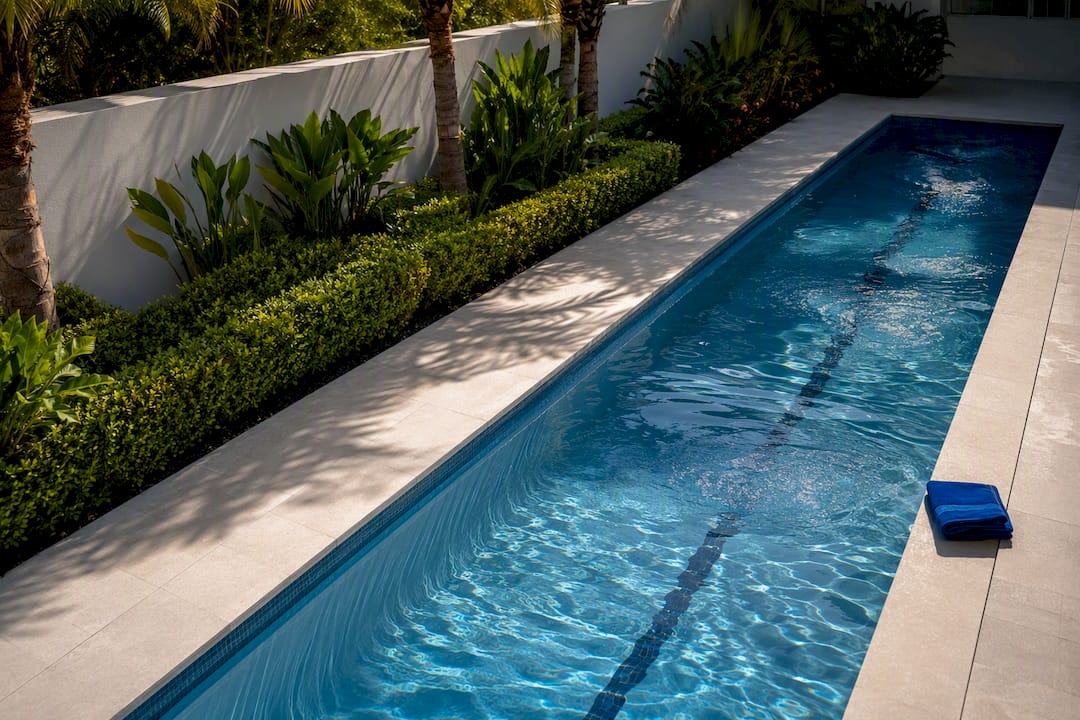
Most residential lap pools run 40 to 75 feet long, with 50 to 60 feet hitting the sweet spot for daily fitness swimming. A single lane should be 7 to 10 feet wide, and depth should stay uniform at 4 to 4.5 feet across the whole pool. If your lot can’t accommodate that length, a shorter pool (30 to 40 feet) paired with a swim jet closes the gap, and fiberglass shells cap out around 40 feet before gunite becomes your only custom option.
TL;DR:
- Most residential lap pools should be between 50 and 60 feet long for effective training without taking up excessive yard space.
- Single lanes need 8 to 10 feet of width, and pools should have a uniform depth of 4 to 4.5 feet to ensure steady water movement and lower maintenance costs.
- Fiberglass shells are limited to fixed sizes up to 40 feet, while gunite offers custom lengths beyond 45 feet with longer construction times and higher costs.
- Lot size and setbacks primarily determine your feasible pool dimensions, making site surveys essential before finalizing size and shape.
- Depth beyond 4.5 feet offers minimal benefit for casual swimmers but helps serious athletes with flip turns and stroke comfort; competition pools are deeper but unnecessary for home use.
Table of Contents
- What Are the Standard Lap Pool Dimensions?
- How Do You Choose a Size for Your Yard?
- Fiberglass or Gunite: Which Fits Your Target Dimensions?
- What Design Factors Change Your Effective Pool Size?
- Builder Perspective: Turning Dimensions Into a Buildable Plan
- How Do Pool Size and Depth Affect Safety?
- Do Lap Pools Need Lane Dividers?
- How Does Pool Size Affect Maintenance?
- Which Pool Shape Swims Best in a Small Yard?
- How Deep Should a Lap Pool Be for Different Swimmers?
- Residential vs. Commercial Lap Pool Dimensions
- Why Most Homeowners Overthink Lap Pool Length and Underthink Width
- Ready to Build? How R&R Swimming Pools Approaches Custom Lap Pools
- Sources
What Are the Standard Lap Pool Dimensions?
Anything under 30 feet stops functioning as a real lap pool. You spend more time pushing off walls and executing turns than actually swimming, and the stroke rhythm you’re chasing never develops. That’s the physics of it: a competitive swimmer covers roughly 1.5 to 2 body lengths per stroke cycle, so a pool shorter than 30 feet turns every lap into a start-stop shuffle instead of continuous swimming.
Lengths around 50 to 60 feet provide adequate distance for swimmers to maintain consistent stroke and breathing patterns without frequent interruptions. This range has become the default recommendation among pool designers for exactly that reason. It’s long enough to train seriously, short enough to fit most suburban lots without eating the entire backyard.
Width matters more than most homeowners assume going in. A true single lane needs 7 to 9 feet of clear water to avoid clipping the wall mid-stroke, and 8 to 10 feet is the more comfortable residential target because it gives you room for bilateral breathing without brushing a shoulder against the edge on every third stroke. Go narrower than 7 feet and freestyle swimmers start adjusting their stroke just to stay centered, which defeats the purpose of building a dedicated lane in the first place. A two-lane layout, meant for a spouse or training partner to swim alongside you, needs roughly 16 to 18 feet total.
Depth is where residential design diverges most sharply from what people picture when they hear “swimming pool.” Lap pools skip the deep end entirely and hold a uniform depth of 4 to 5 feet, with 4 to 4.5 feet as the practical target. Uniform depth keeps turbulence down, since water moving across a flat floor behaves more predictably than water sloshing between shallow and deep zones, and it also caps how much water you need to heat and treat. Competitive facility standards from FINA call for greater depth and stricter lane widths at the elite level, but those thresholds exist for meet conditions, not for a homeowner doing morning laps before work.
| Dimension | Compact | Standard Residential | Serious Training |
|---|---|---|---|
| Length | 30–40 ft | 50–60 ft | 75 ft (25 yd) or 82 ft (25 m) |
| Width (single lane) | 7–8 ft | 8–10 ft | 9–10 ft |
| Depth | 4 ft | 4–4.5 ft | 4.5–5 ft |
How Do You Choose a Size for Your Yard?
Your lot dictates the starting point more than any workout goal does. A yard that can’t fit a 50-foot run doesn’t automatically rule out lap swimming, it just changes the tool you pair with the pool.
Compact lots (30 to 40 feet): This length alone gets you maybe 8 to 10 strokes per lap before you’re turning again. Add a swim jet or counter-current system and the math changes completely, because you’re now swimming against a continuous current instead of covering ground. Homeowners on narrow or shallow lots use this combination most often. If your backyard is long and skinny rather than square, a narrow yard layout can still deliver a legitimate training lane.
Standard residential (40 to 60 feet): This is where most custom lap pools land, and for good reason.
- At 50 feet, expect roughly 12 to 16 strokes per length, enough for a real warmup set and interval training.
- At 60 feet, you can string together longer sets without feeling like you’re constantly flipping and pushing off.
- This range fits comfortably on a quarter-acre lot once you account for decking and setbacks.
Competition-oriented (75 to 82 feet): A 25-yard (75 ft) or 25-meter (82 ft) pool matches the short-course standards swimmers train on for USA Swimming-sanctioned events. This length only makes sense if you have the acreage and the budget, and it usually means gunite construction since fiberglass shells don’t reach this size. Homes with this kind of footprint often lean into a luxury lap pool build that treats the pool as a design centerpiece rather than a purely functional lane. For a sense of what different footprints look like on actual Central Florida lots, this pool size comparison breaks down common yard sizes against realistic pool dimensions.
Fiberglass or Gunite: Which Fits Your Target Dimensions?
The material you choose limits, or frees up, the dimensions you can actually build. This decision usually happens earlier in the process than most homeowners expect, often before the final length is even locked in.
- Fiberglass shells come pre-manufactured in fixed sizes, commonly 30, 35, and 40 feet, which means your length choice is really a choice among a handful of factory molds.
- Fiberglass installs faster, often in a matter of weeks rather than months, and typically comes with a manufacturer warranty on the shell itself.
- Gunite and concrete construction has no shell to work around, so length becomes a design decision rather than a shopping decision. Want 55 feet instead of 40? Gunite gets you there.
- Gunite costs more and takes longer to cure and finish, generally adding weeks to the timeline compared to a fiberglass drop-in.
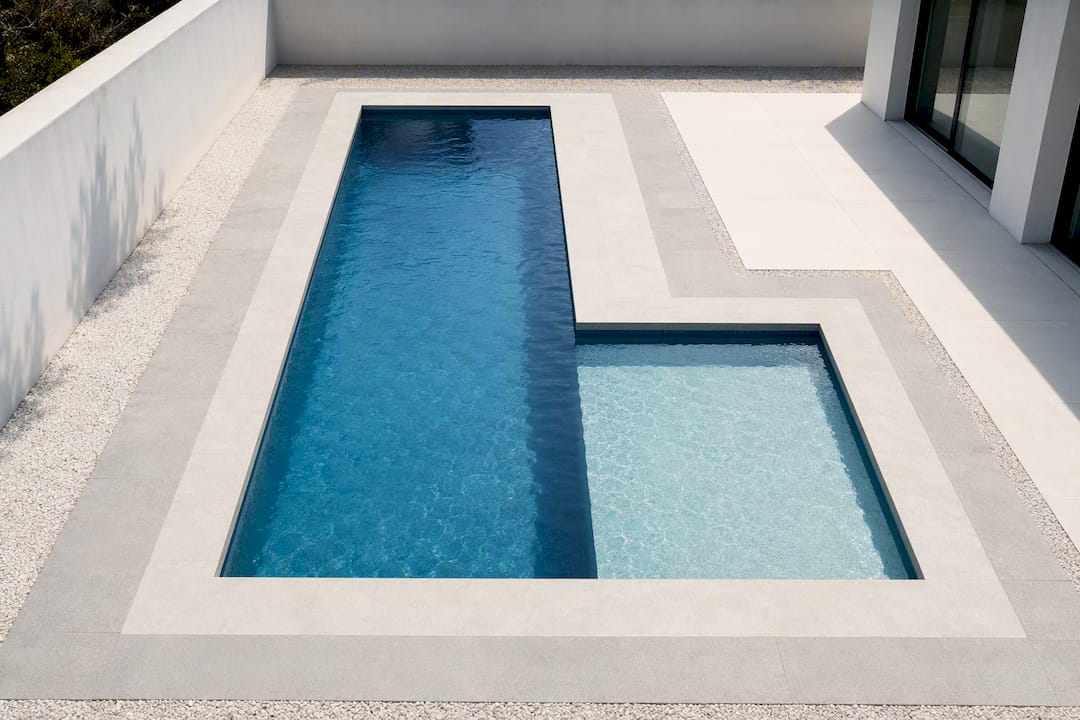
- L-shaped layouts, attached spas, and anything beyond a straight rectangle require gunite, since fiberglass molds are cast in fixed shapes.
If your target length falls at or under 40 feet, fiberglass is worth strong consideration for the speed and lower long-term maintenance. Once you’re planning past 45 feet or want a custom shape, gunite becomes the only realistic path, and a custom pool installation guide walks through how that process differs from a standard build.
What Design Factors Change Your Effective Pool Size?
The dimensions on paper rarely match the dimensions you end up swimming in, once you factor in the site itself. A few variables consistently shrink or reshape the plan between the first sketch and the final excavation.
Water volume and heating. Width and depth drive volume more than length does, since you’re multiplying all three. A narrower lap pool at 8 feet wide instead of a 15-foot recreational rectangle holds meaningfully less water, and narrower pools can cut heating costs by roughly 25 to 35% compared to wider recreational designs, though the exact number depends on climate and heater efficiency.
Statistic Callout: Trimming pool width from a recreational 15 feet down to a lap-focused 8 to 10 feet can lower ongoing heating costs by roughly a quarter to a third, simply because there’s less water to bring up to temperature.
Setbacks and site constraints. Local codes usually require a buffer between the pool edge and property lines, fences, or septic fields, and that buffer eats directly into your usable run length. A lot that measures 65 feet from house to back fence rarely yields a 60-foot pool once setbacks, decking, and equipment pads are subtracted. A site survey before you commit to a length is what prevents the classic mistake of designing a 55-foot pool for a 50-foot space.
Swim jets as a space-saving alternative. Where the yard simply won’t allow the length you want, a counter-current swim jet turns a 30 to 40-foot pool into a continuous-swim experience, letting you train against resistance instead of relying on distance.
Combining a lane with social space. An L-shaped design or an attached shallow shelf lets you keep a full-length training lane while still giving kids or guests a shallow area to lounge in, without shortening the lane itself. Reviewing your pool depth planning options by activity helps map out where that shallow zone can go without compromising the swim lane’s uniform depth.
Builder Perspective: Turning Dimensions Into a Buildable Plan
Choosing numbers on paper is the easy part. Turning 55 feet by 9 feet by 4.5 feet into an actual excavation requires a site survey that checks the details most homeowners never think to measure.
- Usable run length after subtracting setbacks, easements, and any HOA buffer requirements.
- Utility lines, septic fields, and drainage paths that might sit exactly where the deep excavation needs to go.
- Overhead obstructions like tree canopies or power lines that affect equipment access during construction.
- Deck width and coping choices, since a 4-foot deck on each side effectively narrows your buildable footprint by 8 feet.
- Safety fencing placement, which in many jurisdictions has to sit a set distance from the water’s edge.
R&R Swimming Pools weighs fiberglass against gunite for every lot individually, since a shell that fits one backyard in Clermont might be the wrong call for a narrower lot two streets over. Deck and coping decisions often shave a few feet off the “ideal” length once they’re accounted for on the actual survey, which is why the numbers on a sketch and the numbers in the ground rarely match exactly.
Pro Tip: Measure your usable run length before you fall in love with a specific pool length. A 60-foot dream pool on paper often becomes a 52-foot pool once setbacks and deck width get subtracted from the real lot.
How Do Pool Size and Depth Affect Safety?
Uniform depth does more than help your stroke mechanics, it also simplifies the safety picture. A pool that holds 4 to 4.5 feet across its entire length means every point along the edge presents the same risk profile, which makes it easier to plan consistent fencing, alarms, and supervision rules rather than treating a shallow end differently from a deep end.
Length and width shape emergency access more than people expect. A longer, narrower lap pool needs exit points spaced along both sides rather than concentrated at one end, since someone in distress in the middle of a 60-foot run needs a nearby edge, not a swim back to the shallow steps. Most residential lap pools include a step or ladder at each end at minimum, and pools over roughly 40 feet often add a mid-length exit point or a wide step recessed into one long side.
Edge design matters just as much as exit count. A rounded or beveled coping edge reduces injury risk if a swimmer grabs the edge awkwardly during a flip turn, and a non-slip deck surface around the entire perimeter cuts down on the most common lap-pool injury: slipping on wet concrete or pavers during the walk from the house to the water. Because lap pools lack a shallow end for kids to wade in gradually, fencing and self-latching gates carry more weight in the overall safety plan than they might for a freeform recreational pool. Local code typically dictates specific fence height and latch requirements, and those rules apply the same way regardless of whether the pool is a compact 35-footer or a full 75-foot training lane.
Do Lap Pools Need Lane Dividers?
Most residential lap pools skip lane dividers entirely, and that’s the right call for the vast majority of homeowners. Floating lane ropes and dividers are built for competitive and training facilities where multiple swimmers share a pool simultaneously and need a visual and physical boundary to stay in their own water.
A single-lane residential pool at 8 to 10 feet wide doesn’t need a divider because there’s only one swimmer using the space at a time. Where dividers start to matter is in a two-lane build, roughly 16 to 18 feet wide, meant for a couple or training partners to swim side by side. In that setup, a lightweight floating lane line anchored at both ends keeps swimmers from drifting into each other’s path mid-stroke, particularly during backstroke sets when visual reference points disappear.
Competitive facilities follow strict lane-width standards set by FINA and USA Swimming, typically around 7 to 9 feet per lane measured centerline to centerline, with permanent floating dividers between every lane. Those standards exist to prevent contact between swimmers moving at race pace, a concern that simply doesn’t apply to a backyard pool used by one or two people. If you’re building a two-lane residential pool and want the option later, most contractors can install anchor points for a removable lane line during construction rather than retrofitting them afterward, which is a far more expensive fix.
How Does Pool Size Affect Maintenance?
Bigger isn’t automatically harder to maintain, but the shape and depth profile change what maintenance actually looks like week to week. A longer, narrower lap pool has less surface area per linear foot than a wide recreational pool of the same length, meaning less water exposed to evaporation, less debris settling into the water, and generally lower chemical demand for the volume of swimming space it provides.
Uniform depth simplifies filtration and circulation planning considerably. A pool that stays at 4 to 4.5 feet throughout doesn’t create the dead zones and uneven circulation patterns you get in a pool with a sloped shallow end transitioning into a deep well, since water moves more evenly across a flat floor and skimmers and returns can be spaced consistently along the length rather than clustered around a deep end. That translates to more predictable filter run times and fewer algae hot spots forming in low-circulation corners.
Length introduces its own tradeoff. A 75-foot competition-length pool holds substantially more water than a 40-foot compact pool, which means more total chemical volume to balance and a larger surface for leaves and debris to land on, even though the narrow width keeps that surface area more modest than a same-length recreational pool would produce. Shape complexity adds maintenance overhead too. An L-shaped design with an attached shallow shelf has more corners and edges where debris collects and circulation weakens compared to a straight rectangular lane, so homeowners choosing that layout for social flexibility should expect slightly more skimming and edge-brushing than a simple straight lap lane requires.
Which Pool Shape Swims Best in a Small Yard?
A straight rectangle remains the most efficient shape for actual swimming, full stop. Every foot of length in a rectangle is usable swimming distance, with no water wasted on curves, corners, or transitional zones that don’t contribute to the stroke.
Kidney and freeform shapes look appealing in a landscaping rendering, but they’re the worst choice for anyone prioritizing laps. Curved walls interrupt sightlines down the length of the pool, and the varying width along a kidney shape means your stroke has to adjust constantly rather than settling into a consistent rhythm. If swimming performance is the actual goal, that shape works against you no matter how good it looks from the patio.
For tight lots, a straight rectangle at minimal width, 7 to 8 feet, maximizes length within a fixed footprint better than any shape with curves or tapering. Every square foot goes toward swimming distance instead of aesthetic flourish. Where a homeowner wants both a lane and a social gathering spot, an L-shape preserves a full straight run for laps while adding a shorter perpendicular leg for lounging, and that design keeps the training lane at full length rather than compromising it for the sake of a shallow shelf. The key discipline with an L-shape is keeping the swim leg genuinely straight and uninterrupted, since any taper or curve introduced into that leg to save space defeats the entire purpose of building a dedicated lane in the first place.
How Deep Should a Lap Pool Be for Different Swimmers?
Depth needs shift depending on who’s using the pool and how seriously they train, even though the standard 4 to 4.5-foot range covers most residential situations well. A recreational swimmer doing casual laps a few times a week doesn’t need depth beyond that range at all, since the goal is simply clearing the bottom during strokes and turns without excessive water volume driving up heating costs.
Someone training more seriously, doing flip turns at the wall or swimming with a more aggressive stroke that generates deeper arm pull, benefits from the upper end of that range, closer to 4.5 to 5 feet. That extra half foot to a foot of depth gives more clearance during flip turns, where a swimmer’s body rotates below the surface, and reduces the chance of scraping the bottom during a mistimed turn. Depth also affects how a stroke feels physically. Very shallow water, anything under 3.5 feet, creates a choppier swimming experience because the body sits closer to the surface interaction of waves bouncing off the bottom, which is part of why 4 feet functions as a practical floor rather than a ceiling for most builds.
Competitive and facility-standard depths run deeper still. FINA and USA Swimming sanctioned pools require significantly greater depth than residential guidance suggests, largely to accommodate racing starts and turns at speed that residential swimmers never approach. A homeowner training for fitness, even a serious one doing structured interval sets, doesn’t need to match those competitive thresholds, since the reasoning behind them (starting blocks, race-pace turns, multiple lanes of simultaneous swimmers) simply doesn’t apply to a backyard lane used by one or two people at a time.
Residential vs. Commercial Lap Pool Dimensions
The gap between a backyard lap pool and a commercial or facility lap pool comes down to scale, regulation, and purpose, and conflating the two leads homeowners to overbuild for a use case they’ll never actually have. Residential lap pools, as covered throughout this guide, generally run 40 to 75 feet, with width and depth scaled to a single swimmer or occasional training partner rather than a full roster of simultaneous users.
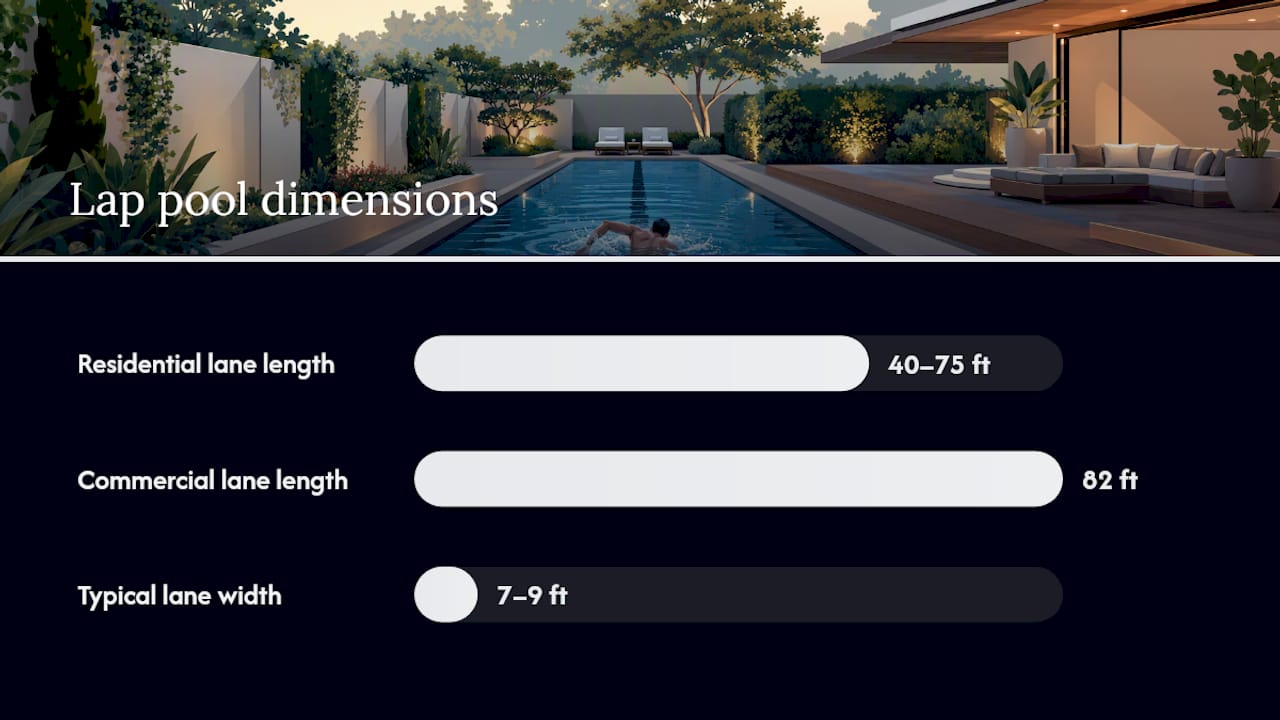
Commercial and institutional facilities operate under an entirely different set of constraints. A community center or school pool typically needs multiple lanes side by side, each meeting the 7 to 9-foot width standards set by governing bodies, plus depth sufficient for diving starts and simultaneous multi-lane use during competition or lesson time. These facilities also face stricter code requirements around accessibility, lifeguard sightlines, and bather load calculations that simply don’t apply to a private backyard pool used by a household.
Cost and construction timeline diverge sharply as a result. A commercial facility building six lanes at 82 feet each is managing a project an order of magnitude larger than a homeowner’s single 55-foot lane, with corresponding differences in permitting, engineering, and mechanical systems. For residential purposes, borrowing commercial dimensional thinking, wider lanes, greater depth, multiple parallel lanes, almost always means overbuilding relative to actual need. The practical takeaway for most homeowners is straightforward: match your dimensions to how you’ll actually use the pool, not to the standards written for a facility serving dozens of simultaneous swimmers.
Why Most Homeowners Overthink Lap Pool Length and Underthink Width
The conventional advice on lap pool planning spends most of its energy on length, and that emphasis is backwards. Length is the easy number, pick something between 40 and 60 feet and you’re in reasonable territory for almost any residential goal. Width is where the real design decisions live, and it’s the dimension most homeowners shortchange to save a few square feet of yard.
A pool that’s 60 feet long and 7 feet wide will frustrate a swimmer far more than a pool that’s 45 feet long and 9 feet wide, because narrow water forces constant stroke correction that breaks rhythm on every single length. If the budget and the yard force a tradeoff, give up length before giving up width. A shorter pool with a swim jet still delivers a real workout. A long, narrow pool just delivers a longer version of an uncomfortable swim.
The other underrated lever is build method. Homeowners often pick a length first and then discover it doesn’t match any fiberglass shell, when flipping that order, choosing the material based on the target dimensions, saves a redesign later. Start with how you’ll actually train, size the width generously, and let length follow from what the lot and the budget can support.
— Results
Ready to Build? How R&R Swimming Pools Approaches Custom Lap Pools
Randrswimmingpools has spent decades building custom inground pools across Central Florida, and lap pools bring their own set of decisions: shell size versus gunite flexibility, width versus length tradeoffs, and how much yard you actually have to work with once setbacks are factored in. Where other routes leave homeowners guessing between generic online calculators or a one-size-fits-all shell catalog, Randrswimmingpools starts with an on-site survey of your actual lot before recommending a single dimension.
That site visit is where theoretical dimensions meet reality. Randrswimmingpools walks through fiberglass shell options for straightforward rectangular lanes and gunite construction for custom lengths, L-shapes, or anything past 45 feet, then builds a plan around what your specific backyard can support. The inground pool installation guide walks through what that process looks like from first sketch to final plaster, and it’s the natural next step once you have a target length and width in mind. If you’re ready to see how your yard translates into an actual buildable lap pool, schedule a free consultation and site visit with Randrswimmingpools to get real numbers instead of estimates.
Sources
- Lap Pool Design Visualizer – Design Your Custom Lap Swimming Pool
- Lap Pool Ideas: Designs, Dimensions & Real 2026 Costs | PoolPad
- Lap Pool Installation: Dimensions, Design, and Installer Selection | Pool Installer Authority