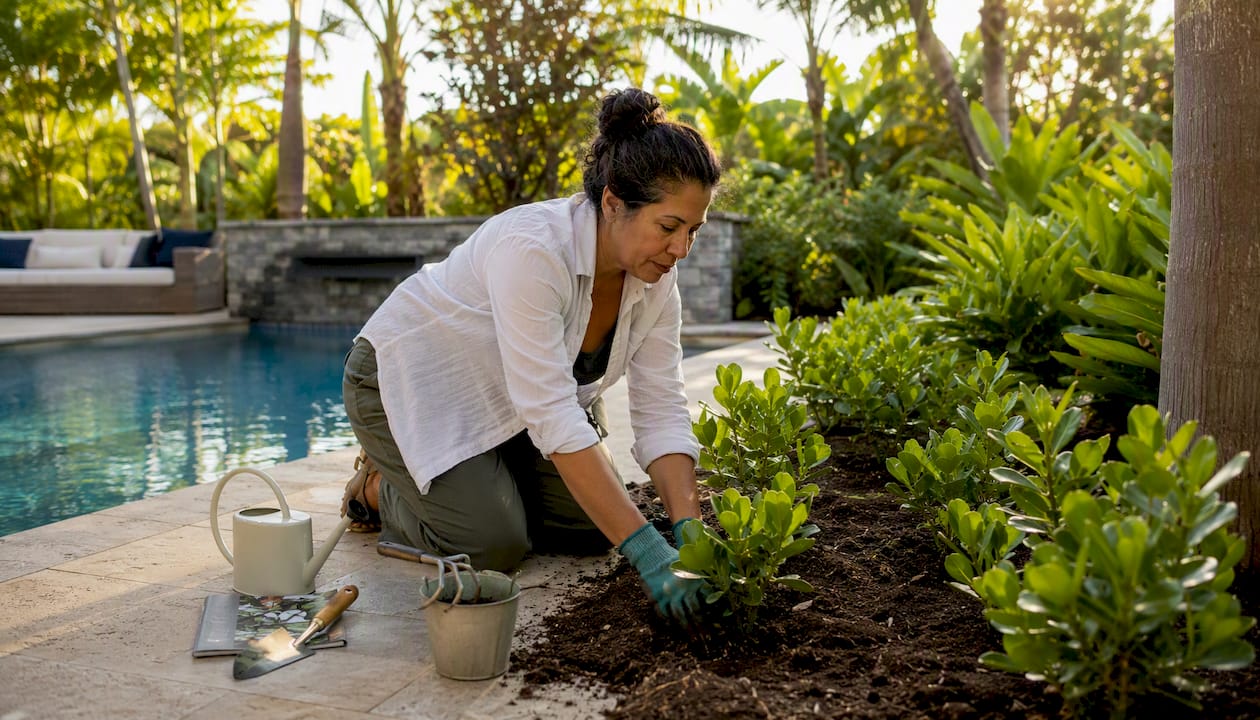
For most pool yards, ornamental grasses, coontie, dwarf Clusia, bird of paradise, and container-grown cannas or crotons deliver the best combination of low litter, minimal root risk, and resort-style looks. Keep splash-tolerant species within 6 feet of the pool edge and place higher-litter or root-aggressive plants farther back. According to UF/IFAS, bird of paradise, hibiscus, cordyline, ginger, croton, and bromeliads are proven poolside performers across Florida’s hardiness zones.
Top pool-friendly picks at a glance:
- Dwarf Clusia — dense privacy hedge, fibrous roots, minimal leaf drop
- Coontie (Zamia integrifolia) — native, low-growing, splash-tolerant
- Bird of Paradise (Strelitzia) — bold tropical color, low litter
- Muhly grass — feathery texture, near-zero debris, drought-tolerant
- Hibiscus — fast-growing color, handles splash well
- Canna — vivid container accent, easy seasonal refresh
- Ornamental grasses (general) — structural, low-maintenance, filter-friendly
Table of Contents
- What are the best pool-friendly landscaping plants by role?
- Practical planting tips that prevent the most common pool problems
- Which plants should you avoid near a pool?
- How do you choose the right plants for your pool?
- What Central Florida homeowners need to know about poolside plants
- How should you water plants near a pool?
- What pests and diseases should you watch for near pools?
- How does seasonal care differ for pool-area plants?
- Key Takeaways
- The plant choices that actually save money over time
- How Randrswimmingpools builds pool landscapes that work from day one
What are the best pool-friendly landscaping plants by role?
Grouping plants by what they actually do in the yard makes selection far easier than scrolling through a generic species list.
Privacy hedges
Dwarf Clusia (Clusia guttifera) is the go-to privacy hedge for Florida pool yards. Dense evergreen foliage, almost no seasonal leaf drop, and a fibrous root system that won’t lift pavers make it genuinely hard to beat for the 6-to-15-foot zone around a pool deck. It tolerates occasional chlorinated splash without leaf scorch, which most hedges cannot say.
Podocarpus (Podocarpus macrophyllus) is a tighter, more formal alternative. It grows slowly to 10–15 feet, takes shearing well, and drops almost nothing into the water. USDA zones 8b–11.
Cocoplum (Chrysobalanus icaco) handles beachfront salt spray better than Clusia and is worth considering for coastal or high-humidity sites where ocean spray is a factor.
Low-litter structural plants
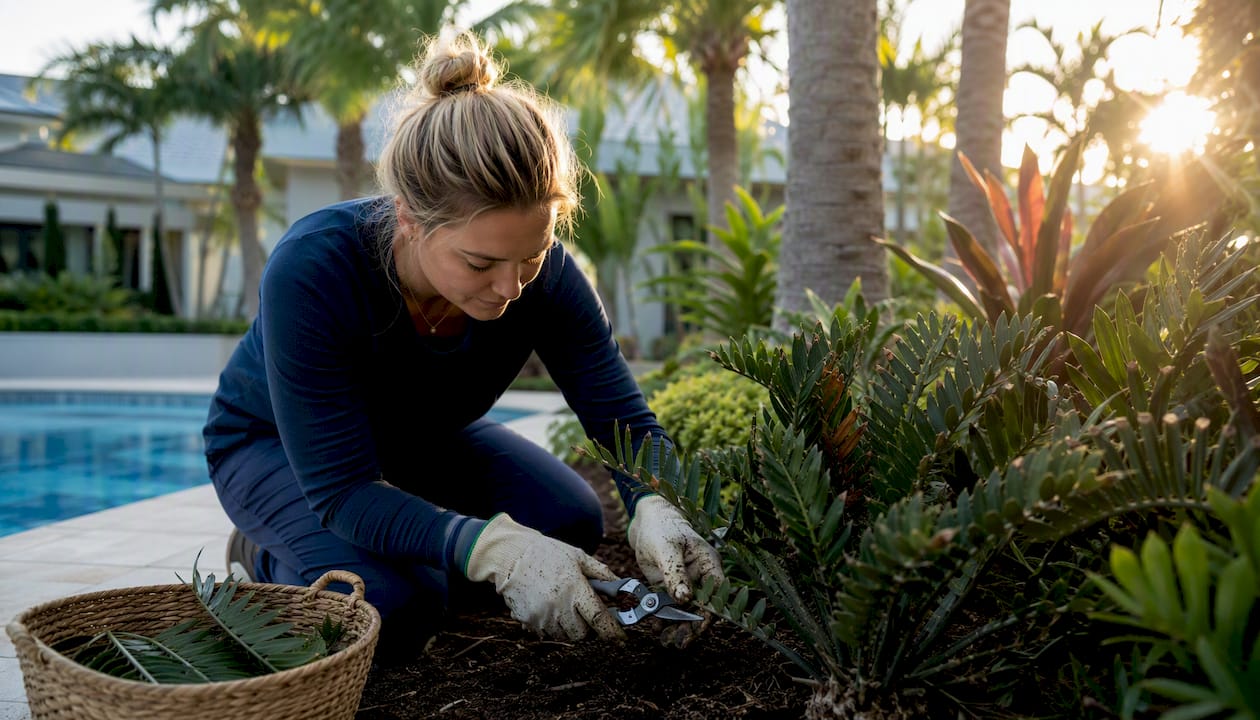
Coontie (Zamia integrifolia) is a Florida native that stays under 3 feet, tolerates both drought and occasional flooding, and produces almost no debris. It handles chlorine and salt splash without complaint, making it one of the most recommended backbone plants for the immediate pool perimeter.
Boxwood (Buxus spp.) works well in zones 5–9 as a compact, formal edging shrub. It’s slow-growing, easy to shear, and drops minimal foliage. In Central Florida’s heat, choose heat-tolerant varieties like ‘Green Mountain’ or ‘Wintergreen’ and keep them slightly back from direct splash.
Ligustrum (Ligustrum japonicum) is a dense evergreen shrub that clips into a tight hedge and tolerates full sun. It does produce small berries that can drop, so site it at least 8–10 feet from the pool edge.
Tropical and resort-style accents
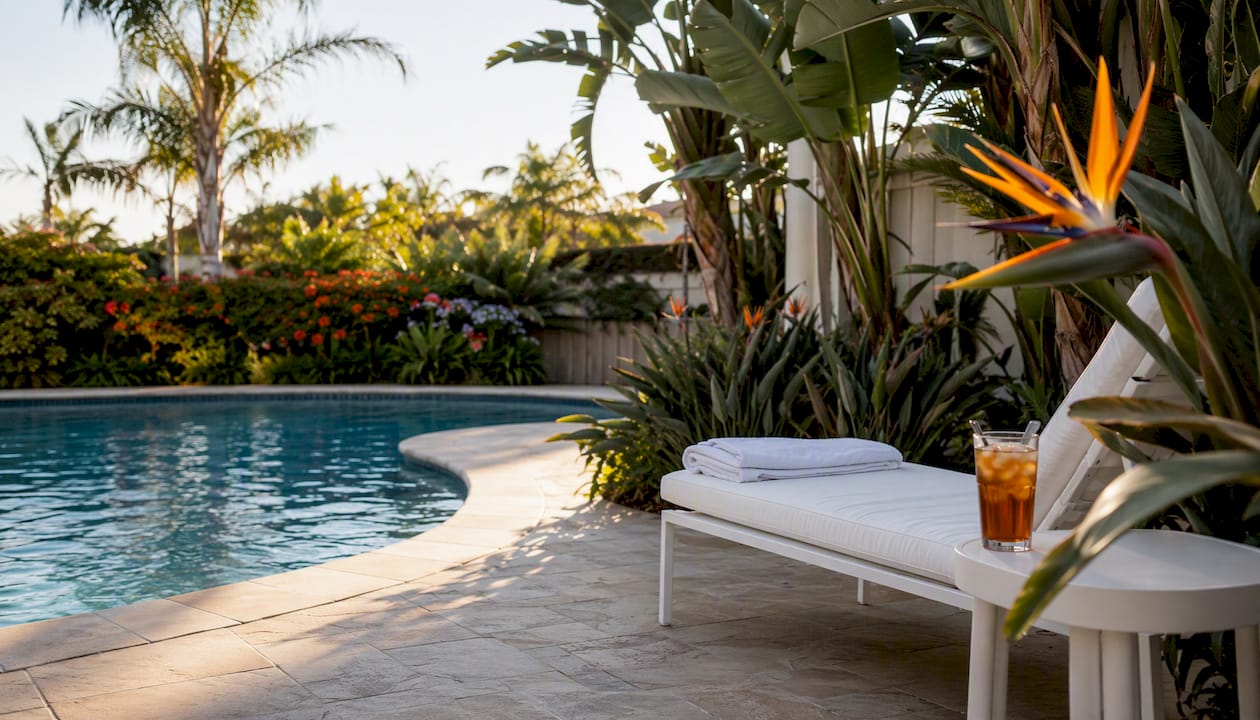
Bird of Paradise (Strelitzia reginae or S. nicolai) is the signature poolside plant for a reason. Large, waxy leaves shed water cleanly, the plant produces almost no litter, and the orange-and-blue blooms photograph well. Zones 9–11. Mature size: 4–6 feet for S. reginae, up to 20 feet for the giant white-flowering S. nicolai.
Banana (Musa and Ensete spp.) delivers instant tropical drama. The catch: large leaves tear in wind and drop regularly, so plant bananas at least 10–12 feet from the pool edge or use them as a backdrop specimen rather than a poolside accent. Zones 8–11 for cold-hardy varieties like ‘Basjoo.’
Hibiscus (Hibiscus rosa-sinensis) blooms nearly year-round in Central Florida, tolerates splash, and is listed by UF/IFAS as a reliable poolside performer. Spent blooms drop, so deadhead weekly during peak season or site it slightly back from the coping.
Canna (Canna x generalis) is best used in containers near the pool. Bold foliage in green, burgundy, or striped, plus tall flower spikes in red, orange, or yellow. Zones 7–11. Refresh containers regularly for continuous color.
Russian sage (Perovskia atriplicifolia) is an underused option for drier, sunnier pool edges in zones 5–9. Silvery stems and lavender-blue flowers, drought-tolerant once established, and minimal litter. It won’t survive Central Florida’s humidity long-term but works well in northern and central U.S. pool yards.
Spirea (Spiraea spp.) is a compact flowering shrub for zones 3–9. It blooms in spring, stays tidy, and drops petals rather than heavy debris. Good for pool yards in cooler climates where tropical options aren’t viable.
Ornamental grasses and groundcovers
Muhly grass (Muhlenbergia capillaris) is a Florida native that produces a cloud of pink-purple plumes in fall. It stays under 4 feet, needs almost no water once established, and drops nothing that clogs a filter. One of the lowest-debris options for the pool perimeter.
Daylily (Hemerocallis spp.) is a reliable, low-maintenance perennial for zones 3–9. Spent blooms need deadheading, but the strap-like foliage stays tidy and the plant spreads slowly without becoming invasive. Good for sunny pool borders.
Liriope (Liriope muscari) works as a neat, grass-like edging along pool decks. It tolerates shade, drought, and occasional splash, and stays under 18 inches.
Container-friendly picks
Palms in containers (dwarf varieties like Pygmy Date Palm or Areca Palm) deliver the resort look without committing to in-ground root systems. Bromeliads, coleus, and seasonal annuals round out container displays and can be swapped out every 4–8 months to keep the palette fresh, a strategy UF/IFAS recommends for maintaining a resort-style look with minimal effort.
Quick-reference comparison table
| Plant | Best for | USDA zones | Mature size | Maintenance | Root invasiveness | Splash tolerance |
|---|---|---|---|---|---|---|
| Dwarf Clusia | Privacy hedge | 9b–11 | 6–10 ft | Low | Non-invasive, fibrous | High |
| Coontie | Low-litter structure | 8b–11 | 2–3 ft | Very low | Non-invasive | High |
| Bird of Paradise | Tropical accent | 9–11 | 4–20 ft | Low | Non-invasive | High |
| Muhly grass | Texture, low debris | 5–11 | 3–4 ft | Very low | Non-invasive | Moderate–High |
| Hibiscus | Color, tropical feel | 9–11 | 4–8 ft | Moderate | Non-invasive | High |
| Boxwood | Formal edging | 5–9 | 2–4 ft | Low–Moderate | Non-invasive | Moderate |
| Ligustrum | Dense hedge | 7–10 | 6–12 ft | Low | Non-invasive | Moderate |
| Canna | Container color | 7–11 | 3–6 ft | Low | Non-invasive | High |
| Banana (Musa) | Backdrop drama | 8–11 | 8–20 ft | Moderate | Clumping, manageable | Moderate |
| Daylily | Border color | 3–9 | 1–3 ft | Low | Slow-spreading | Moderate |
| Russian sage | Dry, sunny borders | 5–9 | 3–4 ft | Low | Non-invasive | Low–Moderate |
| Spirea | Flowering shrub | 3–9 | 2–5 ft | Low | Non-invasive | Moderate |
Practical planting tips that prevent the most common pool problems
Getting the plant selection right is only half the job. Where and how you plant matters just as much.
Respect the splash zone. Plants within 6 feet of the pool edge must tolerate chlorinated and salt-laden water. Low-tolerance species like azaleas and most ferns typically show leaf scorch and dieback within one growing season when hit by repeated pool splash. Stick to coontie, muhly grass, dwarf Clusia, bird of paradise, and hibiscus in that inner ring.
Buffer hardscape by 18–24 inches. Professionals recommend keeping major shrubs and any tree at least 18–24 inches from pool decking, coping, and underground plumbing. That gap lets roots spread without lifting pavers or pressuring pipes. For a step-by-step approach to spacing and bed layout, the pool landscaping guide for homeowners from Randrswimmingpools covers the full process.
Use micro-drip irrigation. Micro-drip lines automate watering for containers and beds without requiring anyone to drag a hose across a wet deck. Schedule irrigation during early morning or late evening, when pool use is lowest, to avoid runoff onto the deck surface.
Manage debris proactively. Choose small, waxy-leaved species for the inner 6 feet. Put high-litter plants (banana, large palms, flowering trees) in beds at least 10–15 feet back. Non-fruiting varieties of ligustrum and other berry-producing shrubs reduce filter-clogging debris significantly.
Seasonal maintenance checklist:
- Prune hedges (Clusia, Podocarpus, Ligustrum) twice yearly, in spring and early fall
- Fertilize with a slow-release, low-phosphorus formula in March and September; check local fertilizer ordinances before applying near waterways
- After heavy chemical treatments or storm events, rinse foliage near the pool with fresh water to prevent chemical burn
- Divide ornamental grasses every 2–3 years to prevent clumping and maintain clean form
Pro Tip: When you’re unsure whether a plant can handle your pool’s splash pattern, start it in a container. Containers let you move plants away from heavy splash zones or protect them during cold snaps, and they’re easy to swap out when a species underperforms.
Which plants should you avoid near a pool?
A few common choices cause disproportionate damage and maintenance headaches.
- Ficus (Ficus benjamina, F. microcarpa): Aggressive surface roots that crack pool shells, lift pavers, and penetrate underground plumbing within just a few years of growth. Local pros and UF/IFAS explicitly advise against planting large ficus near pools in Central and South Florida.
- Schefflera (Schefflera actinophylla): Invasive in Central and South Florida, with seeds spread by birds. It also develops thick, woody roots that damage hardscape. Avoid entirely near pools.
- Running bamboo (Phyllostachys spp.): Rhizomes spread aggressively and can travel 20–30 feet underground, surfacing through cracks in decking. Clumping bamboo (Bambusa spp.) is a safer alternative if the tropical look is a priority.
- Large canopy trees (live oak, laurel oak, sweet gum): Heavy leaf and seed drop clogs filters, raises chemical demand, and creates a constant cleaning burden. If shade is the goal, choose a dwarf palm or a screened enclosure instead.
- Thorny palms and plants (Washingtonia palms with serrated petioles, bougainvillea, roses): Spines and thorns create safety hazards around barefoot pool traffic. Bougainvillea is especially problematic near pool coping.
- Azaleas and most ferns: Beautiful plants, but they cannot handle chlorinated splash. They’ll look great for a season and then decline fast in the inner splash zone.
If any of these species must stay in the yard, relocate them to beds at least 15–20 feet from the pool, or contain aggressive spreaders in large raised planters with root barriers.
How do you choose the right plants for your pool?
A short checklist you can use at the nursery or with a landscape designer:
- Check root behavior first. Ask: “Does this species have fibrous or tap roots? Will it spread aggressively?” Fibrous-rooted species (Clusia, coontie, ornamental grasses) are almost always the safer choice near hardscape.
- Assess litter profile. How much does it drop, and how often? Small, waxy leaves are far easier to manage than large, papery ones or heavy seed pods.
- Confirm splash tolerance. Ask directly: “Will this variety tolerate occasional chlorinated splash?” If the nursery staff can’t answer, default to species on the UF/IFAS poolside list.
- Check mature size. A plant that looks perfect at 2 feet in a pot may reach 15 feet in five years. Confirm height and spread at maturity, not at purchase.
- Evaluate maintenance needs. How often does it need pruning? Does it produce fruit or berries? Will it need seasonal replacement?
- Decide: container or in-ground? Sensitive species, seasonal color, and anything with uncertain splash tolerance belong in containers first. Move in-ground only after confirming performance.
Spacing and bed sizing: Follow the 18–24 inch hardscape buffer for all major shrubs. Space privacy hedges like Clusia 2–3 feet apart for a solid screen within 2–3 growing seasons. For specimen plants like bird of paradise, allow 4–6 feet of clearance on all sides.
Zone and microclimate check: Verify your USDA hardiness zone before purchasing. Central Florida sits in zones 9a–10a, which means most tropical species survive year-round, but a cold snap can damage bananas and cannas. Screened enclosures raise the microclimate by several degrees and extend the range of marginally hardy species. Coastal yards need extra salt-tolerance consideration; cocoplum outperforms Clusia in direct ocean spray.
For privacy screening ideas and root-safe hedge selection, the backyard privacy landscaping guide from Modern Yardz covers design approaches that translate well to pool yards.
What Central Florida homeowners need to know about poolside plants
Central Florida’s combination of intense summer heat, frequent afternoon storms, and year-round pool use creates conditions that generic plant lists don’t fully address.
The backbone plants that consistently perform here are coontie, dwarf Clusia, muhly grass, and bird of paradise. All four handle chlorine and salt splash, tolerate the region’s wet-dry cycle, and require minimal intervention once established. For the Central Florida pool landscaping approach Randrswimmingpools recommends, these four form the structural core, with containers of hibiscus, canna, or bromeliads adding seasonal color.
Two species come up repeatedly in local professional conversations as plants to avoid: Schefflera actinophylla and large ficus. Both are flagged by UF/IFAS and local landscape pros for invasive behavior or aggressive root systems that can damage pool infrastructure.
Fertilizer ordinances in many Central Florida counties restrict phosphorus applications near water bodies. Always check your county’s current rules before fertilizing beds within 10 feet of a pool or any drainage feature.
For beachfront or high-salt-exposure properties, cocoplum handles constant ocean spray with less leaf burn than Clusia and greater drought hardiness once established.
How should you water plants near a pool?
Watering near a pool requires a different approach than standard garden irrigation. The goal is consistent moisture for plant roots without adding water to the deck surface, which creates slip hazards and accelerates surface wear.
Micro-drip irrigation is the most practical solution. Drip emitters deliver water directly to the root zone, reduce evaporation, and eliminate the need to run a hose across pool decking. For containers, self-watering inserts or drip rings keep moisture consistent through Central Florida’s dry spells without waterlogging roots during the rainy season.
Frequency depends on plant type and season. Established in-ground species like coontie and muhly grass need watering only once or twice a week during dry periods; newly planted specimens need more frequent attention for the first 60–90 days. Container plants dry out faster than in-ground beds, especially on hot pool decks, so check moisture levels every 2–3 days in summer.
Avoid overhead sprinklers near the pool. They deposit mineral-laden water on pool surfaces and can introduce fertilizer or soil particles into the water, raising chemical demand and clouding the pool.
What pests and diseases should you watch for near pools?
Pool environments create specific pest and disease pressures that differ from a standard garden bed.
High humidity near the water surface encourages fungal issues, particularly on plants with dense foliage. Ligustrum and boxwood can develop cercospora leaf spot or powdery mildew in poorly ventilated spots. Spacing plants to allow airflow and avoiding overhead watering reduces fungal pressure significantly.
Aphids and scale insects are common on hibiscus and canna. Both respond well to insecticidal soap or neem oil, but apply these treatments in the evening and avoid spraying directly over pool water. Runoff from pesticide applications can disrupt pool chemistry.
Whiteflies are a persistent problem on many Florida landscape plants, including Clusia and ligustrum. Systemic treatments applied to the soil (rather than sprayed) are safer near pools because they don’t drift into the water.
Root rot can affect container plants that sit in standing water on pool decks. Use containers with drainage holes and elevate them slightly on pot feet to prevent water from pooling beneath them.
How does seasonal care differ for pool-area plants?
Central Florida’s seasons don’t follow the national calendar, but they do create distinct care windows.
Spring (March–May): The main planting and fertilizing window. Apply slow-release fertilizer to established beds, prune hedges to shape before the growth flush, and refresh container plantings with new annuals or seasonal tropicals. This is also the best time to install new in-ground specimens before summer heat peaks.
Summer (June–September): Growth is fast but so are pests and fungal issues. Reduce fertilizer applications during the peak rainy season to avoid nutrient runoff. Monitor for whiteflies and scale weekly. Deadhead hibiscus and canna regularly to reduce debris near the pool.
Fall (October–November): Muhly grass peaks with its signature pink plumes. Cut back spent canna foliage after flowering. A light pruning of Clusia and Podocarpus hedges in October keeps them tidy through the holiday season.
Winter (December–February): Cold snaps below 32°F can damage bananas and cannas. Move container tropicals under a screen enclosure or against a south-facing wall. Established coontie, Clusia, and bird of paradise handle brief cold snaps without protection in zones 9b–10a.
Key Takeaways
The most effective pool-yard plant strategy pairs a splash-tolerant structural backbone (coontie, dwarf Clusia, muhly grass) with container-based seasonal color that can be refreshed or moved as conditions change.
| Point | Details |
|---|---|
| Respect the 6-foot splash zone | Only chlorine and salt-tolerant species like coontie, muhly grass, and bird of paradise belong within 6 feet of the pool edge. |
| Buffer hardscape by 18–24 inches | Keep all major shrubs and trees at least 18–24 inches from decking and underground plumbing to prevent root damage. |
| Use containers for flexibility | Cannas, bromeliads, and hibiscus in containers let you refresh color seasonally and move plants away from heavy splash or cold snaps. |
| Avoid aggressive-root species | Ficus, Schefflera, and running bamboo cause hardscape and plumbing damage; remove or relocate them well away from the pool. |
| Randrswimmingpools integrates plant and pool design | Randrswimmingpools plans splash zones, irrigation, and planting beds during pool construction to prevent costly retrofits later. |
The plant choices that actually save money over time
The conventional wisdom on pool landscaping focuses almost entirely on aesthetics: tropical look, privacy, color. That’s understandable, but it’s the wrong starting point. The homeowners who spend the least on pool maintenance over a decade are the ones who chose plants based on root behavior and litter profile first, and looks second.
Root damage is the single most expensive landscaping mistake around pools. A ficus or large oak planted 8 feet from the pool edge looks fine for three years. By year six, the roots are under the deck. By year ten, you’re looking at a pool renovation, not just a landscaping refresh. Choosing fibrous-rooted species from the start costs nothing extra and avoids that outcome entirely.
The splash zone rule is equally underappreciated. Replacing azaleas or ferns that scorch out every season isn’t just frustrating; it’s a recurring cost that compounds. One correct plant selection eliminates that cycle permanently.
The plants on this list aren’t just pretty. They’re the ones that don’t create problems. That’s the distinction worth making before any trip to the nursery.
How Randrswimmingpools builds pool landscapes that work from day one
Randrswimmingpools has been designing and installing custom inground pools across Central Florida since 1985, and the most consistent feedback from homeowners is that getting the plant and pool plan right together, rather than treating them as separate projects, saves significant time and money.
During pool construction, R and R Swimming Pools accounts for splash zones, underground plumbing routes, and deck drainage before a single plant goes in the ground. That means irrigation lines are placed correctly, hardscape buffers are built into the design, and the plants you choose won’t conflict with the pool structure five years from now. The result is a backyard that looks like a resort and stays that way without constant intervention.
Central Florida homeowners across Clermont, Tavares, Mount Dora, The Villages, and surrounding communities can schedule a consultation or view completed pool and landscape installations to see exactly what’s possible. If you’re starting from scratch or renovating an existing pool, the inground pool installation guide walks through every step of the process, including landscape integration. Contact Randrswimmingpools to get a free quote and start planning a pool yard that performs as well as it looks.
