TL;DR:
- Pool privacy solutions in Florida must meet strict safety codes and satisfy HOA aesthetic rules while providing effective screening. Targeted barriers like fences, landscaping, and enclosure upgrades are more practical and visually appealing than full-perimeter walls. Consistent planning and permit application ensure safety compliance and long-term privacy in the subtropical climate.
Pool privacy solutions are physical or natural barriers that limit visibility into your pool area while meeting Florida’s mandatory safety codes. Central Florida homeowners face a specific challenge: the Florida Residential Swimming Pool Safety Act sets strict barrier requirements, and your HOA may add its own aesthetic rules on top of those. The best examples of pool privacy solutions work within both sets of rules while creating a backyard that actually feels like a retreat. This guide covers compliant fencing, strategic landscaping, enclosure upgrades, and fast-install options suited to Florida’s subtropical climate.
1. What are the best examples of pool privacy solutions?
The strongest pool privacy solutions combine legal compliance with targeted screening. Florida law sets the floor, and your site conditions determine which materials and methods deliver the most privacy per dollar spent. The options below range from code-required barriers to creative add-ons that go well beyond the minimum.
2. Mandatory pool safety barriers and how they shape your privacy choices
Florida’s pool barrier requirements are non-negotiable: any barrier must stand at least 48 inches tall, with no gaps larger than 4 inches. Gates must be self-closing and self-latching. These rules do not conflict with privacy goals. They actually push you toward taller, denser structures that block sightlines by default.
Horizontal rails are a common compliance failure. Rails must be spaced at least 45 inches apart or positioned on the pool side of the fence so children cannot use them as a ladder. Choosing aluminum picket or solid vinyl fencing solves both the climbing hazard and the visibility problem at once.
Pool barrier installations require specific permits and inspections in Florida, separate from standard yard fencing permits. Pull the permit before you break ground. Skipping this step can force you to tear out finished work.
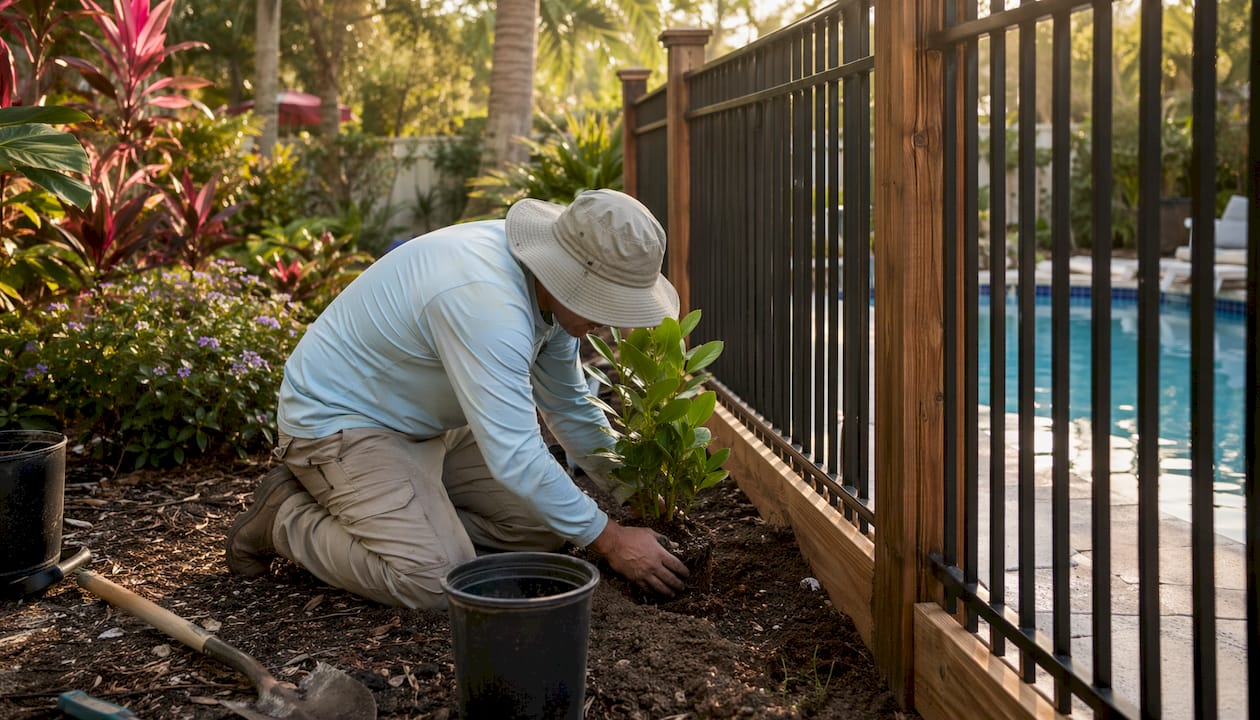
- Aluminum picket fencing: Meets the 48-inch minimum, resists corrosion, and comes in powder-coated colors that satisfy most HOA palettes.
- Solid vinyl fencing: Provides a full visual block and handles Florida humidity without rotting or warping.
- Masonry walls: Maximum privacy and durability, but require structural permits and typically cost more per linear foot.
- Glass panel fencing: Maintains sightlines for supervision while blocking wind. Less effective for privacy but popular in upscale installations.
Pro Tip: Check your HOA rules before selecting a fence material. Florida state law overrides HOA aesthetics on safety code conflicts, but your HOA can still restrict color, material finish, and post style within those legal limits.
3. How landscaping creates natural pool privacy screens
Strategic planting is one of the most attractive backyard privacy solutions available to Central Florida homeowners. The key word is “strategic.” Planting a dense hedge around the entire perimeter looks heavy and takes years to fill in. A single focal screen placed within 18 to 36 inches of the pool deck blocks the most-used sightline and looks lighter than a wall of shrubs.
Florida’s climate supports fast-growing privacy plants like Clusia guttifera, Green Buttonwood, and Podocarpus. These species tolerate salt air, pool chemical drift, and the wet-dry cycle that defines Central Florida summers. Avoid planting directly in the splash zone. Chlorinated water damages roots and foliage over time.
Fertilizer timing matters here. Florida’s fertilizer blackout period runs from june 1 to september 30 to protect local waterways. Plan your planting schedule around this window. Establish new plants before june or wait until october to fertilize them properly.
- Clusia hedges: Dense, salt-tolerant, and fast-growing. Reaches 6 feet in two to three growing seasons.
- Podocarpus: Narrow profile, ideal for tight side yards where width is limited.
- Bamboo in root barriers: Creates a tall, tropical screen quickly. Always use a root barrier to prevent spreading.
- Layered planting: Combine a tall canopy tree with a mid-height shrub and a low ground cover for a screen that works at multiple eye levels.
Pro Tip: Pair your pool landscaping plan with a drip irrigation system. Hand-watering near a pool is inconsistent and often leads to overwatering in the splash zone.
4. Pool enclosure privacy upgrades and screen solutions
Pool cages are standard in Central Florida, and they are one of the fastest platforms for adding privacy. Privacy mesh and opaque vinyl panels integrate directly into existing pool cage frames without structural changes. You get immediate results without a contractor rebuilding your enclosure from scratch.
Privacy mesh provides daytime one-way viewing. You can see out clearly, but neighbors looking in see only a dark screen. This works well on sides facing the street or a neighbor’s second-story window. At night, interior lighting reverses the effect, so mesh alone does not deliver full privacy after dark.
Opaque vinyl panels create a total visual block and resist pool chemical exposure. They are the right choice for sides where you want complete seclusion regardless of time of day. Slat inserts offer a middle ground: adjustable louvers let you control airflow and visibility at the same time.
For professional installation of privacy screen upgrades in your existing enclosure, Rescreen Rescue serves the Tampa Bay and Central Florida area with screen repair and replacement services.
- Privacy mesh: Best for daytime privacy on high-traffic sightline sides.
- Opaque vinyl panels: Best for total, all-day visual blocking on exposed sides.
- Slat inserts: Best when airflow and adjustable privacy are both priorities.
- Combination approach: Use opaque panels on the neighbor-facing side and mesh on the yard-facing side to balance privacy with openness.
5. How fence extensions and freestanding walls compare as privacy options
When your existing fence is structurally sound, fence extensions add 1 to 2 feet of height quickly and at low cost. This is the fastest way to block a neighbor’s view without replacing the entire fence. The limitation is structural. If the existing posts cannot handle the added wind load, extensions create a safety hazard.
Freestanding walls give you custom placement anywhere in the yard, independent of existing structures. They work well as focal screens near the pool deck. Most masonry or concrete freestanding walls require a building permit in Florida, so factor that timeline into your planning.
Artificial hedge panels deliver immediate dense coverage with no irrigation or grow-in period. They handle chemical splash zones without degrading, making them practical near pool equipment pads. Quality panels use UV-stabilized polyethylene and hold their color for years in Florida’s intense sun.
| Option | Speed | Cost | Durability | Permit Required |
|---|---|---|---|---|
| Fence extension | Fast | Low | Moderate | Sometimes |
| Freestanding masonry wall | Slow | High | Very high | Usually yes |
| Artificial hedge panels | Immediate | Moderate | High | Rarely |
| Natural hedge planting | Slow (2–3 years) | Low to moderate | High | No |
Pro Tip: Before installing a freestanding wall, check your property survey. Walls placed on or near a property line often trigger neighbor notification requirements under Florida statutes.
6. Situational factors Central Florida homeowners must evaluate
Targeting specific sightlines is more effective than screening the entire perimeter. Stand at your pool and identify exactly where you feel exposed. Most homeowners find one or two angles account for nearly all of their discomfort. Solving those two angles costs far less than building a full perimeter wall.
Second-story views require a different approach. A 6-foot fence does nothing against a neighbor’s second-floor window. Options include overhead shade structures, tall canopy trees positioned to block the downward angle, or elevated privacy screens mounted above the cage roofline.
Florida’s environmental rules affect material choices near water. Fertilizer restrictions, stormwater drainage requirements, and impervious surface limits all influence what you can install and where. A site-specific plan accounts for all of these at once.
- Map your sightlines first. Walk the perimeter at pool level and note every angle where you feel visible.
- Check for second-story exposure. Look up, not just sideways.
- Identify the splash zone. Mark the area within 3 feet of the pool edge and avoid placing plants or materials that degrade with chlorine exposure there.
- Review your HOA guidelines. Confirm allowable materials, colors, and heights before purchasing anything.
- Pull permits early. Florida pool barrier permits and fence permits run on separate tracks. Start both applications before construction begins.
Key takeaways
Effective pool privacy in Central Florida requires combining Florida’s 48-inch barrier code with targeted, site-specific screening that addresses actual sightlines rather than the entire perimeter.
| Point | Details |
|---|---|
| Code compliance is the starting point | Florida law requires 48-inch barriers with self-latching gates before any privacy upgrade. |
| Target sightlines, not perimeters | Screening one or two exposed angles costs less and looks better than full perimeter walls. |
| Enclosure upgrades are fast | Privacy mesh and opaque vinyl panels install into existing pool cages without structural work. |
| Landscaping needs a grow-in plan | Natural hedges take 2–3 seasons; pair them with a structural screen for immediate coverage. |
| Permits protect your investment | Pool barrier and fence permits in Florida are separate. Pull both before construction starts. |
Why targeted privacy beats perimeter screening every time
Most homeowners I talk with want to screen everything. They imagine a wall of green around the entire pool, or a solid fence on all four sides. That instinct is understandable, but it almost always produces a result that feels smaller, darker, and more expensive than expected.
The most effective pool privacy setups I have seen focus on one or two key sightlines. A single well-placed Clusia hedge or a section of opaque vinyl panel on the neighbor-facing side of a pool cage does more work than a full perimeter treatment. It also leaves the yard feeling open on the sides that do not need screening.
Safety code compliance is not optional, but it is also not the obstacle homeowners fear. The 48-inch barrier requirement pushes you toward structures that already block most ground-level views. Build to code first, then layer in targeted privacy enhancements where the code minimum falls short.
The subtropical climate here adds one more variable most guides ignore: maintenance. A bamboo screen that looks great in year one can become a root invasion problem by year three. Artificial panels near the equipment pad avoid that entirely. Natural hedges on the perimeter need fertilizer timing that respects Florida’s blackout periods. Every material choice carries a maintenance commitment. Factor that in before you commit to a plan.
— Results
Planning your pool privacy with expert help
Central Florida’s pool privacy requirements sit at the intersection of state safety codes, HOA rules, and subtropical landscaping realities. Getting that combination right from the start saves time, money, and the frustration of redoing work that failed an inspection.
R and R Swimming Pools has been building and upgrading custom inground pools across Central Florida since 1985. The team understands local code requirements, HOA dynamics, and which privacy solutions hold up in Florida’s climate year after year. Whether you are planning a new pool installation with privacy features built in from day one, or adding screening to an existing pool, Randrswimmingpools can guide you through compliant, site-specific options. Explore the modern fencing ideas resource for design inspiration that meets Florida’s safety standards.
FAQ
What is the cheapest pool privacy solution in Florida?
Fence extensions are the lowest-cost option when your existing fence is structurally sound, adding 1 to 2 feet of height quickly. Artificial hedge panels are the next most affordable choice for immediate coverage without permits.
How do I block a neighbor’s second-story view of my pool?
Overhead shade structures, tall canopy trees positioned to intercept the downward angle, or elevated privacy screens mounted above the pool cage roofline are the most effective options for blocking views from above.
Do I need a permit for a pool privacy fence in Florida?
Yes. Pool barrier installations require specific permits and inspections in Florida, separate from standard yard fencing permits. Apply before construction begins.
Can my HOA override Florida’s pool fence height requirements?
No. Florida’s Building Code overrides HOA rules on pool barrier height and safety features. Your HOA can restrict material finish and color, but cannot require a barrier shorter than 48 inches.
What pool enclosure screen gives the most privacy?
Opaque vinyl panels provide a total visual block at all hours and resist pool chemical exposure. Privacy mesh is effective during daylight but loses its one-way effect after dark when interior lights are on.
