
TL;DR:
- Pool water test kits measure chemical balance to keep pools safe and clear throughout the season. Liquid reagent kits offer the highest accuracy and are best for proper dosing, while test strips are useful for quick daily checks with less precision. Digital testers provide the most accurate readings but come at a higher cost and are ideal for large or professional pools.
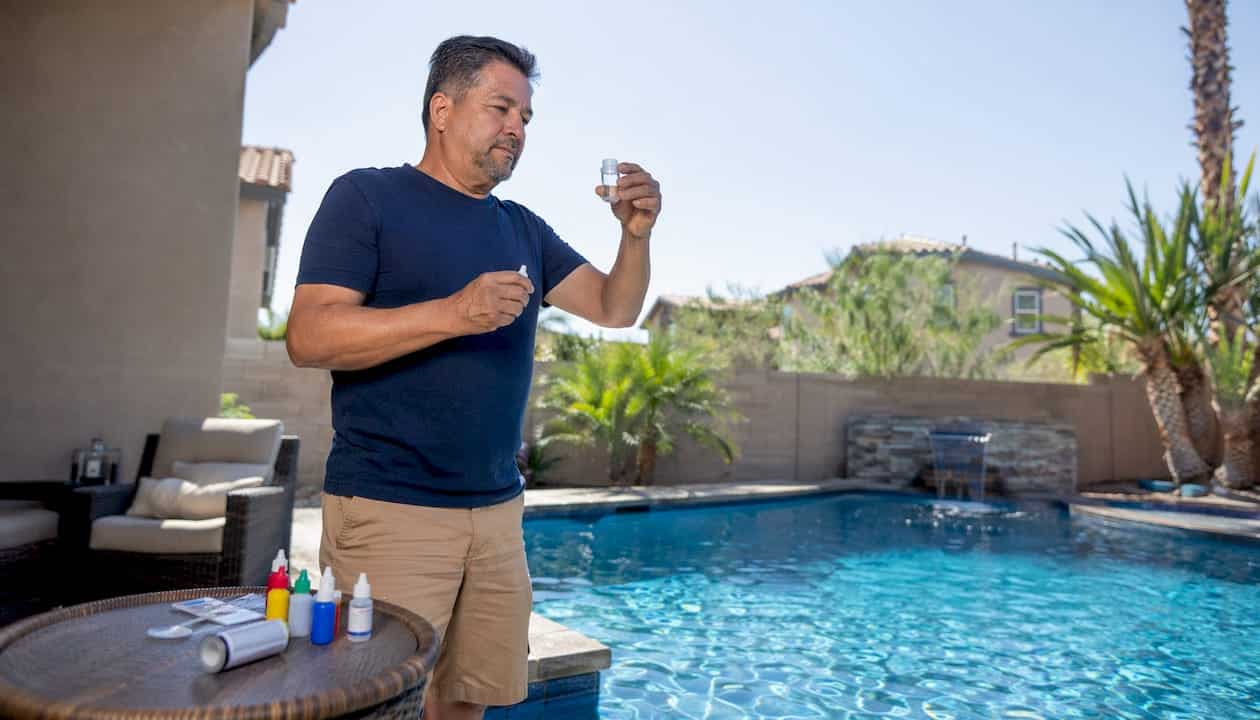
Swimming pool water test kits are tools that measure the chemical balance of pool water, including free chlorine, pH, total alkalinity, cyanuric acid, and calcium hardness. Choosing the right kit determines whether your pool stays safe, clear, and equipment-friendly all season. The three main categories are test strips, liquid reagent kits, and digital testers. Each serves a different purpose, and the best approach combines more than one. This guide breaks down every type, explains how to use them correctly, and tells you exactly when to reach for each one.
1. Types of swimming pool water test kits
Three distinct categories of pool water testing supplies exist, and each one trades accuracy for convenience at a different price point.
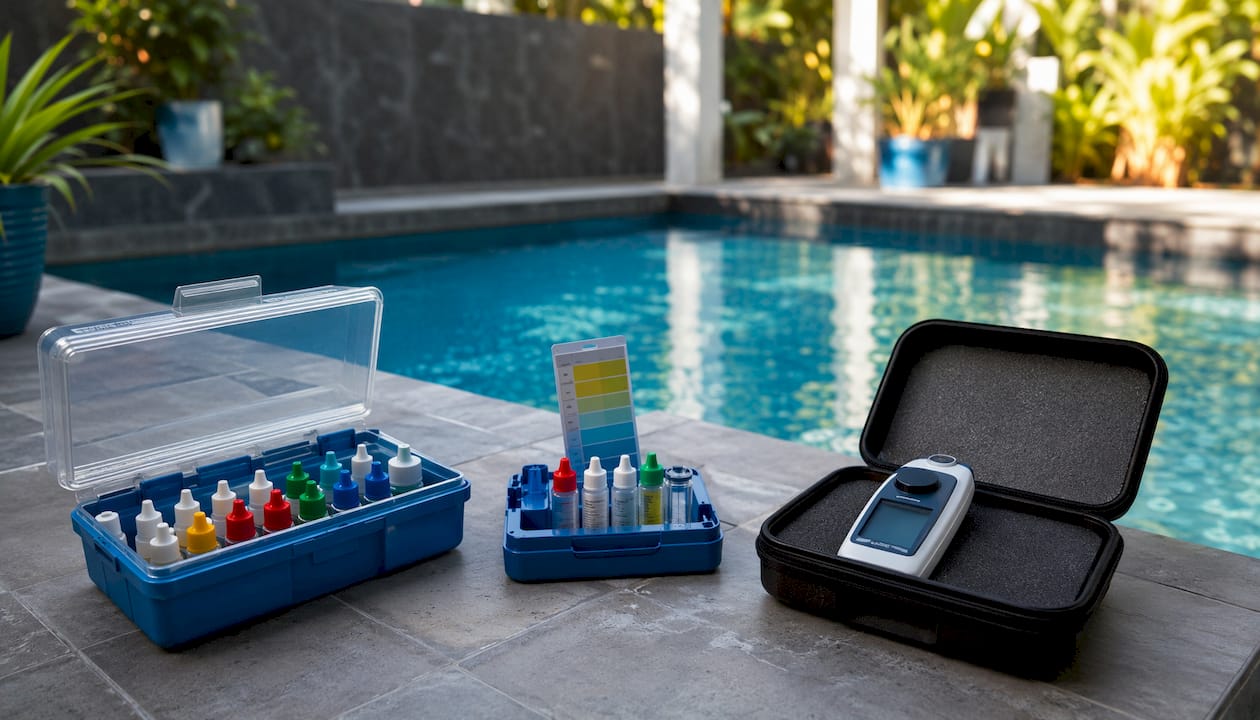
Test strips are the most accessible option. You dip a strip into the water, wait a few seconds, and compare the color change to a printed chart. They cost very little per test and require no training. The tradeoff is accuracy: test strips carry a ±0.5 pH unit and ±1 ppm free chlorine error margin. That gap is wide enough to cause real chemical dosing mistakes. Strips also degrade quickly when exposed to moisture or sunlight, and their shelf life once opened is only 6–12 months.
Liquid reagent kits are the standard choice for serious home pool owners. You add liquid reagents to a water sample, count drops, and read a color change against a comparator block. These kits reach 95–98% accuracy for key chemicals and cost $50–$70 upfront, with each test running $0.15–$0.50. That accuracy level is sufficient for reliable dosing decisions.
Digital testers and photometers sit at the top of the accuracy range. They deliver 95–99% accuracy and many include data logging. The upfront cost runs $100–$300 or more. They suit tech-savvy homeowners or those managing larger pools where precision pays off quickly.
| Kit type | Accuracy | Cost range | Best use |
|---|---|---|---|
| Test strips | 85–90% | Under $20 | Quick daily checks |
| Liquid reagent kit | 95–98% | $50–$70 | Weekly dosing and troubleshooting |
| Digital photometer | 95–99% | $100–$300+ | Commercial or data-driven owners |
2. How to properly test pool water with a liquid reagent kit
Liquid reagent kits produce reliable results only when you follow correct sampling and testing procedures. Skipping any step introduces error that compounds into bad dosing decisions.
Sample collection
Collect your water sample from 12–18 inches below the surface, away from return jets and skimmers. Turn the pump off 15 minutes before sampling. Sampling near return jets causes false high chlorine or pH readings because freshly dosed water has not yet mixed evenly through the pool.
The FAS-DPD titration method
The FAS-DPD process is the professional standard for measuring chlorine with a liquid kit. You add a DPD indicator to your sample, which turns the water pink. Then you add FAS reagent drop by drop until the color disappears. Each drop counts as 0.5 ppm of chlorine. This drop-count method removes the guesswork of color matching and gives you a clear, quantitative endpoint. Professionals prefer it because standard color-comparator tests suffer bleach-out effects at high chlorine levels, making readings unreliable.
Reading results accurately
Read your results immediately after the reaction completes. Compare colors in natural daylight, not under artificial indoor lighting. Ambient lighting and timing are critical factors that shift color perception enough to produce a wrong reading. Never let the sample sit before comparing.
Pro Tip: Use your liquid kit specifically when troubleshooting cloudy water or after a heavy rain event. Strips cannot reliably detect combined chlorine, which is the real cause of eye irritation and pool odor.
| Parameter | Target range | Why it matters |
|---|---|---|
| Free chlorine | 1–4 ppm | Kills bacteria and algae |
| pH | 7.2–7.8 | Protects skin and equipment |
| Total alkalinity | 80–120 ppm | Stabilizes pH swings |
| Cyanuric acid | 30–50 ppm | Protects chlorine from UV breakdown |
| Calcium hardness | 200–400 ppm | Prevents surface etching or scaling |
These ranges follow CDC and industry standards for residential pool water quality.
3. Free chlorine vs. combined chlorine: why the difference matters
Total chlorine minus free chlorine equals combined chlorine. That calculation reveals a number most pool owners never check. Combined chlorine causes eye irritation, skin irritation, and the sharp chemical odor that people mistakenly blame on too much chlorine. The real problem is too little effective chlorine doing too much work. Test strips generally do not measure combined chlorine. Liquid and digital kits do. When combined chlorine rises above 0.5 ppm, the pool needs shocking, not just a top-up dose of sanitizer.
4. How often to test your pool water
Residential pools need chemical testing 2–3 times per week during the swimming season. That frequency covers free chlorine and pH, the two parameters that shift fastest. A full panel test, covering alkalinity, cyanuric acid, and calcium hardness, should happen once a week using a liquid reagent kit.
Certain events demand more frequent testing:
- After a pool party or heavy swimmer load
- After a rainstorm or flooding near the pool
- After adding a large dose of any chemical
- When the water looks cloudy or has an unusual odor
- After extended periods without use
Test strips work well for quick daily checks between full liquid kit tests. They give you a fast read on whether chlorine and pH are in a safe range without consuming reagents. Think of strips as a smoke detector and the liquid kit as the fire inspector.
Quarterly professional lab testing adds a useful layer of verification. A lab can detect metals, phosphates, and other contaminants that home kits miss entirely. This is especially relevant for Florida homeowners dealing with well water effects on pool chemistry.
Pro Tip: Keep a written or digital log of every test result. Patterns in your data reveal whether your pool is drifting toward an imbalance before it becomes a visible problem. Apps like Pool Math make logging and dosing calculations straightforward.
5. Choosing the right kit for your pool and budget
The right chemical balance test kit depends on your pool size, how often you swim, and how much precision you need for safe water management.
For most homeowners, a quality liquid reagent kit as the primary tool paired with test strips for quick checks is the most cost-effective approach. The liquid kit handles all dosing decisions. The strips handle daily monitoring between full tests. This hybrid testing strategy avoids the costly mistakes that come from relying on strips alone. A ±20–30% error margin on a strip reading can lead to significant over- or under-dosing of chemicals.
For new pool owners or those with smaller pools, a reliable test strip brand plus one liquid kit confirmation per week is a practical starting point. As you build confidence in reading results, the liquid kit becomes your go-to tool.
For larger or commercial pools, a digital photometer is worth the upfront investment. The data logging feature alone saves time and reduces human error across multiple tests per day.
Common pitfalls to avoid:
- Relying solely on test strips for dosing calculations
- Storing strips in humid bathrooms or direct sunlight
- Testing immediately after adding chemicals instead of waiting for full circulation
- Ignoring cyanuric acid levels until they exceed 80–100 ppm, at which point partial draining is the only fix
- Assuming clear water is safe water. The Langelier Saturation Index (LSI) measures water balance and equipment risk, and it requires accurate, consistent testing to calculate reliably
| Situation | Recommended kit | Frequency |
|---|---|---|
| Daily monitoring | Test strips | Daily |
| Weekly dosing | Liquid reagent kit | 2–3 times weekly |
| Troubleshooting | Liquid reagent kit | As needed |
| Large or commercial pool | Digital photometer | Daily |
| Quarterly verification | Professional lab | Every 3 months |
For Central Florida homeowners, maintaining pool water balance is especially critical given the region’s heat, heavy rainfall, and high bather loads during the long swim season.
Key takeaways
Liquid reagent kits are the most reliable home pool testing tool because they measure free and combined chlorine accurately, support correct chemical dosing, and cost far less per test than digital alternatives.
| Point | Details |
|---|---|
| Liquid kits outperform strips | Liquid reagent kits reach 95–98% accuracy versus 85–90% for test strips. |
| Hybrid strategy works best | Use strips for daily checks and liquid kits for all dosing and troubleshooting decisions. |
| Sample collection matters | Collect water from 12–18 inches deep with the pump off for 15 minutes before testing. |
| Combined chlorine is the real problem | Only liquid or digital kits detect combined chlorine, the true cause of eye irritation and odor. |
| Clear water is not safe water | LSI calculation requires accurate, consistent testing to protect both swimmers and equipment. |
What I’ve learned after years of watching homeowners test their pools
Most pool problems I’ve seen trace back to one of two mistakes: testing too infrequently or trusting the wrong tool for the job. A homeowner who tests with strips three times a week and never runs a liquid kit is flying partially blind. Strips confirm that something is roughly in range. They do not tell you whether your combined chlorine is creeping up or whether your alkalinity has drifted low enough to start corroding your pool surface.
The other mistake is poor sampling technique. Testing from the shallow end near a return jet gives you a reading of freshly dosed water, not the actual pool chemistry. That one habit alone explains why some pools seem perpetually out of balance despite constant chemical additions.
My honest recommendation is to treat the liquid reagent kit as your primary instrument and the test strip as a quick sanity check between full tests. If your strip reading ever looks off, confirm it immediately with the liquid kit before adding any chemicals. Dosing based on a bad strip reading is how you end up with a pool that swings from too much chlorine to too little within 48 hours.
Log every result. The pattern across two or three weeks tells you more than any single test. If your pH consistently drifts high, your aeration or CO2 balance needs attention. If your cyanuric acid climbs every month, you are adding too much stabilized chlorine. The data makes these trends obvious. Guessing does not.
— Results
Randrswimmingpools and your pool’s long-term health
Proper water testing is the foundation of every well-maintained pool. At Randrswimmingpools, we have been building and installing custom inground pools across Central Florida since 1985, and we know that the best pool starts with the right construction and stays great through consistent care.

Whether you are considering a new concrete pool build or exploring your inground pool options, our team brings decades of hands-on experience to every project. A well-built pool with balanced water chemistry protects your investment, your equipment, and everyone who swims in it. Contact R and R Swimming Pools for a free quote and find out how we can help you build a pool that stays beautiful for decades.
FAQ
What is the most accurate type of pool water test kit?
Liquid reagent kits reach 95–98% accuracy, and digital photometers reach 95–99%. Both significantly outperform test strips, which carry an 85–90% accuracy rate with wider error margins on pH and chlorine readings.
How often should I test my pool water?
Test free chlorine and pH 2–3 times per week during the swimming season. Run a full panel test with a liquid kit once a week, and increase frequency after heavy use, rain, or any large chemical addition.
Can I rely on test strips alone for pool maintenance?
Test strips work for quick daily checks, but their ±20–30% error margin makes them unreliable for dosing decisions. A liquid reagent kit is necessary for accurate chemical adjustments and troubleshooting.
What does combined chlorine mean and why does it matter?
Combined chlorine is total chlorine minus free chlorine. When it rises above 0.5 ppm, it causes eye irritation and pool odor. Only liquid or digital kits measure it reliably, making them the better choice for diagnosing water quality problems.
How do I collect a proper water sample for testing?
Collect your sample from 12–18 inches below the surface, away from jets and skimmers, with the pump turned off for 15 minutes beforehand. This prevents freshly dosed or circulated water from skewing your results.
